
The Rage Number is the amount of revenue a service business is probably leaking through ordinary front-door failures.
Treat any number without a nearby source or stated method as a planning assumption, then replace it with your own records.
Missed calls.
Slow callbacks.
After-hours leads.
Stale estimates.
Dormant customers.
Review gaps.
It is called the Revenue Leak Diagnostic because owners usually do not enjoy seeing it.
Not because the math is complicated.
Because the leak was already inside the business.
The calls were already coming in. The estimates were already being sent. The customers were already in the CRM. The work was close enough to touch.
That is what makes the number sting.
What The Revenue Leak Diagnostic Measures
The Revenue Leak Diagnostic measures annualized opportunity loss across the front door and follow-up system.
It is not meant to be perfect accounting.
It is meant to make invisible leakage visible enough to prioritize.
The number can include:
- Missed-call value.
- Delayed response value.
- Lost estimate follow-up.
- Dormant customer value.
- Review/reputation leakage.
- Paid lead waste.
The goal is not to create a scary number for the sake of it.
The goal is to answer one question:
What is the cost of not fixing the front door?
Why Owners Underestimate It
Owners underestimate the leak because the loss is quiet.
Nobody writes "lost $1,200" next to a missed call.
No CRM field says "this estimate died because we forgot the second follow-up."
No dashboard shows the customer who would have left a review if asked at the right time.
The business sees activity.
It does not always see the almost-revenue.
The Revenue Leak Diagnostic forces that almost-revenue into view.
The Basic Formula
Start with the biggest leak.
For missed calls:
Missed calls x real-buyer percentage x likely booking rate x average job value.
Then annualize it.
For example:
- 60 missed calls per month.
- 30 percent likely real buyers.
- 40 percent likely to book.
- $900 average job value.
That is about 7 lost jobs per month.
At $900 each, that is $6,300 per month.
Annualized, that is $75,600.
That is one leak.
Add Slow Response
Slow response is separate from missed calls.
A lead may be captured but contacted too late.
Track:
- Forms answered late.
- Missed callers called back hours later.
- Paid leads not handled quickly.
- After-hours leads waiting until morning.
Estimate how many would have booked with faster response.
This number is less precise than call math, but it matters because delay changes buyer behavior.
Add Stale Estimates
Estimate follow-up is often a large Revenue Leak Diagnostic component.
Track:
- Estimates sent.
- Estimates with no follow-up.
- Estimates with no second touch.
- High-value estimates gone quiet.
If the business sends 30 estimates per month and 10 go quiet with no real follow-up, the leak may be large.
Even recovering one or two per month can change the year.
Add Dormant Customers
Dormant customers are often ignored in early calculations.
That is a mistake.
Past customers are not cold strangers. They already trusted the business once.
The Revenue Leak Diagnostic can include:
- Expired maintenance plans.
- Seasonal customers.
- Old estimates.
- Past buyers not contacted in 12 months.
- Customers who should have received reminders.
This is not new lead generation.
It is revenue recovery.
Add Reputation Leakage
Reviews affect future buyer behavior.
If good work is not turning into public proof, the business may lose future calls before they happen.
This part is harder to calculate, so keep it conservative.
Ask:
- How many completed jobs did not receive review requests?
- How many happy customers were never asked?
- Is review velocity weaker than competitors?
- Are recent reviews too thin?
The point is not fake precision.
The point is to recognize that invisible trust has value.
Why The Number Gets Big
The Revenue Leak Diagnostic gets big because small leaks repeat.
One missed call is easy to ignore.
Fifty missed calls a month is not.
One stale estimate is normal.
Dozens per quarter are expensive.
One old customer forgotten is harmless.
Hundreds sitting untouched in a CRM are not.
The annualized number reveals repetition.
That is why it can feel shocking.
How To Use The Number
Do not use the Revenue Leak Diagnostic to panic.
Use it to prioritize.
If missed calls are the largest leak, fix intake.
If stale estimates are the largest leak, fix follow-up.
If old customers are the largest leak, fix reactivation.
If reviews are weak, fix reputation.
The number should point to the next operating layer.
A Conservative Example
Use conservative inputs first.
Suppose a service business has:
- 40 missed calls per month.
- 25 percent likely real buyers.
- 40 percent likely to book.
- $750 average job value.
That produces 4 likely lost jobs per month.
At $750 each, that is $3,000 per month.
Annualized, that is $36,000.
That is only missed calls.
If the owner thinks $36,000 is not worth fixing, fine.
But at least the conversation is now honest.
A More Complete Example
Now add other leaks.
Missed calls: $36,000 per year.
Slow form response: $18,000 per year.
Stale estimates: $72,000 per year.
Dormant customers: $24,000 per year.
Weak review capture: $12,000 per year in conservative future lead value.
The Revenue Leak Diagnostic becomes $162,000.
This is not a guarantee that fixing everything produces $162,000 tomorrow.
It is a map of where the business may be leaking opportunity.
That is enough to make better decisions.
Why Conservative Math Is Better
Aggressive assumptions make the number dramatic.
Conservative assumptions make the number useful.
If you assume every missed call is a buyer, the number will be inflated.
If you assume every estimate would close, the number will be inflated.
If you assume every old customer is ready to buy, the number will be inflated.
Do not do that.
Use lower assumptions. Remove obvious junk. Count only the leaks you can defend.
If the number is still large, the case is stronger.
The Revenue Leak Diagnostic By Industry
The calculation changes by business type.
For emergency trades, missed calls and response time may dominate.
For contractors, stale estimates may dominate.
For med spas, consultation follow-up and dormant client reactivation may dominate.
For dental practices, missed calls, emergency appointment requests, and recall gaps may dominate.
For property management vendors, urgent routing and account follow-up may dominate.
Do not copy another business's Revenue Leak Diagnostic.
Build your own from your own leaks.
The Emotional Part
Owners often feel frustrated when they see the number because the leak feels avoidable.
That reaction is understandable.
But the point is not blame.
The point is that most front-door leaks are structural.
The team was busy. The owner was overloaded. The CRM was passive. The phone system did not recover hangups. Reviews depended on memory. Follow-up had no owner.
Those are fixable operating problems.
The Revenue Leak Diagnostic turns frustration into a punch list.
The Fix Order
Use the Revenue Leak Diagnostic to decide what to fix first.
Start with the largest measurable leak closest to revenue.
Usually that means:
- Missed calls and after-hours intake.
- Speed to lead.
- Estimate follow-up.
- Dormant customer reactivation.
- Review velocity.
- Weekly visibility.
Do not fix everything at once.
Fix one layer, measure it, then move to the next.
The 14-Day Audit
To calculate the number, run a 14-day audit.
Track:
- Calls received.
- Calls missed.
- No-voicemail hangups.
- Forms received.
- First response time.
- Estimates sent.
- Estimates followed up.
- Dormant customer opportunities.
- Review requests.
- Booked jobs.
Then annualize carefully.
Fourteen days is not perfect, but it is enough to reveal patterns.
If the pattern is ugly in two weeks, it is probably costing money across the year.
The Weekly Rage Review
After the first calculation, review the number monthly or quarterly.
Weekly, review the behaviors:
- Missed calls.
- Slow responses.
- Stale estimates.
- Dormant opportunities.
- Review gaps.
The Revenue Leak Diagnostic is the big annualized picture.
The weekly review is how the business prevents it from growing.
What AI Can Do
AI can reduce the Revenue Leak Diagnostic when the leak is repeatable.
It can answer overflow calls, recover missed calls, qualify leads, route urgent requests, trigger estimate follow-up, request reviews, reactivate dormant customers, and summarize dashboard patterns.
AI does not magically create revenue.
It reduces the number of already-earned opportunities that disappear.
That is the right promise.
What AI Cannot Do
AI cannot fix a bad offer.
It cannot make poor service good.
It cannot replace judgment on complex calls.
It cannot recover demand that does not exist.
It cannot guarantee every lost opportunity comes back.
The Revenue Leak Diagnostic should be used with that honesty.
It shows likely leakage.
It does not suspend reality.
What Not To Do
Do not treat the Revenue Leak Diagnostic as guaranteed revenue.
It is not a promise.
It is a directional estimate.
Do not use aggressive assumptions just to make the number bigger.
Use conservative numbers. If the conservative number is still painful, the leak is worth fixing.
The Owner Question
The owner question is simple:
If this number were sitting as an unpaid invoice, would you chase it?
Most owners would.
But because the Revenue Leak Diagnostic is spread across missed calls, slow response, stale estimates, and forgotten customers, it does not feel like one invoice.
It feels like normal business noise.
That is why the calculation matters.
It gathers the noise into a number the owner can act on.
The Revenue Leak Diagnostic Is A Prioritization Tool
The number should change what gets fixed first.
If missed calls are $20,000 and stale estimates are $90,000, start with stale estimates.
If after-hours calls are $60,000 and dormant customers are $10,000, start with after-hours intake.
If review gaps are hurting lead quality but missed calls are bleeding immediate demand, fix calls first.
This prevents random automation.
The business stops asking, "What AI tool should we buy?"
It starts asking, "Which leak deserves a system first?"
The False Comfort Of Busy
Busy businesses often ignore the Revenue Leak Diagnostic because they feel active.
The phones ring. The team works. Jobs get done. The owner is tired. The calendar is not empty.
But busy does not mean efficient.
A business can be busy and still leak a frightening amount of almost-revenue.
That is why the Revenue Leak Diagnostic is useful even for companies that are not struggling.
It shows whether the current growth is being achieved with unnecessary waste.
The Marketing Budget Connection
The Revenue Leak Diagnostic should be calculated before increasing marketing spend.
If the front door is leaking, more marketing can amplify the leak.
More calls missed.
More forms delayed.
More estimates unfollowed.
More paid leads wasted.
Before buying more traffic, make sure the business can receive the demand it already has.
That is usually the cheaper fix.
The Calm Version Of The Number
The name sounds emotional, but the work should be calm.
Pull the data.
Use conservative assumptions.
Rank the leaks.
Fix one workflow.
Measure again.
That is it.
The Revenue Leak Diagnostic is only dramatic when it stays invisible for too long.
Once it becomes part of the operating rhythm, it is just another management number.
What A Good Reduction Looks Like
You do not need to reduce the Revenue Leak Diagnostic to zero.
That is not realistic.
Some calls will still be bad fit. Some estimates will still be lost. Some customers will not review. Some old contacts will not reactivate.
The goal is to reduce preventable leakage.
If the Revenue Leak Diagnostic drops because missed calls are recovered, follow-up improves, and reviews become consistent, the system is working.
Progress is the metric.
Perfection is not.
A Simple Worksheet
Use this worksheet for the first pass:
- Missed calls per month:
- Estimated real-buyer percentage:
- Estimated booking rate:
- Average job value:
- Monthly missed-call leak:
- Annual missed-call leak:
- Stale estimates per month:
- Estimated recoverable estimates:
- Average estimate value:
- Annual estimate leak:
- Dormant customers worth contacting:
- Estimated reactivation value:
- Annual dormant leak:
Then add the annual lines.
That is the first Revenue Leak Diagnostic.
It will not be perfect.
But it will be more useful than guessing.
What To Tell The Team
Do not use the Revenue Leak Diagnostic to blame staff.
Use it to explain why systems matter.
The team is usually not missing revenue because they do not care.
They are missing it because the workflow depends on perfect human timing.
The point of the system is to make good behavior easier.
Answer faster. Capture cleaner. Follow up on time. Ask for reviews. Surface the leak.
That framing gets better buy-in than accusation.
Why The Name Works
The name works because owners remember it.
Most KPIs sound sterile.
The Revenue Leak Diagnostic sounds like what the owner feels when they realize the business has been paying for demand and then letting some of it escape.
That emotional punch is useful if it leads to action.
Then the emotion can fade and the operating work can begin.
The Next Step After Calculation
After calculating the number, choose one workflow to fix.
Not five.
One.
For most owners, that first workflow should be the leak with the clearest path to recovery.
If calls are missed, build missed-call recovery.
If estimates are stale, build follow-up.
If dormant customers are obvious, build reactivation.
The Revenue Leak Diagnostic should turn into a build order.
That is when it becomes useful.
Bottom Line
The Revenue Leak Diagnostic is not meant to make owners feel bad.
It is meant to make the leak visible.
Once the leak is visible, the business can stop guessing and start fixing the front door.
That is where the useful work begins.
Use your own records before you decide
Source: start with your call log, CRM notes, booking calendar, missed-call records, web form timestamps, and Google Business Profile. Those records show whether buyers reached you, how fast they heard back, what they asked for, and where the next step broke down.
For seven days, mark each missed call, late reply, unbooked form, stale estimate, and review request that never went out. That small sample gives an owner a practical picture of the front-door gap before they spend more on ads, software, or staff.
The loss estimate is basic business math, not a magic claim.
Revenue-leak examples on this site are built from visible operating inputs: inquiry volume, missed-call or slow-response rate, booking rate, average job or client value, repeat value, and follow-up recovery. The fastest way to make the number real is to run the diagnostic for your closest business type, then compare it against your own call log, CRM, booking calendar, form timestamps, and review activity.
The practical questions behind this decision.
What is the Rage Number?
It is the estimated annual dollar value of revenue leaking through missed calls, slow response, stale estimates, dormant customers, review gaps, and other front-door failures.
Why is it called the Rage Number?
Because owners often get frustrated when they realize how much revenue was already close to the business but not captured.
Is the Rage Number exact?
No. It is a directional operating estimate, not formal accounting. Its purpose is to help prioritize fixes.
What should I calculate first?
Start with missed calls and stale estimates. Those are usually easier to measure and often close to revenue.
How do I reduce the Rage Number?
Fix the layer causing the leak: intake, triage, follow-up, reputation, reactivation, or visibility.
Turn the article into one week of real numbers.
Use your own call log, form timestamps, calendar, and CRM before accepting any industry estimate.

Vikram Roy is the founder of The Quiet Protocol, a Toronto-based systems firm serving service businesses across the Greater Toronto Area, Canada, and the United States. He works directly with professional firms, home service companies, dental practices, clinics, and local businesses to connect websites, customer intake, booking, reviews, follow-up, and practical AI into a clearer digital front door. All content is written from Toronto, Ontario. See the editorial method →
Use your own operating numbers to see where response, booking, reviews, and follow-up may be costing the business.
See how the capability in this article fits into a complete customer journey.
Service BusinessesSee the same decision through the language, buyer behavior, and operating reality of this industry.
Client Results & ProofInspect the starting condition, installation, measurement window, and outcome behind real client work.

What a $497/Month Business Platform Includes, and What It Does Not
A practical buyer guide to platform access, launch configuration, usage charges, team-owned software, and the point where a custom system becomes a separate engagement.

The Missed Call Problem: How Service Businesses Lose $180,000 Per Year From the Front Door
Missed calls are not harmless. Learn how service businesses calculate the annual revenue leak from unanswered calls, delayed callbacks, and lost buyer intent.

The Revenue Leak Diagnostic: A Free 15-Minute Diagnostic Any Service Business Can Run Today
Run a 15-minute Revenue Leak Diagnostic for your service business. Score after-hours calls, missed-call recovery, form response, reviews, and booking friction.
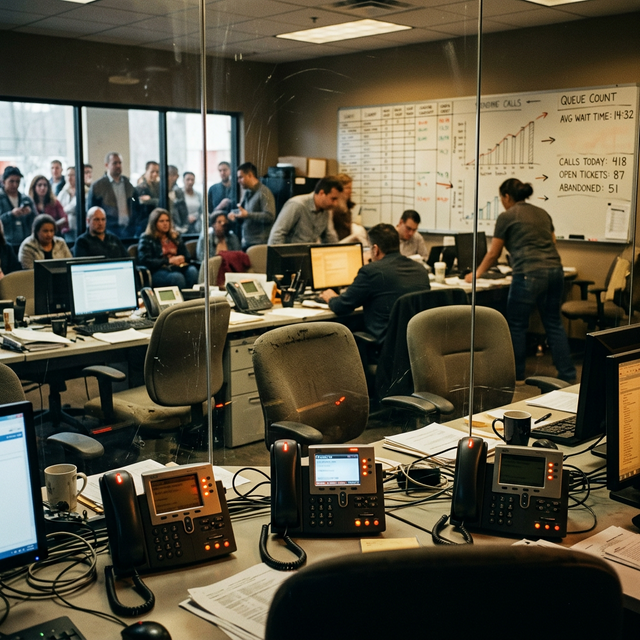
Why So Many Service Business Calls Go Unanswered
Many service business calls never reach a real next step. Here are the five silent signals that predict missed calls, lost bookings, and invisible revenue leaks.

Database Reactivation for Service Businesses: A Controlled Recovery Plan
Clean the records, define permission, segment by relationship, prepare the response path, and measure completed work before scaling outreach.