Dental marketing & answering serviceYour next new patient calls at 12:15. The front desk is at lunch.
Dental marketing brings the calls, and the front desk has to catch them. When the phone rings at lunch, after close or while a patient is paying at the counter, our AI receptionist answers, books the new patient into your schedule and texts your forms.
AI receptionist from $1,495 setup + $497/monthFull dental system from $995/monthCalls, texts and AI minutes are billed at actual use. Prices in USD.
Based in TorontoServing the United States and Canada
Morning huddle
Tuesday · 7:45 AM
8 calls came in while the desk couldn't answer: 4 at lunch, 4 after close. None of them is waiting on voicemail.
New patients booked by phone
- Mon 12:14 PMJust moved here. PPO through her husband's work.New-patient exam and cleaning, Thu 8:00 with Dr. Shah. Forms link texted.
- Mon 5:42 PMThree years since a cleaning. Nervous, asked about sedation.New-patient exam Fri 10:00. Note for Dr. Shah: anxious, ask about comfort options.
- Mon 8:10 PMFamily of four, kids 6 and 9.Back-to-back hygiene Wed 3:30 and 4:30, after school.
Emergency
- Mon 7:48 PMBroke a back tooth on a popcorn kernel. Sore, no swelling.Safety line read. Today's 8:00 emergency slot.
Schedule
- Tue 6:55 AM10:30 hygiene cancelled by text.Offered to the ASAP list at 6:56. Filled at 7:04.
- Mon 12:52 PMWants to move Wednesday's cleaning.Moved to next Tuesday 9:00.
- Mon 12:31 PM“Do you do clear aligners? Roughly what do they cost?”Range from your price card. Consult Mon 4:00.
For the team
- Mon 12:40 PMCurrent patient: new crown feels high since Friday.Message to Dr. Shah's assistant. Callback promised by 10 AM.
- Mon 6:15 PM“Are you in network with my new plan?”Answered from your insurance card. Plan name left for billing to verify.
Without an answer, this huddle starts with eight voicemails to return before the first patient sits down, and the ones who hung up leave no number at all.
Your front desk is good at its job. It can't be on the phone and at the counter.
One or two people run the desk: check-in, checkout, insurance, the next patient's paperwork. The phone rings through all of it. The calls that slip are rarely the easy ones. They are the new patients shopping for a dentist and the toothaches that need a slot today.
- 11:50 AM
A patient at the counter
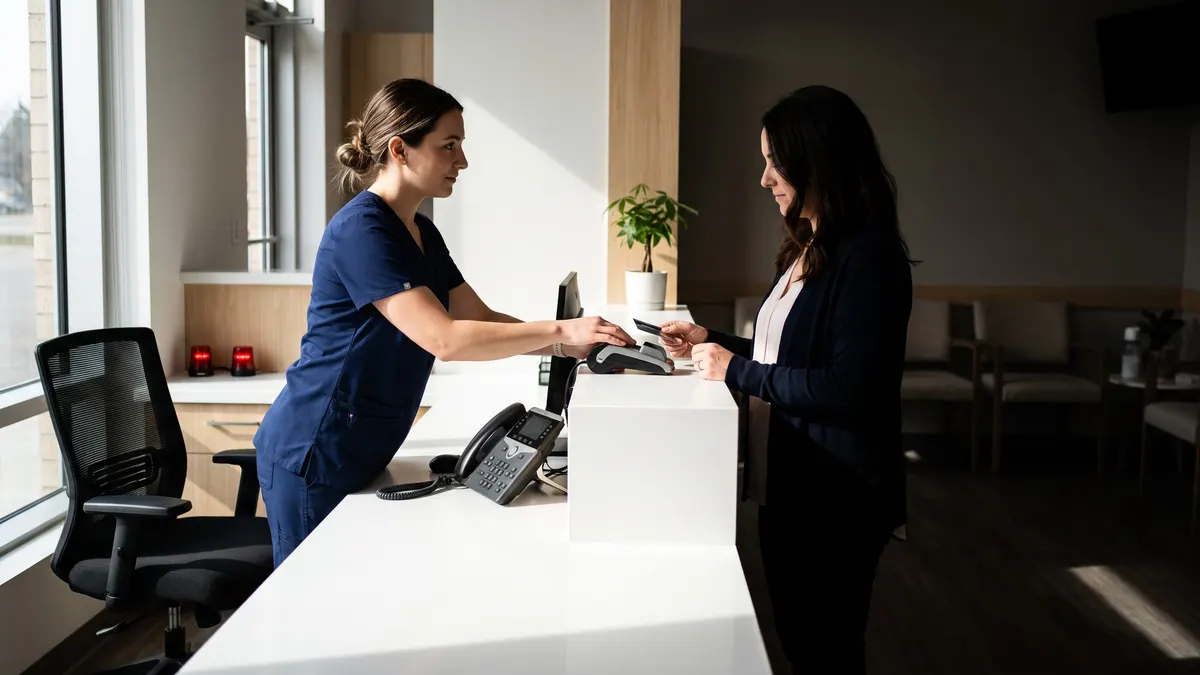
One person is checking out and paying, the other is seating the next patient. Line one rings four times and goes to voicemail.
- 12:15 PM
Lunch
The phones go to the machine for an hour, which is exactly when working people have a minute to call a dentist.
- 7:48 PM
After close
A broken tooth at dinner, or a parent booking for the whole family after the kids are in bed.
The lunch-hour audit
Your phone system can print a report of every call and whether anyone picked up. Pull one normal week. For each hour, write down the calls that rang out. Circle lunch and after five. Then ask how many of those were new patients: that is the number your marketing is paying for and your desk never hears.
Planning what a new patient is worth? Use first-year value, not lifetime, and count missed calls separately from no-shows and cancellations. The free Revenue Leak Diagnostic keeps them apart.
| Day | 8 AM | 9 | 10 | 11 | 12 PM | 1 | 2 | 3 | 4 | 5 | After 5 |
|---|---|---|---|---|---|---|---|---|---|---|---|
| Mon | |||||||||||
| Tue | |||||||||||
| Wed | |||||||||||
| Thu | |||||||||||
| Fri |
Your AI receptionist covers lunch, after close and the moments both lines ring, from $1,495 setup + $497/month.
A callback list, or a patient on the schedule.
Here is the same Monday-evening call, handed over two ways. A message service gives your desk one more callback for the morning rush. Your receptionist gives them a booked new patient with everything the dentist should know.
Stuck to the monitor, from the message service
MON 17:42 NEW PT KEVIN 555-0133 WANTS APPT CALL BACK
New patient booked by phone, Mon 5:42 PM
- Booked
- New-patient exam, Friday 10:00 AM, Dr. Shah
- Patient
- Kevin Morales, 555-0133
- Why he called
- “It's been about three years since a cleaning. I'm a bit nervous about it.”
- Asked about
- Sedation and comfort options. Told the dentist will talk it through at the visit.
- Insurance
- Says he has a PPO through work. Carrier and member ID left for billing to verify.
- Found you
- Google Maps, “dentist near me”
- Sent
- Forms link and a confirmation text, with his okay
Four questions to ask any dental answering service
Can it book straight into our schedule?
Listen for: Whether a “booked” patient still means a message your desk has to turn into a callback.
Ours: It books into the appointment types and times you open for phone booking. A direct link to your practice software is checked during setup, never promised blind.
What does it say when someone asks if we take their insurance?
Listen for: Anything that sounds like confirming coverage or benefits on the phone.
Ours: It answers from your insurance card, then says your team checks the plan before the visit.
What happens with a toothache at 8 PM?
Listen for: Whether the service follows your emergency rules or just takes a name.
Ours: It reads your safety line, then books your emergency slot or texts your on-call dentist, by your rules.
What will a busy Monday cost?
Listen for: Per-minute plans with an allowance make your busiest day your most expensive one.
Ours: From $1,495 setup and $497 a month. Calls, texts and AI minutes billed at actual use, with no allowance to run past.
Native speech-to-speech voice AI
- GPT Realtime by OpenAI
- Gemini by Google
 GPT Realtime
 Dental marketing, end to end
From “dentist near me”
to the next cleaning.
The phone decides whether a new patient ever sits in your chair, so it sits in the middle. Around it we cover each step a patient takes with your practice, from the search to the recall six months later.
- Get foundMaps and listings for dentist, emergency dentist and each service you offer.
- Get noticedShort videos of your team and office, so a nervous patient knows who they'll meet.
- Get chosenA page for each service, your dentists' faces and the insurance you take.
- Get answeredCalls answered at lunch, after close and when both lines ring.
- Get bookedNew patients and emergencies on your schedule, forms texted.
- Come backConfirmations, the ASAP list, recall and reviews after the visit.
Signature System
The Signature System for dental practices
Your phone answered at lunch, after close and whenever both lines ring, new patients and emergencies booked by your rules, forms and confirmations sent, cancellations filled from the ASAP list, overdue patients brought back for recall and review requests sent after good visits, built as one system for your practice and looked after by our team every month. Fully managed by our team, AI included. From $995/month.
Or start with one piece
- AI receptionistFrom $1,495 setup + $497/monthFor practices whose lunch hour and evenings go to voicemail. Where most dental practices start.See the AI receptionist
- Get Found local SEO$99/month, or $82.50/month billed yearlyFor practices that don't show up on the map for dentist and emergency dentist searches nearby.See Get Found
- Review growthFrom $995 setup + $297/monthFor practices whose reviews trail the dentists ranked above them.See review growth
- Smart WebsiteFrom $2,395 setup + $197/monthFor practices that want a custom site with a page for each service, connected to booking.See Smart Websites
- Essential Website$99/month, no setup feeFor new or small practices that just need a professional site with services, team and insurance.See the Essential Website
Prices in USD. Setup and monthly fees are listed separately; calls, texts and AI usage are billed at actual use. Each piece joins the same connected system, so you can add the next one without starting over.
“Do you take my insurance?” Answered from one card.
It is the question your desk answers more than any other, and the one that decides whether a shopper books or keeps scrolling. Fill in this card once. The receptionist answers from it, the same way every time, and never goes past it: coverage, benefits and frequency limits are for your billing team to check before the visit.
In Canada, patients also ask whether you see patients through the Canadian Dental Care Plan. Put your answer on the card and the phone gives it word for word.
The insurance card is written in the first setup session for the AI receptionist.
Insurance card fill in once
Plans we're in network withList them by name
“Yes, we're in network with that plan.”
Out of networkDo you file claims for patients?
“We're not in network with that one, but we can still see you, and we file the claim for you.”
Government plansMedicaid in your state, or the Canadian Dental Care Plan
Your answer, word for word.
No insuranceMembership plan, new-patient offer, payment options
“Many of our patients don't have insurance. Here's how that works here.”
What billing checksCoverage, benefits, frequency limits
“Our team checks your plan before your visit and lets you know about any costs.”
The toothache card. Your dentist writes it, the phone reads it.
The American Dental Association tells patients that most dentists keep time in the day for emergencies and to call with as much detail as they can (ADA MouthHealthy). That only works if someone answers. The card below sorts what the caller describes into your three rules. It never diagnoses, never judges how serious it is beyond your wording and never suggests medication.
Safety line first
The caller saysSwelling that makes it hard to breathe or swallow, a high fever, or an injury to the face or jaw.
The phoneReads your safety line word for word: go to the emergency room or call 911 now. Then leaves a note for the dentist.
Your same-day rule
The caller saysPain that won't settle, a broken or knocked-out tooth, a lost crown with pain.
The phoneBooks your emergency slot, or texts your on-call dentist after hours, exactly as you set it.
Next open visit
The caller saysA chipped tooth with no pain, a loose crown, a lost filling that doesn't hurt.
The phoneBooks the next open visit of the type you choose, and tells the caller to call back if anything changes.
Every line on this card is your dentist's, approved before launch. The examples are a starting point, not clinical advice.
The patients already on your books. The six-month clock.
A new patient is the most expensive one to win. The cheapest is the patient who is already yours and is three months late for a cleaning. Recall is where the phone and the reminders meet: every reply and every callback has to land somewhere that answers.
At checkout
The next cleaning is booked before they leave. The best recall is the one that never needs chasing.
Two weeks before
A reminder with the date and time, and an easy way to move it instead of missing it.
The day before
A confirmation text. Replies of “can't make it” go to the ASAP list, not a voicemail.
One month overdue
A friendly note in your practice's voice, with a link to book or a number that always answers.
Three months overdue
A last note, and the patient goes on your team's call list with the history attached.
Recall, confirmations and the ASAP list run in the Signature System for dental practices, from $995/month.
ASAP list · Tuesday 6:56 AM
Good morning! A 10:30 cleaning with Maya opened up today at Brightwater Dental. Reply YES to take it. First reply gets the spot.
YES please!
It's yours, Mrs. Alvarez: today at 10:30 with Maya. See you then. Reply STOP to opt out of these texts.
What the phone asks, and what it leaves to your forms.
A booking call doesn't need a medical history. The phone asks what the front desk needs to book and prepare, and nothing more. It is the same idea as HIPAA's minimum necessary standard, which asks practices to take reasonable steps to limit the health information they use and request to what the purpose needs (HHS).
The phone asks
- Name and the best number to reach them
- New or current patient
- Why they're calling, in their own words
- Insurance plan name, if they have one
- How they found you
- Anything the dentist should know before the visit, like nerves
Your forms collect
- Full medical and dental history
- Medications and allergies
- Member ID, group number and subscriber details
- Consent and financial policy signatures
- Card numbers or payment details (never on the phone)
Before launch we go through privacy with you: HIPAA in the United States, federal and provincial privacy law in Canada, where call recordings and transcripts are kept, who can open them and which agreements your practice needs. We scope it in writing; we don't promise compliance on a web page.
Where new patients come from, and what each one needs.
Dental marketing agencies sell new-patient calls: Google Ads, map rankings, social ads and new-patient offers. The good ones report new patients per month and listen to call recordings, because a call only counts once it becomes a visit. We don't run your ads. We make sure the calls you pay for get answered and booked.
| Where they come from | What they expect | What wins them |
|---|---|---|
| Google Maps | A practice nearby that is open, with reviews that mention real visits. | Honest hours, photos of your office and team, and a phone that answers during lunch. |
| Insurance directories | To confirm you take their plan and book. | An instant answer from your insurance card, and a booked new-patient exam. |
| Google Ads and social ads | The offer they tapped, on the phone right away. | The receptionist knows the offer and books the visit it promised. |
| Friends, family and your own patients | To be welcomed. Someone vouched for you. | The referral recorded, so you can thank the patient who sent them. |
| Your website at night | A number or a booking link that leads to a real appointment. | The same receptionist, and online booking for the visits you allow. |
The patients that cost nothing
Someone searches “dentist near me” and calls one of the first practices on the map. Set your primary category to Dentist, add the services you actually offer, keep your hours right on holidays and post real photos of your team and operatories. Get Found keeps your profile and listings right every month, $99 a month. Run the free Google check to see where you stand.
And the website?
Patients read it before they call, mostly for three things: do you take my insurance, what are the dentists like and can I book. Put all three on the first screen. The Essential Website is $99 a month with no setup fee. A Smart Website with a page for each service, connected to booking, is from $2,395 setup + $197/month.
How we set it up.
Your schedule rules
One session with your office manager: which appointment types the phone can book, the times you open for it, your emergency slot, who is on call and what you never book by phone.
Your cards, approved
The insurance card, the price ranges you're happy to say, the toothache card and the greeting that says it is AI, read back and signed off before a single call.
Your software and calendars
Bookings go into your schedule the way your practice software allows. Forms links, confirmations and the ASAP list are connected with the patient's consent to texts.
Test calls, then lunch and after hours
We make every call on the test sheet first. Most practices start with lunch, after close and overflow when both lines ring, and keep their front desk on the phone the rest of the day.
Monthly review
We listen to calls with your office manager, fix what is wrong and adjust the rules as your schedule changes.
The test sheet
Every call on this list is made before a patient ever reaches your receptionist.
- A new patient who asks about three things at once
- “Do you take my insurance?” for a plan on your card, and one that isn't
- A toothache with swelling at 9 PM
- A parent booking for three kids
- A current patient moving an appointment
- “How much is a cleaning without insurance?”
- A nervous patient who asks about sedation
- A caller in Spanish or French
- Two calls at once while the desk is busy
After launch we compare your own phone report and schedule, before and after, so you see the change in your records.
What stays with your team
- Diagnosis and treatment plans
- Anything clinical a patient asks
- Insurance verification and benefits
- Treatment fees and financing
- Consent and medical history review
- Billing questions and refunds
- Who gets the last emergency slot
The receptionist answers, books and sends. Your dentists and hygienists look after patients.
Questions dentists ask us.
Straight answers. If yours isn't here, ask us on a call.
How much does dental marketing cost with you?
It depends on where you start. Most practices start with the phone: the AI receptionist is from $1,495 to set up and $497 a month, with calls, texts and AI minutes billed at actual use. The Signature System for dental practices, where we run the phone, new-patient booking, confirmations, the ASAP list, recall and reviews for you, starts at $995 a month with setup from $5,000. A professional website on its own is $99 a month with no setup fee. Get Found, our Google Maps service, is $99 a month, or $82.50 a month billed yearly. Prices are in US dollars.
What does the AI receptionist's starting price cover?
One main call job with one booking path, for example calls at lunch, after close and when both lines are busy, with new-patient exams booked into the times you open. We map it, build it, test it and keep it running. More call jobs, such as a second location or a separate line for specialist referrals, are scoped in writing before you pay for them.
Is this a dental answering service?
It does what a dental answering service does: your phone answered when the front desk can't. Then it books the visit itself, in the times you open, and sends the forms link. It works for your practice only. An answering service hands your desk a callback list in the morning; this hands them a schedule that is already filled in.
Can it book into our practice management software?
Sometimes directly. Practice software differs in what it lets outside tools do, so before we promise anything we look at yours, its version and what access your vendor allows. Where a direct booking isn't possible, each booking reaches your front desk the way we agree during setup, with the whole new-patient card attached.
Will it answer insurance questions?
It answers from the insurance card you fill in: which plans you are in network with, how you handle out-of-network plans and what patients without insurance can do. It never confirms coverage or benefits. It says your team checks the plan before the visit.
What happens with a dental emergency after hours?
It follows the toothache card your dentist writes. Swelling that affects breathing or swallowing, a high fever or a facial injury hears your safety line to go to the emergency room or call 911. Everything else goes to your emergency slot or your on-call dentist, exactly as you set it. It never diagnoses and never suggests medication.
Can it tell patients what things cost?
Yes, from the ranges you approve: a cleaning without insurance, your new-patient offer, whitening, a clear aligner consult. It never quotes a treatment plan. Exact fees come from your team after the dentist has seen the patient.
What about HIPAA and patient privacy?
Patient calls carry health information, so we scope privacy with you before launch: HIPAA in the United States, federal and provincial privacy law in Canada. That covers where recordings and transcripts are kept, who can open them and which agreements your practice needs. The phone only asks what the front desk needs to book. Health history stays on your forms.
Will patients know they're talking to AI?
Yes. The first thing a patient hears is that they have reached your practice's AI receptionist, in your wording. Plenty of patients simply book. Anyone who would rather speak to a person can say so, and your rules decide whether that reaches the desk, a callback list or the on-call dentist. Try our live AI line to hear how it sounds.
Can it speak Spanish or French?
Yes. Many practices add Spanish or French, and we test real booking calls in each language before launch. The voice comes from native speech-to-speech models, GPT Realtime from OpenAI and Gemini from Google: they hear the patient and reply in speech directly, which is why the conversation doesn't lag like older phone bots.
Can it help with patients who are overdue for a cleaning?
Yes. Recall reminders go out by text and email to patients who agreed to receive them, in your practice's voice. When they reply or call back, the receptionist books them. Recall runs in the Signature System for dental practices.
Is there a contract?
The AI receptionist starts with a 3-month commitment, so it can be set up and tuned before it carries your lunch hour alone. Signature Systems start with 6 months, agreed in writing before work begins. The Essential Website and Get Found are month to month. We're a Toronto team working with dental offices in both the United States and Canada.
Fill tomorrow's schedule from tonight's calls.
Book a call and tell us how your phones run: who answers at lunch, what happens after close and where new patients slip. We will show you what we would switch on first and exactly what it costs. You will talk to the people who build it, led by our founder, Vikram Roy.