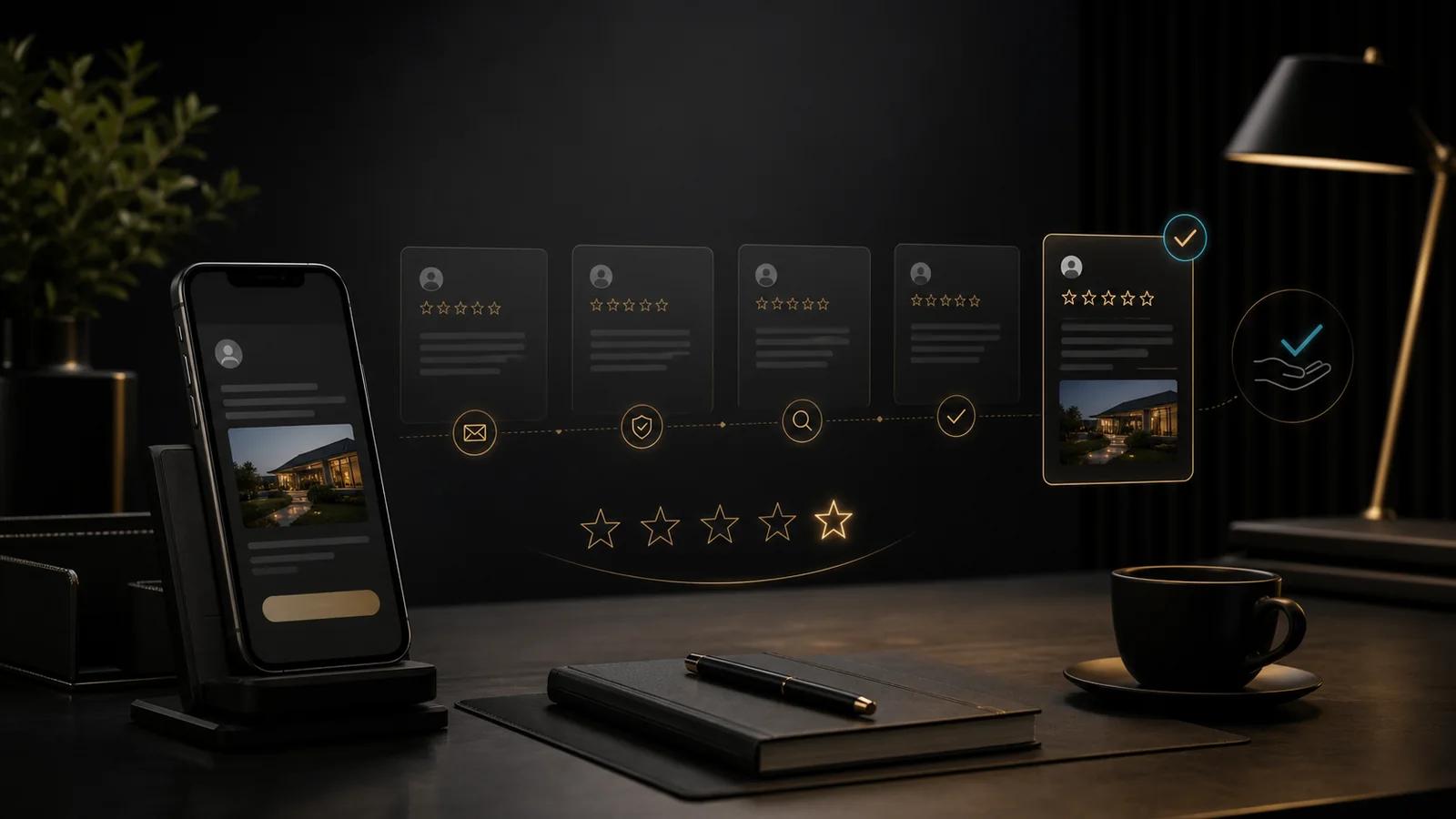

A review request system should identify a genuine customer interaction, wait for an appropriate completion event, send a neutral request, provide a direct path to the review platform, record the workflow state, and stop at a reasonable boundary. The customer chooses whether to respond and what to say.
This article links to 5 external sources beside the claims they support.
Good work does not automatically become public proof. A service is completed, the customer is satisfied, the team moves to the next job, and nobody asks for an honest review. The problem is usually not a lack of goodwill. It is the absence of a reliable request, response, and service-recovery process.
Automation can make that process consistent, but it must not decide whose honest opinion is allowed to reach a public platform. A system that asks only people predicted to be happy, blocks unhappy customers, buys sentiment, or drafts fictional experiences is not a reputation system. It is a policy and trust risk.
This guide explains a safer operating model for eligible service businesses. It covers valid triggers, customer choice, public review links, private feedback, response approval, privacy, and a weekly audit. It is operational guidance, not legal advice.
The short answer: automate the request, not the opinion
A review request system should identify a genuine customer interaction, wait for an appropriate completion event, send a neutral request, provide a direct path to the review platform, record the workflow state, and stop at a reasonable boundary. The customer chooses whether to respond and what to say.
Keep service recovery available to every customer, but do not use a private satisfaction survey to decide who receives the public review link. The private support path and the public review request can coexist. One should not be a gate for the other.
What review gating looks like in practice
Review gating often begins with a seemingly helpful question: “How was your experience?” People who select a high score are sent to Google. People who select a low score are diverted to a private form and never receive the same public-review opportunity. That selection process can create a misleading picture.
Google's Maps policy prohibits rating manipulation and fake engagement, including incentives for reviews and conduct intended to manipulate a place's rating. Its review-request guidance says reviews should reflect genuine experiences and advises businesses to value honest and balanced feedback.
- Do not send the public link only after a positive private score.
- Do not ask for a particular rating or language.
- Do not offer a discount, gift, or other benefit in exchange for a review.
- Do not have staff, relatives, or agents pose as ordinary customers.
- Do not use AI to invent a customer's experience or write a review for them.
The U.S. rule also reaches fake reviews and suppression
The Federal Trade Commission's Consumer Reviews and Testimonials Rule questions and answers explain that the rule took effect on October 21, 2024. It addresses fake or false reviews, sentiment-conditioned incentives, undisclosed insider reviews, certain review suppression practices, and other deceptive conduct.
The FTC has also taken action involving an AI service that generated false review content. The lesson is straightforward: AI can help administer a request workflow or assist a business with a draft response to an existing review. It should not generate a customer's supposed experience.
Policies and laws can change. Assign a person to review the current platform rules and applicable legal requirements before launch and when the workflow changes. A template is not a substitute for accountable review.
Build the workflow around a valid customer event
The best trigger is a real operational state that the team already recognizes. It might be a completed appointment, a paid invoice, an approved project milestone, a resolved support matter, or another point when the customer has actually experienced the service.
Choose a trigger the record can prove
- Home and field service: The work order is complete and the customer has received the completion message.
- Professional firm: A defined engagement milestone is complete, subject to professional and privacy boundaries.
- Clinic or wellness practice: The visit is complete, but the message and response process respect health-information rules.
- Recurring service: Use a meaningful service milestone rather than asking after every routine interaction.
Avoid arbitrary timing claims. The appropriate interval depends on the service, channel consent, urgency, and when the customer can fairly judge the experience. Test the timing against your own completion records and customer responses.
Use a neutral request that sounds like the business
The request can be short. Identify the business, refer to the real service or interaction without exposing sensitive information, ask for honest feedback, and provide the approved link. Do not imply that only a positive review is welcome.
Google provides a way for eligible businesses to create and share a review link or QR code. The same guidance states that incentives for posting, changing, or removing a review are prohibited.
A plain-language example
“Thank you for choosing [Business Name]. If you would like to share your honest experience, you can leave a Google review here: [link]. If you need help with the service, reply to this message and our team will follow up.”
This example is intentionally neutral. Adapt it to the service, consent rules, and brand voice. Keep the support option visible, but do not remove the review link based on what the customer says privately.
Separate review requests from service recovery
A customer who reports a problem needs a responsible human path. Create a support state, assign an owner, preserve the context, set a response expectation, and record the resolution. That is good operations whether or not the customer ever posts a review.
Do not pressure a reviewer to change or remove criticism as the price of receiving help. If the issue is resolved, the customer may decide to update their review. That decision belongs to the customer.
- Acknowledge: Confirm that the concern reached the business.
- Own: Assign a person with authority to investigate or escalate.
- Protect: Move private details away from the public reply.
- Resolve: State what can be done, what cannot, and when the customer will hear again.
- Learn: Track recurring themes that should change training, scope, or service delivery.
Respond publicly without exposing the customer
A review response is visible to future buyers. It should be professional, specific enough to show attention, and limited enough to protect the customer. Google recommends concise, relevant replies and warns businesses not to disclose private information in responses to negative reviews.
Positive review response
Acknowledge the feedback and one non-sensitive detail if appropriate. Avoid turning every reply into a promotion. Repeated generic replies can make a real review profile feel automated even when the reviews are genuine.
Critical review response
Do not argue the full case in public. Acknowledge the concern, avoid confirming private facts, and give the customer a direct way to continue the conversation. If the review appears to violate platform policy, use the platform's reporting process rather than threatening the reviewer.
AI-assisted response drafts
AI can summarize the review, identify an approved response pattern, and draft a concise reply. A responsible person should review the final text, especially for regulated, clinical, legal, financial, employment, safety, or disputed matters. The system should never invent the service history.
Connect reviews to the wider trust system
Reviews are one trust surface, not the whole reputation. The website, Google Business Profile, proof, service descriptions, locations, and customer handoff should reinforce the same accurate story. A polished profile cannot repair a website that hides the service or a team that never follows up.
The same evidence discipline applies to the firm's own marketing. Use the proof and case-study library to see how customer sentiment, measured operating results, and directional examples should be labeled differently.
Google states that local results are mainly influenced by relevance, distance, and prominence, and that complete information, reviews, and helpful replies can help a business stand out. Its local ranking guidance also says there is no way to request or pay Google for better local ranking.
For broader guidance on website proof, structured data, reviews, and AI-era credibility, use the Search and AI Readiness framework.
Use one connected operating record
A useful system can connect the completion event, contact permissions, request status, support replies, public review link, review response task, and owner visibility. The record prevents duplicate requests and shows when a customer needs help.
The Quiet Platform can support review requests, unified conversations, customer records, and response workflows. Access to software does not mean every workflow is designed and operated for the business. Custom triggers, messages, approvals, integrations, and monitoring require an agreed scope.
- Record the customer interaction that made the request appropriate.
- Respect channel consent, opt-out requests, and communication rules.
- Stop duplicate requests across email, text, and staff follow-up.
- Route direct replies to the same inbox and assigned team.
- Keep public-response approval visible and auditable.
Run a 30-day review workflow audit
- List eligible completion events. Identify which real customers reached the agreed trigger.
- Compare requests with eligibility. Find missed requests, duplicates, wrong recipients, and people contacted without the required permission.
- Inspect message neutrality. Remove rating pressure, incentives, and language that asks only for positive sentiment.
- Trace direct replies. Confirm that questions and complaints reached a named person.
- Review public responses. Check privacy, accuracy, tone, repetition, and approval.
- Review the underlying service. Look for repeated issues that belong in operations rather than reputation messaging.
Measure the workflow with the business's own counts: eligible events, requests sent, delivery failures, opt-outs, reviews received, replies awaiting approval, unresolved service issues, and recurring feedback themes. Do not turn an industry average into a promise.
A 10-point policy-aware launch test
- The business is eligible for the profile and accurately represents its real operations.
- Every request follows a genuine customer experience and a documented trigger.
- The same public-review opportunity is not withheld based on predicted sentiment.
- No incentive is conditioned on posting, changing, or removing a review.
- AI never writes or invents a customer review.
- Direct replies reach a responsible person and do not disappear in an automation.
- Public responses protect privacy and receive human approval where risk is higher.
- Opt-outs and channel-consent rules are enforced.
- The team reviews policy changes and workflow exceptions.
- Reporting distinguishes genuine reviews, service recovery, and operational improvement.
Choose the smallest complete solution
Platform configuration
Use standard configuration when the business needs a completion trigger, neutral request, approved link, unified reply inbox, basic reporting, and a clear human owner. Keep the scope visible so software access is not mistaken for unlimited campaign work.
Custom Conversion System
Use a custom system when several locations, service lines, record systems, approval roles, consent states, or service-recovery rules need business-specific design and ongoing monitoring. The system can support reputation and retention without pretending to run advertising or replace the team.
See the current platform and custom-system investment paths or review the measured operating results to understand how a connected front door is scoped.
What a responsible reputation system changes
The business stops relying on staff memory. Genuine customers receive a respectful opportunity to share feedback. Service concerns reach a person. Public replies remain professional. Recurring problems become visible to operations. Future buyers see a current record of real experiences rather than manufactured enthusiasm.
If review requests, replies, customer records, and service recovery are currently disconnected, book a Systems Review. We will map the current path and explain whether the first fix belongs in platform configuration, customer communication, Google Business Profile support, or a custom conversion system.
The practical questions behind this decision.
Can a business ask every customer for a Google review?
A business can request genuine reviews from real customers, subject to platform policy, eligibility, consent, and applicable law. Use a neutral request and do not offer incentives, require a particular sentiment, or filter the public link based on a private score.
Can AI reply to Google reviews?
AI can help draft a reply, but a responsible person should review accuracy, privacy, tone, and risk. Higher-risk or disputed matters need human judgment. Never let a draft invent facts about the customer or service.
Should negative feedback be sent to a private form?
A private support path is useful, but it should not be used to block the same public-review opportunity offered to other customers. Resolve the service issue because it matters, not in exchange for silence or removal.
How many reminders should the system send?
Use the minimum needed for a respectful process and test against your own response and opt-out data. The answer depends on the relationship, channel, consent, and service. Stop when the customer opts out or the workflow reaches its stated boundary.
Does review automation improve local rankings?
Google says reviews and positive ratings can help local ranking, alongside relevance, distance, and prominence. No provider can promise a position. The defensible goal is an accurate profile, genuine reviews, useful responses, and a better customer operation.
Review the trust signals visible before someone decides to call.
The useful question is not only the star rating. It is whether recent proof supports the promise the website makes.
Inspect review recency, response habits, and the public trust signals buyers see before they contact the business.
See how the capability in this article fits into a complete customer journey.
Service BusinessesSee the same decision through the language, buyer behavior, and operating reality of this industry.
Client Results & ProofInspect the starting condition, installation, measurement window, and outcome behind real client work.

Website Ranks but Buyers Still Leave? Audit Trust and Authority Signals
A practical audit for established firms whose website earns visibility but does not yet make the business easy for people, search engines, and AI systems to understand and trust.

Delegate Customer Intake Without Losing Control
A practical handoff playbook for turning owner judgment into clear intake rules, decision rights, escalation paths, and measurable customer care.