Restoration marketing & 24/7 answering serviceThe water is on the floor at 2 AM. Your on-call tech is already at another loss.
Restoration marketing only pays when someone answers at 2 AM. A homeowner standing in water calls the next company within minutes, and the drying clock is already running. Our AI answering service picks up every call, reads your safety lines, fills in the loss sheet and pages your on-call tech.
AI answering service from $1,495 setup + $497/monthFull restoration system from $995/monthCalls, texts and AI minutes are billed at actual use. Prices in USD.
Based in TorontoServing the United States and Canada
The night the storm drains backed up
Calls to one restoration company, 8 PM to 4 AM
| Time | Calls |
|---|---|
| 8:00 | 1 |
| 8:30 | 2 |
| 9:00 | 4 |
| 9:30 | 6 |
| 10:00 | 5 |
| 10:30 | 4 |
| 11:00 | 3 |
| 11:30 | 3 |
| 12:00 | 2 |
| 12:30 | 2 |
| 1:00 | 1 |
| 1:30 | 1 |
| 2:00 | 1 |
| 2:30 | 0 |
| 3:00 | 1 |
| 3:30 | 1 |
Reached your on-call tech: 15 Busy signal or voicemail: 22 One phone, one call at a time
With your AI answering service every bar is answered in full, at the same time. Water still coming in goes to the on-call tech first; the rest are booked for the morning with the loss sheet filled in.
The caller talks. The loss sheet fills itself in.
A message service would page your tech with “WATER IN BASEMENT PLS CALL”. Your AI answering service listens the way your best coordinator does and writes every answer where it belongs. By the time the page goes out, the tech knows the house, the water, who owns it and who sent them.
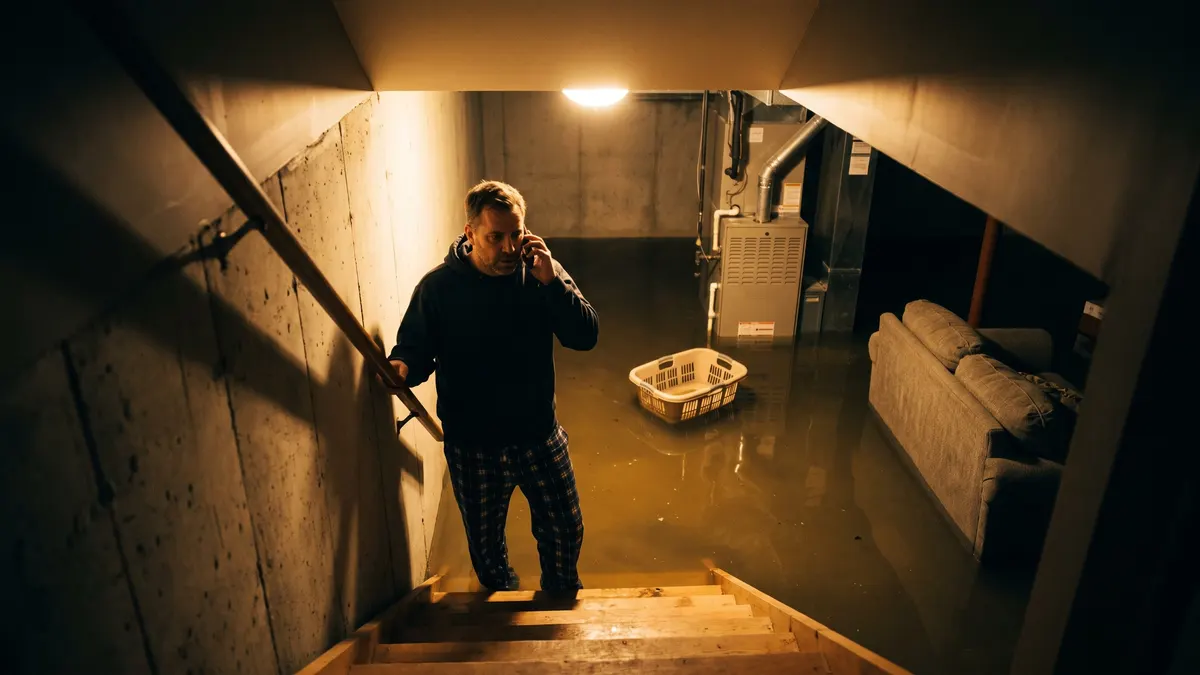
“Water's coming up through the floor drain in the basement. It smells bad.”
“Maybe two inches, across the whole basement. The furnace is down there.”
“The power's still on down there.”
“We own the house. I'm Priya.”
“Our plumber said to call you. Dave, from Northside.”
“We haven't called the insurance yet.”
Loss sheet
Paged 2:09 AM
- Received
- Tuesday 2:07 AM, answered on the first ring
- 1What she sees
- Water coming up through the basement floor drain. Says it smells bad.
- 2How much
- About two inches across the finished basement. Furnace room affected.
- 3Power
- Still on. Safety line read: stay out of the water, don't touch anything electrical.
- 4Caller
- Priya Nair, owner of the home, 555-0162, 27 Willow Street
- 5Referred by
- Dave, Northside Plumbing
- 6Insurance
- Not called yet. Told we can't say what's covered; the tech can document the loss.
- Photos
- Four, texted with her okay
- Paged
- Marcus, on call, 2:09 AM, with this sheet
- Told the caller
- Marcus calls you back within 15 minutes.
Native speech-to-speech voice AI
- GPT Realtime by OpenAI
- Gemini by Google
 GPT Realtime
 Restoration marketing, end to end
From “water damage near me”
to the next referral.
The phone decides most restoration jobs, so it sits in the middle. Around it we cover each step a property owner takes with your company, from the search at midnight to the plumber who sends the next one.
- Get foundMaps and listings for water damage, fire damage and mold searches in your area.
- Get noticedShort videos from real jobs: the equipment, the crew, the before and after.
- Get chosenA page for each service, your certifications and your number on top.
- Get answeredEvery call answered at night and on storm nights, many at once.
- Get dispatchedThe loss sheet paged to your on-call tech, sorted by your rules.
- Come backJob updates, partner thank-yous and review requests when the job is done.
Signature System
The Signature System for restoration companies
Your emergency line answered all night and every storm night, the loss sheet paged to your on-call tech, property managers, adjusters and referrals each on their own path, job updates sent while the equipment runs, referral partners thanked and review requests sent when the job is done, built as one system for your company and looked after by our team every month. Fully managed by our team, AI included. From $995/month.
Or start with one piece
- AI receptionistFrom $1,495 setup + $497/monthFor restoration companies losing night and storm calls to one on-call phone. Where most start.See the AI receptionist
- Get Found local SEO$99/month, or $82.50/month billed yearlyFor companies that don't show up on the map for water damage and fire damage searches nearby.See Get Found
- Review growthFrom $995 setup + $297/monthFor companies whose reviews trail the ones ranked above them.See review growth
- Smart WebsiteFrom $2,395 setup + $197/monthFor companies that want a custom site with a page for each service, connected to the phone.See Smart Websites
- Essential Website$99/month, no setup feeFor new or small companies that just need a professional site with services, area and certifications.See the Essential Website
Prices in USD. Setup and monthly fees are listed separately; calls, texts and AI usage are billed at actual use. Each piece joins the same connected system, so you can add the next one without starting over.
Who's on the line changes everything after hello.
The owner can authorize the work; the tenant can't. The property manager has four units and an approval limit. The adjuster has a claim number and a program clock. Your coordinator knows this by heart. The phone asks the question that tells them apart, then follows the path you set for each one.
| Who's calling | What the phone asks | Where it goes | What it never promises |
|---|---|---|---|
| Homeowner | What they see, when it started, whether the water is stopped, who lives there, access. | Your on-call tech, paged now with the loss sheet, or first slot tomorrow by your rules. | What insurance will cover, or when a truck will arrive unless your rule sets it. |
| Tenant | The same, plus the landlord or property manager's name and number. | Your on-call tech, with a note that the owner still has to authorize work on the building. | That work can start without the owner's okay. |
| Property manager | Addresses and units, the contact on site, any work order number, their approval limit. | Your commercial or property path, with every unit on one sheet. | A price for the building. Your estimator scopes it. |
| Adjuster or program assignment | Claim or assignment number, the insured's name and number, the response times the program requires. | Whoever owns program work on your team, logged against the assignment. | Scope, pricing or anything about the carrier's decision. |
| Plumber, agent or other referral | The homeowner's details, what they saw on site, and whether they are still there. | Your on-call tech, with the referral noted so you can thank the right person. | That the homeowner has agreed to anything yet. |
| Commercial facility | The building, the affected area, after-hours access, who can sign. | Your commercial on-call, by your rules. | Equipment counts or a dry-out time. |
The safety lines, read word for word.
Before anything about the loss, the phone listens for five things and reads your approved line for each one. Keep this card by your own office phone too: it is the same card, whoever answers.
What it never says
“That's Category 3 water.”“Your insurance will cover this.”“That's definitely mold.”“The floor is safe to walk on.”“We'll be there in 30 minutes.”
Water categories, mold, whether a structure is safe and arrival times belong to your trained techs. The phone gives an arrival time only if your rules set one.
Water near outlets, the panel, a furnace or appliances
“Please stay out of the water and don't touch anything electrical. If you can't reach the panel without stepping in water, leave it.” Flood water and live electricity are a deadly mix (ESFI).
A smell of gas
“Please leave the house now, don't switch anything on or off, and call your gas company or 911 from outside.” (PHMSA)
Water from a floor drain or toilet, or it smells
“Please keep children and pets away from the water, and don't start cleaning it up yourself.”
A ceiling that is sagging or dripping
“Please keep everyone out from under it until our tech has looked.”
Mold they can see
“Please don't scrub or disturb it. Our tech will look at it.” EPA advises professional help when mold covers more than about 10 square feet or there was a lot of water (EPA).
Your wording, approved before launch. These lines are a starting point, not safety advice for your market.
The first 48 hours start with the first ring.
The EPA tells homeowners to dry water-damaged areas and items within 24 to 48 hours to prevent mold growth (EPA). Homeowners who know that clock is running don't wait for a callback. Here is where the phone helps across those two days, and where it steps aside for your crew.
- 0 h
The call
Answered on the first ring. Safety lines read, loss sheet filled in, on-call tech paged.
- 15 min
The callback
Your tech calls the homeowner back already knowing the house, the water and who referred them.
- 1 to 4 h
On site
Your crew does the work: extraction, readings, equipment and the work authorization. The phone stays out of it.
- 24 h
Day-one update
A short text in your words: equipment is running, the next check is tomorrow, here is who to call.
- 48 h
The next check
A reminder the night before each visit, so nobody is out when your tech arrives.
Job updates, visit reminders and review requests run in the Signature System for restoration companies, from $995/month. Texts go only to people who agreed to them: in the US under the FCC's consent rules, in Canada under CASL.
The partners who send you work judge you by the first ring.
Restoration marketing agencies sell calls: Local Services Ads, Google Ads for water damage searches, map rankings. The good ones report cost per job, because a call only counts once the work authorization is signed. The cheapest jobs come from people who already trust you. We don't run your ads. We make sure the calls you pay for, and the ones partners send, get answered.
Plumbers
They expectYou answer when they hand a homeowner your number at midnight.
What keeps themThe referral noted on every loss sheet, and a thank-you when the homeowner is happy for you to send one.
Insurance agents
They expectTheir client gets a calm, fast answer and no talk of coverage.
What keeps themCoverage questions sent back to the insurer, every time.
Property managers
They expectOne call covers every unit, with their work order number.
What keeps themA property path that logs units, contacts and approval limits.
Program work
They expectContact inside the time the program requires, day or night.
What keeps themEvery assignment answered and logged, so your contact times hold up.
The calls that cost nothing
Someone with a wet basement searches “water damage restoration near me” and calls one of the first companies on the map. Set your primary category to Water damage restoration service, add fire damage and mold as services, say honestly that you answer 24 hours and post real job photos. Get Found keeps your profile and listings right every month, $99 a month. Run the free Google check to see where you stand.
And the website?
A homeowner at midnight wants three things: that you do this, that you are near and that someone answers. Put your number, your area and “24/7” on the first screen, and give water, fire and mold their own pages. The Essential Website is $99 a month with no setup fee. A Smart Website is from $2,395 setup + $197/month.
How we set it up.
Your rules for the night
One session with the owner or operations manager: what gets paged now, what waits for morning, who is on call, your service area and what you never promise on the phone.
Your safety lines, approved
The caution card, the greeting that says it is AI and the insurance wording are read back to you and signed off before a single call.
The page and the sheet
The on-call tech gets the loss sheet by text the moment the call ends. Photos and callbacks are connected with the caller's consent.
Test calls, then nights and storms
We make every call on the test sheet first. Most companies start with nights, weekends and overflow, the hours one person can't cover.
After the first storm
We go through the busy night's calls with you, fix what is wrong and adjust what gets paged.
The test sheet
Every call on this list is made before a property owner ever reaches your answering service.
- A homeowner in water with the power still on
- A caller who smells gas
- A tenant who can't reach the landlord
- A property manager with four units
- An adjuster assignment with a claim number
- “Will my insurance cover this?”
- “Is it safe to go down there?”
- A call from outside your service area
- Six calls at the same time
After launch we compare your own call log and jobs, before and after. Weighing it up? The free Revenue Leak Diagnostic counts first-phase gross profit, not the whole rebuild, and keeps coordinator hours separate.
What stays with your team
- Water category, contamination and mold decisions
- Whether a floor or ceiling is safe
- Scope, equipment and dry-out time
- Estimates and pricing
- Coverage and the insurance claim
- The work authorization
- Who goes out and when
The answering service answers, fills in the sheet and pages. Your techs run the loss.
Questions restoration owners ask us.
Straight answers. If yours isn't here, ask us on a call.
How much does restoration marketing cost with you?
It depends on where you start. Most restoration companies start with the phone: the AI receptionist is from $1,495 to set up and $497 a month, with calls, texts and AI minutes billed at actual use. The Signature System for restoration companies, where we run the phone, the on-call page, job updates, partner follow-up and reviews for you, starts at $995 a month with setup from $5,000. A professional website on its own is $99 a month with no setup fee. Get Found, our Google Maps service, is $99 a month, or $82.50 a month billed yearly. Prices are in US dollars.
What does the AI receptionist's starting price cover?
One main call job with one path. For most restoration companies that is the emergency line after hours: water, fire and mold calls answered, the loss sheet filled in and your on-call tech paged. We build that path, test it with real loss calls and look after it. A second path, such as program assignments on their own line or a commercial desk, is quoted in writing first.
Is this a restoration answering service?
It does what a restoration answering service does: your emergency line answered all night. Then it fills in the loss sheet as the caller talks, reads your safety lines and pages your on-call tech with everything on one text. It works for your company only, and it answers many calls at the same time, which matters on the night everybody's basement floods.
What happens when a storm floods the phone?
Every call is answered at the same time, so nobody hits a busy signal or a full voicemail box. Your rules decide the order: water still coming in and power near water go to the on-call tech first, and calls that can wait are booked for the morning with the sheet already filled in.
Will it tell callers what kind of water it is, or whether it's safe?
Never. It writes down what the caller sees in their own words and reads the safety lines you approved. It doesn't name a water category, call anything mold, judge whether a floor or ceiling is safe or promise an arrival time your rules don't set.
Will it talk about insurance claims?
Only to write down what the caller tells you, such as whether they have called their insurer or have a claim number. It never says what a policy covers. It tells the caller your tech can document the loss and that coverage is between them and their insurer.
Can it handle property managers, adjusters and program work?
Yes, each as its own path: units and approval limits for property managers, claim or assignment numbers for adjusters and programs, and the referral noted for plumbers and agents. Program assignments are logged with the time they were answered.
Will callers know they're talking to AI?
Yes, the greeting tells them, in your words. Someone standing in water mostly wants to know help is coming, and it sounds calm and natural. If a caller wants a person, your rules say whether that pages the on-call tech right away or books the first callback. Ring our live AI line to hear it.
Can it speak Spanish or French?
Yes. We set up and test each language you serve before launch, with real loss calls. The voice runs on native speech-to-speech models, GPT Realtime from OpenAI and Gemini from Google, which hear the caller and speak back directly instead of passing text through a relay, so there is no awkward pause at 2 AM.
Can it connect to our job management software?
Sometimes. Restoration job software varies in what it lets an outside tool create, so we check yours and your vendor's access before promising anything. Without a direct link, the loss sheet reaches your on-call tech and office by text and email, the way we agree during setup.
Do we need a new website first?
No. Your number already rings; the answering service makes sure somebody picks up, whatever site you have today. When the site is the weak spot, the Essential Website is $99 a month and a Smart Website with a page for water, fire and mold is from $2,395 setup + $197/month.
Is there a contract?
The AI receptionist starts with a 3-month commitment, so it is set up and tuned before storm season tests it. Signature Systems start with 6 months, agreed in writing before work begins. The Essential Website and Get Found are month to month. We work from Toronto with restoration companies in the United States and Canada.
Answer the whole storm, not just the first call.
Book a call and tell us how your nights run: who is on call, what happens when two losses come in at once and where jobs slip. We will show you what we would switch on first and exactly what it costs. You will talk to the people who build it, led by our founder, Vikram Roy.