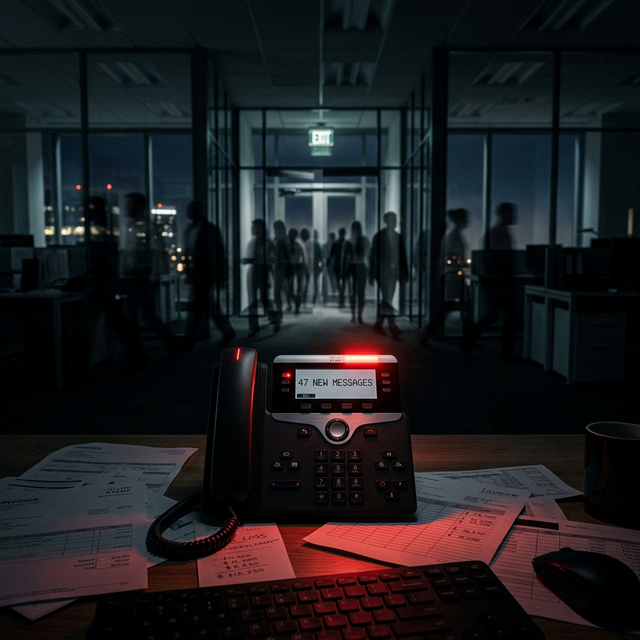

The business sees only the small group of callers who left a voicemail. It does not see the larger group that heard the greeting, made a decision, and left without a trace.
Treat any number without a nearby source or stated method as a planning assumption, then replace it with your own records.
Voicemail feels responsible.
That is why service businesses keep using it.
It sounds professional enough. It gives the caller instructions. It captures messages from people who are willing to wait. It lets the office close, the team breathe, and the owner believe that after-hours demand is still being handled.
But voicemail is not a capture system.
It is a filter.
And it filters out a large share of the buyers who were ready to act.
That is the uncomfortable part. Many callers who reach voicemail do not leave a message. They do not complain. They do not explain why they disappeared. They usually do not return the next morning to give your business another chance.
They call the next credible result.
The business sees only the small group of callers who left a voicemail. It does not see the larger group that heard the greeting, made a decision, and left without a trace.
That missing group is where the modeled $126,000 problem lives.
Not because every business loses exactly $126,000. It is a working model, not a promise.
Some lose far less. Some lose far more.
But because the math becomes serious very quickly when after-hours calls, caller impatience, conversion rate, and average job value are combined.
Why Voicemail Is Worse Than Owners Think
Owners tend to think about voicemail from the business side.
"We missed the call, but they can leave a message."
The buyer thinks about it differently.
"This business is not available."
That interpretation happens fast.
The caller is usually holding a phone with search results still open. There are other companies one tap away. If the problem is urgent, their patience is even shorter. If the category is competitive, they do not need to wait. If they do not already know your business, they have no emotional reason to give you extra time.
Voicemail asks the buyer to do three things:
- Trust that someone will listen.
- Trust that someone will call back soon.
- Stop searching while they wait.
That is a big ask.
For many service categories, it is too big.
A homeowner with water in the basement will not wait for tomorrow morning. A parent with a dental emergency will not leave a message and relax. A driver with a broken garage door at 9 PM will not assume your team checks voicemail quickly. A legal prospect who just had a difficult event will not patiently wait while anxiety climbs.
Voicemail makes the business feel organized from the inside.
From the outside, it often feels like a dead end.
The Psychology of the Hang-Up
Callers do not hang up because they are unreasonable.
They hang up because the next action is obvious.
They have alternatives.
That is the first driver. Local search gives buyers a list. If the first business goes to voicemail, the second business is not a theoretical competitor. It is already on the screen.
They have urgency.
That is the second driver. Many service-business calls happen because a problem crossed the threshold from "I should handle this" to "I need someone now." Once a buyer reaches that threshold, waiting feels risky.
They have learned that voicemail is weak.
That is the third driver. Most people have left messages that were never returned, returned late, or returned with no context. They do not need a research report to tell them voicemail is unreliable. Their own experience already taught them.
They also do not want to perform extra work.
Leaving a useful voicemail requires the caller to explain the problem, say their phone number clearly, repeat details, and hope the business understands the situation later. Calling the next company is simpler.
This is why voicemail abandonment is not only a technology issue.
It is a trust issue.
The business is asking for trust at the exact moment it has failed to be present.
How the $126,000 Leak Happens
The voicemail problem becomes easier to see when you stop treating it like a customer service issue and start treating it like a revenue equation.
The basic formula is:
After-hours calls x voicemail abandonment x live-answer conversion rate x average job value x 12.
Use conservative numbers.
Assume a small service business receives 35 calls per month outside staffed hours or during busy overflow periods.
Assume 70 percent of those callers do not leave a useful message or do not wait for a callback.
That is 24.5 lost caller opportunities per month.
Assume 40 percent of those opportunities would have converted if they reached a real intake path.
That is 9.8 missed jobs per month.
At a $1,075 average job value, that is $10,535 per month.
Annualized, it is $126,420.
That is the $126,000 voicemail problem.
The number is not magic. It is a model.
For a lower-ticket business, the number may be smaller. For plumbing, HVAC, roofing, restoration, legal, dental, med spa, or high-value professional services, the number can climb quickly.
The business does not need to believe any outside benchmark to run this exercise.
It only needs four numbers:
- How many calls reach voicemail or go unanswered each month?
- What share of those callers fail to leave a useful message or fail to wait?
- What is the conversion rate when a call is answered properly?
- What is the average value of the first transaction?
If the business cannot answer those questions, that is part of the problem.
The Voicemail Count Is Not the Missed-Call Count
This is the mistake that hides the leak.
Owners often review voicemail volume and assume that is the missed-call problem.
"We only had nine voicemails this weekend."
But voicemail count tells you how many people were patient enough to leave evidence.
It does not tell you how many callers reached voicemail and left nothing.
That difference matters.
If nine callers left voicemail and twenty-seven callers hung up without leaving one, the business sees nine messages and misses thirty-six calls. The visible evidence represents only a slice of the actual demand.
This is especially true for high-urgency calls.
The more urgent the need, the less likely the caller is to wait. Emergency buyers do not behave like calm shoppers. They keep moving until someone answers.
That is why call logs matter more than voicemail inboxes.
The call log shows attempts.
The voicemail inbox shows only the most patient survivors.
If your business has never compared total missed calls against voicemail messages, you may be dramatically underestimating the front-door leak.
Where Voicemail Hurts Most
Voicemail is not equally damaging in every category.
It hurts most when the buyer has urgency, high value, or many alternatives.
Emergency home services.Plumbing, HVAC, restoration, electrical, locksmith, garage door, and roofing calls often happen when the buyer wants help immediately. Voicemail does not feel neutral in those moments. It feels like rejection.
Healthcare and wellness appointments.Dental, chiropractic, veterinary, med spa, urgent care, and specialty clinic inquiries often happen after work or on weekends. The caller may not be in crisis, but motivation is perishable. If they reach another practice that books them now, the first practice loses the moment.
Legal intake.Personal injury, family law, immigration, and estate-related inquiries often come with anxiety. A caller who reaches voicemail may interpret delay as low priority. The firm that answers first shapes the relationship.
Seasonal contractors.Roofing, landscaping, pool, pest control, and restoration businesses often receive compressed call volume during seasonal windows. Voicemail during a surge is expensive because every caller is part of a short buying window.
High-ticket consultative services.Custom home builders, commercial cleaners, financial advisors, private aviation providers, and other high-value services may not have emergency urgency, but they do have comparison urgency. The buyer is evaluating several providers. The first competent conversation becomes the anchor.
The common thread is not industry.
It is decision momentum.
Voicemail interrupts momentum.
Why Callbacks Do Not Fully Solve It
Callbacks are better than ignoring a voicemail.
They are not a full fix.
A callback only helps when the caller left a message and remained available.
That is a narrow group.
The caller who hung up without leaving a message is gone. The caller who called three competitors after leaving your voicemail may already be booked. The caller who left a message at 9:40 PM may not answer when your office returns the call at 8:52 AM because their problem has already been handled.
This is why "we call everyone back" can be true and still insufficient.
The question is not whether your team is diligent.
The question is whether the callback happens while the buyer is still in the decision window.
For many service categories, the decision window is measured in minutes, not business days.
By the time voicemail becomes a callback task, the revenue may already have moved.
What Replaces Voicemail
The goal is not to make voicemail nicer.
The goal is to reduce the number of buyers who ever reach it.
A modern front-door system usually has four layers.
Layer 1: Live answer when staff are available.If a person can answer quickly and competently, that is still excellent. Human warmth matters.
Layer 2: Overflow routing.If the main line is busy, the call should route to another answer path before voicemail. That could be another staff member, an answering service, or AI intake.
Layer 3: Missed-call text-back.If a call still slips through, the caller should receive a useful text within minutes. Not a generic apology. A real next step.
Layer 4: After-hours intake.Outside staffed hours, callers should be able to explain the issue, answer key questions, receive confirmation, and know what happens next.
The business does not have to start with every layer.
It should start where the data says the leak is largest.
If most missed calls happen during business hours, start with overflow. If most happen after 5 PM, start with after-hours intake. If the team cannot afford a full system yet, start with text-back recovery.
The point is to stop letting voicemail be the default front door.
What a Better After-Hours Call Feels Like
A good after-hours experience does not need to pretend the office is open.
It needs to make the caller feel handled.
For a service business, that means:
- The call is answered quickly.
- The business name is clear.
- The caller can explain the issue in plain language.
- The system collects the right details.
- The caller gets a realistic next step.
- Emergency situations are escalated.
- Routine requests are queued with confirmation.
- The team receives a clean summary.
That experience beats voicemail because it turns the moment into a record, a triage path, and a follow-up commitment.
The caller does not have to wonder whether the message was received.
The team does not have to decode a rushed voicemail.
The owner does not have to rely on memory, guilt, or inbox archaeology the next morning.
The front door has done its job.
The Revenue Leak Diagnostic for Voicemail
Run this before buying anything.
Pull the last 30 days of phone logs.
Mark every call that:
- Arrived outside staffed hours.
- Rang out.
- Reached voicemail.
- Arrived while the line was busy.
- Lasted under 20 seconds.
- Was returned more than 30 minutes later.
- Was never returned.
Then compare those calls against actual booked jobs.
You are looking for three patterns.
Pattern 1: After-hours volume.If meaningful call volume arrives after the office closes, voicemail is acting as your night shift.
Pattern 2: Business-hours overflow.If calls reach voicemail while the business is technically open, the team does not have enough answer capacity.
Pattern 3: Callback decay.If callbacks after 30 minutes rarely turn into booked conversations, the buyer window is closing faster than the team responds.
Once you see the pattern, the fix becomes much less theoretical.
You are not buying AI because AI is exciting.
You are closing a specific leak because the call data made it visible.
The Bottom Line
Voicemail is not a harmless fallback.
It is where many service-business buyers decide whether to wait or move on.
Most move on.
That is why the voicemail problem deserves the same attention owners give to ads, reviews, SEO, and sales. A business can spend thousands creating demand, then lose the demand because the first response is a recording.
The fix is not complicated in principle:
- Measure the calls that reach voicemail.
- Compare voicemail count to total missed attempts.
- Identify the highest-leak window.
- Add overflow, text-back, or after-hours intake.
- Review outcomes weekly.
The business that does this does not need to be louder than every competitor.
It only needs to be present when the buyer is still deciding.
That is the part voicemail cannot do.
*To find your own voicemail leak, pull 30 days of call logs and run a Revenue Leak Diagnostic. The number is usually visible before the first meeting is over.*
Sources and further reading
- The Short Life of Online Sales Leads, Harvard Business Review
- Stop Unwanted Robocalls and Texts, Federal Communications Commission
The loss estimate is basic business math, not a magic claim.
Revenue-leak examples on this site are built from visible operating inputs: inquiry volume, missed-call or slow-response rate, booking rate, average job or client value, repeat value, and follow-up recovery. The fastest way to make the number real is to run the diagnostic for your closest business type, then compare it against your own call log, CRM, booking calendar, form timestamps, and review activity.
The practical questions behind this decision.
Is voicemail always bad for a service business?
No. Voicemail is fine for low-urgency messages from existing customers who already trust the business. It is weak as the default path for new prospects, emergency calls, after-hours inquiries, and high-value decision moments. The problem is not that voicemail exists. The problem is when voicemail becomes the first serious response to a buyer who is ready to act.
Do callers really hang up without leaving messages?
Yes, and most owners already know this from their own behavior. When you call a business you do not know and reach voicemail, you often call another option. Buyers do the same. The exact abandonment rate varies by industry and urgency, but the pattern is consistent enough that every service business should measure it.
What is the fastest way to reduce voicemail loss?
Start with missed-call text-back and overflow routing. Text-back gives callers a recovery path within minutes. Overflow prevents busy-hour calls from falling straight to voicemail. If after-hours volume is meaningful, add AI intake or an answering layer for that window.
Is an answering service enough?
Sometimes, but only if it does more than take a message. If the service can qualify the caller, follow your rules, route emergencies, and create a clear next step, it can help. If it simply says someone will call back, it may only be a warmer voicemail.
How do I know whether AI intake is worth it?
Calculate the voicemail leak first. If the monthly revenue at risk is larger than the system cost, the decision becomes operational rather than speculative. A single captured emergency job, consultation, treatment plan, or high-ticket appointment can often cover the monthly cost of the system.
Decide what the AI must handle before you choose the software.
A useful intake system begins with the caller journey, the rules, and the human handoff, not a long feature list.
Give the receptionist a realistic scenario and hear how it answers, gathers context, and moves the caller toward a useful next step.
See how the capability in this article fits into a complete customer journey.
IndustriesSee the same decision through the language, buyer behavior, and operating reality of this industry.
Client Results & ProofInspect the starting condition, installation, measurement window, and outcome behind real client work.
Calculate the revenue leak.
Stop guessing. See how much demand your business may be losing through missed calls, slow replies, weak booking, review gaps, and follow-up drag, then decide whether AI Receptionist is the right system path.
Run the calculationPrefer to hear it first?
Call the live AI receptionist and test the conversation.
Call the live AI receptionist anytime. Tell it about industries, then hear a short live roleplay based on the calls your front desk actually gets.