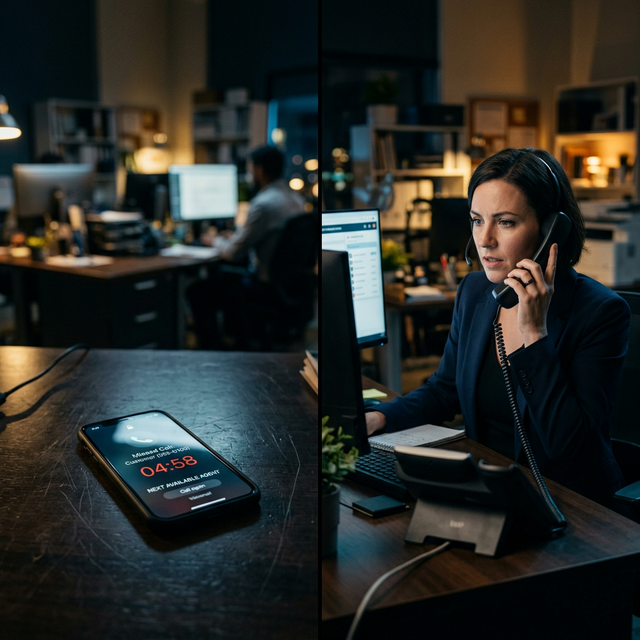
The real question is whether your business reaches the buyer while they are still inside the decision window.
Treat any number without a nearby source or stated method as a planning assumption, then replace it with your own records.
The five-minute rule is not really about the exact minute mark.
It is about whether the buyer is still in motion when your business responds.
That is the part service business owners miss.
They hear "respond within five minutes" and treat it like a sales benchmark. A useful goal. A nice standard. Something the team should try to do when the day is not too busy.
But from the buyer's side, the clock feels different.
Five minutes is enough time for a motivated buyer to call two competitors. It is enough time to submit another form. It is enough time to read reviews, check another profile, or decide that the first business is not available.
So the real question is not whether five minutes is a magic number.
The real question is whether your business reaches the buyer while they are still inside the decision window.
That is why the five-minute rule still matters.
What the 5-Minute Rule Means in Practice
The rule is simple:
The faster a business responds to a new inquiry, the higher the chance that inquiry becomes a real conversation and then a booked job.
For service businesses, the five-minute clock starts when a buyer:
- Calls.
- Leaves a voicemail.
- Submits a form.
- Sends a chat message.
- Clicks from a local search result.
- Requests an estimate.
- Gets referred by someone else.
The clock does not start when the office sees the message.
It starts when the buyer reaches out.
That distinction matters because many businesses measure response time from the wrong side. They say, "We called them back when we saw it." The buyer experienced the full delay, not the internal delay.
If the form arrived at 8:12 PM and the callback happened at 8:40 AM, the response time was not 10 minutes after opening. It was 12 hours and 28 minutes.
The buyer knows which timeline matters.
Why the Benchmark Has Become More Aggressive
The original speed-to-lead research became famous because it showed how much response time affects qualification and conversion.
But buyer expectations have only moved faster.
People now expect real-time confirmations, instant delivery updates, same-day availability, and immediate replies from businesses that want their money. Whether that expectation is fair is irrelevant. It is the market.
This is especially true in service categories where the buyer has urgency.
A plumbing emergency, no-heat call, dental pain inquiry, med spa booking request, garage door failure, restoration lead, or legal consultation request does not sit quietly in one provider's inbox.
The buyer keeps looking.
That is why five minutes should be treated as a ceiling, not a target. For phone calls and emergencies, the real target is immediate answer or immediate recovery.
The Industry Benchmark That Actually Matters
Benchmarks are useful, but they can become a distraction.
The owner does not need to know whether the industry average response time is 47 minutes or 2 hours. The owner needs to know whether their business responds fast enough to beat the buyer's next option.
That is the only benchmark that matters.
For emergency home services, the benchmark is the competitor who answers now.
For medical and dental inquiries, the benchmark is the clinic that offers a clear next step first.
For legal inquiries, the benchmark is the firm that makes the prospect feel heard before anxiety pushes them elsewhere.
For med spas and consultative services, the benchmark is the provider that turns curiosity into a booked appointment while motivation is still high.
The five-minute rule gives the business a practical internal standard. But the external standard is simpler:
Can the buyer reach a real next step before they reach someone else?
Where Service Businesses Fail the Rule
Most service businesses do not fail because nobody cares.
They fail because the response system depends on human availability at the exact wrong moment.
The front desk is on the phone. The owner is in the field. The dispatcher is solving a technician problem. The office is closed. The form notification goes to email. The chat widget creates a ticket. The voicemail waits until someone has time.
Every one of those scenarios creates delay.
From inside the business, the delay feels explainable.
From the buyer's side, it feels like silence.
This is why the five-minute rule is an infrastructure issue, not a motivational slogan. The team cannot manually catch every lead at the perfect moment. The system has to catch the first signal and move it forward.
How to Apply the Rule by Channel
Different channels need different response rules.
Phone callsshould be answered live whenever possible. If missed, they should trigger text-back within 2 to 5 minutes.
After-hours callsshould reach AI intake, an answering layer, or an emergency triage path. Voicemail should not be the default for high-intent categories.
Web formsshould trigger immediate acknowledgment plus a real intake question. The buyer should not only receive a receipt.
Chat messagesshould either be handled in real time or clearly set expectations. A fake live chat is worse than a simple form.
Voicemailsshould enter a callback queue with timestamps and urgency. They should not be reviewed only when the office slows down.
Referral leadsshould be assigned immediately because the business is borrowing someone else's trust.
The rule is not that every channel gets the same message.
The rule is that no channel gets ignored while the buyer is still deciding.
The Revenue Math of Missing the Window
Assume a service business receives 60 qualified leads per month.
If fast response converts 35 percent, that is 21 booked jobs.
If slow response converts 20 percent, that is 12 booked jobs.
The gap is 9 jobs per month.
At $1,500 average job value, that is $13,500 per month.
Annualized, that is $162,000.
This is why response time should not be treated as a customer service preference. It is a revenue lever.
The business may already be paying for the leads through ads, SEO, referrals, reviews, or reputation. Slow response simply lets those paid-for opportunities decay before they become revenue.
What a Five-Minute System Looks Like
A five-minute system has three layers.
First, immediate capture.
Every call, form, chat, and voicemail is detected quickly. The system knows the lead exists before a human happens to notice it.
Second, first response.
The buyer receives a useful reply: answer, text-back, intake question, booking link, triage prompt, or callback confirmation.
Third, escalation.
Urgent leads reach the right person. Routine leads enter a queue. Complex leads get a human. Dead-end leads do not disappear without status.
This is the practical version of speed to lead.
It is not asking the office manager to live inside the inbox. It is designing the first move so the buyer never waits in silence.
How to Audit Your Response Time
Pull the last 30 days of inquiries.
For each lead, record:
- Arrival time.
- Channel.
- First meaningful response time.
- Whether the lead became a conversation.
- Whether the lead booked.
- Whether the lead was urgent.
- Whether follow-up happened.
Then group the leads by response window:
- Under 5 minutes.
- 5 to 30 minutes.
- 30 minutes to 2 hours.
- Same day.
- Next day or later.
The pattern will usually show itself.
If faster leads book more often, the business has a response-time leak. If response is fast but conversion is weak, the issue may be qualification, offer, pricing, or trust. The point is to stop guessing.
Benchmarks by Service Business Type
Different service businesses have different decision windows.
The principle stays the same, but the urgency changes.
Emergency home services.Plumbing, HVAC, electrical, restoration, garage door, and locksmith calls often need immediate response. The buyer may call three companies in five minutes. For these categories, five minutes is generous. The target should be answer now or recover immediately.
Appointment-driven clinics.Dental practices, med spas, chiropractic offices, and other clinics often have a slightly longer window, but the lead still cools quickly. A prospect who submits a form after work may book with the clinic that confirms availability first.
High-ticket estimate businesses.Roofing, remodeling, landscaping, pool installation, and similar categories may have a longer buying cycle, but the first response still shapes trust. A fast response does not guarantee the sale. It gives the business control of the first conversation.
Professional services.Law firms, accountants, wealth advisors, and consultants deal with trust-heavy decisions. Speed matters because the first firm to create a sense of order often earns the next conversation.
Recurring service businesses.Pest control, maintenance, cleaning, and subscription-style services need speed because buyers are often comparing convenience. The provider that makes booking easiest wins more often than the provider with the most elaborate explanation.
This is why generic benchmarks are not enough.
The owner should know the decision window for their own buyer.
The Buyer Is Not Always Ready to Buy, But They Are Ready to Move
One mistake owners make is assuming fast response only matters for ready-to-buy leads.
It also matters for uncertain leads.
The buyer may not be ready to sign. They may have questions. They may be comparing. They may be checking price range, availability, service area, or credibility.
Fast response still matters because it captures the conversation while the buyer is open.
If the business responds quickly, it can shape the next step. If the business responds slowly, the buyer may answer those questions with someone else.
This is especially important for higher-ticket services. The first response may not close the job, but it can establish trust, clarify scope, and keep the business in the decision.
Slow response gives away that first shaping moment.
Why "We Called Back" Is Not Enough
Many businesses technically respond.
They call back at lunch. They reply after the job. They check the inbox in the morning. They return voicemails at the end of the day.
The problem is not whether the business eventually responded. The problem is whether the response happened while the buyer still cared.
This is the difference between activity and capture.
Activity means the team did something.
Capture means the buyer entered the next step.
The five-minute rule is about capture. A callback that happens after the buyer booked elsewhere may satisfy the internal task list, but it does not recover the opportunity.
That is why response-time reporting should include outcome, not only activity.
Track whether the lead became a conversation. Track whether the conversation became a booked job. Track whether late callbacks are mostly cleanup.
The truth usually appears in the outcomes.
The Implementation Priority
If the business cannot fix every channel at once, prioritize by urgency and value.
Start with the channels where the buyer is most likely to be ready to act.
For many service businesses, the order is:
- Live calls and missed calls.
- After-hours calls.
- Web forms.
- Chat messages.
- Voicemails.
- Referral leads.
- Estimate follow-up.
This order can change by industry, but the principle holds. Fix the highest-intent, fastest-decay channels first.
Do not spend three weeks polishing an email nurture sequence while emergency calls still hit voicemail.
Do not redesign a form before knowing whether form leads are answered within minutes.
Do not ask staff to manually monitor every channel if the business has no automatic alerts or routing.
The first response should become a system before it becomes a training reminder.
What Good Looks Like After 30 Days
After 30 days, the business should know whether the fix is working.
The report should show:
- Average response time by channel.
- Percentage of leads reached within 5 minutes.
- Missed calls recovered.
- Web forms responded to within 5 minutes.
- Conversations created.
- Jobs booked.
- Revenue from recovered or fast-response leads.
This does not need to be a complex dashboard at first.
A simple spreadsheet is better than a vague feeling.
The owner should be able to say, "We used to respond to 22 percent of leads within five minutes. Now we respond to 78 percent. Booked jobs from inbound inquiries increased by X."
That is how the five-minute rule becomes management.
Use your own records before you decide
Source: start with your call log, CRM notes, booking calendar, missed-call records, web form timestamps, and Google Business Profile. Those records show whether buyers reached you, how fast they heard back, what they asked for, and where the next step broke down.
For seven days, mark each missed call, late reply, unbooked form, stale estimate, and review request that never went out. That small sample gives an owner a practical picture of the front-door gap before they spend more on ads, software, or staff.
The loss estimate is basic business math, not a magic claim.
Revenue-leak examples on this site are built from visible operating inputs: inquiry volume, missed-call or slow-response rate, booking rate, average job or client value, repeat value, and follow-up recovery. The fastest way to make the number real is to run the diagnostic for your closest business type, then compare it against your own call log, CRM, booking calendar, form timestamps, and review activity.
The practical questions behind this decision.
What is the 5-minute lead response rule?
The 5-minute lead response rule says businesses should respond to inbound leads within five minutes because conversion probability drops quickly as the buyer waits. For service businesses, the rule applies to phone calls, missed calls, web forms, chat messages, voicemails, quote requests, and referral leads.
Does the 5-minute rule apply to phone calls?
Yes. It may matter even more for phone calls because a caller is usually looking for immediate help. If the call is missed, a recovery text or callback should happen within minutes. A phone lead that reaches voicemail is not safely captured just because the caller had the option to leave a message.
Is an automated message enough?
Only if it moves the buyer forward. A basic auto-reply that says "we received your request" is not enough. A useful automated response asks an intake question, confirms urgency, offers a next step, or routes the lead to someone who can help. Confirmation is not the same as conversion.
What if my team cannot respond within five minutes?
Then the first response should be systemized. Use missed-call text-back, AI intake, web form automation, triage queues, and escalation rules. The team should handle judgment-heavy conversations, not manually monitor every channel all day.
What should I measure first?
Measure response time by channel and compare it with booked-job rate. The most useful report shows inquiry time, first response time, conversation status, and booked outcome. That turns the five-minute rule from a slogan into an operating metric.
Turn the article into one week of real numbers.
Use your own call log, form timestamps, calendar, and CRM before accepting any industry estimate.

Vikram Roy is the founder of The Quiet Protocol, a Toronto-based systems firm serving service businesses across the Greater Toronto Area, Canada, and the United States. He works directly with professional firms, home service companies, dental practices, clinics, and local businesses to connect websites, customer intake, booking, reviews, follow-up, and practical AI into a clearer digital front door. All content is written from Toronto, Ontario. See the editorial method →
Use your own operating numbers to see where response, booking, reviews, and follow-up may be costing the business.
See how the capability in this article fits into a complete customer journey.
Legal, Financial & AdvisorySee the same decision through the language, buyer behavior, and operating reality of this industry.
Client Results & ProofInspect the starting condition, installation, measurement window, and outcome behind real client work.

The Speed to Lead Equation: Why the First Five Minutes Decide the Job
In emergency services, the first company to answer wins. Not the best company. Not the cheapest. The fastest. Here is the math that proves it.
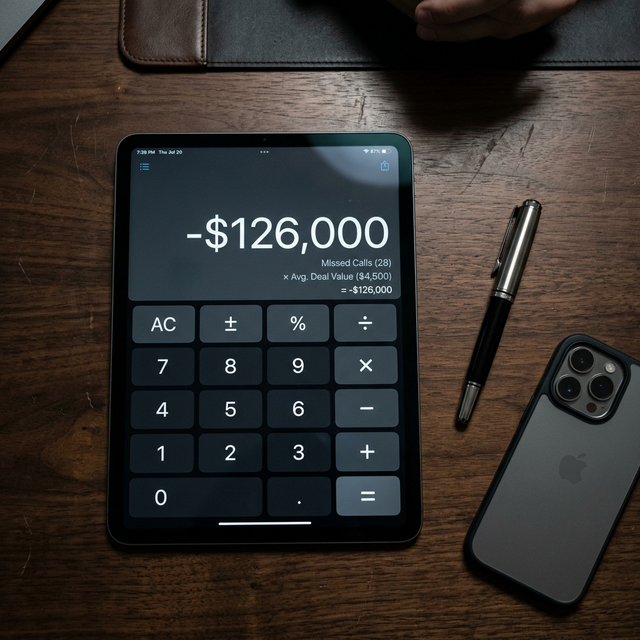
Missed Call Revenue Calculator: The Math Behind Silent Demand
Most missed calls do not leave enough evidence behind. This calculator framework helps service business owners estimate the revenue hidden inside unanswered calls.

Personal Injury Lead Response Time: Why 5 Minutes Protects More Consultations
If you don't respond to a PI inquiry within 5 minutes, conversion drops by 400%. Why expensive ad campaigns fail when the intake team goes home.