Roofing marketing & answering serviceThe storm fills your phone. Whoever answers gets the roof.
Roofing marketing starts with the phone: after a storm, homeowners call three roofers and book whoever answers first. Our AI answering service picks up every leak and hail call, day or night, and books the inspection.
AI receptionist from $1,495 setup + $497/monthFull roofing system from $995/monthCalls, texts and AI minutes are billed at actual use. Prices in USD.
Based in TorontoServing the United States and Canada
- 6:52 AMWater dripping through the bedroom ceilingHung up, no messageSafety lines read · tarp crew at 8:30
- 7:31 AMShingle pieces all over the lawnVoicemail, 0:19Inspection Wed 9 AM · Dana
- 8:05 AMA man knocked. Says our roof is damaged. Is that you?Hung up, no messageTold who we are · inspection Thu 8 AM
- 8:40 AMDented gutters and a cracked skylightHung up, no messageInspection Wed 11 AM · Dana
- 9:15 AMAdjuster is coming Friday. Can you look first?Voicemail, 0:34Inspection Thu 1 PM · Luis
- 10:02 AMRoof is 22 years old. What does a new one cost?Hung up, no messageRange given · estimate Thu 4 PM
- 11:48 AMProperty manager: three townhomes on Birch CrescentVoicemail, 0:41Three addresses · walk-through Fri 9 AM
- 12:26 PMSkylight leaking onto the kitchen floorHung up, no messageSafety lines read · tarp crew at 2
Answered by speech-to-speech voice AI fromGPT Realtimeby OpenAIGeminiby Google
 GPT Realtime
Three roofing calls. Three different clocks.
Nobody answers a phone from a 10/12 pitch, and the office line is busy from the first clap of thunder. Every roofing call runs on its own clock, and voicemail stops all of them.
Minutes count more than most owners think. In a study of 1.25 million sales leads, companies that tried to reach a new lead within an hour were nearly seven times as likely to have a real conversation with the decision maker as companies that waited even an hour longer (Harvard Business Review).
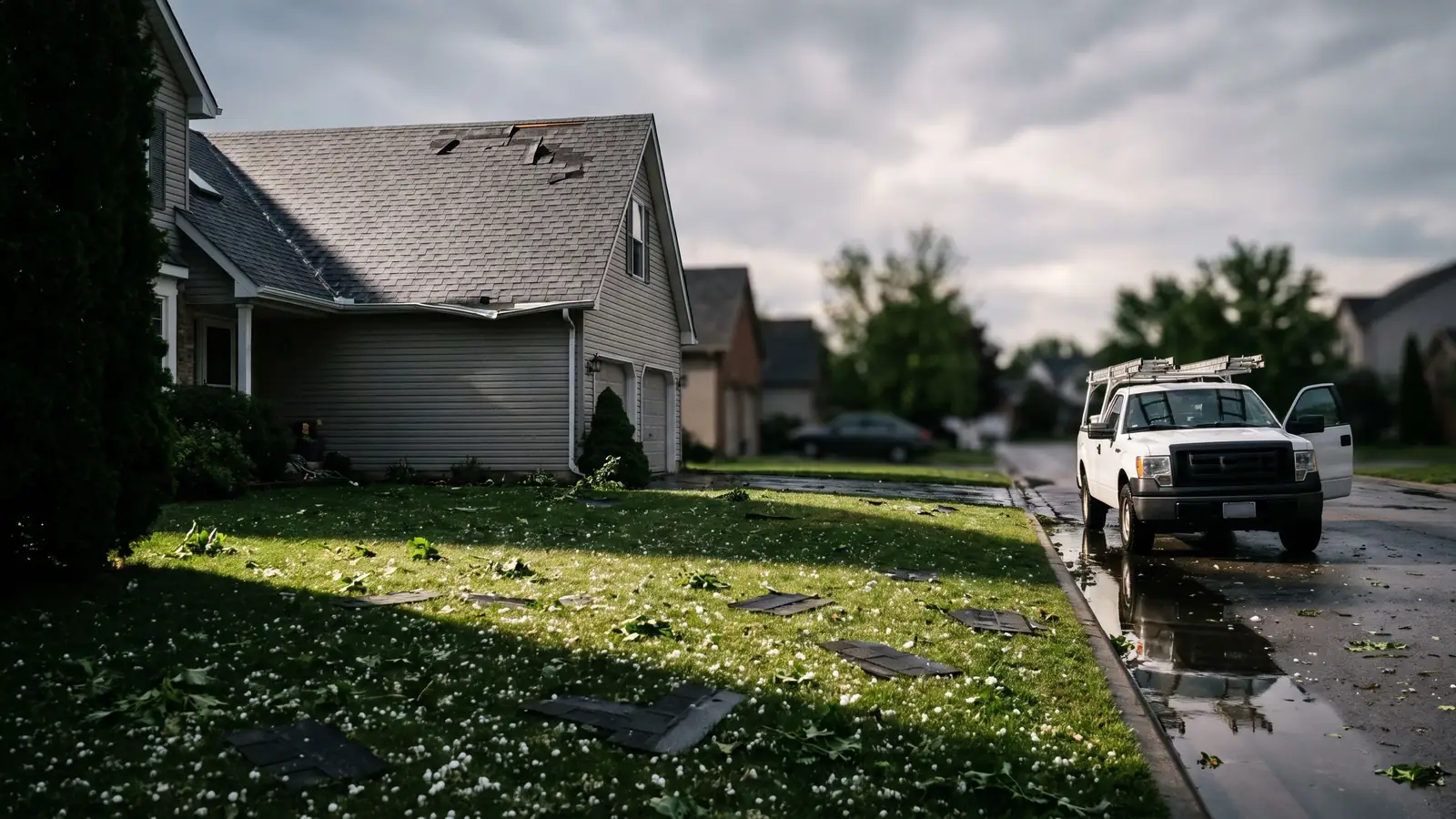
The leak
Water is coming through the ceiling. Can somebody come?
On voicemailThey go down the list until someone picks up. Your tarp job becomes another roofer's replacement next spring.
AnsweredSafety lines first, then your tarp crew or on-call person by your rules. The homeowner remembers who came in the rain.
The hail call
Hail last night. There are shingle pieces on the lawn. Can someone take a look?
On voicemailBy the time you call back, a door knocker has been on the porch and there is a yard sign next door.
AnsweredThe inspection is booked while they are still standing on the lawn, in the slots your estimators opened for that area.
The replacement
Our roof is 22 years old. What would a new one run us?
On voicemailNothing is leaking, so it waits. They collect three quotes, and the roofer who came first sets the bar.
AnsweredYour approved range on the phone, then an estimate booked for a time when everyone who decides can be home.
An answering service takes a message. Yours books the inspection.
Plenty of roofers already pay an answering service. An operator picks up, types a name, a number and a line about the problem, and sends it to you. That beats a ringing phone. But the operator is working through a script for dozens of companies, and what you get is one more callback. By the time someone in your office makes it, the homeowner has let two other roofers look.
Our AI receptionist answers for your company only, on every call, day and night, at about what an answering service costs, not what a hire costs. It runs on native speech-to-speech voice models, GPT Realtime from OpenAI and Gemini from Google, and it asks what your estimator needs before the truck leaves: when the storm hit, what the homeowner sees, whether water is coming in, who has to be home and how to get to the back of the house. Then it books the inspection.
MSG 07:31 LINDA 555-0142 HAIL DAMAGE?? PLS CALL BACK
Then your office calls back. Maybe.
InspectionTaken 7:31 AM
- Booked
- Wednesday 9:00 AM with Dana
- Homeowner
- Linda Park, 555-0142, 41 Birch Crescent
- Storm
- Hail Monday night, around 11 PM
- She sees
- Shingle pieces on the lawn, dented gutters on the north side
- Inside
- No water coming in
- Roof
- About 15 years old, one layer, she thinks
- Insurance
- Hasn't called her insurer yet. Told we can't say what's covered.
- Home
- Both owners, Wednesday morning
- Access
- Side gate unlocked. Dog stays inside.
Same homeowner, same hail. You choose the questions for each kind of call, so the estimator knows what they are walking into.
Five questions to ask any roofing answering service
Whoever you choose, ask these before storm season. The answers tell you how your busiest week will go.
What happens when eighty people call the morning after a hailstorm?
Listen forHow many calls get answered at once, and how long callers sit on hold when every operator is busy.
OursMany calls are answered at the same time. Nobody waits for an operator to free up.
Can they book straight onto my estimators' calendars?
Listen forWhether a booked inspection still means a message your office has to turn into a callback.
OursIt books into the slots your estimators open, by area and by day. A direct link to your roofing CRM is checked during setup, never promised blind.
Will they tell a caller whether insurance covers the roof?
Listen forThere is only one right answer, and it's no.
OursNever. It notes what the caller says about their claim and books the inspection.
What will my storm week cost?
Listen forMany plans are per minute or per call with a monthly allowance, so the week hail hits is the most expensive week on the bill.
OursFrom $1,495 setup and $497 a month. Calls, texts and AI minutes billed at actual use, with no allowance to run past.
What does my estimator know before knocking?
Listen forA name, a number and “hail damage??”.
OursThe inspection sheet above: storm, what they see, water inside or not, roof age if known, who decides and how to get in.
Want a person on every call? A good answering service is a fair choice, and some roofers keep one for daytime. We can set the AI up for nights, weekends and storm overflow only. Read the full comparison.
Roofing marketing, end to end
From “roof repair near me”
to the neighbour's roof.
The phone decides most roofing jobs, so it sits in the middle. Around it we cover each step a homeowner takes with your company, from the search to the referral next door.
- Get foundMaps and listings for roof repair, replacement and storm damage.
- Get noticedDrone shots and short videos of real tear-offs and finished roofs.
- Get chosenA page for each service, your number on top, reviews that name the roof.
- Get answeredLeak and hail calls answered day and night, storm week included.
- Get bookedInspections on your estimators' calendars, leaks to your tarp crew.
- Come backEstimate follow-up, review requests and the neighbours who saw your sign.
Signature System
The Signature System for roofing companies
Your phone answered day and night, leaks sent to your tarp crew, inspections booked by area, every estimate followed up until the homeowner decides, insurance jobs checked in on after the adjuster's visit and review requests sent when the roof is done, built as one system for your company and looked after by our team every month. Fully managed by our team, AI included. From $995/month.
Or start with one piece
- AI receptionistFrom $1,495 setup + $497/monthFor roofers losing leak and hail calls to voicemail while the crew is up top. Where most roofing companies start.See the AI receptionist
- Get Found local SEO$99/month, or $82.50/month billed yearlyFor roofers who don't show up in the map for roof repair, replacement and storm damage searches.See Get Found
- Review growthFrom $995 setup + $297/monthFor roofers whose reviews trail the companies ranked above them.See review growth
- Smart WebsiteFrom $2,395 setup + $197/monthFor roofers who want a custom site with a page for each service, connected to booking.See Smart Websites
- Essential Website$99/month, no setup feeFor roofers who just need a professional site with services, service area and reviews.See the Essential Website
Prices in USD. Setup and monthly fees are listed separately; calls, texts and AI usage are billed at actual use. Each piece joins the same connected system, so you can add the next one without starting over.
The leak call and the hail call, on one card.
Two calls make up most of storm week. One has water coming in. The other has a worried homeowner and a lawn full of shingle pieces. Write both once, and the receptionist follows the card on every call. The notes in the margin are decisions you make once.
Water coming in
“Is water coming inside right now?”
Yes: this card. No: the storm card.
First question on every storm call.
“Is the water near a light, an outlet or anything electrical?”
“Please stay out of that room, and don't touch anything electrical near the water.”
Safety line, read word for word.
“Is the ceiling sagging or bulging?”
“Please keep everyone out from under it until we get there.”
Your wording.
The roof
“Please don't go up on the roof or a ladder while it's wet or windy. That part is our job.”
Every leak call hears it.
“What's the address?”
Outside your service area, the caller hears that kindly and nothing is booked.
Service area check.
Your fee
“Emergency tarping has a fee of [your fee]. The crew explains anything else before starting.”
Said your way.
Help on the way
“Our crew has your address and everything you told me, and will call you shortly.”
The sheet goes to your tarp crew.
Storm damage, no water inside
“When did the storm hit, and what are you seeing?”
Their words go on the sheet: shingle pieces, dents, granules in the downspout.
Nothing is diagnosed.
“How old is the roof, if you know?”
“No problem if you're not sure. Our estimator will check.”
Helps you send the right person.
“Have you called your insurance company yet?”
“We can't tell you what your policy covers. Your insurer can. We can inspect the roof and show you what we find.”
Never a coverage opinion.
“Who needs to be there?”
Book when everyone who decides can be home.
Saves the second visit.
The inspection
The next open slot for that area, from your estimators' calendars.
Grouped by street in a surge.
The confirmation
A text with the day, the time and your estimator's name, so the homeowner knows who is knocking.
Sent with the caller's okay.
The AI receptionist runs both cards in your words, day or night. From $1,495 setup + $497/month, calls and minutes at actual use.
Play a homeowner with hail on the lawn: +1 855-916-4334Five lines your phone never says in storm season.
Storms bring out-of-town crews and door knockers, and homeowners have heard every pitch. Your phone can be the calm voice that sounds nothing like them. These lines come off the receptionist's script for good, and this is what it says instead.
These rules come with every roofing setup, so your phone sounds like the roofer who will still be in town next year.
“Don't worry, we'll cover your deductible.”Instead“Your deductible is between you and your insurer.”
In Texas it is illegal for a contractor to offer to waive, rebate or absorb a policyholder's deductible, or to advertise it (Texas Department of Insurance).
“We'll handle your claim with the adjuster.”Instead“We inspect the roof and document what we find. Your insurer handles the claim.”
Texas does not allow a roofer to act as a public adjuster on a job they are also doing (TDI). Other states and provinces set their own rules. We write to yours.
“Your insurance will pay for a new roof.”Instead“Your insurer decides what's covered. We'll show you what we find on the roof.”
The FTC tells homeowners not to rely on a contractor to say what's covered (FTC).
“Sign today and we'll hold this price.”Instead“Take your time with the estimate. Call us with any question.”
A discount only if you sign right away is on the FTC's list of signs of a storm scam (FTC).
“That's definitely hail damage.”Instead“Our estimator will look, and show you photos of what they find.”
Nobody can see a roof over the phone. That call belongs to your estimator.
When the hail map lights up.
Hail doesn't book ahead. When it comes, a season of calls can land in a few days. Calgary's August 2024 hailstorm was the second-costliest insured event in Canadian history, with nearly $2.8 billion in insured damage in the first estimate (Insurance Bureau of Canada). Nobody plans that week from inside it. Plan it before the season.
Before the season
- Decide who takes leak calls at night, and who backs them up.
- Open inspection slots by area, so a surge fills in order.
- Record the storm greeting: “We're booking storm inspections today. Here's our next opening.”
Storm night
- Every line answered, all night.
- Water coming in goes to your tarp crew or on-call person.
- Everything else gets a morning slot.
Days 1 to 3
- Inspections booked in order and grouped by street, so estimators don't cross town.
- Each homeowner gets a confirmation with the estimator's name.
Weeks 2 to 8
- Insurance jobs wait on adjusters. Each gets a check-in after the adjuster's visit.
- Retail estimates get their follow-up.
After the build
- A review request the day the crew cleans up.
- Ask happy customers about a yard sign. Neighbours read them.
The estimate went out. Keep it alive.
A replacement is a big cheque, and homeowners take their time with it. They collect two or three quotes, talk it over and wait for the adjuster. Most roofers send the estimate and hope. The roofer who checks in, politely and on time, stays in the conversation.
Five short messages, approved by you and signed by the estimator who walked the roof. They stop the moment the homeowner replies or signs.
- Same dayA thank-you from the estimator, with the roof photos from the visit.
- Day 3Any questions on the options? Financing, if you offer it.
- Day 10A short check-in before your schedule fills up.
- Adjuster decidesInsurance jobs: a note when the decision is due, not before.
- Next springOne last note on open quotes before the season starts.
Estimate follow-up runs in the Signature System for roofing companies, from $995/month.
Roof replacement41 Birch Crescent
When they ask “roughly what does a new roof cost?”
If the answer is “we'll have to come out”, some callers keep dialing until somebody gives them a number. You already price by the square. Fill in this card once and the receptionist answers from it, then says plainly that the exact price comes after your estimator measures.
Phone price card fill in once
- Roof inspection
- Leak repair, starting at
- Emergency tarp
- Replacement, your standard shingle
- Tear-off, each extra layer
- Shingle brands and lines you install
- Financing offered on
- Never priced by phonefor example, flat roofs, or anything needing a deck check
Said on the phone: “For a home this size, most of our replacements land in that range. Your estimator gives you the exact price after measuring.”
Where roofing calls come from, and what each one needs.
Roofing marketing agencies sell calls: Local Services Ads with the Google Guaranteed badge, Google Ads, map SEO and bought leads. The good ones report cost per inspection, which is the right number, because a call only counts once it is on an estimator's calendar. We don't run your ads. We make sure the calls you pay for get answered and booked.
| Where the call comes from | What the homeowner expects | What wins it |
|---|---|---|
| Google map and Local Services Ads | Someone to pick up now. They tapped Call on the first name they trusted. | Every call answered. Google's Local Services Ads help pages count responsiveness, and missed calls can count against you. |
| Google Ads | They clicked “roof repair near me” and have three sites open. | A page for that service with your number on top, and a person or receptionist that answers it. |
| Leads bought from lead sites | The same homeowner is often sold to several roofers at once. | The first real conversation. Minutes matter here more than anywhere. |
| Door knocking and yard signs | They met your rep, or read your sign, and will call when they're ready. | The number on the sign answered in your company's name, day or night. |
| Referrals and past customers | To be treated like someone you already know. | A warm answer, a quick inspection, and a review request after the job. |
The calls that cost nothing
Someone searches “roof leak repair near me” and calls one of the first names on the map. Set your primary category to Roofing contractor, list each service on its own, say honestly whether you answer at night, and post real roofs: drone shots, tear-offs, the finished ridge. Get Found keeps your profile and listings right every month, $99 a month. Run the free Google check to see where you stand.
And the website?
It matters less than the phone, but it has to look like a company that will still be here next year. “Roof repair”, “roof replacement” and “storm damage” are different searches, and each deserves its own page with your number on top. The Essential Website is $99 a month with no setup fee. A Smart Website connected to booking is from $2,395 setup + $197/month.
How we set it up.
A call about your calls
Half an hour on how your phone runs today: who picks up from the roof, what happens after hours, who tarps at night and how inspections get booked.
Your call card and price card
Greeting, service area, the leak and storm cards, the lines it never says, fees, ranges and who gets which call. We draft them; you approve every line.
Test calls before any homeowner
We run every call on the test sheet ourselves. Then you call it too, and read the inspection sheet your estimator gets.
Live where it hurts most
Most roofers start with after-hours and storm overflow, or every call while the office is on another line. Widen it whenever you like.
Looked after every month
We listen for problems, fix what breaks and update the cards before storm season, when prices change or when your crew changes.
The test sheet
Every call on this list is made before a homeowner ever reaches your receptionist.
- Water through a bedroom ceiling at 10 PM
- Hail last night, shingle pieces on the lawn
- “Will my insurance pay for a new roof?”
- “Can you cover my deductible?”
- “A guy knocked and said my roof is damaged. Is that you?”
- Property manager with three townhomes
- “Roughly what does a new roof cost?”
- A caller outside your service area
After launch we compare the same numbers from your own call log and calendar, before and after, so you see the change in your records. Prefer a calculator first? The free Revenue Leak Diagnostic counts gross profit, not contract value, and keeps estimator hours separate.
What stays with your team
- Every inspection, and what it finds
- Damage, safety, and repair or replace
- Final prices, materials and warranties
- Anything about insurance coverage or claims
- Crew schedules and start dates beyond your rules
- The customer relationship
The receptionist answers, sorts and books. Your estimators and crews still run the roof.
Questions roofing owners ask us.
Straight answers. If yours isn't here, ask us on a call.
How much does roofing marketing cost with you?
It depends on where you start. Most roofing companies start with the phone: the AI receptionist is from $1,495 to set up and $497 a month, with calls, texts and AI minutes billed at actual use. The Signature System for roofing companies, where we run the phone, inspection booking, estimate follow-up and reviews for you, starts at $995 a month with setup from $5,000. A professional website on its own is $99 a month with no setup fee. Get Found, our Google Maps service, is $99 a month, or $82.50 a month billed yearly. Prices are in US dollars.
What does the AI receptionist's starting price cover?
One main call job with one booking path, for example leak and storm calls after hours, or overflow while your office is on the phone. We map it, build it, test it and keep it running. More call jobs, such as property manager accounts or a separate commercial line, are scoped in writing before you pay for them.
Is this a roofing answering service?
It does what a roofing answering service does: your phone answered day and night, and urgent leaks passed to the right person. Then it books the inspection itself, on your estimators' calendars, with the storm, the damage the homeowner sees and the access notes attached. It works for your company only. An answering service hands you a message; this hands your estimator an appointment.
What happens when a hailstorm floods the phone?
Many calls are answered at the same time, so nobody sits on hold. Water coming in goes first, by your rules. Inspections fill the slots you opened, grouped by area. When the slots run out, callers hear honestly when the next opening is, and their details go on your list.
Will it talk about insurance claims?
Only to write down what the caller tells you, such as whether they have called their insurer. It never says what a policy covers, never offers to pay or waive a deductible and never offers to handle a claim. Those lines are off the script for good.
Can it tell callers what a roof costs?
Yes, from the price card you fill in: your inspection fee, leak repair minimum, tarp fee and the per-square ranges you're happy to say. It never quotes a roof nobody has measured. The exact price comes from your estimator.
Will homeowners know they're talking to AI?
Yes. The greeting says so, in words you approve. It sounds natural, and anyone can ask for a person; you decide who that reaches and what happens when nobody is free. Call our live AI line and hear it for yourself.
Can it book into our roofing CRM?
Sometimes. Roofing software varies, so we check yours and its access before promising a direct connection. Where there isn't one, bookings and inspection sheets still reach your team the way we agree during setup.
Can it handle property managers and commercial roofs?
Yes, as their own path: the addresses, the contact on site, who approves the work and any work order number. If commercial roofing is most of your work, see our commercial roofing page.
What AI is behind it, and can it speak Spanish or French?
It runs on native speech-to-speech voice models: GPT Realtime from OpenAI and Gemini from Google. The model listens and answers in its own voice in real time, instead of turning speech into text and reading a reply back. It can be set up for more than one language, and we test real calls in each one before launch.
Do we need a new website first?
No. The phone comes first, and it works with the site you have. If yours looks dated, the Essential Website is $99 a month and a custom Smart Website is from $2,395 setup + $197/month.
Is there a contract?
The AI receptionist starts with a 3-month commitment, so it can be set up and tuned before storm season tests it. Signature Systems start with 6 months, agreed in writing before work begins. The Essential Website and Get Found are month to month. We're based in Toronto and work with roofing companies across the United States and Canada.
Be the roofer who answers the next storm.
Book a call and tell us how your phone runs in storm season. We will show you where calls slip, what we would switch on first and exactly what it costs. You will talk to the people who build it, led by our founder, Vikram Roy.