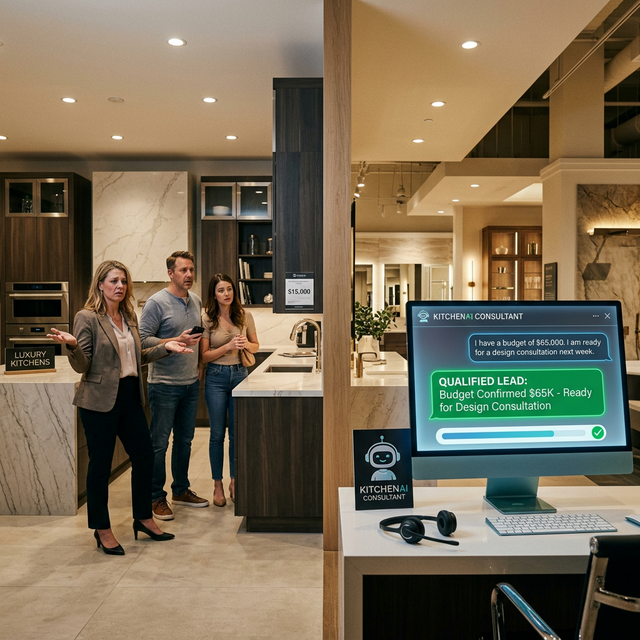
The proliferation of aspirational home design content online has created a class of prospect that the remodeling industry has no efficient defense against: the deeply inspired, thoroughly researched, genuinely enthusiastic homeowner who has no realistic understanding of what their dream kitchen actually costs.
Treat any number without a nearby source or stated method as a planning assumption, then replace it with your own records.
Jennifer has been designing kitchens for eleven years. Her portfolio opens with a $140,000 whole-home kitchen and butler pantry renovation in a lakefront property. Her firm has won three regional design awards. She charges $250 per hour for design consultation after an initial qualifying call.
Last Saturday, she spent four hours in her showroom with a couple who had found her firm on Houzz. They were enthusiastic, photographed everything, asked detailed questions about quartzite countertop fabrication, and left with three color swatches and a warm handshake. They have not returned a call since.
Tuesday morning, Jennifer checks the couple's lead status. No response to the follow-up email. She pulls up their intake form. Under "project budget," it reads: "Not sure yet - hoping to stay reasonable." Under "timeline to start," it reads: "Whenever we are ready."
The Saturday visit cost $1,000 in designer time plus two hours of showroom overhead. The project value was zero. This is not an unusual event in a remodeling firm that has no intake qualification layer. It is the weekly tax that premium design-build companies pay for the privilege of being discoverable on the internet.
The kitchen and bath remodeling industry runs on aspiration. Homeowners spend years pinning kitchen images on Pinterest, watching renovation shows, and imagining the version of their home they will someday build. When they finally make contact with a design firm, they are emotionally ready for a beautiful showroom experience. They are frequently not financially ready for the invoice that follows.
The Pinterest Paradox: Inspiration Without Intention
The proliferation of aspirational home design content online has created a class of prospect that the remodeling industry has no efficient defense against: the deeply inspired, thoroughly researched, genuinely enthusiastic homeowner who has no realistic understanding of what their dream kitchen actually costs.
This prospect has watched forty-three renovation YouTube videos. They know the difference between shaker and inset cabinet door styles. They have a strong opinion about unlacquered brass hardware versus brushed nickel. They can have an intelligent conversation about waterfall edge countertops for fifteen minutes without pausing for breath. They will absolutely love your showroom.
They also have a budget of $18,000 for a kitchen renovation that requires $75,000 to execute at the quality level their inspiration board suggests. This is not their fault. Design media has completely decoupled aesthetic aspiration from construction economics. The homeowner who grew up watching renovation shows where $40,000 kitchen overhauls happen in a forty-two-minute episode has no reference point for the actual cost of materials, fabrication, skilled labor, project management, and the design expertise your firm brings to bear.
The damage to your business comes not from the fact that this prospect exists - they will always exist - but from the fact that without a qualification layer, they consume the same exact amount of your firm's intake time as a prospect with an approved $85,000 home equity line and a project start date of June 1.
The Polite AI Interrogation: Asking What No Human Will
Every experienced remodeling design consultant knows the three questions that determine immediately whether a prospect is worth a showroom visit. Every experienced remodeling design consultant also knows that asking those questions directly in the first thirty seconds of a phone call feels presumptuous, transactional, and occasionally rude. So the questions do not get asked. The appointment gets booked. Saturday gets consumed.
The three questions are:What is your budget range for this project? What is your target start date? And are you currently working with other design firms, or is this your first consultation?
The first question establishes whether the project economics are even compatible with your firm's minimum project size. The second establishes whether the prospect is an active buyer or a future planner. The third reveals whether you are one of six firms they are interviewing or the first serious conversation they have had. Each answer materially changes how your firm should engage with this prospect.
A Voice AI intake system has no ego. It does not feel presumptuous asking about budget. It does not feel awkward when a prospect says their budget is $20,000 for a project that realistically starts at $55,000. It acknowledges the answer, provides a gentle and warmly worded reality check about typical investment ranges for the scope they described, and offers two paths forward: a referral to a more accessible service provider, or a complimentary design consultation focused on phasing the project across two or three budget cycles.
This is not a rejection. It is a service. The prospect who budgeted $20,000 for a $60,000 kitchen is not a bad person. They just need honest information. The AI delivers that information without the social friction that inhibits human consultants from doing the same, and does it at the moment of inquiry rather than sixty minutes into a Saturday showroom visit.
The Decision-Maker Problem
Beyond budget, the most expensive intake failure in kitchen and bath remodeling is the appointment booked with only one half of a two-person decision-making unit. This happens constantly: a wife calls after seeing the portfolio on Instagram, books the consultation, and arrives at the showroom. The husband, who controls the finances and has a hard ceiling of $35,000 for any home project, was not part of the call and is not at the appointment.
The consultant spends ninety minutes presenting a vision the homeowner loves. The proposal goes home. The husband says no. The sale is lost. The follow-up cycle begins. Three months later, the couple books with the firm that had a lower price point. The engagement cost the firm a full designer day.
A qualification system that asks, upfront, "Will all of the primary decision-makers be available for the initial consultation?"solves this before the calendar invite goes out. If the answer is no, the AI books the appointment for a date when full decision-making authority will be present, and explicitly notes in the confirmation that both partners are expected, along with a warm explanation of why the initial conversation is most productive when the full team is together.
This is not gatekeeping. It is logistics management. It protects the homeowner from a conversation that leads nowhere and protects the firm's designer from a half-day investment in a sale that was structurally impossible from the start because a key decision-maker was absent.
The Economics of Showroom Pre-Qualification
A kitchen and bath design firm that performs three showroom consultations per week, each averaging ninety minutes of designer time plus thirty minutes of follow-up, is committing approximately twelve hours of premium talent weekly to intake alone. At a blended fully-loaded rate of $185 per hour for design staff time, that is $2,220 per week in intake-related payroll. A remodeling business owner who accepts this number as a fixed cost of doing business is leaving the single largest operational lever untouched.
If 40 percent of those consultations convert to signed projects,the cost per converted client from intake alone is approximately $1,850. This is before marketing spend, before materials, before any production cost. This is purely the cost of talking to people until one of them says yes.
A remodeling business owner who installs an AI pre-qualification layer that filters out the bottom 30 percent of unqualified showroom traffic before a designer ever touches them does not reduce their pipeline - they concentrate it. The twelve weekly intake hours compress to eight or nine, with the surviving consultations being stronger candidates at a higher average budget. The conversion rate rises. The cost per signed project falls. Designer burnout from repetitive unproductive consultations declines measurably within sixty days.
For a firm doing $3M in annual remodeling revenue,a 15 percent improvement in intake-to-signed-project conversion rate is worth approximately $450,000 in additional top-line revenue without adding a single marketing dollar. The qualification layer does not generate leads. It stops destroying them after they arrive.
The most important insight for any remodeling business owner reviewing their intake conversion data is this: the problem is almost never the quality of the marketing, the brand, or the portfolio. The problem is the surface area of exposure to prospects who were never going to become clients, consuming the time that should be protected for the ones who will.
Building the Remodeling Intake Framework
The AI intake protocol for a kitchen and bath remodeling business needs to gather four data points before routing a prospect to the showroom scheduling system. Each data point has an escalation path for mismatches, rather than a hard rejection.
Project scope:"Are you considering a full kitchen renovation, a kitchen refresh (appliances and surfaces only), or a bathroom project?" This routes the call to the appropriate consultation type and immediately reveals whether the prospect understands the distinction between a renovation and a replacement.
Budget range:"To help us prepare the most relevant design concepts, could you share a general investment range you're working with? Our full kitchen designs typically start at $45,000 and range upward from there." Framing the question around preparation rather than gatekeeping reduces resistance. The stated minimum also gently signals the firm's market position without requiring a confrontation.
Timeline:"When are you hoping to have the project completed?" A target completion date indicates active buying intent. "Sometime next year" puts the prospect into a long-cycle nurture sequence with a revisit scheduled six months out. "Spring" with a current month of February indicates urgency that should be honored with immediate scheduling.
Decision-makers:"Will all the key decision-makers in your household be available for the consultation?" This single question eliminates the single most common cause of wasted showroom appointments across the entire industry.
What every remodeling business owner discovers after implementing this protocol is that the consultations that remain on the calendar are simply better. The designers are energized rather than drained. The proposals written after qualified visits have a materially higher acceptance rate. The project pipeline has higher average contract values. The administrative cost of chasing unresponsive prospects who were never going to sign drops to near zero.
The "Selection Fatigue": Why Your Showroom is a Bottleneck
In a high-end kitchen and bath business, the showroom is your most powerful sales tool. But it's also your biggest bottleneck. Every hour your lead designer spends walking a "maybe" client through countertop samples is an hour they aren't spent finalizing a $75,000 contract.
Most homeowners are overwhelmed by the number of decisions involved in a remodel. They want the "Magazine Look," but they don't know the difference between quartz and quartzite. If your intake process requires a human to educate every single lead on materials and pricing, your margins are being eaten by "Selection Fatigue."
The "Quiet Protocol" for design-build firms is to move the education upstream.By using an AI-guided intake that provides virtual "Material Lookbooks" and ballpark pricing estimates based on square footage *before* the showroom visit, you ensure that only the most committed, educated clients walk through your door.
The Owner's Weekend Sacrifice
Ask a remodeling business owner what they did last Saturday, and they'll usually tell you they were catching up on "Quote Requests" from the week. This is the "Weekend Sacrifice"-the cost of not having a system that can qualify and nurture leads while you actually try to have a life.
A relatable AI system doesn't just "take a message." It conducts the initial design interview. It asks about the age of the home, the primary goal of the remodel (Rental vs. Forever Home), and the realistic investment range.
When you walk into the office on Monday morning, you don't have a pile of work to "catch up on." You have three qualified showroom appointments with the preliminary project specs already attached. You can focus on the "Design" while the system handles the "Drudgery." That is the path to a seven-figure remodeling business that doesn't require a seven-day work week.
Can the AI handle the consultations itself, or does it only screen?
The AI handles the intake and qualification phase only. Once a prospect has cleared the three budget, timeline, and decision-maker gates, the system books the showroom appointment directly into the design team's calendar, sends the prospect a confirmation with the designer's name and a brief portfolio preview, and passes the full intake transcript to the consultant as pre-read material. The designer walks into the showroom appointment already knowing the project scope, budget comfort level, timeline urgency, and who else will be making the decision. That preparation changes the entire quality of the initial conversation.
The Authority Standard: High-Resonance Scaling
In the context of Kitchen & Bath Remodeling: Qualifying $50K Projects Before the Showroom Visit, we must address the fundamental friction that exists in manual intake. Every 'missed call' is a missed revenue opportunity, but more importantly, it's a signal of operational weakness that high-value prospects detect instantly. By bridging this gap with AI-driven intake, you're not just 'automating.' You're humanizing the interaction by ensuring that your clients get the attention they deserve, instantly. This is the math of responsiveness that wins markets.
Strategic ROI: When we apply the Quiet Protocol math to Kitchen & Bath Remodeling: Qualifying $50K Projects Before the Showroom Visit, the result is always the same: a dramatic reduction in cost-per-acquisition (CAC) and a significant increase in client lifetime value (LTV) through immediate resolution.
Use your own records before you decide
Source: start with your call log, CRM notes, booking calendar, missed-call records, web form timestamps, and Google Business Profile. Those records show whether buyers reached you, how fast they heard back, what they asked for, and where the next step broke down.
For seven days, mark each missed call, late reply, unbooked form, stale estimate, and review request that never went out. That small sample gives an owner a practical picture of the front-door gap before they spend more on ads, software, or staff.
The loss estimate is basic business math, not a magic claim.
Revenue-leak examples on this site are built from visible operating inputs: inquiry volume, missed-call or slow-response rate, booking rate, average job or client value, repeat value, and follow-up recovery. The fastest way to make the number real is to run the diagnostic for your closest business type, then compare it against your own call log, CRM, booking calendar, form timestamps, and review activity.
The practical questions behind this decision.
Will asking about budget upfront scare away high-budget clients?
The inverse is true. High-budget clients who are serious about a $100,000 kitchen renovation actively appreciate a firm that establishes its positioning and process from the first contact. A prospect who becomes uncomfortable at a politely stated minimum investment range of $45,000 was not going to spend $100,000 regardless of how many times they saw the showroom. Pre-qualification does not scare away premium prospects - it signals that the firm works at a premium level, which is precisely what premium buyers are looking for. Every remodeling business owner who has implemented a clear minimum project threshold reports that the average contract value of their new clients increases within the first quarter, because the positioning naturally attracts buyers who are calibrated to it.
What happens to the prospects who do not meet the budget minimum?
They receive a warm redirect. The AI acknowledges their project, provides the firm's minimum investment range for context, and offers two options: a referral to a firm that works at smaller project scales, or a brief educational conversation about phasing the project to spread the investment across multiple budget cycles. This is a materially better outcome than having them drive across town for a showroom appointment that cannot result in a sale.
Can the AI handle the consultations itself, or does it only screen?
The AI handles the intake and qualification phase only. Once a prospect has cleared the three budget, timeline, and decision-maker gates, the system books the showroom appointment directly into the design team's calendar, sends the prospect a confirmation with the designer's name and a brief portfolio preview, and passes the full intake transcript to the consultant as pre-read material. The designer walks into the showroom appointment already knowing the project scope, budget comfort level, timeline urgency, and who else will be making the decision. That preparation changes the entire quality of the initial conversation.
Map how a serious buyer decides in this kind of business.
Use the operating reality of the industry instead of copying a generic lead-generation playbook.

Vikram Roy is the founder of The Quiet Protocol, a Toronto-based systems firm serving service businesses across the Greater Toronto Area, Canada, and the United States. He works directly with professional firms, home service companies, dental practices, clinics, and local businesses to connect websites, customer intake, booking, reviews, follow-up, and practical AI into a clearer digital front door. All content is written from Toronto, Ontario. See the editorial method →
Replace broad industry assumptions with the business's actual inquiry volume, customer value, response time, and booking data.
See how the capability in this article fits into a complete customer journey.
Kitchen & Bath RemodelingSee the same decision through the language, buyer behavior, and operating reality of this industry.
Client Results & ProofInspect the starting condition, installation, measurement window, and outcome behind real client work.

High-End Landscaping: How to Filter $500 Mowing Jobs from $50,000 Hardscape Projects
The design-build landscaping firm is not a lawn care service. It is an architecture firm that works with soil and stone. But the phone does not know that. Every spring, the same cycle repeats: a premium hardscape company spends thousands per month on local SEO and beautiful portfolio photography, only to have their senior designer spend 40 minutes a day fielding calls from homeowners who want a quote on mowing their quarter-acre lot. Every mowing call answered is a design-build proposal not written. Every maintenance quote given is a $50,000 outdoor kitchen conversation that never happened.

Stop Buying Local Service Leads: Fix Your Intake Infrastructure Before You Buy Another Ad
Bad lead quality is not always the problem. Many service businesses lose paid leads because callbacks are slow, after-hours intake is weak, and follow-up is inconsistent.
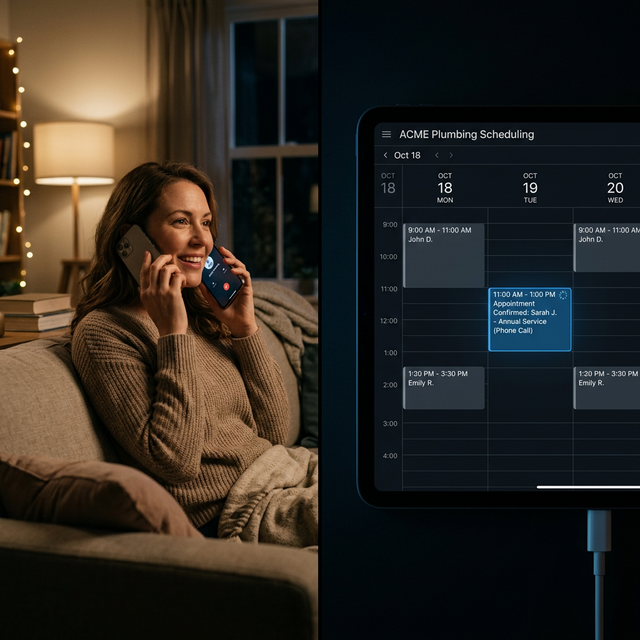
From Inbound Call to Calendar in 60 Seconds: The Zero-Friction Booking Workflow
Phone tag quietly kills service business bookings. Learn how to move an inbound call to a confirmed calendar appointment quickly without creating scheduling chaos.