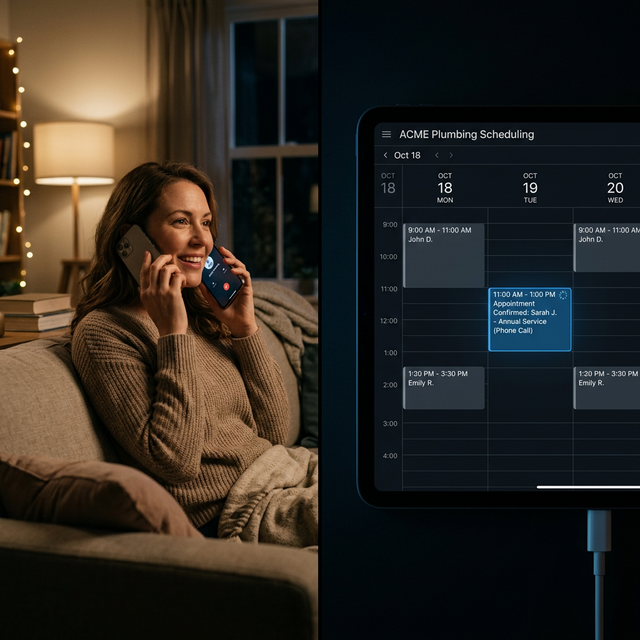
When a buyer is ready, the business should create the next step before the buyer's attention moves somewhere else.
Treat any number without a nearby source or stated method as a planning assumption, then replace it with your own records.
Phone tag feels normal because everyone has learned to tolerate it.
The buyer calls.
The business misses the call.
The business calls back.
The buyer is busy.
The buyer calls again.
The coordinator is on another line.
Another voicemail.
Another callback.
Two days later, an appointment finally lands on the calendar.
Or it does not.
The business usually remembers the appointments that eventually booked.
It does not remember the buyers who disappeared during the back-and-forth.
That is the leak.
The goal is not to make booking feel futuristic.
The goal is simpler:
When a buyer is ready, the business should create the next step before the buyer's attention moves somewhere else.
Phone Tag Is Not Harmless
Phone tag looks like inconvenience.
It is actually conversion friction.
Every extra contact attempt creates another chance for the buyer to cool down, get distracted, compare competitors, or decide the business is harder to work with than expected.
The buyer does not think in operational categories.
They do not say:
"This business has a scheduling infrastructure gap."
They feel:
"This is taking too long."
That feeling matters.
The booking process is often the first real experience of the company.
If it feels organized, the buyer assumes the business is organized.
If it feels slow, scattered, or dependent on callbacks, the buyer starts to wonder what the service experience will feel like.
The job has not started yet.
The brand already has.
What 60-Second Booking Really Means
The point is not that every service business must book every job in exactly 60 seconds.
Some calls are complex.
Some require estimates.
Some need human review.
Some should not be booked at all.
The phrase means the routine path should be short.
For common, qualified calls, the buyer should be able to move from first contact to confirmed next step in one conversation.
That next step may be:
- A service appointment.
- An estimate visit.
- A consultation.
- A dispatch request.
- A diagnostic call.
- A human escalation.
The important part is that the buyer leaves with something concrete.
Not "someone will call you."
Not "we will check the schedule."
Not "leave a message."
A real next step.
The First 60 Seconds
A clean booking workflow does four things quickly.
1. Identify the Need
The system asks what the buyer needs in plain language.
Not a long menu.
Not an IVR maze.
"What can we help with today?"
Then it listens for the service type.
2. Confirm Fit
Before offering a time, the system confirms the basics.
Service area.
Job type.
New or existing customer.
Urgency.
Any must-have details.
This prevents bad bookings.
3. Offer Real Availability
The system checks actual calendar or dispatch availability.
It should offer specific options:
"We have tomorrow between 9 and 11, or Thursday between 1 and 3."
Specific options are easier for buyers than open-ended scheduling.
4. Confirm and Send Proof
Once the buyer chooses, the appointment should be created and confirmed.
The buyer should receive a text or email with the details.
The team should receive the notes.
The calendar should update.
That is the moment the opportunity becomes operational.
What the Calendar Must Know
Most businesses cannot book quickly because the calendar is not structured enough.
The person answering the phone has to ask someone.
They need to check technician availability.
They need to understand travel time.
They need to know which job types fit which windows.
They need to avoid overpromising.
So the caller waits.
The fix is not only AI.
The fix is calendar logic.
The system needs to know:
Which services can be booked directly.
Which services require estimates.
Which areas are covered on which days.
Which technicians or teams handle which job types.
Which windows are available.
Which call types need emergency routing.
Which jobs require photos or prep.
Which appointments need deposits or forms.
Without this logic, any booking system will be messy.
AI can execute rules.
It cannot rescue a calendar with no rules.
The Workflow
Here is the basic version.
The caller reaches the business.
The system asks what they need.
The system identifies the call type.
The system confirms service area.
The system asks the required qualifying questions.
The system checks the booking rules.
If the call is routine and qualified, it offers appointment windows.
If the call is urgent, it routes to emergency protocol.
If the call is complex, it books an estimate or consultation.
If the call is bad fit, it gives a polite next step or referral path if one exists.
If the caller needs a human, it escalates with context.
Then it sends confirmation and logs the interaction.
That is the whole idea.
It is not complicated.
It is just rarely built cleanly.
What It Looks Like by Service Type
The workflow changes by category.
For HVAC, a no-cooling call may need service area, system type, urgency, indoor temperature, and preferred window before dispatch or appointment booking.
For plumbing, active water changes the path. A clogged drain and a burst pipe should not be treated the same.
For dental, the system may separate emergency pain, hygiene, cosmetic consult, and new patient exam.
For legal, the first step may be a consultation, but only after matter type, jurisdiction, urgency, and conflict-screening basics are captured.
For property management, the next step may be emergency dispatch, work order creation, or next-day review depending on the maintenance issue.
For med spas, the booking path may depend on treatment interest, prior patient status, consultation requirement, and provider availability.
For premium renovation, the correct next step may be a discovery call, not an installation appointment.
This is why "book faster" is not enough as a strategy.
The business has to define the right bookable step for each call type.
If the wrong thing gets booked quickly, the business only creates a faster mess.
The best workflow is fast because the logic is clear.
Before and After
Before the workflow is fixed, the office team spends the day catching fragments.
A missed call from 9:12.
A voicemail from lunch.
A web form from last night.
A text asking if Tuesday still works.
A technician asking whether the caller sent photos.
An owner asking why an estimate was not booked.
The team is busy, but the work is scattered.
After the workflow is fixed, the front door creates cleaner records.
The caller is qualified.
The appointment type is correct.
The calendar entry exists.
The buyer receives confirmation.
The team sees the notes.
The reschedule path is clear.
The owner can see what happened.
This does not remove all human work.
It removes the avoidable coordination work that makes the team feel constantly behind.
Why Text Alone Is Not Enough
Text confirmations are useful.
Online booking links are useful.
But they do not replace the first conversation.
Many service buyers still call because they want confidence before choosing a time.
They want to know whether the business handles the problem.
They want to know whether the timing works.
They want to ask a small question.
They want to feel the business is real.
If the system only sends a booking link, some buyers will use it.
Others will stall.
Voice intake helps because it can answer and book in the same flow.
The best system often uses both:
Voice to qualify and create confidence.
Text to confirm and make the next step easy.
When Not to Book Immediately
Not every caller should go straight onto the calendar.
Immediate booking is wrong when:
The caller is outside the service area.
The job type is not offered.
The scope needs senior review.
The buyer is below the minimum project size.
The issue is unsafe or requires emergency guidance.
The caller is an existing customer with an unresolved problem.
The appointment requires documents, photos, or payment before confirmation.
A good system should know when to stop.
Speed without qualification creates downstream chaos.
The goal is not to book everything.
The goal is to book the right next step quickly.
The Failure Modes to Watch
A booking workflow can fail in predictable ways.
It Books Too Much
If every caller gets a slot, the calendar fills with bad-fit appointments.
The team gets busy but revenue quality drops.
Qualification has to come before booking.
It Books Too Little
If every caller requires human review, the system becomes a message-taking layer.
The buyer still waits.
The business has not removed phone tag.
It Books the Wrong Step
A complex project gets scheduled like a routine repair.
An emergency gets scheduled for next week.
A quote request gets sent to the wrong person.
Speed is only useful when the next step is correct.
It Confirms Poorly
The appointment is technically created, but the buyer receives no confirmation, no prep instructions, or no reschedule path.
That creates no-shows and confusion.
The confirmation is part of the booking.
The Owner Checklist
Before launching a fast booking workflow, the owner should be able to answer these questions.
Which call types can be booked immediately?
Which call types require an estimate?
Which call types require a human?
Which call types should be declined?
What are the available appointment windows?
Who handles each service type?
What information must be collected before booking?
What should the buyer receive after booking?
What happens if the buyer needs to reschedule?
What happens if the system is unsure?
If those questions are not answered, the workflow is not ready.
The problem is not the technology.
The problem is the operating logic.
The Cost of Slow Booking
Slow booking costs more than lost leads.
It creates internal drag.
The office team spends time chasing people who were ready yesterday.
Technicians receive incomplete notes.
Customers show up confused.
No-shows increase because confirmation was weak.
The owner sees a busy front desk and assumes demand is being handled.
But busy is not the same as effective.
A clean booking workflow reduces that noise.
It turns the first call into a structured record.
It gives the buyer proof.
It gives the team context.
It gives the owner data.
This is why booking speed is not just a sales issue.
It is an operations issue.
The Revenue Leak Diagnostic for Booking
Pull 30 days of inbound calls and forms.
For each opportunity, ask:
How long did it take to reach the buyer?
How many contact attempts were needed before booking?
How many buyers never booked after first contact?
How many appointments were booked during the first conversation?
How many required a callback just to choose a time?
How many had incomplete notes?
How many were bad-fit appointments?
How many rescheduled because expectations were unclear?
Then listen to the calls that did book.
Where did the process slow down?
Was the person answering able to offer real availability?
Did the buyer have to wait for someone else?
Were the next steps clear?
This audit tells you whether the problem is call capture, calendar structure, qualification, or confirmation.
Each one needs a different fix.
The Number That Matters
Track first-conversation booking rate.
That is the percentage of qualified opportunities that leave the first interaction with a confirmed next step.
If that number is low, the business is pushing buyers into follow-up loops.
Do not hide behind answer rate.
A call can be answered and still fail to book.
Do not hide behind busy calendars.
A calendar can be busy while good opportunities leak before they ever reach it.
First-conversation booking rate tells the owner whether the front door is actually moving demand.
A 30-Day Fix
Week 1: Define Bookable Call Types
List the calls that can be booked immediately.
Routine service.
Estimate visits.
Consultations.
Diagnostics.
Emergency triage.
Then list the calls that require human review.
Week 2: Clean the Calendar Rules
Define appointment windows, territories, job types, technician limits, and escalation paths.
If the rules are fuzzy, booking will stay slow.
Week 3: Build Confirmation
Every booking should create:
Calendar entry.
Customer text or email.
Internal notes.
Prep instructions if needed.
Reschedule path.
Week 4: Measure First-Conversation Booking
Track how many qualified opportunities book during the first interaction.
That number should rise.
If it does not, inspect where the handoff is breaking.
Can every service business book calls in 60 seconds?
No. Some businesses have complex scopes or regulated workflows. But most can reduce routine booking friction significantly by defining call types, calendar rules, and confirmation paths.
What should be booked directly?
Routine services, estimate visits, consultations, diagnostics, and standard appointment types with clear rules are usually good candidates. Complex or sensitive work should route to the right human.
Does AI need live calendar access?
Yes, if it is booking real appointments. Without live availability, the system may create appointments that later need correction, which damages trust.
What if callers want a specific time?
The system should offer the closest available options and keep the conversation moving. If no good time works, it should create a human follow-up or waitlist path.
What is the first metric to track?
Track first-conversation booking rate: the percentage of qualified opportunities that leave the first interaction with a confirmed next step.
The Bottom Line
Phone tag is not a normal cost of doing business.
It is a front-door leak.
The buyer who is ready now should not have to survive three rounds of voicemail before the business offers a time.
The right workflow turns the call into a next step while the buyer is still engaged.
That requires more than answering the phone.
It requires qualification rules, calendar logic, confirmation infrastructure, and a clear escalation path.
When those pieces work together, the business feels easier to buy from.
And in local service markets, easier often wins.
*If your team spends too much time chasing buyers just to book the first appointment, run a Revenue Leak Diagnostic on the path from inbound call to calendar. The leak may be hiding in normal phone tag.*
Use your own records before you decide
Source: start with your call log, CRM notes, booking calendar, missed-call records, web form timestamps, and Google Business Profile. Those records show whether buyers reached you, how fast they heard back, what they asked for, and where the next step broke down.
For seven days, mark each missed call, late reply, unbooked form, stale estimate, and review request that never went out. That small sample gives an owner a practical picture of the front-door gap before they spend more on ads, software, or staff.
Decide what the firm needs to know before the first useful conversation.
A useful intake path protects the buyer's time and the firm's capacity by connecting fit, booking, preparation, reminders, and human handoff.

Vikram Roy is the founder of The Quiet Protocol, a Toronto-based systems firm serving service businesses across the Greater Toronto Area, Canada, and the United States. He works directly with professional firms, home service companies, dental practices, clinics, and local businesses to connect websites, customer intake, booking, reviews, follow-up, and practical AI into a clearer digital front door. All content is written from Toronto, Ontario. See the editorial method →
See how qualification, booking, reminders, documents, and team handoff can become one clearer client journey.
See how the capability in this article fits into a complete customer journey.
Legal, Financial & AdvisorySee the same decision through the language, buyer behavior, and operating reality of this industry.
Client Results & ProofInspect the starting condition, installation, measurement window, and outcome behind real client work.

Speed to Lead is Dead: Why Resolution Speed is the Only Metric That Closes in 2026
Speed to lead only measures how fast a business responds. Resolution speed measures how fast the buyer gets a real next step. Learn how service businesses should measure intake in 2026.
The After-Hours Revenue Leak: How Service Businesses Lose Their Best Jobs After 5 PM
After-hours callers are often the highest-intent buyers in a service business. Learn how to calculate the leak, triage calls, and protect revenue without burning out staff.

Stop Buying Local Service Leads: Fix Your Intake Infrastructure Before You Buy Another Ad
Bad lead quality is not always the problem. Many service businesses lose paid leads because callbacks are slow, after-hours intake is weak, and follow-up is inconsistent.