Homeowners still notice leaks, broken heat, garage door failures, electrical problems, pest issues, roof damage, dental pain, tenant maintenance issues, and legal stress after business hours.
Treat any number without a nearby source or stated method as a planning assumption, then replace it with your own records.
Most service businesses close the office at a reasonable time.
That is not the problem.
People need rest.
Teams need boundaries.
Owners should not live permanently attached to the phone.
The problem is when the business also closes the front door.
The market does not stop at 5 PM.
Buyers still search.
Emergencies still happen.
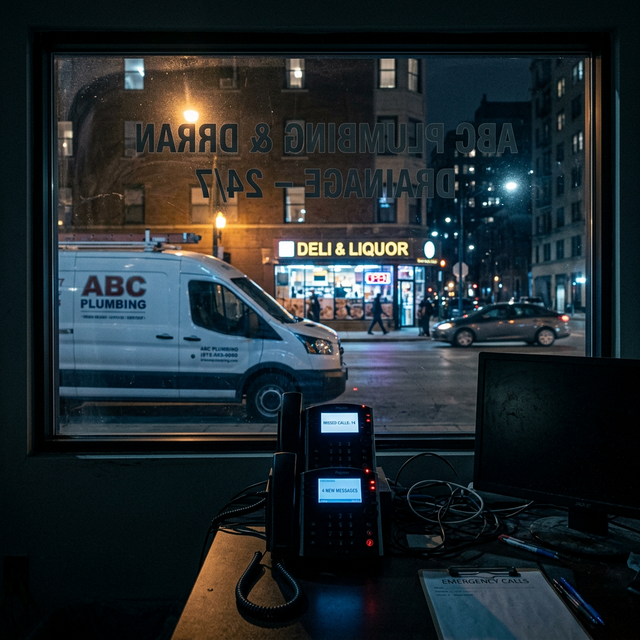
Homeowners still notice leaks, broken heat, garage door failures, electrical problems, pest issues, roof damage, dental pain, tenant maintenance issues, and legal stress after business hours.
The person calling at 8:40 PM is often not casually browsing.
They are calling because the situation has become important enough to interrupt their evening.
That makes after-hours calls different.
The volume may be lower than business hours.
The intent is often higher.
And when those calls hit voicemail, the business usually does not get a second chance.
The Mistake Owners Make
Owners often think in operating hours.
We are open from 8 to 5.
We run crews from 7 to 4.
We schedule estimates during the day.
We return messages in the morning.
Those are operating decisions.
They may be completely reasonable.
But intake hours and operating hours do not have to be the same.
A business can close the office and still capture demand.
A business can let staff sleep and still triage calls.
A business can avoid sending technicians to every night call and still tell the buyer what happens next.
That separation is the key.
The question is not:
Should humans work 24 hours a day?
The question is:
Should buyers who contact us after hours receive a useful next step?
For most service businesses, the answer should be yes.
Why After-Hours Callers Are Different
An after-hours caller has already crossed a threshold.
They could wait until morning.
They could fill out a form.
They could make a note and deal with it later.
Instead, they call now.
That usually means one of three things.
The Problem Feels Urgent
Water is moving.
The house is too hot or too cold.
Something feels unsafe.
A tenant is upset.
A patient is in pain.
A legal issue feels time-sensitive.
Urgency changes buyer behavior.
The caller is not waiting patiently for a callback tomorrow if another provider can help tonight.
The Buyer Is Available Now
Many buyers research after work.
They have the time to compare options in the evening.
They may be ready to book a consultation, estimate, repair, or appointment while the decision is active.
If the business waits until morning, the buyer's attention may be gone.
The Competitor Is One Tap Away
Mobile search makes after-hours competition simple.
If the first business goes to voicemail, the caller goes back to the search result and taps the next number.
The competitor does not have to be better.
They only have to be available.
That is what makes the after-hours leak so frustrating.
It is often not a brand problem.
It is not a pricing problem.
It is an availability problem.
The Leak Looks Different by Industry
After-hours demand does not mean the same thing in every category.
That is why the system should be calibrated instead of copied.
For plumbing, HVAC, electrical, restoration, locksmith, garage door, pest control, and roofing, after-hours calls often contain true urgency.
The buyer may need immediate help or at least a fast triage decision.
For dental, medical specialists, veterinary practices, family law, personal injury, and property management, the urgency may be emotional, legal, clinical, or safety-related.
The caller needs acknowledgment and a clear next step, even when the final appointment happens later.
For landscaping, cleaning, remodeling, accounting, and other planned-service categories, after-hours calls are often convenience-driven.
The buyer is researching after work.
They may not need immediate fulfillment, but they are ready to ask questions, book a consultation, or request an estimate.
That still matters.
The after-hours strategy should fit the category.
Emergency categories need triage and escalation.
Appointment categories need booking and reassurance.
Project categories need qualification and next-step capture.
The common thread is simple:
The buyer should not be forced to wait until morning just to find out what happens next.
Voicemail Is Not Coverage
Voicemail feels like coverage from the business side.
The phone technically answered.
The caller had a place to leave a message.
The office can call back tomorrow.
But from the buyer's side, voicemail often feels like the end of the path.
They needed help now.
The business told them, politely, that help was not available now.
So they keep moving.
Many do not leave a message.
Some leave a message and still call someone else.
Some leave a message, book with a competitor, and then ignore the morning callback.
The business may see a voicemail count.
It does not see all the callers who heard the greeting, hung up, and disappeared.
Those callers are the leak.
The Morning Callback Trap
The morning callback feels responsible.
The team comes in.
They check messages.
They call the after-hours list.
They feel like they are doing the right thing.
Sometimes they are.
For routine requests, a morning callback may still convert.
But for urgent or comparison-driven calls, the morning callback is often too late.
The buyer's decision window was last night.
By morning, three things may already have happened.
They booked a competitor.
They solved the problem temporarily and no longer feel urgency.
They lost confidence because the business did not respond when it mattered.
This is why owners should measure callback outcomes, not callback effort.
How many after-hours voicemails became booked jobs?
How many no-answer callbacks happened?
How many callers said they already found someone?
How many were still qualified but colder?
If the morning callback list is long and conversion is low, the business is not recovering after-hours demand.
It is documenting lost demand.
The After-Hours Revenue Formula
You can estimate the leak with simple math.
Start with 30 days of call logs.
Use this formula:
After-hours contact attempts x qualified percentage x likely booking rate x average job value = monthly after-hours leak.
Then multiply by 12 for the annual number.
Example:
The business receives 50 after-hours calls per month.
After removing vendors, spam, duplicates, and wrong-fit calls, 30 are real buyer opportunities.
If 35 percent would have booked with a useful real-time response, that is 10.5 jobs.
If the average first job value is $700:
10.5 x $700 = $7,350 per month.
Annualized, that is $88,200.
The owner can make the assumptions more conservative.
Use 25 qualified calls.
Use 25 percent booking.
Use $500 job value.
The number is still meaningful.
This is the point:
After-hours calls should not be valued at zero.
If the current system treats them like zero, the business is making a financial decision without naming it.
Not Every After-Hours Call Needs Dispatch
This matters.
After-hours intake does not mean every call becomes a midnight service call.
That would burn out staff and create chaos.
The system should separate calls into categories.
Emergency
The issue needs immediate escalation.
Examples include active flooding, no heat in dangerous temperatures, safety risk, electrical hazard, lockout, property damage in progress, or a true medical or legal urgency depending on the industry.
These calls should trigger the on-call path.
Urgent but Not Immediate
The buyer needs acknowledgment, but the job may be scheduled for first available.
The system should capture details, set expectations, and book the next step.
This prevents the buyer from continuing to shop while still protecting the team from unnecessary night work.
Routine
Some after-hours contacts are normal scheduling requests.
The buyer is available now because they are off work.
They may not need immediate service.
They still need an immediate path to book or request the next step.
If the business can book them tonight for tomorrow or next week, that is still revenue captured.
The goal is triage, not chaos.
What Good After-Hours Intake Does
A useful after-hours system should do five things.
First, it should answer.
Second, it should identify the caller's need.
Third, it should decide urgency.
Fourth, it should create the right next step.
Fifth, it should document the interaction for the morning team.
That can be done with AI, a live answering service, an on-call rotation, or a hybrid.
The tool is secondary.
The outcome is primary.
The caller should not end the interaction wondering:
Did anyone get this?
Am I supposed to wait?
Is someone coming?
Should I call another company?
When a system answers those questions, it reduces anxiety.
When it does not, the buyer keeps searching.
Where AI Fits
AI is useful after hours because the alternative is often voicemail.
This is an important comparison.
The question is not whether AI is better than your best human on their best day.
The question is whether AI is better than a voicemail greeting at 9:30 PM.
In most repeatable intake situations, it is.
AI can collect the issue.
It can ask urgency questions.
It can confirm service area.
It can book available windows.
It can text confirmation.
It can notify the on-call person only when needed.
It can summarize the call for the office.
It can do this without asking the owner to personally answer every evening call.
That is the value.
AI should not be allowed to invent emergency policy.
The business must define the rules.
But once the rules exist, AI can execute them consistently.
When Live Answering Is Enough
Some businesses do not need voice AI as the first step.
A live answering service may be enough when call volume is low, the need is mostly non-urgent, and the business only needs message capture.
It can also be useful in sensitive categories where a human voice is part of the brand experience.
But the owner should be honest about what the answering service does.
If it only takes messages, it may not capture urgent buyers.
If it cannot book, route, or escalate, the caller still waits.
If the morning callback is the real point of conversion, the business is still vulnerable to competitors who create the next step immediately.
Live answering can be a good layer.
It should not be mistaken for a complete after-hours revenue system unless it actually moves the buyer forward.
The Revenue Leak Diagnostic for After-Hours Calls
Run this audit before choosing a system.
Pull 30 days of data.
Separate calls by time.
Look at:
How many calls arrived after office hours.
How many went to voicemail.
How many left messages.
How many did not.
How many received same-night response.
How many converted after morning callback.
How many were emergencies.
How many were routine booking requests.
How many were existing customers.
How many were new prospects.
How many came from paid ads.
How many came from Google Business Profile.
This tells you whether the after-hours gap is small, large, urgent, routine, seasonal, or source-specific.
Then listen to a sample of messages and short calls.
You will usually hear the pattern quickly.
The buyer did not need a perfect sales pitch.
They needed a path.
A 30-Day Fix
Do not solve every after-hours scenario at once.
Start with the biggest leak.
Week 1: Count and Classify
Tag after-hours contacts as emergency, urgent, routine, existing customer, new customer, vendor, or wrong fit.
This prevents the business from treating all after-hours calls the same.
Week 2: Write the Rules
Define what happens for each category.
Who gets notified?
What can be booked?
What gets a text?
What waits until morning?
What language should the caller hear?
Week 3: Add Coverage
Choose the layer that fits the leak.
AI intake.
Live answering.
Missed-call text-back.
On-call routing.
Hybrid.
The system should match the call types, not the trend.
Week 4: Review Outcomes
Measure:
After-hours answer rate.
After-hours bookings.
Emergency escalations.
Morning callbacks avoided.
Caller questions.
Calls incorrectly classified.
Revenue from after-hours bookings.
Then tune the system.
After-hours intake is not a set-and-forget project.
It is a front-door loop.
Are after-hours calls worth answering for every service business?
Not equally. Emergency and high-ticket categories usually see the strongest return. Planned-service businesses may see less urgency, but they can still capture evening buyers who are ready to book while they are available.
Does after-hours intake mean offering 24-hour service?
No. Intake and fulfillment are different. A business can answer, qualify, and book after hours without dispatching crews overnight for every call.
What is the fastest after-hours fix?
Missed-call text-back or AI after-hours intake are often the fastest. The best first move depends on whether callers need booking, emergency triage, or simple acknowledgment.
Should the owner answer after-hours calls personally?
Not as a long-term system. Owner coverage can work temporarily, but it creates burnout and inconsistency. The business should build a process that does not depend on the owner being available every night.
How do I know if after-hours calls are leaking revenue?
Pull 30 days of call logs and compare after-hours contact attempts against booked jobs from those contacts. If many calls go to voicemail and few convert the next morning, the leak is real.
The Bottom Line
After-hours revenue loss is not caused by having reasonable business hours.
It is caused by letting intake stop when the office closes.
The buyer may not need a technician at midnight.
But they do need a useful next step while their attention and urgency are active.
That is the difference.
The service businesses that win after hours are not necessarily the ones with the biggest teams.
They are the ones with a front door that stays awake.
*If your voicemail handles after-hours calls today, run the numbers before assuming the leak is small. The best jobs may be arriving when your team is already home.*
The loss estimate is basic business math, not a magic claim.
Revenue-leak examples on this site are built from visible operating inputs: inquiry volume, missed-call or slow-response rate, booking rate, average job or client value, repeat value, and follow-up recovery. The fastest way to make the number real is to run the diagnostic for your closest business type, then compare it against your own call log, CRM, booking calendar, form timestamps, and review activity.
Turn the article into one week of real numbers.
Use your own call log, form timestamps, calendar, and CRM before accepting any industry estimate.

Vikram Roy is the founder of The Quiet Protocol, a Toronto-based systems firm serving service businesses across the Greater Toronto Area, Canada, and the United States. He works directly with professional firms, home service companies, dental practices, clinics, and local businesses to connect websites, customer intake, booking, reviews, follow-up, and practical AI into a clearer digital front door. All content is written from Toronto, Ontario. See the editorial method →
Use your own operating numbers to see where response, booking, reviews, and follow-up may be costing the business.
See how the capability in this article fits into a complete customer journey.
Legal, Financial & AdvisorySee the same decision through the language, buyer behavior, and operating reality of this industry.
Client Results & ProofInspect the starting condition, installation, measurement window, and outcome behind real client work.
Speed to Lead is Dead: Why Resolution Speed is the Only Metric That Closes in 2026
Speed to lead only measures how fast a business responds. Resolution speed measures how fast the buyer gets a real next step. Learn how service businesses should measure intake in 2026.
Phone Trees (IVR) vs. Conversational AI: Why 'Press 1' is Costing You High-Ticket Jobs
At some point in the last decade, you have called a business, heard a recorded menu, and felt a specific frustration that is difficult to articulate but instantly recognizable. It is the frustration of wanting help and being handed a list. Of being asked to sort yourself before anyone has decided whether you are worth sorting. Interactive Voice Response systems, known as phone trees or IVR, were built to produce exactly that experience. And there are service businesses spending money on Google Ads right now routing the leads those ads generate into a system engineered to make people want to hang up.