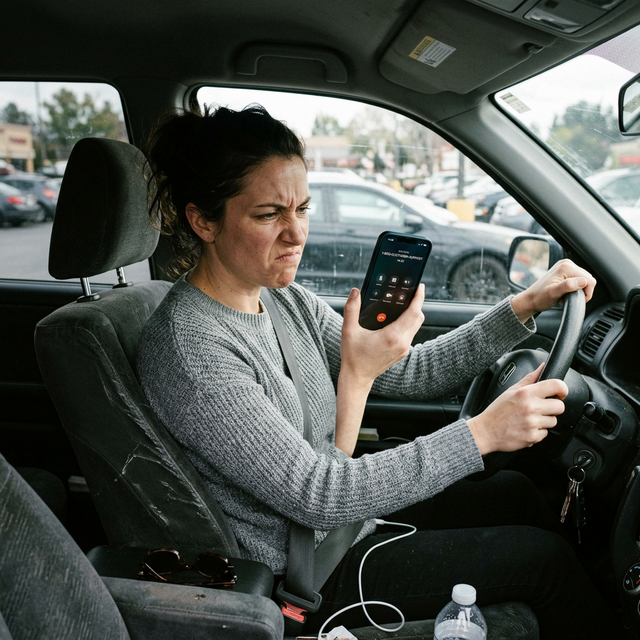
Most people in that situation do one of three things: they navigate the menu with gritted teeth if the need is urgent enough, they hang up and try a different business if the need is not, or they send a form submission and then answer the follow-up call from the business two days later when the moment has already passed.
Treat any number without a nearby source or stated method as a planning assumption, then replace it with your own records.
Think about the last time you pressed 1 for English.
Not at a government agency. Not at a bank. At a local business you were trying to hire. Maybe it was a plumber you found on Google after your utility sink backed up. Maybe it was a roofer someone had recommended. Maybe it was a med spa you had been meaning to call for three months.
You called. A recorded voice answered. It told you to press 1 for service scheduling, 2 for billing, 3 for estimates, or to stay on the line for a directory. You pressed a number and reached a submenu. Or a hold. Or possibly a voicemail that no one had checked since Tuesday.
Most people in that situation do one of three things: they navigate the menu with gritted teeth if the need is urgent enough, they hang up and try a different business if the need is not, or they send a form submission and then answer the follow-up call from the business two days later when the moment has already passed.
None of those outcomes are what the business wanted. None of them represent a successful intake interaction. And yet the phone tree that produced them is probably still live on that business's main number, routing callers who found the business through paid advertising or word of mouth into an experience engineered for the convenience of the staff, not the resolution of the caller.
Where Phone Trees Came From and What They Were Designed to Do
Interactive Voice Response technology was developed in the 1970s and adopted broadly by large corporations in the 1980s and 1990s. At its origin, IVR had a specific and legitimate purpose: to route high call volumes across large organizations with many departments, while deflecting simple, repetitive inquiries from live agents to automated self-service options. Check your account balance. Hear your flight status. Confirm your appointment.
IVR is a defensive technology. It was designed by operations teams to protect staff capacity from low-value calls, not to serve callers. The design logic of a phone tree is: of all the people who call us, what percentage of their needs can we address without a human agent? Route those calls to self-service. Use the staff for everything else. The system's stated success metric was call deflection rate, meaning the percentage of callers who completed their interaction without reaching a human. High deflection was good. Callers not reaching humans was the goal.
This design philosophy made sense in a high-volume corporate environment where thousands of customers called daily with routine questions, and routing a large percentage of them to automation saved significant labor cost without damaging relationships. Bank customers checking balances do not need warmth. They need an accurate number.
The local service business running an IVR on their main business line is using a customer-deflection tool to handle customers they are spending money to acquire. That is the core of the problem, and it is rarely stated so plainly.
The Specific Ways 'Press 1' Costs Service Businesses High-Ticket Jobs
The abandonment problem: Nuance Communications, one of the largest IVR solution providers in enterprise telephony, published research in 2023 finding that 27 percent of callers presented with a multi-level IVR menu abandon the call before reaching an agent or completing a self-service interaction. For a service business running paid advertising at $50 to $120 per inbound call, 27 percent abandonment represents a significant fraction of the ad budget generating no return. The lead paid for the call. The IVR discouraged them from completing it. The ad budget was charged. The job was not booked.
The premium buyer problem: High-ticket buyers, the homeowners considering a $30,000 kitchen renovation, the property manager evaluating a $20,000 commercial HVAC contract, the prospective patient calling a plastic surgery practice to inquire about a $15,000 procedure, have a specific relationship with IVR systems. They do not navigate them. They interpret an IVR as a signal about the organizational competence of the business and make a judgment call about whether to continue. Gartner research on service business phone experience found that consumers with higher household income and higher purchase intent were 38 percent more likely to abandon a call when encountering an IVR with three or more menu levels, compared to lower-income callers with more routine service needs. The customers most worth acquiring are the least tolerant of phone menus.
The urgency decay problem: IVR systems introduce latency into every interaction. A caller pressing through menus is spending time. Every second of menu navigation is a second during which the decision to seek alternatives remains open. Invoca call analytics data from Q3 2024 found that for service businesses in emergency and urgent-response categories (plumbing, HVAC, water damage, locksmith), IVR menus with a time-to-human of more than 40 seconds reduced call-to-booking conversion by 43 percent compared to businesses with under 10 seconds time-to-human. Callers in crisis do not wait for menus. They call the next number while your system asks them to press 2 for service scheduling.
Conversational AI: Built With the Opposite Intention
The design philosophy of conversational AI for service business intake is the exact inverse of IVR. Where IVR asks "what is the least we need to do for this caller before they stop taking staff time?", conversational AI asks "what is the fastest path from this caller's first sentence to their problem being in motion?"
Conversational AI does not present menus. It listens. A caller who says "my AC stopped working" does not get "press 1 for HVAC service." They get "Is the system completely off or cycling without cooling? I have a technician who can reach you today -- what is your address?" The caller's intent is identified from natural speech, the relevant information is requested in the right sequence, and the next concrete step is taken while the caller is still on the phone.
This is not a minor UX improvement over IVR. It is a structural redesign of the intake function. IVR is a routing system: it moves callers to the right slot. Conversational AI is a resolution system: it advances callers toward an outcome. Routing and resolution are different operations. A caller routed to the HVAC service queue is not resolved. A caller who receives a technician dispatch confirmation during the call is resolved.
American Express Customer Service Barometer research consistently finds that when a service interaction resolves a customer's need in the first contact without requiring callbacks or transfers, customer satisfaction scores run 22 to 31 percent higher than interactions that required a second contact to reach resolution. Conversational AI, designed specifically for first-contact resolution, produces that outcome structurally. IVR, designed for call deflection, produces it incidentally at best.
Why Natural Language Processing Changes the Entire Experience
The practical difference a caller feels between IVR and conversational AI is almost entirely attributable to natural language processing. With IVR, the caller must adapt to the system. They must learn the menu structure, identify which option most closely matches their need, and navigate to it correctly, often discovering only at the end of that navigation that they chose the wrong path and must start over.
With conversational AI, the system adapts to the caller. The caller speaks naturally. They say what their problem is the way they would say it to another person. The AI processes that statement for intent, identifies the relevant service category, and responds with a focused question that advances the interaction toward resolution. There is no menu to navigate. There is no risk of choosing the wrong path. There is only a conversation that moves toward an outcome.
The business owner who has experienced both systems as a caller usually has a very clear intuition about which one they would prefer to encounter if they were buying a service. Translating that intuition into an operational decision for their own service business is the step that is often delayed by cost concerns, implementation uncertainty, and inertia. The delay is expensive. Every month a business owner runs an IVR on a number receiving paid advertising traffic, they are converting a fraction of what conversational AI would convert from the same lead volume.
Moving Away from Phone Trees: What the Transition Looks Like
The migration from IVR to conversational AI does not require a business owner to dismantle existing phone infrastructure. In most implementations, the conversational AI system is layered on top of the existing telephony setup. The main business number routes to the AI intake system instead of the IVR menu. The IVR menu may remain in place as a fallback for calls that the AI system escalates, but the primary intake experience is conversational rather than menu-based.
The configuration process requires the business owner to define the intake workflow: what information needs to be collected from every caller, what qualifies a lead for immediate booking, what triggers an escalation to a human, and what the system should do with callers outside the service area or outside scope. This configuration replaces the menu design that the IVR required, but it produces a dramatically different caller experience from the same underlying business logic.
Business owners that have migrated from IVR to conversational AI consistently report three outcomes in the first 90 days: a reduction in call abandonment rate, an increase in first-call booking rate, and a reduction in the volume of "what are your hours / do you service my area / how much does X cost" calls reaching human staff, because the conversational AI handles these common questions in the initial interaction rather than routing them to a staff member for a response.
The "Infinite Hold Loop": Why Your Phone System Is a Brand Liability
We've all been there. You're trying to reach a service provider-maybe it's a high-end contractor or a specialty clinic-and you're met with: "Press 1 for Sales, Press 2 for Billing, Press 3 for..." by the time you reach Press 4, you've forgotten why you called.
To a business owner, an IVR (Interactive Voice Response) system feels like "efficiency." It routes calls without a human. But to a customer who is about to spend $10,000 on a service, an IVR feels like a "Wall." It's a signal that the business is too busy, too disorganized, or too impersonal to just pick up the phone.
The "Hidden Churn" of legacy phone trees is untrackable.People don't leave a voicemail saying, "I hated your automated menu, so I'm calling your competitor." They simply hang up and click the next link on Google.
The Customer Respect Quotient
Modern consumers have a very low tolerance for wasted time. They have what we call a high "Respect Quotient"-they expect the businesses they hire to value their time as much as their own.
A relatable, Conversational AI system doesn't "route" the caller; it "resolves" them. Instead of "Press 1," the caller simply says, "I need to schedule an estimate for a new roof." The AI understands the intent, checks the calendar, and books the appointment in 45 seconds.
There is no hold music. There is no repeating of information. There is only a smooth, human-like transition from "Inquiry" to "Client." By replacing your phone tree with a conversational interface, you aren't just adding technology-you're removing the digital friction that is currently costing you your best leads. That is how you win in a market that values speed as much as quality.
What is the cost comparison between maintaining an IVR system and implementing conversational AI?
IVR systems on business phone platforms typically cost between $50 and $200 per month for the telephony platform that hosts them, plus configuration and maintenance costs whenever the menu structure or options change. Conversational AI intake systems for service businesses range from $300 to $900 per month depending on call volume and integration complexity. The cost difference is real, but the relevant comparison is not monthly platform cost. It is revenue-per-inbound-call. A service business converting 41 percent of inbound calls to bookings via conversational AI versus 23 percent via IVR-to-human routing is generating 78 percent more bookings from the same lead volume. At any reasonable average job value, that conversion difference dwarfs the monthly cost difference within the first billing period.
The Authority Standard: High-Resonance Scaling
In the context of Phone Trees (IVR) vs. Conversational AI: Why 'Press 1' is Costing You High-Ticket Jobs, we must address the fundamental friction that exists in manual intake. Every 'missed call' is a missed revenue opportunity, but more importantly, it's a signal of operational weakness that high-value prospects detect instantly. By bridging this gap with AI-driven intake, you're not just 'automating.' You're humanizing the interaction by ensuring that your clients get the attention they deserve, instantly. This is the math of responsiveness that wins markets.
Strategic ROI: When we apply the Quiet Protocol math to Phone Trees (IVR) vs. Conversational AI: Why 'Press 1' is Costing You High-Ticket Jobs, the result is always the same: a dramatic reduction in cost-per-acquisition (CAC) and a significant increase in client lifetime value (LTV) through immediate resolution.
The loss estimate is basic business math, not a magic claim.
Revenue-leak examples on this site are built from visible operating inputs: inquiry volume, missed-call or slow-response rate, booking rate, average job or client value, repeat value, and follow-up recovery. The fastest way to make the number real is to run the diagnostic for your closest business type, then compare it against your own call log, CRM, booking calendar, form timestamps, and review activity.
The practical questions behind this decision.
Does conversational AI handle calls differently based on the caller's urgency or tone?
Well-designed conversational AI systems for service business intake are configured to identify urgency signals within the first few sentences of a call. Keywords like "flooding," "no heat," "emergency," "burst," or "not breathing" trigger an accelerated intake path that skips lesser-priority qualification questions and moves immediately to dispatch confirmation. The system does not need to be told the call is urgent by a pressed menu option. It identifies urgency from speech and responds accordingly. This is one of the most significant functional advantages of conversational AI over IVR in emergency service contexts: the caller never has to navigate to the right urgency category.
Can conversational AI replace the IVR used for internal call routing within a multi-location business?
In single-location service businesses, the IVR-to-conversational-AI transition is relatively straightforward. In multi-location operations, conversational AI can replace IVR for the caller-facing intake function while still performing the internal routing function: identifying the caller's location or service area and routing their call or their intake data to the correct location's team. The key transition is that the routing happens after the conversational AI has already collected the caller's basic information, rather than requiring the caller to self-select their location from a menu before any information is collected.
What is the cost comparison between maintaining an IVR system and implementing conversational AI?
IVR systems on business phone platforms typically cost between $50 and $200 per month for the telephony platform that hosts them, plus configuration and maintenance costs whenever the menu structure or options change. Conversational AI intake systems for service businesses range from $300 to $900 per month depending on call volume and integration complexity. The cost difference is real, but the relevant comparison is not monthly platform cost. It is revenue-per-inbound-call. A service business converting 41 percent of inbound calls to bookings via conversational AI versus 23 percent via IVR-to-human routing is generating 78 percent more bookings from the same lead volume. At any reasonable average job value, that conversion difference dwarfs the monthly cost difference within the first billing period.
Connect one customer path before adding more disconnected tools.
The first useful system owns a defined journey from customer action to team handoff and follow-up.

Vikram Roy is the founder of The Quiet Protocol, a Toronto-based systems firm serving service businesses across the Greater Toronto Area, Canada, and the United States. He works directly with professional firms, home service companies, dental practices, clinics, and local businesses to connect websites, customer intake, booking, reviews, follow-up, and practical AI into a clearer digital front door. All content is written from Toronto, Ontario. See the editorial method →
See where a Smart Website, software plan, AI intake path, or Custom Customer System fits before committing to a scope.
See how the capability in this article fits into a complete customer journey.
Service BusinessesSee the same decision through the language, buyer behavior, and operating reality of this industry.
Client Results & ProofInspect the starting condition, installation, measurement window, and outcome behind real client work.

Speed to Lead is Dead: Why Resolution Speed is the Only Metric That Closes in 2026
Speed to lead only measures how fast a business responds. Resolution speed measures how fast the buyer gets a real next step. Learn how service businesses should measure intake in 2026.

Why $5M Service Businesses Are Replacing Aggressive Closers with Silent AI Systems
At around $5M, service businesses often outgrow personality-driven sales. Learn why owners are replacing aggressive closer culture with consistent AI-supported intake systems.