
The cost of missed calls has no universal dollar value, and anyone quoting you one is guessing. A missed call can be a repeat attempt, an existing customer, an out-of-area job or a caller you reached later. Only one kind is the real loss: a unique, qualified request that never got a useful response.
I understand why you want one number. A red missed-call badge feels like a visible hole in the business. It is tempting to multiply every ring by the average invoice and call the result lost revenue. That gives a dramatic answer but a poor decision. It can make a small callback problem look like a major sales crisis, or hide a serious after-hours gap inside a report full of repeat calls.
The useful number is not the most exciting one. It is the one your team can trace from the phone to a person, a booking, a completed job and the cost of doing that job.
If the records show a real coverage gap, The Quiet Protocol's AI Receptionist gives that call path an operating owner. We map approved questions, booking or callback rules, records and human handoffs, configure and test the route, then maintain it within scope. Coverage starts at US$449 per month with free setup (normally US$1,495), with no contract, the AI Business OS and call minutes included. The point of this worksheet is to judge whether the defined repair deserves that investment, rather than assume any answered call will pay for it.
Where the $126,000 comes from (we tried to trace it)
Search for the cost of missed calls and one number shows up everywhere. $126,000 a year. Small business. Missed calls. Every year.
I wanted to know where it came from. So I followed the trail.
One roundup, from the business phone company Zadarma (April 2026), credits it to AMBS Call Center. But its own sources table credits a different study for the same line. Another page calls it an unnamed "industry estimate" and admits the math "is not public." A third points to a page that, according to that roundup, no longer loads.
So I went to the company two of those pages credit. AMBS Call Center did publish something in August 2025. It says a missed call costs a business $12.15 on average. It says small and medium businesses missing about six calls a day lose over $26,000 a year.
You can check that yourself. Six calls a day is 2,190 a year. 2,190 times $12.15 is $26,608.50.
And the $126,000? It is not on the page. It is about 4.7 times what the company reported.
The page also does not show its model. It talks about an "industry-backed cost-per-call model." It does not give the call volume, the miss rate, the close rate or the value per customer behind $12.15. Those four inputs are the whole answer.
Here is another famous number: 62% of calls go unanswered. It comes from a 30-day study by a local SEO firm, 411 Locals. The study covered 85 small businesses across 58 industries. According to the roundups that summarise it, 37.8% of calls were answered by a person, 37.8% went to voicemail and 24.3% got no response. The 62% counts voicemail as unanswered.
Those same roundups say the study dates from January 2016, and that people often misdate it to 2023 or 2024. I could not find the original report, so I am going by their summaries. Eighty-five businesses is a small sample either way.
Then there is the price of one call. AMBS says $12.15. SalesAi, another vendor, cites $300 to $1,200 per missed call for home services, from analyses it does not name. Both are "the cost of a missed call." They are between 25 and 100 times apart.
That is not a scandal. It is what happens when the answer is an assumption. A number like $126,000 is a scenario. And a scenario needs its inputs printed next to it.
So here is what has to be true for $126,000 a year to describe your business:
- 2,190 missed calls a year (six a day), each worth about $57.53 in expected revenue. Or
- 416 missed qualified enquiries a year (eight a week), each worth about $303.
Neither is impossible. Both are things you can check in your own records. Which makes them more useful than the headline.
Your own calculator, with every input showing
You do not need a vendor's number. You need four numbers from your own business.
The four inputs, and the arithmetic
- A. Unique qualified requests nobody resolved in a month
- From your call log, after removing repeats, existing customers and work you cannot serve.
- B. Share of those that would have become completed jobs
- Your own completed-job rate for comparable requests. Use a range if you do not have one.
- C. Revenue from the first job
- For that type of work, not an average across everything you do.
- D. Cost of delivering that job
- Materials, field labour, travel and fees that rise with one more job.
- Revenue at risk per month
- A x B x C. It is a scenario, not a ledger entry.
- Contribution at risk per month
- A x B x (C minus D). This is the money available to pay for a fix.
Here are three scenarios. They are chosen planning inputs. Not an industry benchmark, a customer result or a forecast. Replace every cell with your own numbers.
| Cautious | Middle | Generous | |
|---|---|---|---|
| A. Requests / mo | 8 | 24 | 40 |
| B. Close rate | 20% | 25% | 35% |
| Jobs / mo | 1.6 | 6 | 14 |
| C. Job revenue | $400 | $600 | $900 |
| D. Job cost | $240 | $360 | $540 |
| Revenue / mo | $640 | $3,600 | $12,600 |
| Contribution / mo | $256 | $1,440 | $5,040 |
| Revenue / yr | $7,680 | $43,200 | $151,200 |
| Contribution / yr | $3,072 | $17,280 | $60,480 |
How to read the table. A is unresolved qualified requests a month. B is the share of them that would have become completed jobs. Jobs a month is A times B. Revenue and contribution are at risk, not lost.
The middle column is the same month used in the example below. The yearly rows multiply by twelve. That only works if your volume, close rate and job value stay the same all year. For seasonal work, add the months separately.
Now look at where $126,000 sits. As a yearly revenue figure it is about $10,500 a month. You would get there with roughly 35 unresolved qualified requests a month, closing about a third of them, at around $900 a job.
That is a busy business with a big gap. It is not "the average small business." And it is revenue, not profit.
That is the honest version of the number. For most businesses it is smaller than the headline. And it is far more useful, because you can act on it.
Want something to type into? Use our free Revenue & Time Leak Diagnostic. Pick the nearest trade, enter your own numbers, and it estimates the customer opportunity at risk and the senior time your business absorbs. That is the other half of a missed-call problem. It is a scenario tool too, so keep the same rule: your inputs, your ranges.
Start with one month of unique requests
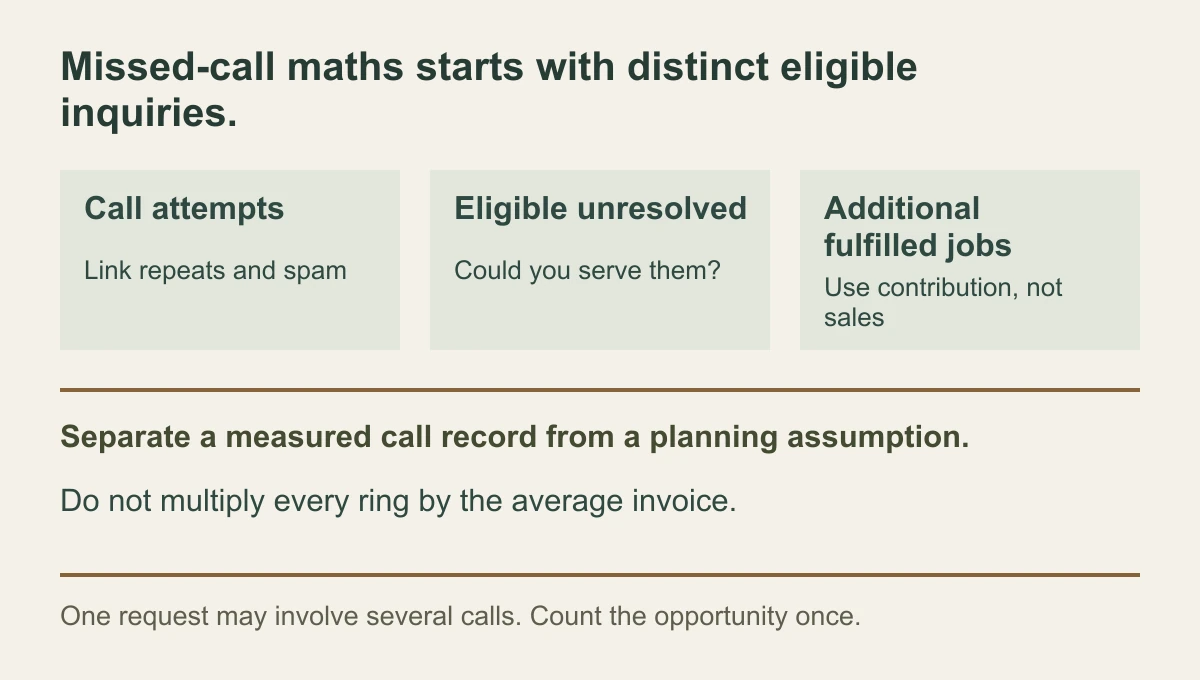
Choose a complete recent month and export the call log. Match it to messages, forms, customer records and jobs. If someone called three times about one leaking pipe, count three attempts when assessing phone coverage, but one customer request when assessing opportunity. If they filled out a form and booked the next day, the first missed ring was recovered. It is not a lost sale.
Separate new business from existing-customer service, suppliers, spam and wrong numbers. Then separate requests your company could serve from those outside its area, scope or available capacity. Keep unknown outcomes visible. A call with no voicemail may have reached the business through another channel, or it may not be identifiable at all. Do not force an answer the records cannot support.
For the remaining requests, record the response and outcome. Was a callback made? Did the caller answer? Was an appointment confirmed? Was the estimate accepted? Was the job completed and paid? You may not be able to connect every step today. That is useful to learn; it tells you which record or ownership gap to fix before making a larger investment decision.
If your main gap is after-hours tracking, start with the after-hours phone test. This article takes the next step: what the unresolved qualified requests could mean financially.
Do not add the risk estimate to the incremental estimate. They describe overlapping views of the same opportunity.
Estimate revenue at risk without calling it a loss
Take the number of unique unresolved qualified inquiries and multiply it by a realistic probability that a comparable inquiry would become a completed first job. Multiply that expected number of jobs by the average first-job revenue for that type of work. The result is an estimate of revenue at risk, not a ledger entry or a promise that every caller would have bought.
Use your own completed-job history if you have enough comparable requests. A booking rate is not the same as a completed-job rate: some estimates are declined, appointments are canceled and jobs move out of scope. If you only know bookings, carry that uncertainty forward rather than quietly treating every booking as paid work.
Keep different jobs separate. An emergency restoration request, a routine maintenance visit and a professional consultation have different fit, timing and value. An average across all three can look precise while describing none of them. Start with the request type that is causing the business concern, then repeat the calculation for other types if the data supports it.
If you have no reliable conversion history, use a range for planning. Write down the low and high assumptions and who chose them. A range honestly shows how much the conclusion depends on uncertainty. It is better than borrowing an industry percentage whose definition, geography and customer mix do not match yours.
You can build the input sheet without a complex dashboard. The phone system supplies call attempts and timestamps. Your contact records help identify unique requests and callbacks. The calendar shows appointments. The job system or invoices show completed first jobs and their value. The operating team supplies which requests were actually in area and within capacity. Keep the source of each number in the sheet so the next person can reproduce it.
If those systems disagree, review a few records manually before extrapolating. A job may be entered under a spouse's name, a caller may use a different number on the form, or an estimate may be scheduled without a phone record. Small matching errors can have a large effect when the unresolved group is small. It is fine to leave those rows uncertain until a person resolves them.
One illustrative month, before buying coverage
These are chosen planning inputs, not an industry benchmark or a client result.
- Qualified unresolved requests
- 24 unique requests after removing repeats, unsuitable work and callers already recovered.
- Assumed completion probability
- 25% from this unresolved stage: 24 × 25% = 6 expected completed first jobs.
- Revenue and delivery cost
- US$600 revenue less US$360 incremental delivery cost = US$240 contribution per job.
- The risk scenario
- 6 × US$600 = US$3,600 revenue at risk; the same jobs represent 6 × US$240 = US$1,440 contribution at risk. Do not add those two amounts.
- The repair question
- If a change creates three genuinely additional completed jobs, it adds US$720 contribution before its full cost. Six expected jobs at risk are not a promise that the change will create six jobs.
Estimate what a better response could recover
Revenue at risk is not revenue a new system will create. Some callers are not ready, some jobs cannot fit the schedule, and some people choose another provider even after a good response. To evaluate a change, compare the completed-job rate for comparable qualified inquiries under the current process with a reasonable target under the proposed one. Multiply the difference by the number of comparable requests and their first-job value.
The rate must describe the same journey on both sides. If the current figure is “booked appointments” and the target is “completed jobs,” the calculation does not compare like with like. If you only have enough data for booking, keep the result labeled as potential additional bookings and avoid converting it into revenue until you know what proportion are completed.
Do not multiply the same opportunity twice. You can estimate improvement from a change in completed-job rate, or you can estimate the share of unresolved requests that might be recovered. If both factors are applied to the same requests without defining separate stages, the forecast will be inflated. Write the denominator beside every percentage so someone else can check it.
And let the model show a disappointing result. If the proposed coverage does not change the completed-job rate, the incremental revenue estimate is zero. If it makes handoffs worse, the model should show a negative change. A spreadsheet that cannot say “this will not pay off” is a sales prop, not a decision tool.
Convert revenue into the amount available to pay for a fix
The full invoice is not available to pay for a receptionist, answering service or software. A completed job may need materials, field labor, travel, transaction fees or outside specialists. Subtract the costs that rise with one additional job from the first-job revenue. What remains is the contribution per additional job toward fixed costs and profit.
Then multiply expected additional completed jobs by that contribution. Compare it with the full incremental cost of the proposed change: setup, recurring fees, call usage, staff review and any operational work needed to make the route function. If staff will spend time correcting records or returning messages, include that work. The cheapest subscription can be expensive in practice if the handoff is poor. When we scope a receptionist installation, the receiving record, human exception route and continuing maintenance belong in the buying decision alongside the voice.
The U.S. Small Business Administration's break-even guidance uses the same core idea: fixed costs divided by the difference between selling price and variable cost gives the number of units needed to break even. For this decision, divide the monthly incremental cost of the new call process by contribution per additional completed job. Round up when the answer is a fraction of a job. If contribution is zero or negative, the usual break-even formula will not make that job attractive.
This is a planning comparison, not a guarantee of profit. It does, however, give you a concrete question: how many genuinely additional completed jobs would this arrangement need to produce before its cost is covered?
Keep repeat business and referrals out of the base case
An acquired customer may return or refer someone else. Those possibilities can matter, especially for recurring work. They can also turn a modest forecast into a fantasy if added without evidence. Use first-job contribution as the base case. Add a separate longer-term view only when you can define the period, observed repeat behavior, delivery costs and overlap with the first job.
Do not add a full future customer value after you have already counted the first job if that future figure includes it. Do not add referral revenue that you are already counting as new inbound demand. Future work is not cash available to cover this month's operating expense.
The same caution applies to reviews. A better first response may help a business earn trust, but a projected review-driven revenue number requires its own evidence. Keep that possibility in the business story without smuggling it into a break-even calculation.
Respect seasons and capacity
Multiplying one month by twelve assumes similar call volume, conversion, job value and delivery capacity every month. That will not describe a roofing storm season, tax season or a spring landscaping rush. For seasonal work, calculate the relevant months separately and add them. Put setup cost in the period when it occurs and recurring cost in each month it is paid.
Capacity can cap the opportunity. If the team is fully booked during the peak, answering more calls may improve honesty and waitlist quality without producing additional completed jobs that month. That still has value, but it is a different value from immediate new revenue. A model should not sell more work than the business can deliver.
Changes in advertising and pricing can also distort a before-and-after comparison. If qualified inquiry volume rises because ad spend doubled, do not credit the phone route with the whole increase. If job value rises because the company changed its service mix, separate that from the effect of answering calls.
Choose the repair the numbers point to
If callers get a prompt callback and many still decline, investigate offer fit, price or capacity before buying broader answering coverage. If the unanswered calls are mostly existing customers, improve service ownership rather than applying a new-customer revenue model. If qualified requests arrive overnight and nobody contacts them, an accountable after-hours route is worth testing. If calls are answered but records disappear between the phone and staff, repair the handoff.
After a change, use the same definitions and comparable periods. Track unique qualified inquiries, useful responses, bookings, completed jobs, staff corrections and actual operating cost. The observed result may be different from the forecast. That is why the forecast should have visible inputs a person can revise, rather than one impressive “lost revenue” number printed on a sales page.
Is there a standard dollar value for one missed call?
No. It depends on whether the call was a unique qualified request, whether the business could serve it, whether the caller was recovered, the chance of completing a job and the contribution from that job. A universal dollar figure hides those distinctions.
What is a missed call worth to an HVAC or other home-service company?
Only your own records can say. Take one month of unique, qualified requests nobody answered, the share you could realistically have booked, the share of those bookings that become completed jobs, and the contribution after labor and materials. Emergency repairs, replacements and maintenance visits carry very different values, so run them as separate lines rather than one average.
Should calls from current customers be included?
Track them, but separately. They affect service quality, retention and existing work. They should not be multiplied by a new-customer acquisition rate.
Does answering every call guarantee more revenue?
No. It can create a chance to respond, but the business still needs a correct next step, delivery capacity and a customer who chooses to proceed. Judge the change by completed work and the actual cost of providing it.
Use the Revenue & Time Leak Diagnostic with your own inputs to explore the scenario and see the time cost alongside the revenue. For acquisition spending and unconverted inquiries across the wider process, use the unconverted-lead economics worksheet. If the call records support a coverage repair, bring the gap to our AI Receptionist service. We can scope the approved call path and handoffs against the additional work your business can actually deliver.
Frequently asked questions
How do I estimate the cost of missed calls?
Start with unique requests the business could serve, then distinguish unanswered contact, lost opportunity and any observed sale. Use explicit conversion and contribution assumptions rather than multiply every missed ring by a full invoice.
Is revenue at risk the same as profit lost?
No. Revenue, acquisition cost and the contribution available after delivering the work are different measures. Keep them separate so the business can compare a proposed repair with the money actually available to pay for it.
What should TQP fix when missed calls expose a coverage gap?
We can implement a defined answering and receiving route, with approved questions, records and human handoffs. Use the business's actual call types and capacity to choose the scope, then judge completed next actions as well as answer counts.
Use the diagnostic with a defined group of qualified unresolved calls. If the numbers support a repair, bring the coverage gap and receiving process to our AI Receptionist service.
Test the missed-call economics with your own inputs