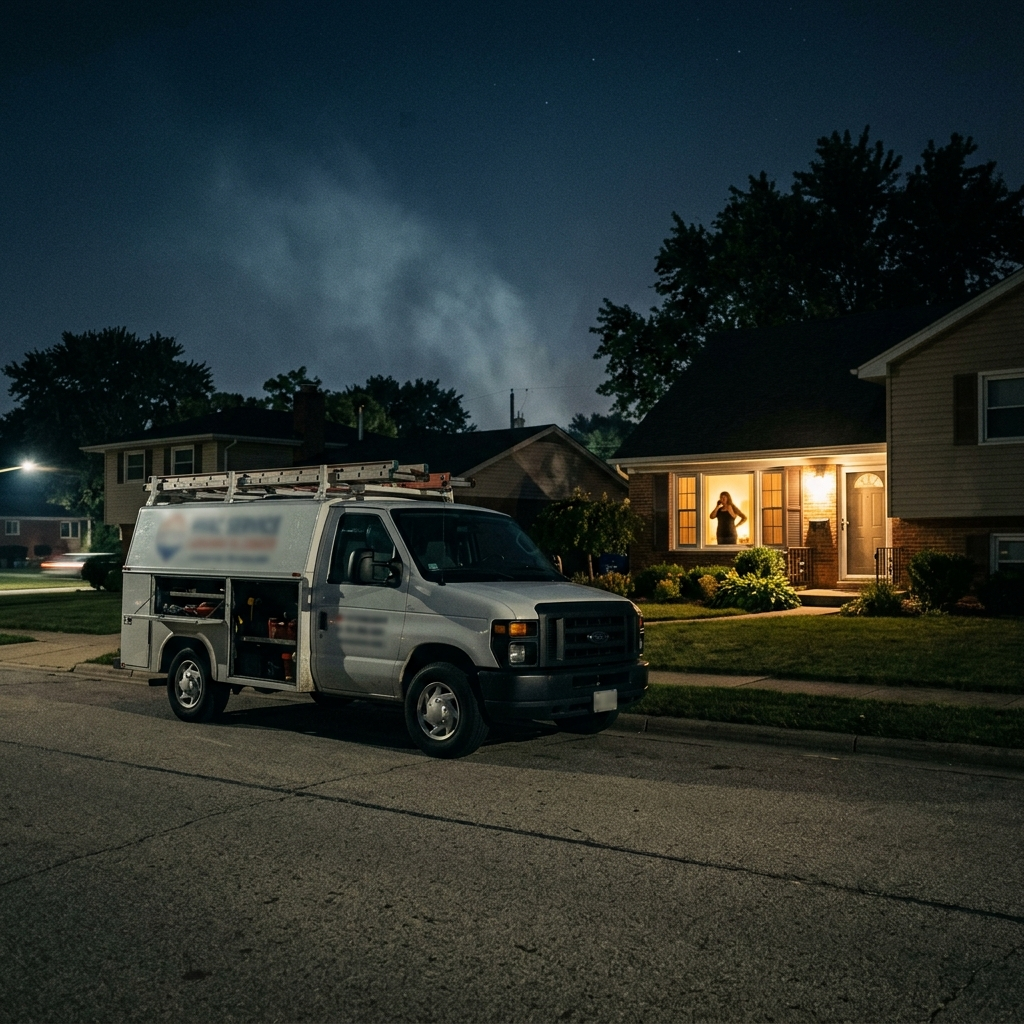

I did an audit last summer for an HVAC company in the GTA. Five trucks, solid reputation, decent marketing, and a real frustration with growth that had plateaued for two seasons.
This article links to 2 external sources beside the claims they support.
The owner was convinced the problem was his website. Maybe Google Ads. He wanted to know if he should be on Angi.
We pulled up his Google Business Profile call data together. From 5 PM to 9 AM, he was receiving an average of nine calls per week. His voicemail greeting said: "Thank you for calling [Company]. Our office hours are 8 AM to 5 PM Monday through Friday. Please leave a message and someone will get back to you first thing in the morning."
Out of those nine weekly calls, his voicemail log showed an average of four messages. Five callers, more than half, hung up without leaving a message.
We did the math together. Five unanswered calls per week, $1,600 average emergency ticket, 35% close rate. $146,000 per year. Walking out the door because nobody answered.
He didn't need a new website. He had an after-hours problem.
Why After-Hours Is Where HVAC Companies Lose the Most
The most expensive calls your HVAC business receives arrive after 5 PM.
Not because the callers are unhappy. Not because your pricing is wrong. Because the buyer calling at 9 PM with a broken AC unit is not comparison-shopping. They are not going to leave a voicemail and wait. They are going to call the next number on their Google search, and that company is going to answer.
The emergency HVAC call is your highest-value transaction type. A failed AC unit in July, a furnace down in January, a heat pump failure at the start of a cold snap, these carry average ticket values of $1,200 to $2,800 depending on the job, market, and whether parts are involved.
A five-truck HVAC operation in a mid-sized US market typically receives between 4 and 8 calls per week that arrive outside standard business hours. A significant portion are high-urgency, high-value jobs where the buyer will hire whoever answers first.
Here's what the conservative math looks like:
- 6 after-hours calls per week, 35% close rate: 2.1 jobs per week recoverable
- At $1,500 average ticket: $3,150 per week in recoverable revenue
- Annually: $163,800 per year going to voicemail
That's the floor. In summer markets like Dallas, Phoenix, or Atlanta, the numbers are meaningfully higher.
Why Missed Calls Are Invisible in Your Business Metrics
The reason most HVAC owners underestimate this figure is structural: missed calls are invisible.
There is no invoice for the job that didn't happen. There is no complaint from the customer who called your competitor instead. The revenue disappears without a trace.
Your CRM does not record the calls that went to voicemail and never converted. Your dispatching software doesn't log the jobs you didn't get. Nobody on your team is reporting the after-hours abandonment rate because nobody knows it's happening.
One proxy measure: if you have Google call tracking installed, look at your after-hours call volume from the past 60 days. The calls between 5 PM and 9 AM. Take that number. Apply your average ticket value. Apply a 30% close rate.
That number, before any lifetime value or referral multiplier, is the floor of what the after-hours gap is costing you.
The Timing Problem: Why After-Hours Is Structurally the Worst Window
The timing of emergency HVAC calls is not random. The calls that arrive after 5 PM and on weekends are structurally different from daytime calls.
The emergency call is your highest-value opportunity.A homeowner calling at 8 PM in August with a broken central air unit is not price-shopping. Their house is 90 degrees. They have a toddler, a dog, and an elderly parent visiting. They want someone who answers. Price is irrelevant. Speed is everything. The first company that answers gets the job, almost without exception.
Your technicians are on jobs during peak evening hours. Late afternoon and early evening are when HVAC teams are finishing their busiest jobs. A technician completing a multi-hour service call cannot simultaneously answer a new inbound call. The calls pile up in voicemail precisely when call volume is at its highest.
The competitive window is minutes, not hours. A buyer searching "HVAC repair near me" at 9:30 PM in summer will call three companies from the first page of Google Maps. The companies that answer get shortlisted. The companies that don't are crossed off. By the time your callback goes out the next morning, the homeowner has already confirmed a technician with a competitor.
What Happens After a Missed Call
Most HVAC owners believe they recover missed calls through callbacks the following morning. The data doesn't support this assumption.
Not because the customer is unhappy with your company. Because they found another option. The urgency was resolved by someone else.
The missed call is also invisible in your analytics. Your CRM doesn't record it. Nobody logs the calls that went to voicemail and never converted. Owners have no accurate measure of how much revenue the after-hours gap is producing because the gap generates no data.
Three HVAC Front-Door Failures, In Order of Cost
Failure 1: Unanswered After-Hours and Weekend Calls
The single largest revenue leak for most HVAC operations. Every call that arrives outside business hours and goes to voicemail is a potential $1,200 to $2,800 job handed to a competitor.
An AI voice system that answers every call 24/7 eliminates this leak at the source. The caller is captured, their details are recorded, and the job either routes to an on-call technician immediately or confirms for first-thing-next-morning scheduling. The caller never reaches voicemail. The lead never disappears.
Failure 2: The Slow Callback Chain
Even when calls are technically received, someone checks the voicemail at 8 AM, the response chain creates damaging delays. The message goes to the dispatcher. The dispatcher calls the customer. The customer is unavailable. A second callback attempt. The job has already gone to a competitor who answered the night before.
Every handoff in a callback chain adds five to fifteen minutes. Four handoffs equals a 20-to-60-minute response time. For an emergency call, that's a death sentence for the conversion.
Failure 3: The Dormant Past-Client Database
Less obvious but equally real. Most HVAC companies have years of past clients who have never been systematically contacted for seasonal maintenance, tune-up campaigns, or equipment age reminders.
A furnace installed 12 years ago needs service or replacement. The homeowner knows this vaguely but hasn't acted. A targeted campaign from the company that installed it, arriving in September before the heating season, converts at remarkably high rates. Almost nobody is doing this systematically.
For lists of 500 or more contacts, a seasonal HVAC reactivation campaign typically generates 8 to 15 percent response rates. At $250 average maintenance call value, 500 contacts at 10% response is $12,500 from one campaign. Run twice per year and the number compounds.
The Summer Peak Amplifier
Everything about the after-hours gap gets worse in summer.
Summer is when HVAC teams are fully deployed. Technicians are running 10-to-12-hour days. Dispatchers are managing dense scheduling. Owners are coordinating parts, callbacks, and customer escalations simultaneously.
That's also when call volume doubles or triples. Emergency AC calls spike exactly when the team has the least bandwidth to handle inbound volume. The mismatch is structural: peak demand meets minimum intake capacity.
The businesses that dominate their local HVAC markets in summer are not necessarily the ones with the best technicians. They're the ones that capture every call. Every call that arrives at 10 PM and gets a live answer, instead of a voicemail, is a job won without additional marketing spend.
There is also a review windfall from fast after-hours response that most HVAC companies miss. A homeowner whose AC gets fixed quickly at 10 PM on a hot night is exceptionally grateful. They will leave a 5-star review. They will tell their neighbors. They will remember that company when their neighbor's system fails the following summer.
That review, generated by fast after-hours response, compounds into local search visibility. Review velocity is one of the top ranking signals in Google Maps for local service businesses. The company that answers after hours wins the job, wins the review, and wins the future searches.
What the Fixed System Looks Like
The solution is not hiring a night-shift dispatcher. The economics don't work, $45,000 to $60,000 annually for 40 hours of coverage per week still leaves evenings, weekends, and holidays uncovered.
An AI voice system built specifically for HVAC intake works differently.
The system answers every call within three rings, any time of day or night. It's trained on the specific services offered, the service area covered, and the urgency tiers used for dispatch. When a caller describes a broken AC unit on a summer night, the system captures their address, confirms their contact information, identifies urgency, and sends an immediate text alert to the on-call technician with all relevant details.
The technician gets a text: "New emergency: AC failure, [address], [customer name], [phone number]. Customer confirmed home until 11 PM."
That's the entire chain, compressed. The handoff that used to take 45 minutes happens in under three minutes.
For non-emergency calls, a scheduling request, a maintenance agreement question, a quote inquiry, the system confirms receipt with an SMS to the caller ("We received your message and will call you first thing tomorrow at 8 AM") and queues the job for the morning team. The caller doesn't feel ignored. The job doesn't fall through.
The HVAC company I mentioned at the start of this piece, the five-truck operation in the GTA, recovered $11,340 in month one from after-hours calls alone. The after-hours call volume was not new. The calls had always been coming in. The system just started answering them.
How to Know If This Applies to Your Business
Three questions worth answering honestly.
First: do you currently have live coverage for every call that arrives between 5 PM and 8 AM, including weekends and holidays? Not voicemail coverage. Live coverage that captures, qualifies, and routes.
Second: when did you last look at your after-hours call volume? If you have call tracking, the number is available. If you're running on a landline with no tracking, the number is invisible and likely larger than you assume.
Third: how many past clients in your system have not had contact from your business in the last 90 days? That number, multiplied by your average maintenance call value and a conservative 10% response rate, is the floor of what a single seasonal campaign is worth.
Before the Next Sales Call
Use this section as a quick buyer check. An HVAC company owner does not need another vague automation pitch. They need to know which part of the front door is leaking, what the system will change, and how they will measure whether the fix is working.
Source method: compare the article against your own call log, CRM notes, booking calendar, missed-call records, web form timestamps, and Google Business Profile review recency. Those records are more useful than a generic benchmark because they show what buyers actually experienced in your business.
What proof should I look for in my own business?
Look for proof in the places where demand either moved forward or stalled: missed calls, short calls, unbooked forms, slow callbacks, no-show recovery, old leads, and reviews that were never requested. If the business cannot see those moments clearly, the first improvement is better tracking and routing.
How do I know whether this is a marketing problem or an operations problem?
If people are already calling, filling forms, asking for prices, requesting appointments, or comparing reviews, the problem is usually operations. More marketing will not fix a front door that lets warm demand wait. The better move is to capture and route the demand already arriving.
What should happen after the first response?
The first response should create a next step: booked appointment, estimate path, intake handoff, callback window, review request, or reactivation sequence. A response that only says someone will get back to you is not enough when the buyer is comparing several providers at once.
Where does The Quiet Protocol fit?
The Quiet Protocol fits when the business already has demand but too much of it depends on manual attention. We connect AI receptionist coverage, web intake, missed-call recovery, booking logic, follow-up, review requests, and reactivation into one managed front-door system.
The loss estimate is basic business math, not a magic claim.
Revenue-leak examples on this site are built from visible operating inputs: inquiry volume, missed-call or slow-response rate, booking rate, average job or client value, repeat value, and follow-up recovery. The fastest way to make the number real is to run the diagnostic for your closest business type, then compare it against your own call log, CRM, booking calendar, form timestamps, and review activity.
The practical questions behind this decision.
How much does the average HVAC company lose to after-hours missed calls?
For a five-truck operation in a mid-sized US market, the conservative estimate is $75,000 to $165,000 per year in direct revenue from missed after-hours and weekend calls. In high-heat markets like Dallas or Phoenix, the figure can exceed $250,000 annually. These numbers are consistently validated when we pull actual call tracking data with clients.
Does an AI voice agent work for emergency HVAC dispatch?
It's particularly well-suited for it. The system captures urgency, address, contact details, and job type, then routes an immediate text to the on-call technician. Dispatch time drops from 30 to 45 minutes to under 3 minutes in most installations.
What should I do with calls that come in at 2 AM?
Genuine emergencies , commercial clients, property managers, or residential customers with real safety concerns , should route to an on-call tech immediately. The AI system is configured with urgency thresholds that determine what gets escalated immediately versus held for morning scheduling. Most 2 AM calls that aren't emergencies can be held; the caller receives confirmation that they'll be called first thing in the morning, which satisfies them.
How does fixing after-hours coverage affect my Google rankings?
Directly. More answered calls mean more completed jobs. More completed jobs mean more review opportunities. Systematic review collection after every job drives review velocity, which is one of the top signals for local map pack rankings. HVAC companies that implement the full system typically see meaningful map pack improvement within 60 to 90 days.
Is this worth it if I'm already pretty busy?
Being busy is not the same as being profitable. A full calendar at current capacity doesn't mean you're capturing all available demand. It often means you're capturing the wrong mix of jobs , and leaving the highest-value emergency calls for competitors who answer at 10 PM.
How long does it take to set up?
A properly managed AI intake installation is typically live within 48 to 72 hours for a single-location HVAC business. Multi-location or complex routing setups take longer to configure correctly.
What proof should I look for in my own business?
Look for proof in the places where demand either moved forward or stalled: missed calls, short calls, unbooked forms, slow callbacks, no-show recovery, old leads, and reviews that were never requested. If the business cannot see those moments clearly, the first improvement is better tracking and routing.
How do I know whether this is a marketing problem or an operations problem?
If people are already calling, filling forms, asking for prices, requesting appointments, or comparing reviews, the problem is usually operations. More marketing will not fix a front door that lets warm demand wait. The better move is to capture and route the demand already arriving.
What should happen after the first response?
The first response should create a next step: booked appointment, estimate path, intake handoff, callback window, review request, or reactivation sequence. A response that only says someone will get back to you is not enough when the buyer is comparing several providers at once.
Where does The Quiet Protocol fit?
The Quiet Protocol fits when the business already has demand but too much of it depends on manual attention. We connect AI receptionist coverage, web intake, missed-call recovery, booking logic, follow-up, review requests, and reactivation into one managed front-door system.
Map how a serious buyer decides in this kind of business.
Use the operating reality of the industry instead of copying a generic lead-generation playbook.
Replace broad industry assumptions with the business's actual inquiry volume, customer value, response time, and booking data.
See how the capability in this article fits into a complete customer journey.
HVAC Emergency ServiceSee the same decision through the language, buyer behavior, and operating reality of this industry.
Client Results & ProofInspect the starting condition, installation, measurement window, and outcome behind real client work.
Why Med Spas Lose 40% of Their Bookings Before the Phone Even Rings
Most med spa revenue leaks before intake, not in the treatment room. Here is exactly where it goes, how much it costs annually, and what the fix looks like without adding staff.

The Speed to Lead Equation: Why the First Five Minutes Decide the Job
In emergency services, the first company to answer wins. Not the best company. Not the cheapest. The fastest. Here is the math that proves it.

Spring Home Services: Why March, April, and May Decide the Year
Spring home service demand moves fast. Here is why March, April, and May expose intake gaps, missed calls, and follow-up problems before summer even starts.