HVAC marketing & answering serviceAnswer every no-heat call. Even the one at 2 a.m.
HVAC marketing only pays when someone answers the phone, so we start there: an AI answering service that picks up every no-heat and no-cool call, day or night, books the work and alerts your on-call tech when your rules say so.
AI receptionist from $1,495 setup + $497/monthFull HVAC system from $995/monthCalls, texts and AI minutes are billed at actual use. Prices in USD.
Based in TorontoServing the United States and Canada
- 6:52 AMNo heat, two kids at home Missed · techs in the morning meeting Booked 8 to 10 AM · first truck out
- 10:14 AMFurnace clicks but won't light Missed · office on another line Booked 1 to 3 PM · notes sent to dispatch
- 1:37 PMPrice on a new heat pump Missed · you were on an estimate In-home estimate booked Thursday
- 5:48 PMTune-up on my maintenance plan Missed · office closed at 5 Booked next Tuesday · reminder set
- 11:26 PMSmells like gas by the furnace Missed · no voicemail left Safety line read · on-call tech alerted
- 2:03 AMNo heat, 58° inside Missed · voicemail, 0:14 Fee explained · on-call tech alerted
6 calls · 6 missed · 1 voicemail
6 calls · 6 answered · 4 booked · 2 sent to on-call
Answered by speech-to-speech voice AI fromGPT Realtimeby OpenAIGeminiby Google
 GPT Realtime
Your phone rings most when nobody can pick it up.
HVAC calls come in bunches: the first hot afternoon, the first cold night, the Monday after a long weekend. That is exactly when your techs are on roofs and in attics and the office is already on a call. Here is where the jobs slip away.
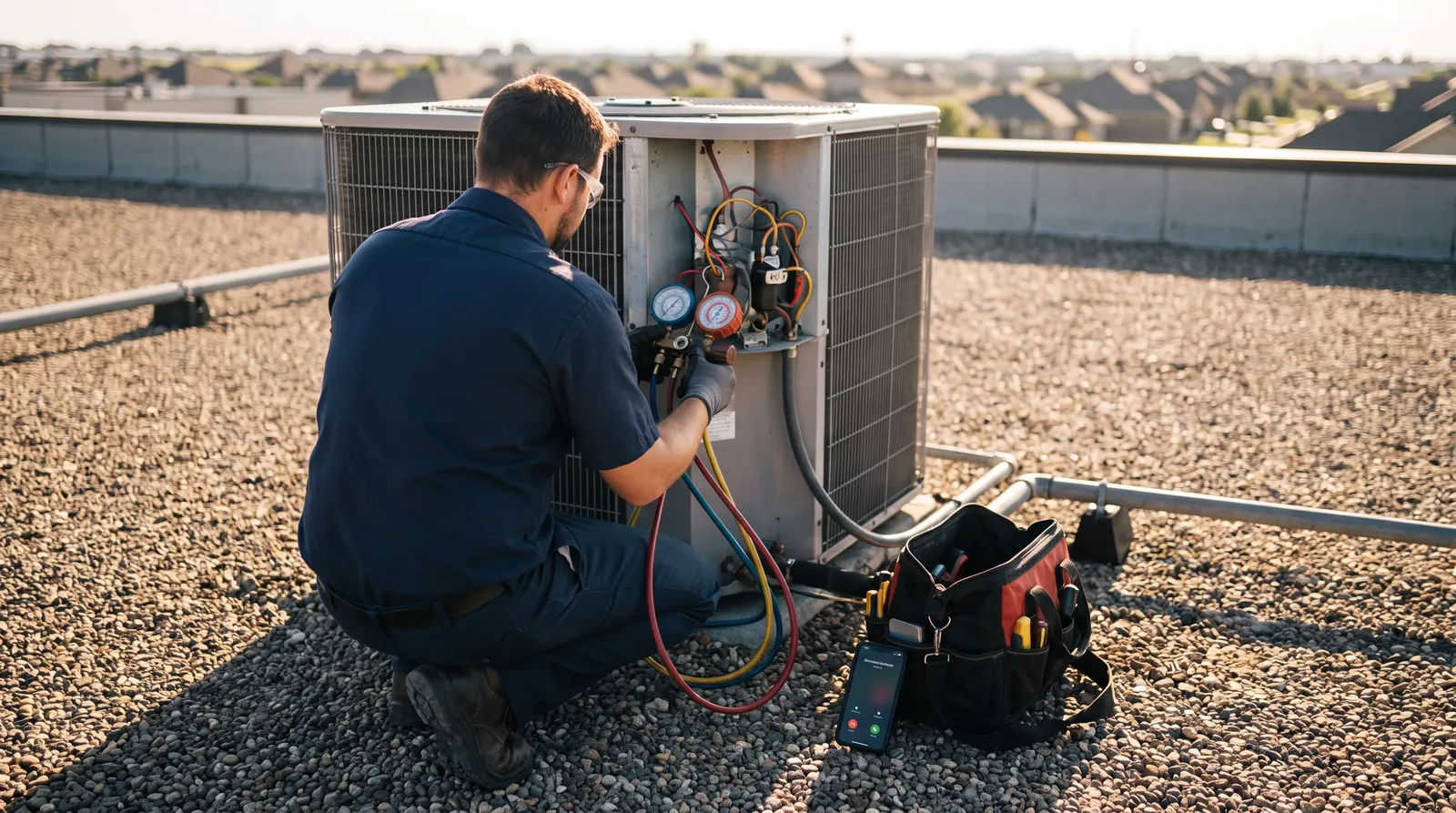
The tech is on a roof.
The phone forwards to someone with gauges on and gloves on. They let it ring, and mean to call back from the truck.
What answers itThe receptionist picks up right away, takes the address and the problem, and books the slot your rules allow.
The office is on another line.
One person, three lines, the first hot afternoon of the year. A homeowner with no cooling does not wait for a callback. They call the next company on the list.
What answers itSeveral calls are answered at the same time, so the fourth caller gets the same greeting as the first.
It's after hours.
Evenings and weekends go to voicemail or an answering service that writes down a name and a number. The job waits until morning, or goes to whoever picked up.
What answers itNight calls are answered, sorted by your rules, and the real emergencies reach your on-call tech with the full story.
The on-call tech gets everything.
A filter question at 11 PM wakes the same person as a no-heat call with a baby in the house. That is how on-call rotations burn good techs out.
What answers itOnly the calls you choose wake anyone up. The rest are booked or left for the office in the morning.
The big ticket leaves a voicemail.
A replacement inquiry is the most valuable call of the week and the easiest to lose, because it never sounds urgent to anyone but the homeowner.
What answers itPrice and brand questions get answers from your approved list, the in-home estimate lands on your comfort advisor's calendar, and a follow-up runs after.
An answering service takes a message. This books the job.
Answering services are how most trades have covered the phone for years. A call center picks up, writes down a name and a problem, and passes it on. It beats voicemail. But the operator answers for dozens of companies, so what you get is a lead: a name, a number and a callback to make.
Our AI receptionist is your own dedicated receptionist, on every call, 24/7, priced like an answering service rather than a hire. It runs on native speech-to-speech voice models, GPT Realtime from OpenAI and Gemini from Google, and it asks the questions that matter before anyone rolls a truck. You get the lead with its context.
| Voicemail | Traditional answering service | Our AI receptionist | |
|---|---|---|---|
| Who it works for | You, eventually. | Dozens of companies from one call center. | Only your company, 24/7, on your rules. |
| What the caller gets | A beep. Many hang up and call the next company. | A friendly person who takes a message. | A booked time, or the on-call tech on the way, by your rules. |
| Who's talking | Your recorded greeting. | A trained operator reading your script. | Native speech-to-speech voice AI (GPT Realtime from OpenAI and Gemini from Google), answering in real time. |
| Nights and weekends | Waits until morning. | Covered, usually on an after-hours plan. | Covered, the same way as daytime. |
| “How much for a 1-ton AC, and what brands do you carry?” | No answer. | “Someone will call you back.” | Answers from the price ranges and brand list you approve, then books the estimate. |
| The first hot day | Fills up. | Depends on how many operators are free. | Answers several calls at the same time. |
| Gas smell or CO alarm | Nobody hears it until morning. | Handled by the operator's script. | Your safety line read word for word, then on-call alerted. |
| What your tech knows before rolling | A voicemail, if they left one. | A name, a number and one line about the problem. | The system, the symptoms, access and what to bring, from the questions you choose. |
| How it's priced | Free, until you count the jobs. | Usually per minute or per call, with overage charges in busy months. | From $1,495 setup + $497/month, calls and minutes at actual use. |
New message, 11:48 PM. Dana Price, (555) 014-2291. Furnace not working. Please call back.
- Call
- No heat, after hours. Sent to on-call.
- Caller
- Dana Price, (555) 014-2291, 14 Birch Lane. Use the side door.
- System
- Gas furnace, about 15 years old, in the basement.
- Symptom
- Clicks but won't light. Started tonight.
- Safety
- No gas smell, no CO alarm. Two kids at home.
- Bring
- Filter 16x25x1. She read it off the old one.
- Fee
- After-hours fee explained and accepted.
Same call, same homeowner. The questions are yours: we set them per call type, so your tech knows what to bring before the truck leaves the shop.
Happy with a person on every call? A good answering service is a fair choice, and some owners keep one for the calls they want a human to take. We can set the AI up for nights and overflow only. Read the full comparison.
HVAC marketing, end to end
From “furnace repair near me”
to the next tune-up.
The phone is where HVAC jobs are won or lost, so it sits at the center. Around it, we cover every step a homeowner takes with your company, from the search to the maintenance plan renewal.
- Get foundMaps and listings for AC repair, furnace repair and heat pumps.
- Get noticedShort videos of real installs and repairs that show your work.
- Get chosenA page for each job, with reviews that name the work.
- Get answeredEvery call answered, day and night, even on the busiest day.
- Get bookedService calls booked, emergencies sent to on-call, quotes to your advisor.
- Come backTune-up reminders, quote follow-up and review requests.
Signature System
The Signature System for HVAC companies
Your phone answered day and night, service calls booked, emergencies sent to your on-call tech, replacement quotes followed up, tune-up reminders and review requests sent, built as one system for your company and looked after by our team every month. Fully managed by our team, AI included. From $995/month.
Or start with one piece
- AI receptionistFrom $1,495 setup + $497/monthFor companies losing calls to voicemail on busy days, nights and weekends. Where most HVAC companies start.See the AI receptionist
- Get Found local SEO$99/month, or $82.50/month billed yearlyFor companies that don't show up in the map for AC and furnace searches.See Get Found
- Review growthFrom $995 setup + $297/monthFor companies whose reviews trail the shops ranked above them.See review growth
- Smart WebsiteFrom $2,395 setup + $197/monthFor companies that want a custom site with a page for each job, connected to booking.See Smart Websites
- Essential Website$99/month, no setup feeFor companies that just need a professional site with services, service area and reviews.See the Essential Website
Prices in USD. Setup and monthly fees are listed separately; calls, texts and AI usage are billed at actual use. Each piece joins the same connected system, so you can add the next one without starting over.
Count your missed calls. It takes half an hour.
Most owners guess. The call log knows. Run this worksheet once, with your own phone records, and you will know whether you have a busy-day problem, a nights problem, or both.
If the blanks worry you, that is the job to fix first. The AI receptionist answers the calls in those blanks. Or book a call and we will run the count with you.
Keep the sheet. After launch we compare the same numbers from your own call log, so you see the change in your records, not in our brochure. Prefer a calculator? The free Revenue Leak Diagnostic takes the same inputs.
Missed-call count 30 days
Pull last month's call log.
Your phone system or carrier can export it. You want every inbound call with its time and whether anyone answered.
Calls in last monthCount the calls nobody answered.
Split them in two: during office hours, and after hours or weekends. The split tells you whether you have a busy problem or a nights problem.
Missed during office hoursMissed after hoursCount the voicemails.
Compare with the missed calls. Every missed call without a voicemail is a homeowner who hung up at the beep.
Voicemails leftCall back ten missed numbers.
Pick ten from last week. Ask if they still need help. Note how many already had someone else out.
Booked with someone else, out of 10Work out your booking rate.
Booked jobs divided by calls in. Your field-service software may already show it. Every missed call drags it down, however good your team is on the phone.
Booked jobs last monthBooking rate (%)Put your own numbers on it.
Your average service call, and how often a service call turns into a replacement. Multiply by the calls you lost, counting the first job only; maintenance plans, future replacements and referrals come on top. That is your number, not ours.
Average service call ($)Service calls that become replacements (%)
What a no-heat call sounds like when it gets answered.
A good call is short. It checks safety, confirms the address, gets what the homeowner knows, says your fee, and gets help on the way. Everything in the margin is a decision you make once.
- Receptionist
Thanks for calling [Your Company]. Is this about heating, cooling, or something else?
Your greeting, your company name.
- Caller
Our furnace stopped. It's getting cold in here.
- Receptionist
I'm sorry, let's get someone out to you. First, do you smell gas, or is a carbon monoxide alarm going off?
Safety check first, in the words you approve.
- Caller
No, nothing like that.
- Receptionist
Good. What's the address?
Service area check. Outside your area, it says so kindly and does not book.
- Caller
14 Birch Lane.
- Receptionist
Thanks. Do you know if it's a furnace or a heat pump? It's fine if you don't.
Equipment if they know it. Never a diagnosis.
- Caller
A furnace, I think. It's about fifteen years old.
- Receptionist
After-hours visits have a service fee of [your fee]. The technician explains any repair cost before starting. Would you like someone tonight?
Your fee, said the way you want it said.
- Caller
Yes, please.
- Receptionist
Done. Our on-call technician has your address and what you told me, and will call you shortly.
Your on-call tech gets the address, the system and the caller's own words.
The AI receptionist runs this call with your wording, on every call, day or night. From $1,495 setup + $497/month, calls and minutes at actual use.
Play a homeowner with no heat: +1 855-916-4334Decide who gets woken up. Write it down once.
Most on-call trouble comes from one rule nobody wrote: every call reaches the tech. Sort your calls into three piles. These are starting points; you decide every line and can change them any day.
Wake the on-call tech
- No heat when it's freezing outside
- Gas smell or a CO alarm, after the safety line is read
- Water pouring from an indoor unit
- A commercial account with an emergency service promise
First slot in the morning
- No cooling on a mild night
- System running but making a new noise
- Heat works in some rooms, not others
- Thermostat blank or not responding
Office follows up
- Tune-up and maintenance plan bookings
- Replacement quotes and financing questions
- Billing and warranty questions
- Filter, humidifier and thermostat questions
We load these rules into the receptionist, so a filter question at 11 PM gets booked for the morning and your on-call tech sleeps.
Your phone's year.
HVAC demand follows the weather, and so does your phone. The months shift with your climate (Phoenix and Winnipeg run different calendars), but the shape holds: two peaks, two quiet stretches. The quiet stretches are when you fill next season.
Heating calls peakCooling calls peakShoulder season
Before the first hot week
Send AC tune-up reminders to plan members and last year's customers. Switch on the busy-day greeting so callers hear an honest wait time.
Heat waves
Answer every line, book no-cooling calls by your rules, and keep plan members first if that is your promise to them.
Before the first cold night
Furnace tune-up reminders go out. Follow up on the replacement quotes that went quiet over the summer.
Cold snaps
After-hours rules do the heavy lifting: no-heat calls answered, sorted, and the urgent ones sent to on-call.
The replacement call is worth the most. Treat it that way.
A new system is the biggest ticket you sell, and the caller is rarely in a hurry. So the call has one job: book an in-home estimate with your comfort advisor. It asks about the home, the age of the system and what they want (quieter, cheaper to run, a heat pump question). When they ask “roughly what does a new AC cost?” or “which brands do you install?”, it answers from the ranges and brands you approve, then offers your advisor's open times.
After the visit, most quotes die of silence. Three short texts, approved by you and signed by your advisor, keep the door open. They stop the moment the homeowner replies or books.
Quote follow-up is part of the Signature System for HVAC companies, from $995/month.
After the estimate
- Day 1
Hi Dana, thanks for having Mike out today. Your three options are in your email. Any questions, just reply here.
- Day 4
Checking you got the quote. Happy to walk through the options by phone, or answer anything by text.
- Day 10
Last note from us on this. If you'd like the install before the cold weather, reply and we'll hold a date.
Then make the phone ring more.
HVAC marketing agencies sell calls: Local Services Ads with the Google Guaranteed badge, Google Ads, SEO for the map. All of it only pays if the calls get answered. Google's own Local Services Ads help pages list responsiveness as a ranking factor, and say missed calls can count against you.
We don't run your ads. We make sure the calls you pay for get answered and booked, and we keep your Google profile ready for the free calls from the map, where someone searches “furnace repair near me” and calls one of the first few names. Run this checklist on your profile this week.
Get Found keeps your profile and listings right every month, $99 a month. Run the free Google check to see where you stand.
And the website?
It matters less than the phone, but it still has to look like a real company. “AC repair” and “furnace replacement” are different searches, so each deserves its own page with your number at the top. The Essential Website is $99 a month with no setup fee. A Smart Website connected to booking is from $2,395 setup + $197/month.
- Primary category matches the work you want most (for many shops, HVAC contractor)
- Services listed one by one: AC repair, furnace repair, heat pumps, maintenance plans
- Service area set to the towns your trucks actually drive to
- Hours that say plainly whether you take emergency calls
- Photos of your trucks, your team and real installs
- A reply on every review, good or bad
How we set it up.
A call about your calls
Thirty minutes on how your phone works today: who answers, when it goes to voicemail, who is on call.
Your rules, written down
Greeting, service area, fees, safety wording, who gets woken up. We draft it; you approve every line.
Set up and tested
We build it and call it ourselves: a no-heat call, a tune-up booking, a replacement question, a gas smell. Then you call it too, and check exactly what your tech receives, before a customer ever does.
Live where it hurts most
Most shops start with nights and weekends, or overflow on busy days. You can widen it later.
Looked after every month
We listen for problems, fix what breaks and change the rules when your season or your team changes.
Questions HVAC owners ask us.
Straight answers. If yours is not here, ask us on a call.
How much does HVAC marketing cost with you?
It depends on where you start. Most HVAC companies start with the phone: the AI receptionist is from $1,495 to set up and $497 a month, with calls, texts and AI minutes billed at actual use. The Signature System for HVAC companies, where we run the phone, booking, follow-up and reviews for you, starts at $995 a month with setup from $5,000. If you only need a professional website, that is $99 a month with no setup fee. Get Found, our Google Maps service, is $99 a month, or $82.50 a month billed yearly. Prices are in US dollars.
What does the starting price for the AI receptionist cover?
One main call job with one booking or on-call path, for example your nights and weekends. We map it, set it up, test it and keep it running. More call jobs, like daytime overflow and replacement routing, are scoped in writing before you pay for them.
Can it answer only after hours, or only when we're busy?
Yes. You choose when it answers: nights and weekends, overflow when your lines are full, or every call. Your phone provider and routing are checked during setup, and we test busy, unanswered and after-hours calls before launch.
What happens when someone says they smell gas?
It stops booking and reads your approved safety line, for example: leave the house and call 911 from outside. Then it alerts your on-call tech. It never tries to judge how dangerous the situation is.
Will homeowners know they're talking to AI?
The greeting and disclosure are set to make it clear. It speaks naturally, and callers can ask for a person at any time; you decide who that reaches and what happens if they can't pick up. Call our live AI line and judge the voice for yourself.
Can it answer price questions, or diagnose problems?
It answers price and brand questions from the ranges and brand list you approve, like what a new system usually starts at, and it says your service call and after-hours fees. It never diagnoses. Exact quotes come from your team after a visit.
Can it book straight into our field-service software?
Sometimes. We look at your actual software and access before promising a direct connection. Where there isn't one, bookings and call notes still reach your team in the way we agree during setup.
Do we need a new website first?
No. The phone comes first, and it works with the website you have. If your site is out of date, the Essential Website is $99 a month and a custom Smart Website is from $2,395 setup + $197/month.
Is there a contract?
The AI receptionist starts with a 3-month commitment so it can be set up and tuned properly. Signature Systems start with 6 months, agreed in writing before any work starts. The Essential Website and Get Found run month to month.
Is this an answering service?
It does what an HVAC answering service does, answering your calls day and night and passing emergencies to your on-call tech, and then it goes further. It works only for your company, asks the questions you choose, answers approved price and brand questions, and books the job. An answering service gives you a lead. This gives you the lead with its context.
What AI is behind it, and can it speak Spanish or French?
It runs on native speech-to-speech voice models: GPT Realtime from OpenAI and Gemini from Google. The model hears the caller's voice and answers in its own voice, in real time, instead of turning speech into text and reading a reply back. It can be set up for more than one language; we test real calls in each language you need before launch, including callers who switch partway through.
Can it handle property managers and commercial accounts?
Yes, as their own path. It asks for the property, the unit, who gives the tech access and any work-order or PO number your team needs, then routes the call the way you promised that account. We are based in Toronto and set this up for HVAC companies across the United States and Canada.
Let's answer the next cold night.
Book a call and tell us how your phone works today. We will show you where calls are getting lost, what we would switch on first, and exactly what it costs. You will talk to the people who build it, led by our founder, Vikram Roy.