
Speed to lead is the time a new inquiry waits for a useful first reply, and an instant autoresponder does not count. "Thanks, we'll be in touch" acknowledges receipt. It does not tell the buyer what happens next. Respond as soon as you can give a next step, with a faster route for urgent requests and a stated window for routine ones.
Two requests arrive just before closing. One caller says water is entering a basement now. Another submits a form about repainting an office next quarter. Both deserve a real response. They do not need the same person, promise, or clock. The first needs a route to a qualified responder and clear safety boundaries. The second needs an owner and a time for a scoping conversation.
That connection is what The Quiet Protocol builds into client intake systems. We map the call or form to an approved response, qualification, booking or review step, and the person who continues the conversation. We configure and test the agreed path, including unavailable owners and failed actions. If the gap is defined phone coverage, our AI Receptionist starts at US$449 per month with free setup (normally US$1,495), with no contract, the AI Business OS and call minutes included. A broader intake workflow is scoped around the transitions your team needs. Buy a useful response and receiving process, not a faster acknowledgment alone.
Define the first useful response
When I test response speed, I do not stop the clock at “message sent.” I ask what the buyer can do after receiving it. A useful response might be an answered call with a booked appointment, a human callback that clarifies the job, a text that asks for the one missing fact needed to route it, or an accurate statement of the next staffed window. For a request your team cannot handle, a prompt, honest decline is also useful.
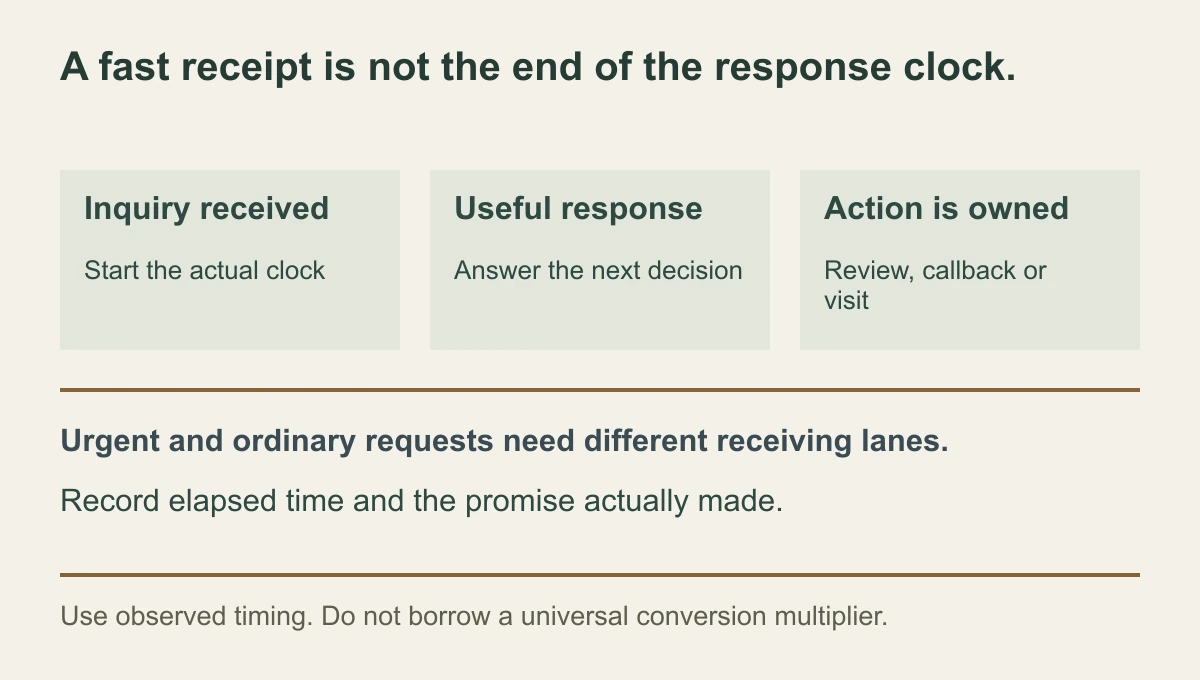
I would measure your own delays before adopting a headline response target. The record should show what the customer needed, which hours were staffed and when a useful next action became available. This guide proposes an operating standard; it does not assign a conversion multiplier to a five-minute reply.
I separate three moments in the record. Receipt means the channel took the message. Useful response means the buyer learned a credible next step. Human decision means someone with the right authority accepted, declined, scoped or escalated the request. They can happen in one call, or hours apart. If a report labels the receipt as the response, the team may celebrate speed while the buyer is still waiting for a decision.
An automatic answer can sometimes be useful. If it offers a real appointment for an eligible service and the appointment reaches the right team, the buyer can move. If it asks for one missing service address and someone checks the reply, it moves the work too. If it says only “we value your inquiry,” it is a receipt. The words matter less than whether the buyer and the business can both see the next action.
Urgent service
Route immediately to the qualified on-call person or approved emergency path. Say when the customer should expect a human response. Do not imply dispatch is confirmed before it is.
Ready-to-book work
Capture the service, location, contact and preferred time. Offer an available appointment or a named callback window that staff can honor.
Complex estimate
Confirm who will review the request, what information is needed, and when the buyer can expect a scoping conversation.
These are operating categories, not numerical benchmarks. Write your actual hours and capacity into each lane before publishing any promise.
Set a promise the roster can support
I would begin with the business's real coverage map. Who answers while the office is open? Who takes over during a job, lunch, shift change or weekend? Is there an actual on-call person for urgent work, and what kinds of calls are they allowed to accept? A response target without those names is an aspiration, not an operating standard.
For each request type, decide what the first response can honestly do. An urgent service call may need a fast human assessment before the business can say whether it will dispatch. A routine estimate request may need a confirmation that a coordinator will review it in the next staffed window. A planned project may need a scoping appointment after the team checks service fit. The customer should hear the difference. “We have your request” must not sound like “a crew is on its way.”
Then write the public promise in the language the staff can repeat. If after-hours messages are reviewed when the office opens, say when that happens. If a live route exists for certain urgent work, say what kinds of requests it covers and what remains subject to a person's decision. If a calendar is open for standard work but not complex jobs, make that distinction before showing times. A shorter, narrower promise the team keeps is more valuable than a universal instant-response badge.
I would test the promise on a day when the primary owner is unavailable. Can the backup see the inquiry, the time it arrived and the response already sent? Does the buyer get a clear answer if the team cannot meet the stated window? A standard that works only while one employee watches their phone is not yet a business process.
The first message for each lane can be written in three parts: what arrived, what happens next, and when the customer should expect that next step. An urgent route might acknowledge the issue and say that the on-call person is reviewing it; it should not announce dispatch until that person accepts the job. A planned-project route can say when a coordinator will review the request and what the buyer can prepare for a scoping call. Each sentence should describe a real step on the staff roster.
If the business cannot keep a published window, give the owner a way to update the customer before it passes. A person can tolerate a delay more easily when they know the request is still owned. Letting a response promise expire silently turns a useful first message into a broken commitment. The measure should reveal those misses so the team can set a better standard.
Assign an owner before choosing a channel
Many response delays begin after a notification reaches the business. The form goes to a shared inbox; the phone logs a missed call; a paid lead appears in a dashboard. Everyone can see it, so no one owns it. Write the handoff rule: who receives the inquiry, who is backup, when the record is escalated, and how the buyer is told what happens next.
If you are on a job or in a meeting, the fallback matters more than a faster notification. A text message or AI intake system may collect context and send a truthful interim answer, but it should not promise a slot or dispatch that no person has accepted. Our after-hours call test shows how to hear this route as a new customer would.
- Received
- Time, channel, caller's stated need
- Owned
- Named person or team, plus backup
- Answered
- What the buyer was told and when
- Advanced
- Booked, qualified, declined, or waiting for a specific fact
Can this response window survive a busy day?
- Request type
- Name the service need and urgency rule. Do not pool an urgent call with a planned-project form.
- Useful first action
- Define what the customer can do next and which facts the business must know before offering it.
- Owner and coverage
- State who acts during this window, who covers absence and what happens after closing.
- Missed promise
- Give the owner a due task and a truthful customer update when the next action will be delayed.
Measure the gap you can actually fix
Take a recent set of inquiries from calls, forms, chat and paid campaigns. Exclude internal tests and duplicates. For each one, record the arrival time, first useful response, owner, requested service, and next outcome. Look at urgent and routine requests separately. A median can hide a handful of long waits; inspect the outliers and the times when no one was assigned.
The questions to ask are concrete. Are calls missed during an active job? Do forms wait overnight because they reach the wrong inbox? Do you respond quickly while your estimator takes days to schedule? Is a reply sent without a next step? Each problem needs a different fix. Buying another lead source will not repair an unowned handoff.
I would read the slow records before drawing a chart. Was the delay from arrival to first acknowledgment, from acknowledgment to useful answer, or from that answer to the promised appointment? Those are different clocks. A service business can improve the first one with an automatic receipt while leaving the important one untouched. Record the handoff point where the request stopped moving.
Keep the groups honest. A call during staffed hours, a call after closing, an existing customer's support request and a new buyer's estimate request should not all be pooled into one average. The business has different people and promises for each. Compare the same kind of request over time, and note when hours, staffing or service capacity changed. Otherwise a busy season can make the number move without telling you what broke.
Do not count a duplicate call from an impatient customer as a second lead. Connect it to the first request and ask why the person felt they had to call again. That second contact may be the clearest signal that the first response did not give them confidence. A dashboard that celebrates two answered calls can miss one unresolved customer.
After the review, choose a repair tied to the delay. If the right person never saw the request, change where it lands. If they saw it but nobody owned it, assign the next action. If the buyer heard an unrealistic promise, change the words and the coverage rule. If the buyer booked but the team was unprepared, fix the brief before chasing a faster first text. Then inspect the next group of records to see whether that particular break improved.
Channel changes the customer's expectation. A caller may be ready to talk now and may not hear an email receipt sent afterward. A form visitor can read a clear confirmation screen and return to work. A paid lead may be contacting several providers at once, while an existing customer may be asking about work already in progress. Do not use one message or one clock for all four. Give each route the next step that makes sense where the person started, then check whether the team received enough context to continue.
This first response is distinct from the follow-up work after an estimate or consultation. The estimate follow-up guide addresses that later stage. Keep the clocks separate so a fast first text does not conceal a slow proposal or forgotten booking.
Do not buy speed by losing trust
A rushed message that gives a false arrival time, guesses at price, or overlooks an urgent exception is worse than an honest response with a responsible owner. If you use email or text for marketing follow-up beyond the immediate inquiry, review the applicable rules before automating a sequence. The FTC explains U.S. commercial-email requirements, and the CRTC explains Canadian consent and unsubscribe requirements. The legal treatment depends on the message and jurisdiction; do not assume a contact form authorizes every future promotion.
What is a good speed-to-lead target?
One your team can state honestly, meet consistently, and shorten where customer urgency requires it. Start by measuring actual waits by request type. Then publish a service standard with an owner and fallback. A headline claiming one perfect number for every channel can make performance look simple while leaving the real handoff unsolved.
Does an automatic reply count as a response?
It counts as an acknowledgment. It becomes useful if it gives accurate context, asks for a needed detail, offers a real booking option, or tells the customer when a qualified person will act. Measure that next action separately from the message's send time.
Should an AI receptionist answer every inquiry?
Only within a defined job. It can gather facts, answer approved questions, offer approved times, and hand off exceptions with context. A person still owns urgent judgment, unusual scope, promises outside the rules, and failed handoffs. Our AI receptionist responsibility guide gives that boundary a practical test.
If your calls and forms arrive but the next step is inconsistent, bring that route to our client intake systems team. Use a few real, safely redacted inquiries to show where the wait begins. We can scope and implement the response, receiving owner, booking or review step and fallback your business can maintain.
Frequently asked questions
How quickly should a business respond to a new lead?
Choose a useful response promise the staffing model can keep. An acknowledgment can confirm receipt, but the business should distinguish it from the person reviewing the request or confirming an appointment.
Is a fast automatic reply enough?
No. The request still needs a usable record, a named owner and the promised next action. Measure those gaps instead of treating the send time as the whole customer experience.
What does TQP connect to improve response?
We connect the website or phone entry point to intake, approved replies, staff ownership and follow-up. Speed becomes useful when the next person has the context and capacity to carry the work.
We map calls and forms to approved responses, service checks, booking or review and the person responsible for continuing. Bring a safely redacted example of where the request waits.
Connect the first response to an owned next action