
An affordable answering service should let you stop interrupting your work to catch the phone. If you cannot justify another full-time hire, start with the calls you need handled and the next action each caller needs. That gives you a practical way to buy coverage without taking on a whole new employee role.
TQP's done-for-you AI receptionist is built for that gap. We configure approved answers, useful intake, permitted actions and the receiving record around your business. You get the setup, testing and agreed ongoing work together, so you do not have to turn an app subscription into a working answering service yourself.
Imagine two calls at 4:55 p.m. while you are helping a client. One caller needs to reschedule; the other is upset about a missed appointment. This is an illustrative scenario. A configured path can handle the approved rescheduling steps and give the complaint a clear human handoff. After closing, it can give an ordinary inquiry the next step your business has agreed to honor. Those are useful coverage jobs to buy.
At The Quiet Protocol, Essential AI Receptionist coverage starts at US$449 per month with free setup (normally US$1,495), no contract and the AI Business OS included. Call minutes are included in the plan. We configure, test and maintain the agreed call paths; more complex qualification, integrations and booking need their own scope.
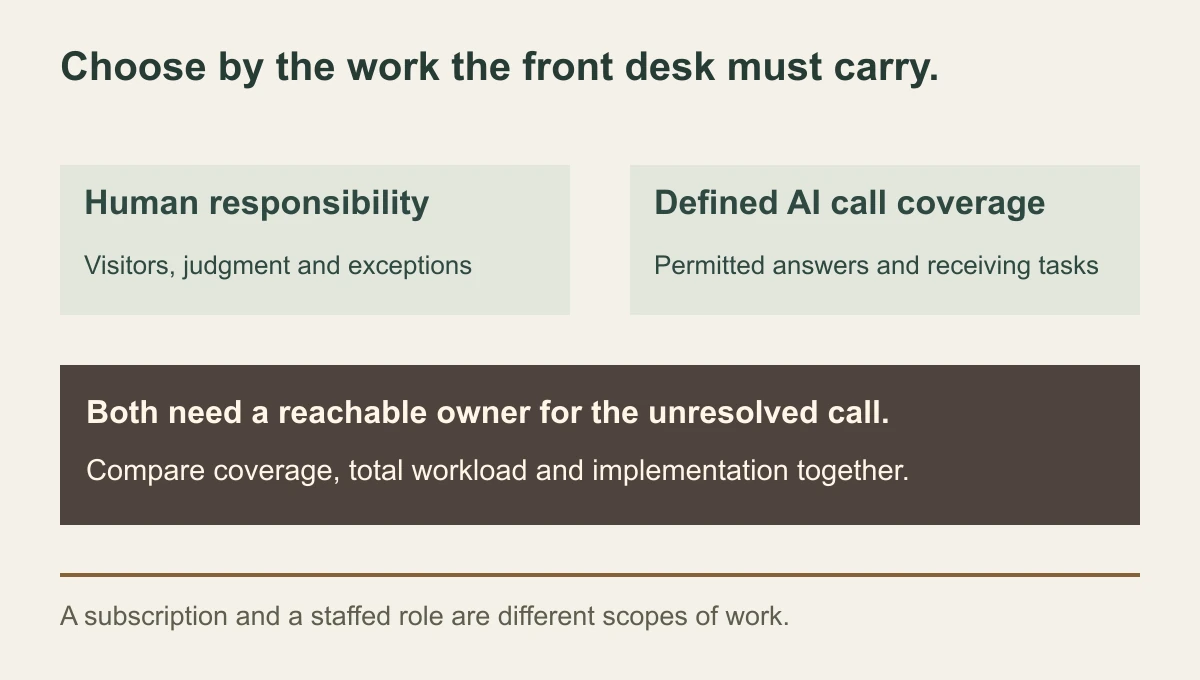
The AI receptionist vs hiring a receptionist comparison still matters. If you need physical reception and broad office work, keep those responsibilities in your staffing plan. If the immediate problem is missed calls, routine questions or overflow, give TQP that defined job before making another hire your default solution.
Draw the coverage roster before asking for prices
List when the work arrives and what type it is. Do not write “answer phones” as if every call requires the same response. Separate an approved routine request from a caller who needs judgment, a visitor who is physically present, and a request that must be escalated.
Human present
Visitors, documents, live coordination and relationship context have an accountable person. Calls can still collide with that work.
PERSON-FIRSTDefined overflow
A configured system can take approved requests, record the facts and route them while staff are occupied. A named colleague owns exceptions.
HYBRIDUseful next step
Let the caller state the need and hear a truthful next move. Do not promise a booking or callback the business cannot honor.
SYSTEM COVERAGEDraw your actual hours, call peaks and request types over these three states. A vendor's “always on” claim is only useful if the resulting records reach an owner.
The U.S. Bureau of Labor Statistics describes receptionist work as more than phone answering: greeting and directing visitors, scheduling, maintaining calendars, entering information, handling correspondence and documents, with duties varying by employer. A voice system cannot receive a visitor, observe the waiting room or decide an unusual situation on the firm's behalf. If those are central to the role, keep a person in the design.
Put the real costs on the same page
A national wage is a reference, not a local hiring quote. The BLS reports a U.S. median of $18.27 per hour in May 2025 for receptionists. Canadian owners can consult Job Bank's receptionist wage tables for the relevant location and reference period. Do not compare different currencies or data periods as if they were quotes for the same role. Use an actual local offer or payroll record for your city, shift and required experience.
A person has wages, benefits, employer obligations, paid absence, hiring, training and management. The BLS separates wages and benefit costs in its employer compensation data; U.S. employers also have tax withholding, reporting and payment responsibilities. Use your own payroll adviser and records for the real amount. Then credit the person for work beyond calls: visitor service, scheduling judgment, internal coordination and retained context.
Your AI receptionist cost includes implementation, recurring platform and communications charges, integration work, call testing, maintenance, review time and exception handling. A cheap subscription that creates confused callers or unowned records has transferred cost to your staff and customers. Ask for a written scope and usage assumptions, then price the actual route.
Person plan
- Wages at your local offer
- Benefits, taxes and paid time
- Hiring, training and supervision
- Tools, space and backup coverage
Count the value: visitors, judgment, coordination and relationships that would still need a person.
System plan
- Implementation and conversation design
- Platform, numbers, usage and integrations
- Testing, monitoring and revisions
- Human review and exception ownership
Count the failure cost: incorrect bookings, unowned follow-up and customer confusion.
Do not turn the wage medians into a fabricated “annual savings” headline. Even a correct payroll calculation would not show the business value of the role or the cost of a poor customer interaction. The outcome to compare is the work completed at an acceptable quality and risk level.
Read what the answering service price actually buys
An advertised monthly fee only helps when you know what it includes. A quote may use minutes, calls or another allowance. Ask how repeat calls, spam, transfers and overage affect the bill. These are questions to put against the offer you are considering, not assumptions that every provider bills the same way.
Then look beyond answering. Does the engagement include your approved service information, the useful details to collect, the configured calendar or receiving person, and the changes needed when your business changes? A transcript still leaves somebody to turn the conversation into the next job.
TQP sells the configured call journey and its agreed ongoing responsibility. That is the commercial difference worth buying: you can have the answering, records and permitted next steps implemented together rather than choosing a low headline price and assembling the working process yourself.
Bring a real month of your call records. Identify the normal requests, busy periods and exceptions. We can use that information to define the scope and usage assumptions for your quote. The AI receptionist service page shows the current starting offer and the path to a scoped engagement.
Calculate three complete plans from your own records
For a person-first plan, start with the local offer and the hours you need covered. Add the employer's actual benefits, taxes, paid time, recruiting, training and backup plan. Then list the non-call work the person performs. If someone must still greet visitors and coordinate the office, their role remains in the plan even if a system takes a portion of calls.
For a system-first plan, use a written quote for the call volume and workflow you actually need. Add setup, connected tools, any phone or usage charges, the staff time required to review records, and the time a person will spend taking exceptions. Spread one-time setup across the period you are evaluating so you are not comparing a first-month project against a single month of wages. Keep a line for correcting bad bookings or missed handoffs rather than assuming every call will end cleanly.
For a hybrid plan, do not pretend the employee's entire salary disappears. If the person stays, the financial question is what useful coverage the additional system provides and whether it frees staff for work that matters. The business might keep its receptionist for visitors and complex coordination while the system takes routine overflow and after-hours inquiries. Compare that against hiring extra coverage, extending shifts, or leaving those calls unanswered. The right alternative depends on the hours and tasks, not the word “hybrid.”
Use one time period and one currency for all three plans. Separate fixed costs from costs that rise with call volume. Record what happens in a peak month, not only a quiet one. If the business operates in Canada and the quote is in U.S. dollars, convert it using the rate you actually expect to pay and note the date; otherwise the apparent price gap is partly a currency artifact.
Will this change remove work or move it?
- Work removed from interruptions
- List the routine calls a configured path may finish without interrupting the front desk.
- Work retained by the person
- Keep visitors, unusual coordination, professional judgment and relationship decisions in the staffing plan.
- Work created by the system
- Count record review, failed actions, callbacks and rule changes. Name the person who performs them.
- Coverage added
- Identify the actual hours or simultaneous requests the new route covers, and its backup when the receiver is unavailable.
Use the trial to revise these entries. A workload benefit must be observed in the team's day; the subscription price alone cannot prove it.
Check the work completed, not only the calls answered
I would choose a small set of outcomes before testing a model. Did the caller reach the right next step? Did a booking match the real service and availability? Did the record reach the person who owns follow-up? Could a caller with an unusual or upset request reach a human without starting over? Those questions apply to a new employee, a vendor and a custom system alike.
Test with the situations your business already mishandles. Call while the front desk is busy. Call after closing. Ask for a service you do not offer. Try to book the wrong time or address. Change the request halfway through. Then inspect both sides: what the caller heard and what your team received. A polished voice that produces an unusable record has not solved the workload.
There is a limit to what the cost ledger can prove before a live trial. You can quote wages and subscription fees. You can estimate review time. You cannot know the quality of future handoffs from a pricing page. Run a bounded trial with a real owner and a way to correct errors. Compare the records against the same call types your person-first plan would handle. That gives the decision a firmer basis than a vendor demo or a blanket promise of savings.
Give the call work to TQP and keep your people on the work that needs them
You may still need someone greeting visitors, coordinating the office or resolving an unusual situation. That does not mean that person should be interrupted by every routine phone request as well.
Start TQP with the defined coverage job: approved service answers, useful intake, permitted booking or routing, and a clear person receiving exceptions. Our AI receptionist responsibility guide helps you define that boundary.
For a busy front desk, use a hybrid. Let the configured system take the agreed first steps while your team keeps the relationship work and decisions requiring judgment. Callers should know when they are speaking to automation, and the receiving person should have enough context to continue the conversation.
You can buy better call coverage without pretending the rest of an employee's job has disappeared. The result to examine is how well the caller reaches the next action and how much routine interruption the system removes from your day.
If hiring keeps failing, inspect the role itself
Difficult hiring does not by itself prove that AI should take the job. Review your own applications, retention, schedules and training. Is the role paid and staffed for the work expected? Does one person manage visitors, urgent calls, calendar exceptions and paperwork at the same time? A recurring vacancy may expose a job-design problem as well as a coverage gap.
Document the work that must continue during recruiting and leave. Assign a backup for exceptions and a named owner for routine call records. If AI supplies overflow coverage, tell staff which tasks move and which decisions remain theirs. Review actual workload after the trial. A lower phone bill is a poor result if employees now spend their day repairing unowned records.
Frequently asked questions
Can an affordable answering service replace another hire?
It can handle an agreed call coverage job when your immediate need is routine answers, intake or overflow. Physical reception, broad office administration and professional judgment still need suitable people. TQP scopes the call journey so you can buy the useful coverage without treating unlike jobs as equivalent.
What does TQP's AI answering service cost?
AI voice agent coverage starts at US$449 a month with free setup (normally US$1,495) and no contract. Call minutes and the AI Business OS are included in the plan. More complex qualification, integrations or booking are scoped separately.
What should you check before buying an answering service?
Test a normal call and an exception against your approved rules. Inspect what the caller hears, the saved details, the permitted booking or routing, and the person receiving unresolved work. TQP can scope, configure and maintain that connected process rather than leaving you with a transcript to sort out yourself.
If your roster shows a coverage gap, get your answering service built by TQP. Bring your coverage roster, actual call types and office hours. We will define what the system should own, connect the record and destinations, and test the exceptions before asking your people to rely on it.
Bring the call types, hours and exceptions from your coverage worksheet. We scope, configure and test the AI call journey, then maintain the agreed routing and handoffs.
Get your answering service built by TQP