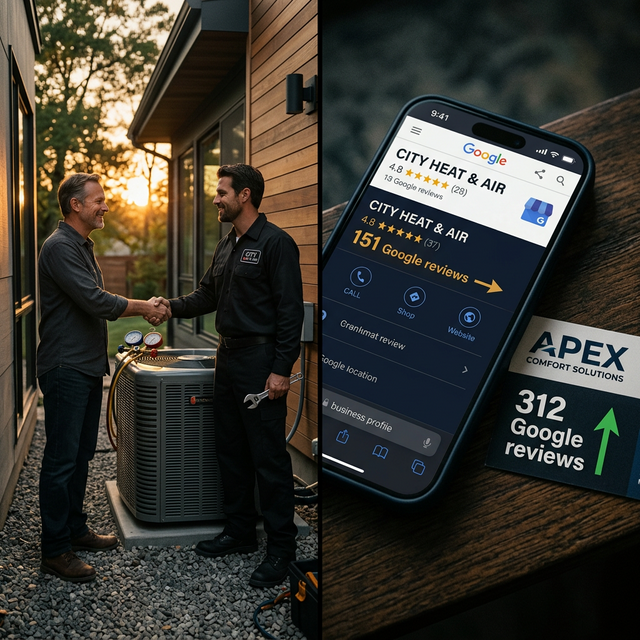

There is a number that haunts a specific type of HVAC service business. It is not a revenue target or a close rate.
Treat any number without a nearby source or stated method as a planning assumption, then replace it with your own records.
Most HVAC business owners discover the 150-review cliff the same way. They glance at their Google Business Profile during a slow Tuesday, notice the number has barely moved in several months, and assume the solution is a new review platform, a better review request email, or a promotion tied to a five-star ask. They try one. Nothing changes. They try another. The needle barely moves. What they are encountering is not a tool problem. It is a system problem rooted in the very moment that produces the highest willingness to leave a review: the instant immediately after a successful service call ends and the customer feels gratitude they have not yet expressed.
The post-job window is a 20-minute event.BrightLocal consumer behavior research from 2024 found that review intent peaks in the 20 minutes following a positive service interaction and decays rapidly after that. A customer who felt genuine appreciation for their HVAC technician at 3:15 PM will still feel that appreciation at 3:30 PM. By 6:00 PM, dinner, email, and the ambient demands of life have diluted the emotional state that produced the intent. By the following morning, the motivation to act has largely evaporated. Most HVAC service businesses capture none of that 20-minute window systematically. They send a generic post-job text from a number the customer does not recognize, hours after the service is complete, referencing no specific detail about the interaction that produced the gratitude. The conversion rate on those messages is 2 to 4 percent. For a 3-truck HVAC operation completing 12 to 18 jobs per day, that is one review every two to four days when the business could be generating three to five.
Why 150 Reviews Is a Competitive Inflection Point, Not a Milestone
The gap between 150 and 300 Google reviews is not a linear distance in consumer perception.It is a categorical divide. Moz Local Search Ranking Factors research and independent local SEO correlation studies consistently show that businesses in the top three positions of Google local pack searches for competitive HVAC keywords in metro markets average 287 reviews. The businesses ranked four through ten in those same searches average 97. The threshold that separates the two groups is not 5.0 stars or a specific set of keywords. It is review density. A business at 150 is visible to consumers who reach its profile, but it is operating below the threshold that most local search algorithms weight as authoritative for competitive mid-market HVAC keywords.
The compounding problem is review velocity.Google's local ranking algorithm weights not just total review count but the rate at which reviews are being accumulated.A business with 310 reviews that added 40 of them in the last 90 days is not just ahead of a business with 160 reviews on a count basis. It is signaling to the algorithm that it is an actively patronized, currently-operating business with fresh customer interactions. The stalled business at 160 reviews with 4 new reviews in the last 90 days is sending the opposite signal. The ranking consequence is that the stalled business falls in local search results not because it got worse but because its competitors got more consistent.
For HVAC operators, this matters in a specific and economically significant way. The local pack is where emergency service calls originate. A homeowner whose air conditioning fails on a 95-degree Thursday does not scroll through a list of ten businesses and compare their feature sets. They open Google, see three to four options in the local pack, and call the one that looks most established. Review count is the fastest legible proxy for establishment that the consumer can assess in under five seconds. The HVAC business at 155 reviews competing against the business at 315 in that local pack slot is already losing the call before it rings.
The voice AI Trigger: Closing the Post-Job Review Loop
The specific mechanism that most HVAC companies are missing is the automated, personalized, timed review request triggered by a signal from the job management system.Here is what that looks like in practice. An HVAC technician closes a service call in ServiceTitan or Housecall Pro. The job is marked complete. That close event triggers an API call from the company's voice AI system. Within 90 seconds, the customer receives a personalized text message from a number they recognize (the company's primary line, not a third-party platform number), containing the technician's name, a reference to the specific service performed, and a direct link to the Google review page. The message reads like a human wrote it because the merge fields pulling from the job record make it specific. The timing hits inside the 20-minute gratitude window because the trigger fires immediately at job close rather than batching at end-of-day.
The review conversion rate on this type of triggered, personalized, timed request is 8 to 14 percentper Birdeye HVAC industry benchmarks for businesses that implement it with under-30-minute trigger windows. For a 3-truck HVAC operation completing an average of 15 jobs per day, that translates to 36 to 63 new reviews per month. A business stalled at 155 reviews implementing this system in March will cross 300 reviews by June. The competitor they were tracking will be trying to reverse-engineer what changed.
The critical difference between this approach and standard post-job SMS platformsis the signal source and the timing.Most review request tools require either manual triggering (a technician or office manager initiates the send) or batch sends at set intervals like end-of-day. Both of these create the timing gap that kills conversion. A voice AI system integrated with the job management platform via webhook fires the trigger at the exact moment of job close, automatically, without requiring technician action. The request arrives while the customer is still in the emotional state the technician created.
The Intake-to-Review Flywheel: How voice AI Creates Compounding Review Density
Breaking through the 150-review cliff is not only about post-job review requests.The businesses that sustain 15 to 30 reviews per month over time are the ones that have integrated their voice AI intake data with their review strategy. Here is the mechanism. When a customer calls an HVAC company and the call is handled by a voice AI system, the intake conversation is logged with structured data: customer name, contact information, service type requested, urgency level, and in many implementations, sentiment signals from the conversation. After the job is completed, the post-job review request is personalized not just to the job type but to the customer's expressed concern at intake.
A customer who called about an emergency AC failure and received same-day service gets a review request that references the emergency context. A maintenance agreement customer who scheduled a seasonal tune-up gets a different message with a different emotional register. The specificity of the request, built from intake data captured at the front door, materially improves conversion over generic post-job automation. This is what the front door problem looks like from the review velocity angle: every interaction that passes through the front door without creating a structured data record is an interaction whose post-job review request will be generic and low-converting. Every interaction that passes through a voice AI intake that creates structured records is an interaction whose post-job request can be personalized and high-converting.
For HVAC companies that typically handle 200 to 400 service calls per month,the compounding effect of voice AI intake data on review velocity is substantial. A business completing 300 jobs per month with a generic post-job SMS at 3 percent conversion generates 9 reviews. The same 300 jobs with a voice AI triggered, intake-personalized request at 10 percent conversion generates 30 reviews. Both businesses spend roughly the same amount on the review request tooling. The difference is the front door infrastructure that feeds the personalization engine. The 3-percent business wonders why reviews have stalled. The 10-percent business is adding 30 reviews per month and has left the 150-review cliff behind permanently.
Technician Training as a Parallel Track
voice AI review triggers are a system-level intervention.They work whether or not the technician remembers to ask. But the highest-performing HVAC review programs run both tracks simultaneously: the automated voice AI trigger fires on every completed job without exception, and technicians are trained to deliver a verbal ask at service close that primes the customer to respond to the follow-up message. BrightLocal research found that customers who received a verbal ask from a technician at job close AND a personalized follow-up text within 30 minutes converted to a review at 19 to 24 percent. That is roughly double the rate of the text-only approach and four to five times the rate of the digital-only approach without the verbal prime.
The verbal ask does not require a sales pitch or an elaborate script. It requires three sentences. Something like: "I hope everything is working the way it should. If you were happy with the service today, we would really appreciate a quick review on Google. I am going to send you a text in a few minutes with a direct link." That priming sentence, combined with a triggered message that arrives in under five minutes, produces the highest review conversion rates available to an HVAC service business without additional per-review cost. The conversion lift comes from aligning the human interaction and the digital follow-up into a single coordinated experience rather than treating them as unrelated events.
Reactivating the 12-Month Backlog
Every HVAC service business that has been stalled at 150 reviews for more than six months has a recoverable review inventory sitting in its CRM.Every job completed during the stall period is a customer interaction where the service was likely satisfactory (repeat customers and referrals are not generated by bad service) but the review capture failed. A targeted re-engagement campaign to that 12-month backlog, using the same personalized approach that a voice AI intake record would enable, consistently generates 5 to 12 percent review response rates in HVAC markets.
For a business that completed 2,400 service calls in the 12 months of review stagnation and accumulated only 14 reviews,a re-engagement campaign at 8 percent response rate generates 192 additional reviews from a single outreach.That is a 128 percent increase in total review count without a single new job being completed. A business at 155 reviews executing that campaign crosses 300 reviews in a matter of weeks and immediately changes its competitive position in local search. The voice AI system that should have been capturing those reviews in real time becomes the infrastructure that sends the re-engagement campaign and captures reviews going forward.
What the 150-Review Cliff Actually Costs
HVAC companies that stagnate at the 150-review cliff do not just lose local search position.They lose calls they never know they missed. A homeowner who searches during an emergency, sees two competitors with 300-plus reviews and the stalled business at 158, and calls the higher-count business is a lost job that never appears in the stalled business's missed call data. It never registered. It was a lost job that happened upstream of the phone ringing. This is the front door problem operating at its most invisible: the business owner believes their conversion rate is acceptable because the calls they are tracking convert at a reasonable rate. They are not tracking the calls that went to a competitor because the Google Business Profile did not win the trust comparison.
The revenue impact of this invisible loss compounds over time.An HVAC service business that is losing an estimated 20 percent of emergency call volume to a competitor with a higher review count and velocity, based on market size and average job value, is losing between $80,000 and $240,000 per year depending on market size and average job value. That loss is invisible in the P&L because the calls never rang. The Google Business Profile that could have won those calls needed 150 more reviews and was getting 3 per month. The voice AI system that could have been generating 30 per month was not in place. The front door closed before the customer ever knocked.
The Operating Standard
In the context of Breaking the 150-Review Cliff: How HVAC Companies Are Using voice AI to Restart Google Review Velocity, we must address the fundamental friction that exists in manual intake. Every 'missed call' is a missed revenue opportunity, but more importantly, it's a signal of operational weakness that high-value prospects detect instantly. By bridging this gap with AI-driven intake, you're not just 'automating.' You're humanizing the interaction by ensuring that your clients get the attention they deserve, instantly. This is the math of responsiveness that wins markets.
Strategic ROI: When we apply the Quiet Protocol math to Breaking the 150-Review Cliff: How HVAC Companies Are Using voice AI to Restart Google Review Velocity, the result is always the same: a dramatic reduction in cost-per-acquisition (CAC) and a significant increase in client lifetime value (LTV) through immediate resolution.
The loss estimate is basic business math, not a magic claim.
Revenue-leak examples on this site are built from visible operating inputs: inquiry volume, missed-call or slow-response rate, booking rate, average job or client value, repeat value, and follow-up recovery. The fastest way to make the number real is to run the diagnostic for your closest business type, then compare it against your own call log, CRM, booking calendar, form timestamps, and review activity.
The practical questions behind this decision.
How does voice AI trigger review requests without requiring technician action?
voice AI systems integrated with job management platforms like ServiceTitan or Housecall Pro use webhook connections that fire automatically when a job status changes to complete. The trigger initiates a pre-built message flow that pulls personalized data from the job record (customer name, technician name, service type) and delivers the review request via SMS to the customer's verified contact number. The technician does not need to initiate, remember, or manually send anything. The system handles the timing, personalization, and delivery automatically. The only action required from the technician is closing the job in the platform they are already using, which they were going to do anyway.
Is running a re-engagement campaign to past customers safe from a review policy standpoint?
Google's review policies prohibit incentivizing reviews (offering discounts, free services, or other benefits in exchange for a review) and prohibit fake or paid reviews. They do not prohibit a business from asking past customers for an honest review of their genuine service experience. A re-engagement campaign that contacts past service customers, references the specific service they received, and asks them to share their experience on Google is consistent with Google policy. The safest implementation references the specific job and makes no mention of any incentive. It simply re-extends the ask that was not made effectively at the time of service.
How quickly can an HVAC business expect to see results from implementing voice AI review triggers?
The immediate impact comes from the re-engagement campaign, if one is run against the backlog of past customers. This is a one-time activity that can add 50 to 200 or more reviews within 30 days depending on the size of the backlog and the quality of the outreach. The sustained impact from voice AI-triggered post-job requests typically shows meaningful velocity improvement within 30 to 45 days of implementation. The compounding effect on local search ranking is a 90 to 180 day observation window in competitive markets, as Google's algorithm needs to register and weight the consistent new review velocity. The business that implements both the re-engagement campaign and the ongoing trigger system simultaneously will see the fastest combination of immediate count improvement and sustained velocity.
Review the trust signals visible before someone decides to call.
The useful question is not only the star rating. It is whether recent proof supports the promise the website makes.
Inspect review recency, response habits, and the public trust signals buyers see before they contact the business.
See how the capability in this article fits into a complete customer journey.
HVAC Emergency ServiceSee the same decision through the language, buyer behavior, and operating reality of this industry.
Client Results & ProofInspect the starting condition, installation, measurement window, and outcome behind real client work.
Why HVAC Maintenance Agreements Have a 60% Renewal Failure Rate (And How to Fix It)
An HVAC maintenance agreement client is worth three times more over their lifetime than a one-time service customer. They refer more, complain less, and are statistically the safest harbors in a volatile seasonal business. They also lapse at a rate of 55 to 65 percent annually at most HVAC companies, and almost none of those lapses happen because the client chose to leave. They happen because nobody called.

Why Local SEO Underperforms When Calls Go Unanswered
Local SEO does not end when a buyer taps call. If your service business sends high-intent searchers to voicemail, the ranking work is turning into wasted demand.

The 3-Review Cliff: Why HVAC Companies (and Service Businesses) Stall at 150 Google Reviews
There is a pattern that repeats across HVAC and home service companies with uncomfortable consistency. The business builds momentum in its early years, collects reviews at a healthy rate, crosses 100 Google reviews, and then slows to a trickle. By the time the owner notices, the business has been sitting at 140 or 160 reviews for 14 months while a competitor who launched two years ago has just passed 300. The business owner tries new review platform features, sends reminder emails, reminds the office manager to follow up. Nothing moves. This is the review cliff. And the reason it happens has almost nothing to do with reviews.