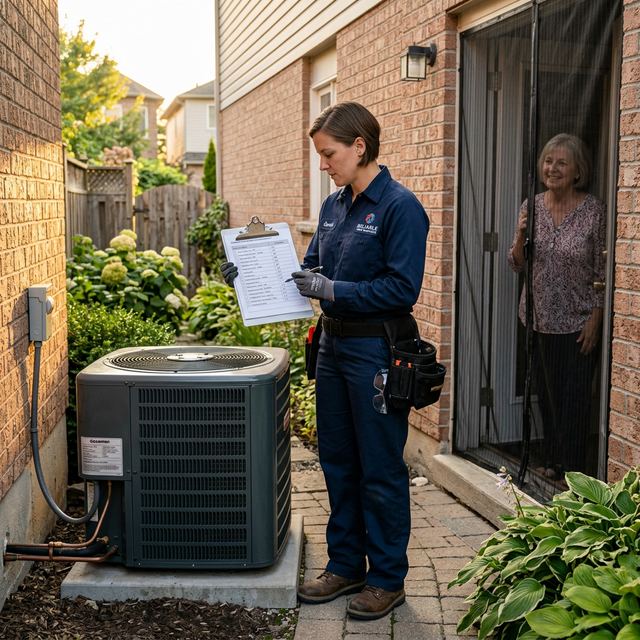

The passive churn window closes whether or not the service business is ready to act on it. The client who hears nothing assumes the relationship has lapsed and responds accordingly.
Treat any number without a nearby source or stated method as a planning assumption, then replace it with your own records.
The HVAC maintenance agreement is the most valuable product a service business sells. ServiceTitan data across thousands of HVAC service businesses found that customers with active maintenance agreements spend 3.4 times more with the company annually than customers without one. They are more likely to call the agreement company first for emergency repairs. They leave more Google reviews. They refer more neighbors. They are also 64 percent less likely to get a competing bid when their system needs replacement, because the company they have an agreement with has built presence, trust, and familiarity across multiple annual visits. The maintenance agreement is not a service add-on. It is the most important customer relationship in the HVAC business.
And most HVAC service businesses lose 55 to 65 percent of their agreement clients every year. Not because those clients are dissatisfied. Not because they found a better price. Not because they had a bad service experience. They lapse because the agreement expires and nothing happened. No call. No letter. No text. The agreement quietly ended, and the client moved on to whoever answered when their next problem occurred. This is passive churn, and it is the single largest destroyable revenue category in the HVAC service business because the work of acquiring that client has already been done and the renewal requires only a fraction of that effort.
The Passive Churn Window: Why 14 Days Determines Your Renewal Rate
Agreement renewal research from ACHR News and Jobber's 2024 State of Field Service Report identifies a consistent behavioral pattern in HVAC maintenance agreement clients. Most clients who intend to renew do so within 14 days of their renewal notice. Most clients who do not receive a renewal notice within 30 days of expiration do not renew at all, and by 60 days past expiration, fewer than 12 percent of lapsed agreement holders ever return to an active agreement with the same company.
The 14-day window is the business owner's leverage point. An HVAC service business that contacts its expiring agreement clients with a personal, relevant outreach in the 30-day window before expiration and the 14-day window after it captures 70 to 82 percent renewal rates. An HVAC service business that does not make proactive contact captures 35 to 45 percent. The difference is not price, not service quality, not competition. The difference is whether someone reached out.
Why the outreach fails at most service businesses. The most common intake process for agreement renewal at independent and regional HVAC companies is manual and inconsistent. A dispatcher or office manager has a list of expiring agreements. When time allows, they make calls. Peak season hits, the list grows stale, calls don't get made, agreements expire. The business owners who have audited this process at their own companies almost uniformly find that proactive renewal outreach happened for 30 to 50 percent of their expiring agreements in any given month. The other 50 to 70 percent expired with no contact attempted.
The passive churn window closes whether or not the service business is ready to act on it. The client who hears nothing assumes the relationship has lapsed and responds accordingly.
The Annual Revenue Calculation Every HVAC Business Owner Should Run
Step 1: Count your active agreements. Pull your current agreement roster from ServiceTitan, Jobber, or your CRM. Count active agreements. The average independent HVAC service business with 3 to 6 technicians carries 150 to 400 active maintenance agreements, per ACHR News benchmarking data.
Step 2: Calculate your average agreement value. Standard residential maintenance agreement pricing ranges from $150 to $350 per year for a two-visit plan depending on market and service scope. Commercial agreements average $400 to $1,200 per year. Use your actual average.
Step 3: Apply your current renewal rate. If you have not measured this, assume industry average (38 to 45 percent) until you have your own data. With 250 active agreements at a $220 average value and a 40 percent renewal rate, 150 agreements lapse annually, representing $33,000 in recurring revenue that expires and is not recovered.
Step 4: Apply a realistic optimized renewal rate. Service businesses with a structured, proactive renewal contact sequence achieve 72 to 81 percent renewal rates consistently. Applying 75 percent to the same 250-agreement base at $220 average: 62.5 agreements lapse instead of 150, recovering $19,250 in annual recurring revenue from the same customer base.
This calculation does not include the compounding effect: a client who renews for a second and third year has a dramatically higher likelihood of calling that company for equipment replacement (average replacement job: $4,500 to $12,000). The renewal retention rate is not just about the annual agreement fee. It is about protecting the full lifetime value of the relationship that the agreement created.
Why Standard Renewal Outreach Fails: The 3 Common Mistakes
Mistake 1: Single-touch renewal notice. The most common renewal process is a single letter or postcard mailed 30 days before expiration. Research from Hatch communication platform data found that single-touch renewal outreach has a response rate of 8 to 14 percent for standard HVAC agreements. Multi-touch sequences (letter or email at 30 days, personal phone call at 14 days, follow-up text at 7 days, final reminder at expiration) achieve response rates of 55 to 70 percent from the same agreement holder base. The difference is not the quality of the pitch. It is the number of opportunities the client had to respond.
Mistake 2: Generic renewal language. "Your maintenance agreement is up for renewal" is the least compelling message an HVAC service business can send. The client does not have an emotional connection to an agreement. They have an emotional connection to the service visit, the technician, the specific problem that was caught and fixed. High-converting renewal sequences reference the specific work done: "During your spring maintenance visit in April, our technician noted your capacitor was showing early wear. We caught it before it became a failure. Your renewed agreement means we will catch the next early warning too." This specificity converts. Generic language does not.
Mistake 3: Treating renewal as an administrative task. Renewal outreach assigned to the same person who handles scheduling, dispatching, and billing gets deprioritized when things get busy. It is not revenue-generating in the way that dispatching a new call feels revenue-generating. But the math above makes clear that it is. An HVAC service business owner who recovers 50 additional renewals per year at a $220 average has generated $11,000 in annual recurring revenue from what is functionally a follow-up phone call series. The business owner who assigns renewal outreach as a dedicated function, with time blocked and metrics tracked, captures that revenue. The one who treats it as an administrative extra does not.
How AI and Automation Fix the Renewal Failure at Its Root
The structural problem driving renewal failure is not motivation or strategy. It is capacity. A dispatcher handling 40 to 60 calls per day during peak season cannot simultaneously run a proactive, personalized renewal sequence for 20 to 30 expiring agreements per month. The work competes with itself. AI-assisted communication systems resolve this by removing the capacity constraint without adding headcount.
Automated renewal trigger sequences. A properly configured CRM or field service platform can trigger a multi-channel renewal sequence automatically when an agreement enters the 30-day pre-expiration window. The sequence runs without manual initiation from the service business team: email at 30 days, SMS text at 21 days with a one-click renewal link, automated voice call at 14 days (AI voice system that confirms the renewal and either completes a credit card payment or schedules a callback), and a final text reminder at 7 days for non-responding clients. The agreement holder is reached across multiple channels without a single manual dial from the dispatcher. When they respond, the dispatcher engages. When they do not, the sequence escalates.
Personalization at scale. AI outreach platforms can automatically populate renewal communication with client-specific data drawn from the CRM: last visit date, technician name, findings noted during the visit, and the specific agreement tier that was active. This transforms "your agreement is expiring" into "Hi [name], we serviced your system on [date] and our technician [technician name] found [specific finding]. Your spring tune-up is coming up as part of your renewal." Service businesses that deploy personalized automated renewal outreach consistently report 15 to 25 point improvements in renewal rates over generic outreach within 60 days.
Real-time renewal capture. The most impactful single element of an AI-assisted renewal system is the ability to complete a renewal transaction during the automated call. When an AI voice system calls an expiring agreement holder, confirms the renewal value, and offers to process a credit card on file or add the renewal to the next service visit invoice, a fraction of those calls converts immediately without any human involvement. ServiceTitan data from 2024 found that HVAC companies using automated renewal calls with payment capture converted 22 percent of those calls to completed renewals without dispatcher involvement. At 30 expiring agreements per month, that is 6 to 7 additional renewals per month from a fully automated process.
Building a Renewal Program That Compounds Over Time
Track renewal rate as a primary business metric. Most HVAC service business owners track revenue, job count, and average ticket. Very few track renewal rate as a standalone metric reported monthly alongside those numbers. This is the first change: pull your renewal data monthly and calculate the percentage of expiring agreements that renewed in the same period. This number is your baseline. A business that does not track it cannot improve it because it has no feedback loop telling it what is working.
Build the 5-touch renewal sequence. At 30 days before expiration: personalized email with visit summary and renewal link. At 21 days: SMS with renewal link and optional callback request. At 14 days: automated voice call confirmation. At 7 days: final text reminder. At expiration: personal call from the service team to any agreement holder who did not respond to previous touches. This sequence requires configuration on the front end and runs automatically thereafter. Document it, implement it in your field service platform, and measure it monthly.
Price the renewal before the expiration visit. One structural change that consistently improves renewal rates: the technician who performs the annual or semi-annual maintenance visit presents the renewal at the end of the service call, before leaving the property. "Your agreement is up for renewal in 45 days. Would you like to take care of that now while I am here?" A face-to-face renewal offer from a technician the client just watched complete a professional inspection converts at dramatically higher rates than any digital outreach. The business owner who adds renewal conversation to the technician's standard service completion checklist sees immediate improvement without any technology investment.
The HVAC maintenance agreement business is a compounding asset. Every agreement renewed is a client retained, a replacement job protected, and a referral preserved. The service business that treats renewal rate with the same rigor it applies to new client acquisition converts that asset into sustainable recurring revenue. The one that lets renewals expire by default is accumulating client relationships and then releasing them for free.
The Authority Standard: ROI and Resonance
When we evaluate the ROI of an intake system like the one described for Why HVAC Maintenance Agreements Have a 60% Renewal Failure Rate (And How to Fix It), we look beyond the immediate convenience of automation. We look at the 'Revenue Leak' that occurs in the silence between a prospect reaching out and a business responding. In this vertical, that silence is the biggest competitor you have.
Data Anchor: The average LTV of a client in this space is significantly higher than the cost of a missed intake opportunity. By resolving for 'concurrency': the ability to handle infinite leads simultaneously-The Quiet Protocol transforms a passive operation into an aggressive revenue engine.
Before changing the offer, check the call log, CRM notes, maintenance agreement list, booking calendar, renewal dates, review requests, and missed-call records from the last 90 days. Most HVAC renewal leaks show up as slow callbacks, unclear next steps, or agreement holders who were never asked to book the next visit.
The loss estimate is basic business math, not a magic claim.
Revenue-leak examples on this site are built from visible operating inputs: inquiry volume, missed-call or slow-response rate, booking rate, average job or client value, repeat value, and follow-up recovery. The fastest way to make the number real is to run the diagnostic for your closest business type, then compare it against your own call log, CRM, booking calendar, form timestamps, and review activity.
The practical questions behind this decision.
What is a realistic renewal rate target for an independent HVAC company?
Best-in-class independent HVAC service businesses with structured renewal programs achieve 75 to 85 percent annual renewal rates. For a business currently at or below industry average (35 to 45 percent), a realistic 12-month improvement target with a structured multi-touch sequence and technician-initiated renewal conversations is 60 to 70 percent. Reaching 80 percent typically requires 18 to 24 months of consistent program operation. The improvement trajectory is not linear: most businesses see a 10 to 20 point improvement in the first 60 days from simply implementing proactive outreach where none existed before, and then slower incremental improvement as they refine messaging and timing.
How do we structure maintenance agreement pricing to improve renewal rates?
Two pricing structures consistently outperform standard annual agreements for retention: monthly billing and tiered plans. Monthly billing converts the annual renewal moment from a single $250 decision to an ongoing $18 to $22 per month subscription that most clients do not actively cancel. The absence of an annual renewal moment dramatically reduces passive churn because there is no single expiration event to miss. Tiered plans (Silver, Gold, and Platinum with increasing visit frequency, priority dispatch, and parts discounts at each tier) give the client an upgrade path and give the service business a retention conversation that frames renewal as progress rather than repetition. HVAC service businesses that move from annual lump-sum to monthly recurring billing for maintenance agreements consistently report 25 to 35 point improvements in retention within the first plan cohort.
How should we handle agreement holders who lapsed more than 90 days ago?
Agreements lapsed more than 90 days require a different approach than active renewal outreach. These clients are in the database reactivation category rather than the renewal category. The most effective reactivation approach for lapsed agreement holders is a specific, value-forward offer tied to urgency: a seasonal diagnostic at a significant discount, offered to "previous agreement members only," positioned as a re-enrollment opportunity rather than a sales call. Lapsed members who receive a personalized reactivation offer in April or May (spring maintenance season) or September or October (fall heating tune-up season) convert at 18 to 28 percent, versus less than 5 percent for generic win-back outreach. The timing alignment with natural service urgency is what drives the higher conversion.
Map how a serious buyer decides in this kind of business.
Use the operating reality of the industry instead of copying a generic lead-generation playbook.
Replace broad industry assumptions with the business's actual inquiry volume, customer value, response time, and booking data.
See how the capability in this article fits into a complete customer journey.
HVAC Emergency ServiceSee the same decision through the language, buyer behavior, and operating reality of this industry.
Client Results & ProofInspect the starting condition, installation, measurement window, and outcome behind real client work.

HVAC Database Reactivation: A Practical Operating Guide
How HVAC teams can review dormant contacts, consent, service history, unresolved estimates, seasonal relevance, ownership, opt-outs, and measured reactivation outcomes.

HVAC Missed Calls: Where Summer Revenue Leaks Before Dispatch
When an AC unit fails in July, the homeowner wants a truck dispatched, not a callback tomorrow. Here is the math behind why HVAC companies consistently lose mid-summer revenue despite full schedules.
How HVAC Companies Are Using AI to Never Miss an Emergency Call
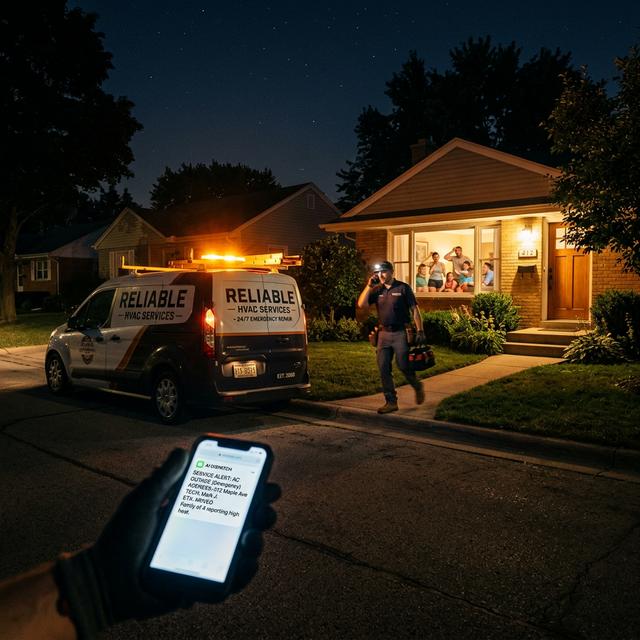
An AC failure at 8 PM in July is not a scheduling problem. It is a medical situation for vulnerable households, and it is the highest-value call your HVAC service business will receive all week. The company that answers it closes the job. The company that sends it to voicemail gives that job to a competitor who does answer. AI voice systems changed that equation permanently in 2025, and the HVAC operators who deployed early are now compounding the advantage.