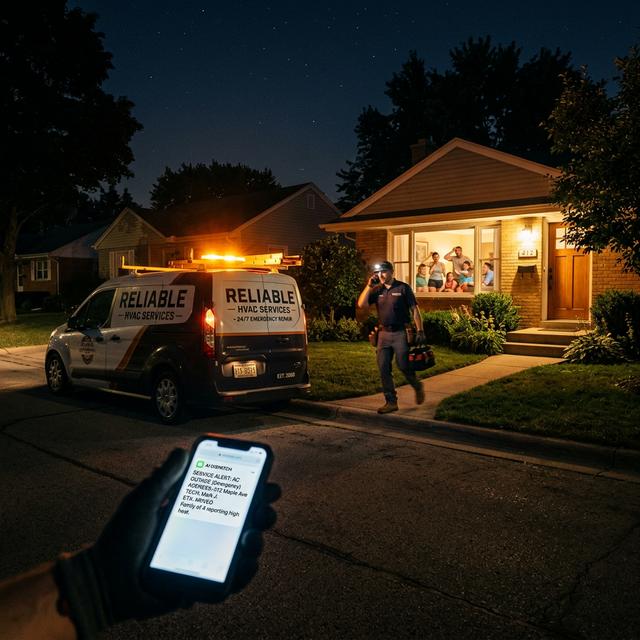
The HVAC service business owners who deployed AI intake in 2024 and have 12 or more months of operational data report three consistent outcomes that align across operator size and market type.
Treat any number without a nearby source or stated method as a planning assumption, then replace it with your own records.
HVAC emergency calls are different from every other type of inbound call a service business receives. They arrive when the need is urgent, often in extreme temperature conditions, and the caller has typically already experienced frustration with the situation before dialing. They do not comparison shop. They call the first number that comes up on Google or that a neighbor recommends, and they make their decision within the first 60 seconds of that call. The HVAC company that answers takes the job. ACHR News industry data consistently shows that the first HVAC company to speak with an emergency caller closes 78 to 87 percent of those jobs, regardless of price. Being second means losing the job entirely, not losing it at a lower margin.
The AI revolution in HVAC intake is not primarily about cost savings. It is about coverage. The three windows where HVAC companies historically lose emergency calls are: after-hours (6 PM to 7 AM), peak-season overflow when every technician is dispatched and the front desk is overwhelmed with incoming calls, and mobile dispatch gaps when the business owner or dispatcher is on the road. In all three scenarios, the problem is identical: a high-value call arrives and nobody with the system access and authority to book a service appointment answers it. AI voice systems, deployed correctly and integrated with HVAC service business platforms, close all three windows simultaneously.
The Three Emergency Call Scenarios Where HVAC AI Delivers Immediate ROI
Scenario 1: The after-hours emergency. A homeowner's central air unit stops working at 9:30 PM in August. The indoor temperature is 84 degrees. There is an elderly parent in the house. They search Google for "emergency HVAC near me" and call the first result. If that result is your business and the call goes to voicemail, they call the second result. The second result's AI answers in 2 rings, confirms it handles after-hours emergencies, captures the address and system details, provides a dispatch time estimate, and sends a confirmation text within 30 seconds. You lost that job to an operator who invested $300 per month in AI intake coverage and you did not. At a typical HVAC emergency call value of $450 to $1,200 including parts and labor, there is an arithmetic argument for after-hours AI coverage that requires no additional justification.
Scenario 2: Peak-season call overflow. The week a heat wave arrives, an HVAC service business with 6 technicians in the field takes 50 to 80 inbound calls in a single day. The front desk can meaningfully engage with 25 to 35 of them. The rest either wait on hold until they hang up, reach voicemail, or get a rushed call interaction that fails to convert booking. ServiceTitan operational data from 2024 found that HVAC companies lose an average of 19 percent of their inbound call volume during peak-season demand surges to hold abandonment and voicemail. In a market where every competitor is experiencing the same surge, the business owner who deploys AI intake to handle overflow calls captures 15 to 20 additional booked jobs per peak week that competitors' voicemail boxes do not. Over a 6-week heat season, this compounds significantly.
Scenario 3: The mobile dispatch gap. Most small HVAC service businesses have a dispatcher or operations lead who also handles intake calls. When that person is in the field, on a parts run, or between system tasks, calls go to their mobile phone. A mobile phone with a missed call from a new emergency customer is a revenue event that has already partially failed. The callback window on emergency HVAC calls is narrow: Hatch data shows that HVAC emergency callers who do not reach someone in the first attempt call an average of 1.4 additional companies before returning to the first. An AI system that intercepts these calls while the dispatcher is unavailable, qualifies the emergency, sets expectations for callback time, and sends the caller a confirmation SMS dramatically extends the effective booking window.
What HVAC-Specific AI Intake Actually Handles (And How It Integrates)
There is a meaningful difference between a generic AI phone system and one configured specifically for HVAC service businesses. The generic system answers calls and collects a name and number. The HVAC-specific system does the work of a trained dispatcher.
HVAC intake qualification at the call level. A properly configured HVAC AI intake captures: system type (central air, mini-split, heat pump, furnace, boiler), age and approximate make/model if available, nature of the failure (not cooling, not heating, unusual noise, failure to start, error codes on thermostat), whether the system has been serviced recently, address for dispatch routing, and urgency level (elderly or medically vulnerable occupant, extreme temperature, commercial property with business impact). This information, structured and delivered to the dispatcher before callback or dispatch, means the technician who arrives already knows what they are dealing with. JobberHQ productivity data found that HVAC calls with structured pre-intake information result in 31 percent fewer second visits for parts pickup compared to calls with no pre-intake.
Direct scheduling integration. The platforms HVAC service businesses already use, ServiceTitan, Jobber, FieldEdge, Housecall Pro, and Successware, offer documented API connections (and in several cases native integrations) with AI voice platforms. When a caller says "I need someone tonight," a well-configured AI can check available dispatch slots in real time, commit an appointment window, and send a confirmation with technician ETA. The caller does not wait for a callback to know when someone is coming. They have confirmation before they hang up. This single change, immediate appointment confirmation on an emergency call, reduces cancellation rates by 22 to 28 percent by creating commitment on both sides before any human follows up.
Emergency triage and escalation. Not every call is the same level of urgency. An elderly occupant in a home reaching 95 degrees in a heat wave is different from a caller whose AC is struggling but the indoor temperature is 78 degrees. A well-built HVAC AI intake system identifies triage signals (temperature reported, occupant vulnerability, commercial versus residential, time of year) and routes accordingly. True emergencies are flagged immediately to the on-call dispatcher's mobile number with a priority alert. Standard after-hours calls receive an appointment confirmation for the next available slot. The system does not treat every call identically. It makes the same triage decisions a trained dispatcher makes, consistently and without variability.
HVAC Companies Already Using AI Intake: What the Operators Report
The HVAC service business owners who deployed AI intake in 2024 and have 12 or more months of operational data report three consistent outcomes that align across operator size and market type.
After-hours booking volume increased by 30 to 45 percent. This is the most consistent reported outcome: operators who deployed 24-hour AI intake saw a meaningful increase in booked service jobs from after-hours calls within the first 60 days. The calls were always arriving. They were previously being lost to voicemail. The AI captured them. One HVAC owner in a mid-sized southeastern US market reported recovering 12 to 18 additional booked service jobs per month from after-hours AI coverage alone, netting approximately $9,000 to $14,000 in additional monthly revenue against a $350 per month AI platform cost.
No-call-back abandonment rate dropped. The percentage of prospective customers who called, reached the business, and then never engaged again dropped sharply in operator deployments with AI intake. The mechanism is the same as in other service business categories: a caller who reaches a professional, responsive intake system and receives a confirmation within 60 seconds has formed an implicit commitment to the appointment. A caller who leaves a voicemail has made no commitment and is simultaneously calling competitors.
Dispatcher workload shifted from intake to dispatch. Operators consistently reported that their dispatcher's time allocation shifted from spending 30 to 40 percent of the day on repetitive intake calls (confirming service area, gathering system information, resetting expectations on wait times) to focusing almost entirely on technician coordination, parts logistics, and complex customer situations. This shift, in most accounts, allowed operators to handle 20 to 30 percent more daily jobs without adding dispatch headcount.
The HVAC business owner who deploys AI intake is not buying a phone system. They are buying dispatcher capacity without adding another dispatcher.
How to Evaluate an AI Intake System for Your HVAC Service Business
Requirement 1: Conversational quality at speed. Test the system yourself by calling in as an upset emergency customer in a high-temperature situation. The voice quality must be natural (not robotic), the response latency must be below 500ms (pauses above that feel like system failure on a high-stress call), and the system must handle the emotional tone of the call without breaking character. An HVAC emergency caller is stressed. The AI must not make them more stressed with awkward gaps or scripted non-answers.
Requirement 2: Direct integration with your dispatch platform. A system that answers the call and then creates a message for you to action manually has solved only 20 percent of the problem. The requirement is a live integration that books, confirms, and routes without creating a manual step. If the vendor cannot name your specific platform (ServiceTitan, Jobber, etc.) and describe the integration specifically, they are not ready for HVAC deployment.
Requirement 3: HVAC-specific intake script, not a generic template. An AI answering system configured with a generic service business script will ask wrong qualifying questions, miss critical system information, and fail to identify true emergencies from non-urgent maintenance calls. The intake script must be built for HVAC specifically: system types, failure symptoms, urgency indicators, service area qualification. Request to see the script before deployment. If it could fit any home service business equally well, it is not built for HVAC.
Requirement 4: Live call data and reporting. The HVAC business owner cannot improve what they cannot measure. The AI intake system must provide: call volume by time of day, booking conversion rate, calls transferred versus calls booked, and emergency versus non-emergency call volume. This data is the management dashboard for intake performance. Without it, the operator cannot tell whether the system is working or where to optimize.
The Authority Standard: High-Resonance Scaling
In the context of How HVAC Companies Are Using AI to Never Miss an Emergency Call, we must address the fundamental friction that exists in manual intake. Every 'missed call' is a missed revenue opportunity, but more importantly, it's a signal of operational weakness that high-value prospects detect instantly. By bridging this gap with AI-driven intake, you're not just 'automating.' You're humanizing the interaction by ensuring that your clients get the attention they deserve, instantly. This is the math of responsiveness that wins markets.
Strategic ROI: When we apply the Quiet Protocol math to How HVAC Companies Are Using AI to Never Miss an Emergency Call, the result is always the same: a dramatic reduction in cost-per-acquisition (CAC) and a significant increase in client lifetime value (LTV) through immediate resolution.
The loss estimate is basic business math, not a magic claim.
Revenue-leak examples on this site are built from visible operating inputs: inquiry volume, missed-call or slow-response rate, booking rate, average job or client value, repeat value, and follow-up recovery. The fastest way to make the number real is to run the diagnostic for your closest business type, then compare it against your own call log, CRM, booking calendar, form timestamps, and review activity.
The practical questions behind this decision.
Will HVAC emergency callers accept being served by an AI system?
In independent tests and operator-reported data, emergency HVAC callers care primarily about three things: being answered, being given a realistic time estimate, and receiving confirmation that help is coming. A well-configured AI that delivers all three within 90 seconds of the call being answered performs better on customer satisfaction metrics than a human who answers but cannot immediately access dispatch data to confirm availability. The caller in distress does not need a human. They need an answer. The emotional need is for certainty, not for conversation. An AI that provides certainty efficiently meets that need. Where operators report poor call outcomes with AI is consistently in systems deployed with generic scripts that cannot answer the basic dispatch questions an HVAC caller always asks: "How soon can someone come?" and "Do you cover my area?"
How do HVAC operators handle calls where the AI cannot determine if the issue qualifies as an emergency?
The standard approach in well-configured HVAC AI systems is a threshold-based escalation. If the system detects keywords or patterns associated with high-urgency situations (specific temperature thresholds mentioned, elderly or infant occupants, commercial property with operational impact, refrigerant leak, carbon monoxide concern), it routes the call to the on-call human immediately. For ambiguous calls, the AI sets an expectation ("Our next available technician can reach you tonight or tomorrow morning, let me get your information and confirm") and captures the lead without creating an emergency dispatch commitment the operator cannot fulfill. The operator reviews flagged calls and makes dispatch decisions with full information. No AI system in production commits a same-day emergency dispatch without a human in the approval loop.
What is the realistic cost and ROI of AI intake for a mid-sized HVAC company?
A mid-sized HVAC service business with 4 to 8 technicians and 30 to 60 inbound calls per day should budget $250 to $500 per month for a properly configured AI intake platform, plus a one-time setup investment of $1,500 to $3,500 for a HVAC-specific script build and dispatch integration. Total first-year investment: $4,500 to $9,500. At an average emergency service call value of $650 and a conservative after-hours recovery rate of 8 additional booked jobs per month from calls previously lost to voicemail, the monthly revenue recovery is $5,200. The system recoups its annual investment from recovered emergency calls in a single month of summer deployment. The HVAC business owner who frames this as a technology cost has misclassified it. It is a revenue recovery mechanism with a 90-day or less payback period.
How does AI intake affect the HVAC company during off-peak seasons?
The ROI argument is strongest in peak seasons (summer cooling, winter heating), but the infrastructure value is year-round. In slower seasons, AI intake handles maintenance scheduling calls, filter replacement reminders, and membership renewal inquiries with the same consistency it applies to emergency calls. Service businesses in HVAC with maintenance agreement programs, which represent the most stable recurring revenue in the industry, use off-peak AI intake to proactively handle renewal calls and outbound follow-up on expiring agreements. The AI that answers emergency calls in August is the same system that runs renewal call sequences in November. The fixed cost of the system is spread across 12 months of use, making the effective cost per captured interaction lower than any human alternative at any call volume.
Map how a serious buyer decides in this kind of business.
Use the operating reality of the industry instead of copying a generic lead-generation playbook.

Vikram Roy is the founder of The Quiet Protocol, a Toronto-based systems firm serving service businesses across the Greater Toronto Area, Canada, and the United States. He works directly with professional firms, home service companies, dental practices, clinics, and local businesses to connect websites, customer intake, booking, reviews, follow-up, and practical AI into a clearer digital front door. All content is written from Toronto, Ontario. See the editorial method →
Replace broad industry assumptions with the business's actual inquiry volume, customer value, response time, and booking data.
See how the capability in this article fits into a complete customer journey.
HVAC Emergency ServiceSee the same decision through the language, buyer behavior, and operating reality of this industry.
Client Results & ProofInspect the starting condition, installation, measurement window, and outcome behind real client work.

The Speed to Lead Equation: Why the First Five Minutes Decide the Job
In emergency services, the first company to answer wins. Not the best company. Not the cheapest. The fastest. Here is the math that proves it.

Why Service Businesses Are Replacing Receptionists with AI in 2026
Service businesses are not replacing good receptionists with AI. They are replacing voicemail, overflow gaps, after-hours silence, and inconsistent intake.
HVAC Missed Calls: Where Summer Revenue Leaks Before Dispatch
When an AC unit fails in July, the homeowner wants a truck dispatched, not a callback tomorrow. Here is the math behind why HVAC companies consistently lose mid-summer revenue despite full schedules.