Your plumbing answering service gets tested by a burst pipe on a Sunday night. The homeowner needs the truth about what happens next, and your on-call plumber needs a message they can act on without calling back to ask the basics.
Picture a fictional Sunday-night call. The homeowner says a pipe has burst. Your phone answers. An alert goes to the on-call number. The caller asks, “So somebody is coming?”
That is the moment to get right. A sent message has no van, no tools and no idea whether the plumber is awake.
I would build the night route around acknowledgment. Who receives the request? Who takes the next action? What does the caller hear if nobody accepts it? A polished greeting is useful, but these answers decide whether the call reaches anyone who can help.
The Quiet Protocol's AI Receptionist starts at US$449 per month with free setup (normally US$1,495), with no contract and call minutes included. We configure the approved call questions, routing and human handoffs, test realistic caller situations, then monitor and maintain the installed path. For a plumbing business, that work belongs around your actual on-call coverage. Buying an answering voice without that route leaves you doing the night shift behind it.
Write tonight's rules before tonight's greeting
Put the current service area, the after-hours work your team accepts, the primary on-call person and the backup in one maintained record. Name the person allowed to change it. A roster copied into several tools is easy to update in one place and forget in another.
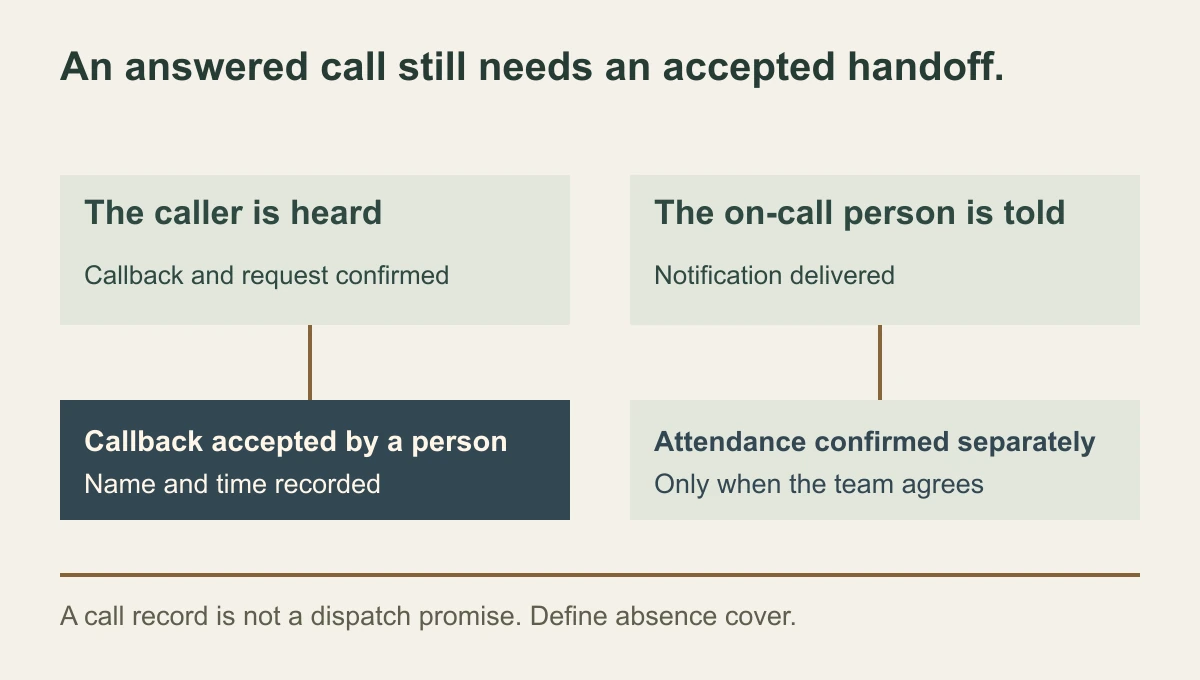
Decide what counts as acknowledgment. A delivered notification does not establish that a person has read it. Opening the record does not establish that they will contact the caller. Require an explicit acceptance of the next action, with the person's name recorded.
Then choose the point at which an unacknowledged request moves to the backup. That interval is your operating decision, based on staffing and the promise you can keep. This guide does not prescribe a dispatch time. Set the rule with the people who will carry it, and test what happens when the first person is unavailable.
Also name the person responsible for the customer update. Otherwise, the office can assume the plumber called while the plumber assumes the office explained the wait. Two reasonable assumptions. One caller with no answer.
Collect a brief a plumber can use
Start with a reachable callback number and the service location. Ask the caller to describe the problem in ordinary words and whether it is happening now. Preserve uncertainty. “Caller reports water near the washing machine; source unknown” is more useful than an assistant deciding which pipe failed.
Ask only the company-approved questions needed to route the request. This is intake, not an inspection or a repair lesson. The first answering layer should not diagnose the fault, give property-safety instructions or promise an arrival. Requests outside its approved scope need the business's defined human route.
A short opening might be:
“What address needs help, and what's the best number to reach you? Tell me what's happening. I'll pass those details to the on-call team so they can confirm whether we can take the request.”
That is proposed wording to adapt, not a script tested with your customers. If the business does not have available on-call coverage, the greeting needs to say so. Receiving a call at night and having a plumber available at night are different services.
The night-call handoff record
Use one record for the request and each change of responsibility. Leave unknown facts marked unknown.
- Caller and location
- Name, confirmed callback number, service address and any access detail the caller supplied.
- Reported problem
- The caller's words, whether they say it is happening now, and what remains uncertain.
- Coverage check
- Service area and work category checked against tonight's approved rules. Anything needing judgment goes to the authorized person.
- Alert and acknowledgment
- Recipient, time sent, acknowledgment time and the exact next action accepted. Record backup attempts separately.
- Customer promise
- What the caller was told, who will update them and the company's agreed update point.
- Disposition
- Callback owned, attendance confirmed by an authorized person, unavailable, caller declined, or still unresolved.
Accepting a callback task does not itself confirm attendance. Keep those decisions separate.
The receiving plumber should find the brief without listening to the entire call. If the caller rings again, join the new information to that request rather than creating an unrelated second job. Ask about changed facts, not the whole story again.
Make an unaccepted request visible
The normal path is straightforward: receive the request, alert the right person, record acceptance of the next action, and update the caller. The exception path deserves equal attention.
If the primary person does not acknowledge, send the request to the approved backup and record the attempt. If neither can take it, the person responsible for updates must communicate the actual situation. Do not let the system keep saying “the team has been notified” as if repetition creates coverage.
For a request still awaiting a decision, proposed wording is:
“Your request has reached our on-call queue. We have not confirmed a plumber or an arrival time. The team is checking whether we can take it.”
Use that wording only when the queue is being monitored and the check is real. Give the caller the genuine next contact or update point your business has agreed. Do not imply they should wait exclusively for you.
If your team cannot attend, say that directly. If attendance is confirmed, use the authorized person's actual plan. A change in that plan needs a new customer update. The log should show both the earlier promise and the correction.
Give the receptionist a clear boundary
An AI receptionist can collect approved facts and carry out the defined routing. Your qualified staff decide whether to accept the work, what the job requires and what timing they can offer. Put that distinction in the call instructions and the receiving workflow.
NIST's voluntary AI guidance recommends documenting responsibilities and human oversight. It supports the general principle of assigning authority; it does not prescribe this plumbing workflow or validate a response-time promise. NIST AI RMF Playbook, GOVERN 2.1 and 3.2
This is why I recommend an implemented, maintained call path rather than leaving a new tool with the office to figure out. We map the approved jobs, transfer rules and exceptions with you, configure the receptionist, and test the handoff. Our recurring work includes monitoring the agreed paths and repairing failures within scope. Your business supplies the plumbers and keeps its operational coverage current.
What the on-call plumber should receive
Burst pipe, kitchen. Caller says water is off at the main. Address 22 Elm St. Callback 555-0177. Wants someone now. Not booked. Please call within 15 minutes.
Invented example. Short, specific and honest: the caller is told what your team has confirmed, and a request for help is not yet a booked visit.
Test the unavailable plumber too
Arrange labelled test requests with the team so nobody mistakes them for a dispatch. Try the ordinary accepted request first. Then try a primary contact who does not acknowledge, an address outside coverage, a repeat caller and an uncertain request needing a person.
For each test, inspect the record and the caller's words. Did the right recipient get enough context? Did acceptance name the next action? Did an unacknowledged request reach the backup? Did the caller hear only what was confirmed? Can the next shift identify anything still open?
Include a failed notification or unavailable call route in the agreed test plan. Define who sees that failure and how the team uses its backup receiving route. A test is useful when it finds the gap before a customer does. Passing one demonstration is not proof of permanent availability.
The next shift should review unresolved requests, failed alerts, accepted callbacks and customer promises still due. Record the outcome rather than marking everything closed because the night is over. Review the path after roster or service-area changes as well.
Take your current night greeting, on-call roster and one anonymized handoff to our home and field services team. Let us configure the reception and receiving route around the work you actually accept. The purchase should give your callers a clearer answer and your team a brief they can carry, while making it easier for you to know when someone else really has the phone.
Frequently asked questions
What should a plumber collect on an after-hours emergency call?
Collect the callback route, service location and the caller's stated situation within the approved intake scope. The brief should let the responsible plumber review the request without forcing the caller to begin again.
What if the on-call plumber does not accept the request?
Keep that state visible and follow the business's approved fallback. Do not tell the caller that a dispatch is confirmed when nobody has accepted it. The customer needs an honest next step.
How does TQP improve after-hours plumbing intake?
We connect the approved questions, on-call route, fallback and receiving record, then test the unavailable-person situation. That gives you a working coverage system rather than just a friendly greeting on the phone.
We configure the approved questions, routing and human handoffs, test the agreed caller situations, and monitor the installed receptionist. Start with the plumbing and field-service call path your business actually needs.
Build an after-hours call route your team can carry