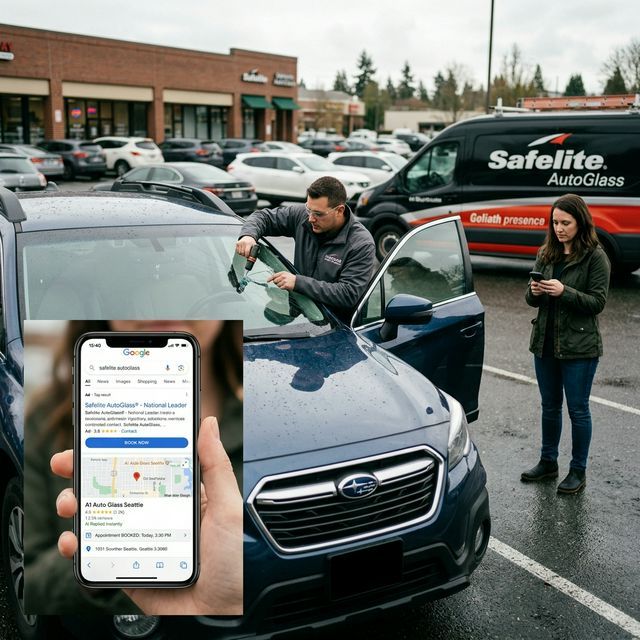

The commuter feels a spike of adrenaline, then annoyance. They pull off at the next exit, park at a gas station, and grab their phone.
Treat any number without a nearby source or stated method as a planning assumption, then replace it with your own records.
A commuter is driving down the interstate at 70 miles per hour. A semi-truck merges into the adjacent lane, kicking up a piece of gravel. There is a sharp *CRACK*, and a spiderweb fracture immediately blooms across the driver's side of the windshield.
The commuter feels a spike of adrenaline, then annoyance. They pull off at the next exit, park at a gas station, and grab their phone.
In the auto glass repair business, this is the exact moment the sale happens. The customer is not going to research auto glass shops for three weeks. They are not going to read "About Us" pages or deeply analyze the structural integrity of different urethane adhesives.
They are going to type "windshield repair" into Google, click the first two results, and attempt to get the problem solved immediately so they can get back to their day.
For the last twenty years, this specific moment has been completely dominated by national franchises. Why? Because when the commuter clicks on the national chain's website, they are met with a sophisticated, frictionless booking engine. If they call the 800-number, they are routed to a massive call center where someone answers immediately.
Conversely, when the commuter calls the independent local shop, the phone rings six times before a distracted technician wipes the grease off his hands, picks up the phone, and yells over the sound of an air compressor, "Bob's Auto Glass, hold please!"
The commuter hangs up.Bob just lost a $450 replacement job not because his workmanship was worse-Bob is probably a better technician than the 22-year-old the national chain is going to send out-but because his intake process was full of friction.
The Power of Fast, Structured Intake
The single biggest leverage point for an independent auto glass shop is modernizing the front door. You cannot outspend the national chains on television commercials. But you can out-perform their call centers by implementing a Voice AI intake system that answers every single phone call on the first ring with absolute perfection.
An AI Intake Coordinator levels the playing field. It does not put the customer on hold. It does not get overwhelmed when three people call at the same time. It has no background noise. It simply answers the phone, expresses empathy for the damaged glass, and immediately begins the triage process.
**AI Intake:** "Thank you for calling Precision Auto Glass. Did you just catch a rock, or are you looking for a full replacement?"
**Caller:** "Yeah, I was just driving on I-95 and got a huge crack. It's about five inches long."
**AI Intake:** "Oh man, I am so sorry to hear that. A five-inch crack means we will likely need to do a full replacement for safety reasons. What is the year, make, and model of your vehicle?"
**Caller:** "It's a 2021 Toyota RAV4."
**AI Intake:** "Got it. A 2021 RAV4. Let me pull up our live inventory really quick... Okay, we do have that OEM-equivalent glass in stock. Since that model has a forward-facing camera, we will also need to recalibrate the ADAS system so your lane-departure warnings work correctly. Would you prefer we send a mobile tech out to your home or office, or did you want to bring it into the shop?"
In less than sixty seconds, the AI has validated the damage type, checked inventory, correctly identified a complex ADAS-calibration requirement, and moved to close the appointment based on the customer's convenience preference. The customer just achieved a state of complete relief. The problem is solved. They will not call the national chain.
The ADAS Calibration Problem
Ten years ago, a windshield was just a piece of laminated safety glass. Today, a windshield is a highly complex sensory organ for the vehicle's computer. Advanced Driver Assistance Systems (ADAS) rely on cameras mounted directly behind the rear-view mirror to control automatic emergency braking, adaptive cruise control, and lane-keeping assist.
If an independent shop replaces the windshield and fails to recalibrate the camera, those safety systems will fail. If those systems fail and the customer crashes, the shop is liable.
The problem is that customers do not know this. They call asking for a $200 piece of glass, and when a human technician tries to explain that they actually need a $350 calibration service attached to it, the customer thinks they are being up-sold.
Voice AI removes the emotion and suspicion from this process by treating it as a matter-of-fact technical requirement. The AI is programmed with a database of every vehicle year and trim that mandates ADAS calibration.
When the customer says "2023 Honda CR-V," the AI immediately cross-references the database and says:
"Just to be completely transparent with you, the 2023 CR-V has a forward-facing safety camera built into the glass. Manufacturer specifications require us to perform a dynamic recalibration on that camera after the replacement so your automatic braking works properly. That service is included in our quote. Do you have comprehensive insurance, or are you paying out of pocket?"
By addressing it proactively and professionally, the AI establishes the local shop as a high-end, safety-conscious expert, sharply contrasting with lower-tier shops that might try to hide the calibration fee until the end of the transaction.
The Insurance Verification Problem
The national chains have convinced the American public that they are the "official" glass repair network for insurance companies. They are "preferred vendors." They are embedded in the claims process.
But the truth is, the customer has a legal right to choose whatever shop they want, and almost every independent shop can bill identical insurance networks through systems like Lynx or Safelite Solutions (the billing entity, not the retail brand).
The independent shop's weakness is answering the question: "Do you take State Farm?"
A busy human tech will usually say, "Yeah, we take State Farm, you just have to call them and file the claim and tell them you want to use us, and they'll send over the dispatch."
To the customer standing in a gas station parking lot, that sounds like a lot of homework.
The Voice AI is trained to execute a smooth, high-conversion insurance dialogue.
**AI Intake:** "Yes! We are an approved vendor for State Farm. If you have comprehensive coverage, this replacement will likely just be the cost of your deductible, and if it's just a rock chip fill, State Farm usually waives the deductible entirely so it's completely free for you. Would you like me to text you our direct insurance routing number so we can process the claim together?"
Instead of pushing the work back onto the customer, the AI takes the burden of process. Furthermore, by explicitly mentioning that chip fills are often free under comprehensive coverage, the AI intercepts customers who were afraid of a massive out-of-pocket bill and gets them scheduled immediately.
Mobile Dispatching Without the Chaos
The strongest weapon the independent shop has is the mobile van. Sending a technician directly to the customer's office parking lot is the ultimate convenience play.
But dispatching mobile technicians is an operational nightmare. If a human answers the phone and promises a customer that "Mike will be there between noon and 2:00 PM," but Mike's 10:00 AM job gets delayed because a rainstorm forces him to set up a canopy, the entire schedule cascades into failure. The customer gets angry and leaves a negative review.
Voice AI solves this by integrating directly with the shop's field service management software (like GlasPacLX or Elmo).
The AI does not guess at availability. It looks at the live GPS clustering of the mobile technicians. If the caller is located in the North Suburbs, the AI looks at the schedule for the northern route technician.
**AI Intake:** "Our mobile technician, Dave, is actually going to be in your zip code tomorrow morning. I can slot you in for an arrival window between 9:00 AM and 11:00 AM right in your driveway. All we need is a flat surface and enough room to open both doors. Does that window work for you?"
If the customer says yes, the AI immediately pushes the work order to Dave's iPad, texts the customer an appointment confirmation, and sends an automated pre-arrival text when Dave finishes his previous job. The independent shop suddenly operates with the logistical precision of Amazon Prime.
After-Hours Lead Capture: The Silent Revenue Generator
Auto glass damage happens all the time. The highest incidence of windshield impacts occurs during the morning and evening commutes.
If an independent shop closes at 5:00 PM, they are entirely missing the evening commute market. When a commuter gets a rock chip at 5:45 PM and calls the local shop, they hear a voicemail. When they call the national chain, they get an answer.
By deploying a Voice AI, the independent shop becomes a 24/7 operation without adding a single dollar of overtime payroll.
If a customer calls at 8:30 PM, the AI picks up, expresses sympathy, qualifies the year/make/model, and books a tentative appointment for the following morning.
**AI Intake:** "Because our office is currently closed, I am putting a priority flag on your vehicle. I have secured an 8:30 AM callback slot for you tomorrow morning. One of our glass specialists will call you right at 8:30 AM to confirm the glass availability and finalize the dispatch time. I just sent a confirmation text to this number. Is there anything else I can help you with tonight?"
The customer goes to bed knowing the problem is fundamentally handled. The next morning, the shop owner walks in, opens their dashboard, and sees three high-intent leads with vehicle data perfectly formatted, ready to be dispatched.
Capturing the Dealership & Fleet Market
While retail consumer work is the bread and butter of auto glass, the highly lucrative whales of the industry are local car dealerships and commercial fleets (plumbers, HVAC vans, delivery vehicles).
Fleet managers and used-car sales managers at dealerships need glass fixed instantly. They do not care about catchy jingles; they care about vehicle downtime. If a dealership has a used F-150 with a cracked windshield, it cannot go on the lot to be sold. Every day it sits waiting for a glass tech is dead money.
The AI can be trained to recognize the phone numbers of established fleet and dealership partners. When the Used Car Manager from the local Ford dealership calls, the AI routes them through a VIP protocol.
**AI Intake:** "Hi Mike! Thanks for calling from Valley Ford. Because you are one of our VIP dealer accounts, I'm routing this directly to the dispatcher's cell phone so we can get your glass ordered immediately. Please hold for one second."
This level of dedicated service solidifies B2B relationships. The dealership knows that when they call your shop, they get VIP priority, skipping the queue entirely. The national chains are often too inflexible and bureaucratic to offer this level of personalized B2B routing.
The Technician Handoff
The ultimate irony of installing an AI to answer the phone is that it actually makes the business feel more human and more professional.
Independent auto glass shops are often run by master technicians who are incredible at setting glass, replacing regulators, and executing flawless urethane beads. But they are frequently terrible at customer service while under a dashboard with urethane on their hands.
When a technician tries to answer a ringing cell phone while mid-installation, they sound distracted, gruff, and rushed. The customer feels like an extreme burden.
By handing the repetitive triage calls to an infinitely patient, perfectly polite AI, the technician is freed to do what they do best: fix the car. When the technician finally speaks to the customer-either upon arrival or during a complex escalation-they are calm, prepared, and focused entirely on the customer in front of them.
Combating the "Network Requirement" Myth
One of the most insidious tactics used in the auto glass industry is the subtle implication by insurance adjusters that a customer *must* use a specific national chain because they are "in-network." When a customer files a glass claim online, the digital interface often routes them smoothly into the scheduling software of a massive franchise, making it appear as if there are no other options.
This practice borders on steering, which is heavily regulated and often illegal, depending on the state. However, the damage is done at the psychological level. The customer believes that if they use their local independent shop, their insurance won't cover the bill or they will be forced to pay completely out of pocket and wait months for reimbursement.
A properly trained AI Intake Coordinator serves as a bulwark against this misinformation array. When the AI speaks to a caller, it can confidently and legally clarify the customer's rights under their specific policy. By deploying phrases like, "By law, you have the right to choose your repair facility, and we function as an approved affiliate for all major networks to ensure your coverage is instantly applied," the AI dismantles the "network" illusion.
This brief, automated education transforms a hesitant, confused caller into a loyal, empowered advocate for the local business. By demystifying the insurance labyrinth instantly on the first phone call, the local shop establishes unmatched authority and earns a lifetime customer.
The AI absorbs the chaos. The humans execute the craft.
The independent auto glass shop does not need to be bigger than the national chain to win.They just need to be faster, smarter, and infinitely more responsive in the four-minute window when the customer is desperately trying to solve a problem.
The Operating Standard
In the context of The Four-Minute Window: How Local Auto Glass Shops Use AI to Compete With National Chains, we must address the fundamental friction that exists in manual intake. Every 'missed call' is a missed revenue opportunity, but more importantly, it's a signal of operational weakness that high-value prospects detect instantly. By bridging this gap with AI-driven intake, you're not just 'automating.' You're humanizing the interaction by ensuring that your clients get the attention they deserve, instantly. This is the math of responsiveness that wins markets.
Strategic ROI: When we apply the Quiet Protocol math to The Four-Minute Window: How Local Auto Glass Shops Use AI to Compete With National Chains, the result is always the same: a dramatic reduction in cost-per-acquisition (CAC) and a significant increase in client lifetime value (LTV) through immediate resolution.
The loss estimate is basic business math, not a magic claim.
Revenue-leak examples on this site are built from visible operating inputs: inquiry volume, missed-call or slow-response rate, booking rate, average job or client value, repeat value, and follow-up recovery. The fastest way to make the number real is to run the diagnostic for your closest business type, then compare it against your own call log, CRM, booking calendar, form timestamps, and review activity.
The practical questions behind this decision.
What proof should I look for in my own business?
Look for proof in the places where demand either moved forward or stalled: missed calls, short calls, unbooked forms, slow callbacks, no-show recovery, old leads, and reviews that were never requested. If the business cannot see those moments clearly, the first improvement is better tracking and routing.
How do I know whether this is a marketing problem or an operations problem?
If people are already calling, filling forms, asking for prices, requesting appointments, or comparing reviews, the problem is usually operations. More marketing will not fix a front door that lets warm demand wait. The better move is to capture and route the demand already arriving.
What should happen after the first response?
The first response should create a next step: booked appointment, estimate path, intake handoff, callback window, review request, or reactivation sequence. A response that only says someone will get back to you is not enough when the buyer is comparing several providers at once.
Where does The Quiet Protocol fit?
The Quiet Protocol fits when the business already has demand but too much of it depends on manual attention. We connect AI receptionist coverage, web intake, missed-call recovery, booking logic, follow-up, review requests, and reactivation into one managed front-door system.
Decide what the AI must handle before you choose the software.
A useful intake system begins with the caller journey, the rules, and the human handoff, not a long feature list.
Give the receptionist a realistic scenario and hear how it answers, gathers context, and moves the caller toward a useful next step.
See how the capability in this article fits into a complete customer journey.
Auto Glass & Windshield RepairSee the same decision through the language, buyer behavior, and operating reality of this industry.
Client Results & ProofInspect the starting condition, installation, measurement window, and outcome behind real client work.

Why Service Businesses Lose Inbound Leads Before the Phone Rings
It is not a traffic problem. Many service businesses lose revenue because the front door breaks before the buyer reaches a real conversation.
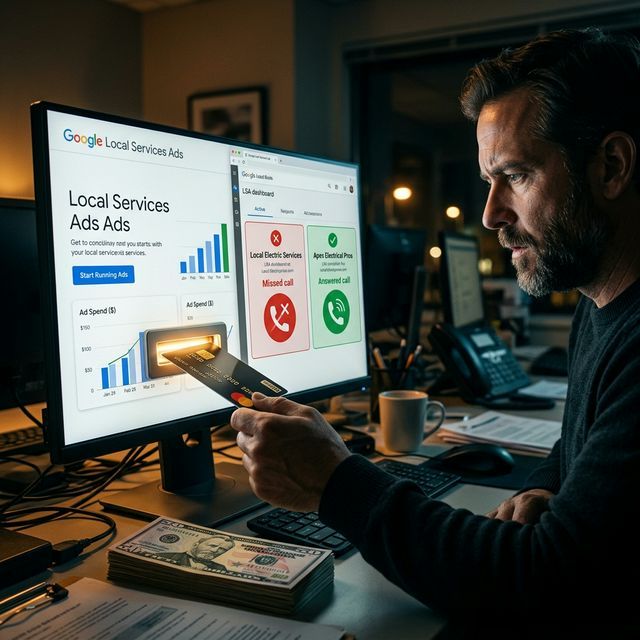
Local Service Ads Are Wasting Your Money Without Voice AI
Local Service Ads can waste budget when paid calls are missed, delayed, or pushed to voicemail. Learn how voice AI protects LSA ROI for local service businesses.
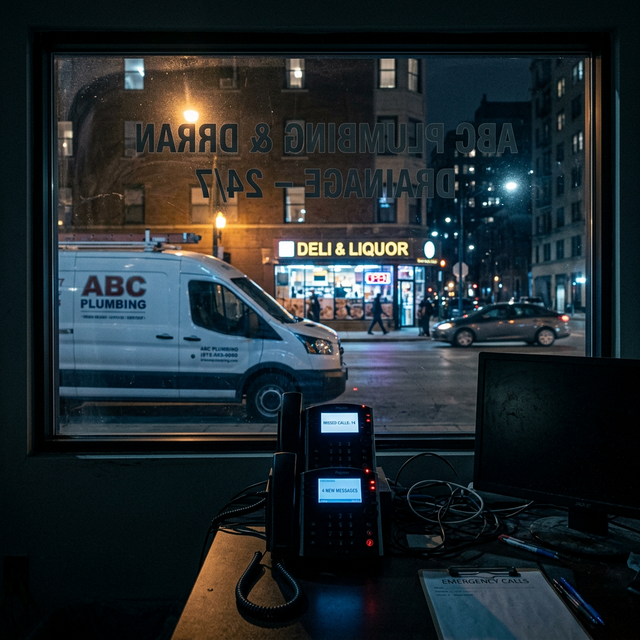
The After-Hours Revenue Leak: How Service Businesses Lose Their Best Jobs After 5 PM
After-hours callers are often the highest-intent buyers in a service business. Learn how to calculate the leak, triage calls, and protect revenue without burning out staff.
Calculate the revenue leak.
Stop guessing. See how much demand your business may be losing through missed calls, slow replies, weak booking, review gaps, and follow-up drag, then decide whether Voice AI is the right system path.
Run the calculationPrefer to hear it first?
Call the live AI receptionist and test the conversation.
Call the live AI receptionist anytime. Tell it about auto glass & windshield repair, then hear a short live roleplay based on the calls your front desk actually gets.