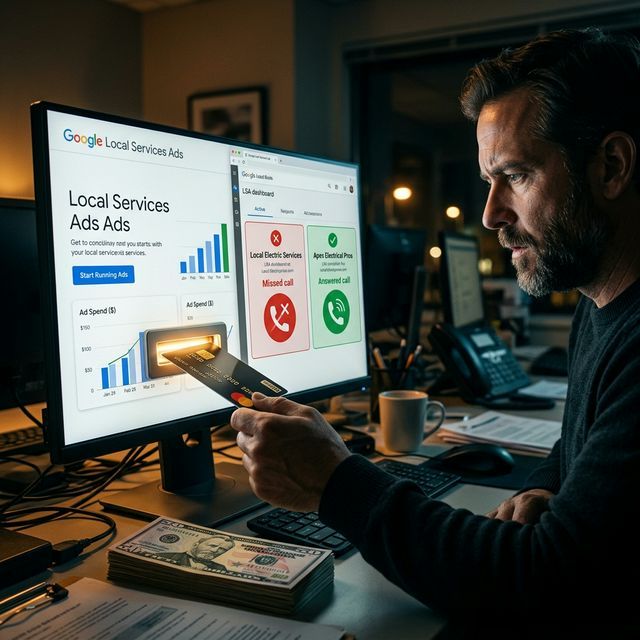

When a paid lead call is missed, the business loses the chance and pays for the privilege.
Treat any number without a nearby source or stated method as a planning assumption, then replace it with your own records.
Local Service Ads create a strange kind of pressure.
The buyer is close.
The intent is high.
The call is not theoretical traffic.
It is a person asking for help.
And the business is paying for that opportunity.
That is why missed Local Service Ads calls hurt more than normal missed calls.
When an organic call is missed, the business loses a chance.
When a paid lead call is missed, the business loses the chance and pays for the privilege.
That is the LSA front-door problem.
Many local service companies treat Local Service Ads as a media-buying problem.
They adjust bids.
They fight lead quality.
They pause categories.
They complain about competitors.
Sometimes those are real issues.
But if the phone rings and nobody can turn the call into a booked job, the campaign is not the first place to look.
The intake system is.
Paid Intent Has a Short Fuse
Local Service Ads usually attract buyers who are ready to talk.
They are not casually browsing.
They are choosing a provider from a short list.
The buyer may need:
- A plumber today.
- HVAC repair before the house gets uncomfortable.
- A locksmith now.
- Pest control this week.
- A cleaner before guests arrive.
- A roofer after a storm.
- A lawyer for a problem they do not want to explain twice.
The buyer clicks because they want a next step.
If the phone rings out, the buyer does not pause the problem.
They call the next provider.
That is why LSA speed matters.
The ad created urgency.
The business has to meet it.
The Paid Lead Leak
Most owners think of ad waste as bad targeting.
Wrong area.
Wrong service.
Low-quality inquiry.
Duplicate lead.
Price shopper.
Those can happen.
But there is another kind of waste that hides inside operations.
A real buyer calls.
The business misses it.
The buyer does not leave a voicemail.
The owner sees a missed call later.
Someone calls back after twenty minutes.
The buyer says they already found someone.
The lead was not bad.
The response was late.
That is the most painful kind of ad waste because it is preventable.
The campaign did its job.
The phone path failed.
Why LSA Calls Are Hard To Handle
Local Service Ads often hit small teams at the worst possible time.
The owner is in the field.
The office manager is on another call.
The technician is driving.
The dispatcher is dealing with a current customer.
The person who can answer pricing questions is not at the desk.
The person who can schedule is also handling cancellations.
That is normal in a local service business.
The problem is that paid leads do not respect your staffing model.
They arrive when they arrive.
If the business only has one or two people capable of handling the first call, paid traffic creates a bottleneck.
More budget pushes more demand into the same narrow pipe.
At some point, the campaign looks inefficient because the operation cannot receive what the campaign is producing.
The Three LSA Failure Modes
The Missed Paid Call
This is the obvious leak.
The phone rings.
Nobody answers.
The buyer leaves.
The team may call back, but the moment is already damaged.
For urgent categories, a five-minute delay can be enough to lose the job.
The Low-Resolution Answer
Someone answers, but cannot move the buyer forward.
They say:
"Someone will call you back."
"Can you submit a form?"
"I need to check with the owner."
"The scheduler is not here right now."
That may be true, but the buyer hears uncertainty.
If the buyer is comparing providers, uncertainty loses.
The Untracked Outcome
The call happens.
The team talks to the buyer.
Nobody records whether it booked.
Nobody marks why it did not book.
Nobody separates wrong-fit calls from missed opportunity.
At the end of the month, the owner only sees spend and frustration.
Without outcome tracking, LSA optimization becomes guesswork.
A Simple LSA Math Example
Imagine a home service company spends $4,000 a month on Local Service Ads.
The ads generate 80 paid phone leads.
The average paid lead cost is $50.
Twenty calls are missed, delayed, or handled without a clear next step.
That is $1,000 in visibly wasted lead spend.
But lead cost is only the small number.
If 10 of those missed opportunities could have become booked jobs at $700 each, the revenue leak is $7,000.
If two of those customers could have become repeat customers, the long-term loss is higher.
If one was a larger replacement or project job, the loss can dwarf the monthly ad spend.
This is why owners can feel like LSAs are expensive even when the lead cost looks reasonable.
The cost per lead is not the real measure.
The real measure is cost per booked, qualified job.
If intake is weak, that number gets ugly fast.
Voice AI Does Not Fix Bad Economics
Voice AI is not a magic fix for every LSA account.
If the business targets the wrong services, the wrong cities, or the wrong job types, intake will not save the campaign.
If pricing is uncompetitive, the close rate may still be poor.
If reviews are weak, the business may not receive enough call volume.
If the service area is too broad, the team may waste time on jobs it cannot profitably serve.
Those are real advertising problems.
But once the ads are producing real calls, the first question becomes operational:
Can the business answer and qualify every paid inquiry?
If the answer is no, voice AI can protect the spend the business is already making.
It does not make bad leads good.
It stops good leads from disappearing.
What Voice AI Should Capture on LSA Calls
The first call should produce a usable brief.
For most service businesses, that means:
- Name.
- Phone number.
- Service requested.
- Address or service area.
- Urgency.
- Availability.
- Job details.
- Photos if useful.
- Existing customer status.
- Preferred next step.
- Whether the call was booked, escalated, or disqualified.
That brief should land somewhere the team actually uses.
CRM.
Calendar.
Dispatch board.
Pipeline.
Shared inbox.
If the AI answers but the information disappears into a transcript nobody reads, the system is not finished.
The point is to make the next human action faster and more confident.
The First-Minute Standard
For LSA calls, the first minute matters more than the perfect script.
The buyer needs to know three things quickly:
You understand the problem.
You serve their area.
There is a next step.
A strong intake path might sound like:
"I can help with that. Are you looking for service today, an estimate, or a future appointment?"
Then:
"What city are you in?"
Then:
"What is the main issue?"
Then:
"I can collect the details and get this to the right person now."
That is a very different experience from ringing, voicemail, and delayed callback.
It does not need to be flashy.
It needs to be immediate and useful.
The Callback Problem
Many owners believe fast callbacks are enough.
They are better than no callbacks.
They are not the same as answering.
When buyers come from paid local ads, they are often calling multiple providers in a short window.
If you call back ten minutes later, you may reach them after the competitor has already booked them.
That does not mean the buyer was low quality.
It means the market moved faster than your process.
The callback should be a recovery tool, not the primary intake strategy.
Voice AI changes the sequence.
Instead of:
miss call, call back, hope buyer still cares.
The sequence becomes:
answer, qualify, book or escalate, then follow up with context.
That is a stronger use of paid traffic.
How To Audit Your LSA Front Door
Run a two-week audit.
For every LSA call, track:
- Lead cost.
- Call time.
- Answered or missed.
- Time to answer.
- Call duration.
- Service requested.
- Location.
- Booked or not booked.
- Reason not booked.
- Follow-up completed.
- Revenue if sold.
Then group the failures.
How many were truly bad leads?
How many were missed?
How many were good but outside the service area?
How many needed faster scheduling?
How many were price objections?
How many were never followed up?
This turns LSA frustration into a fix list.
The owner may discover that the ad account is fine but the phone process is weak.
Or they may discover that targeting needs cleanup.
Both answers are better than guessing.
Where AI Fits In The Workflow
The cleanest workflow is usually simple.
LSA call arrives.
Voice AI answers immediately.
The system identifies service, location, urgency, and contact details.
Emergency calls route to the right person.
Qualified non-emergency calls book directly or request the next available human slot.
Unqualified calls are tagged with the reason.
The summary goes to the CRM.
The owner sees the source, outcome, and next step.
That workflow gives the business a better paid lead record.
It also gives the ad account better operational feedback.
If one category produces too many wrong-fit calls, adjust it.
If one city produces great calls but weak booking because travel time is too long, adjust it.
If after-hours calls are high intent, cover them.
The phone becomes a data source, not just a stress source.
The Budget Conversation Changes
Once the front door is measured, the LSA budget conversation becomes calmer.
Without intake data, the owner only has feelings.
"The leads are bad."
"The ads are too expensive."
"Google is charging too much."
"The phones are busy but revenue is not moving."
Some of that may be true.
But feelings do not tell you where to adjust.
With intake data, the owner can separate four different problems.
First, the ads may be attracting the wrong jobs.
Second, the business may be missing good calls.
Third, the team may be answering but not booking.
Fourth, the follow-up may be too slow after the first conversation.
Each problem has a different fix.
Wrong jobs need targeting cleanup.
Missed calls need coverage.
Weak booking needs script and calendar access.
Slow follow-up needs automation and accountability.
That is why call outcome data is so valuable.
It stops the business from treating every LSA problem like a bid problem.
Sometimes the correct answer is not to spend less.
Sometimes the correct answer is to make the same spend convert properly.
If a company spends $4,000 and books 12 jobs, the account feels expensive.
If the same spend books 22 jobs because the answer rate and booking workflow improved, the conversation changes.
The ad platform did not become cheaper.
The operation became less wasteful.
That is the work most local service companies skip.
What Not To Automate
Do not automate false promises.
Do not let AI quote jobs the business has not priced.
Do not let it promise technician availability if the calendar is not connected.
Do not let it handle emergencies without escalation rules.
Do not bury upset customers in a script.
Do not make it harder to reach a human when judgment is needed.
Good AI intake is controlled.
It knows what it can do.
It knows what it must escalate.
It gives the business speed without inventing authority it does not have.
A 30-Day Fix
Week one: audit LSA calls and missed-call windows.
Week two: define the intake script, qualification rules, service areas, and booking rules.
Week three: connect voice AI to the phone path, CRM, and calendar or dispatch workflow.
Week four: compare answer rate, booking rate, bad-lead rate, and revenue against the prior period.
This is not a branding project.
It is a revenue control project.
The first goal is not perfection.
The first goal is to stop paying for calls that nobody properly catches.
After that, the business can make cleaner ad decisions because the basic intake leak is no longer hiding inside the numbers.
Bottom Line
Local Service Ads do not fail only because the ads are bad.
They often fail because the business pays for buyer intent and then lets the phone path break.
Every missed paid call is a double loss.
You paid to create the moment.
Then the buyer found someone else.
Before increasing LSA budget, audit the front door.
Measure answer rate.
Measure booked jobs.
Measure callback delays.
Measure the difference between a lead and revenue.
Then build an intake system that treats every paid call like inventory that can expire.
*If your Local Service Ads feel expensive, audit the last two weeks of paid calls before touching the budget. The fastest ROI improvement may be answering and resolving the leads you already bought.*
Use your own records before you decide
Source: start with your call log, CRM notes, booking calendar, missed-call records, web form timestamps, and Google Business Profile. Those records show whether buyers reached you, how fast they heard back, what they asked for, and where the next step broke down.
For seven days, mark each missed call, late reply, unbooked form, stale estimate, and review request that never went out. That small sample gives an owner a practical picture of the front-door gap before they spend more on ads, software, or staff.
The loss estimate is basic business math, not a magic claim.
Revenue-leak examples on this site are built from visible operating inputs: inquiry volume, missed-call or slow-response rate, booking rate, average job or client value, repeat value, and follow-up recovery. The fastest way to make the number real is to run the diagnostic for your closest business type, then compare it against your own call log, CRM, booking calendar, form timestamps, and review activity.
The practical questions behind this decision.
Are Local Service Ads bad for service businesses?
No. LSAs can work well when the business can answer, qualify, and book quickly. They become frustrating when paid inquiries hit a weak intake process.
Does voice AI reduce lead cost?
Not directly. It usually improves the economics by increasing the percentage of paid calls that become qualified booked opportunities. The lead cost may stay the same while cost per booked job improves.
Should I pause LSAs until intake is fixed?
If the business is missing a large share of paid calls, reducing spend temporarily can make sense. But the better long-term move is to fix answer rate, routing, and outcome tracking so the account has a fair chance to perform.
Can an answering service do this instead?
Sometimes. The issue is not whether the responder is human or AI. The issue is speed, consistency, booking ability, service knowledge, and CRM follow-through. Many answering services take messages but do not resolve enough of the buyer journey.
What is the first metric to check?
Start with paid-call answer rate. Then check booked-job rate from answered calls. Those two numbers usually reveal whether the problem is advertising, intake, or both.
Decide what the AI must handle before you choose the software.
A useful intake system begins with the caller journey, the rules, and the human handoff, not a long feature list.
Give the receptionist a realistic scenario and hear how it answers, gathers context, and moves the caller toward a useful next step.
See how the capability in this article fits into a complete customer journey.
Legal, Financial & AdvisorySee the same decision through the language, buyer behavior, and operating reality of this industry.
Client Results & ProofInspect the starting condition, installation, measurement window, and outcome behind real client work.

Why Service Businesses Lose Inbound Leads Before the Phone Rings
It is not a traffic problem. Many service businesses lose revenue because the front door breaks before the buyer reaches a real conversation.
The Ringing-Out Penalty: How Unanswered Calls Hurt Google Maps Leads
Local service businesses can lose Google Maps revenue when calls ring out, buyers call competitors, and intake data stays invisible. Learn how to audit and fix the leak.

Why Local SEO Underperforms When Calls Go Unanswered
Local SEO does not end when a buyer taps call. If your service business sends high-intent searchers to voicemail, the ranking work is turning into wasted demand.

Why Your Google Ads Are Failing: The Operational Leak Between Click and Customer
Many service business Google Ads campaigns fail after the click. Learn how missed calls, slow intake, weak landing pages, and after-hours gaps waste paid demand.
Calculate the revenue leak.
Stop guessing. See how much demand your business may be losing through missed calls, slow replies, weak booking, review gaps, and follow-up drag, then decide whether Voice AI is the right system path.
Run the calculationPrefer to hear it first?
Call the live AI receptionist and test the conversation.
Call the live AI receptionist anytime. Tell it about legal, financial & advisory, then hear a short live roleplay based on the calls your front desk actually gets.