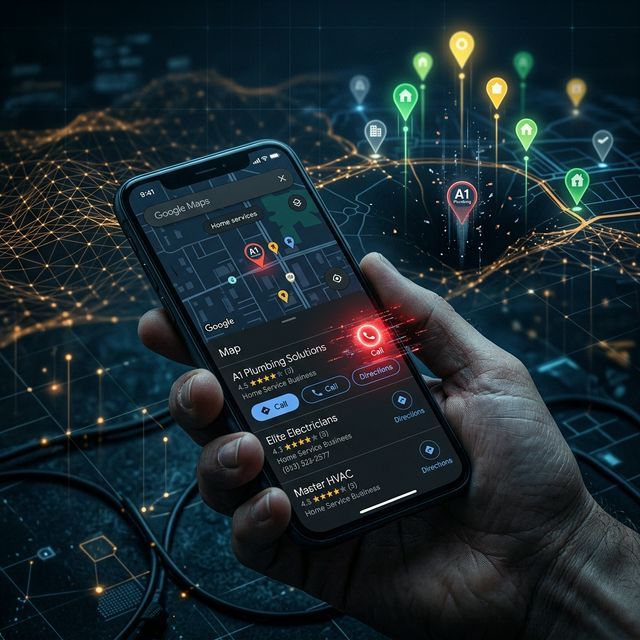

It is the practical penalty a business pays when search demand reaches the phone and the operation fails to catch it.
Treat any number without a nearby source or stated method as a planning assumption, then replace it with your own records.
The most expensive Google Maps problem in a local service business is not always ranking.
Sometimes the business is already visible.
The profile appears.
The reviews look strong.
The photos are current.
The service area is clear.
The buyer taps the call button.
Then the phone rings.
And rings.
And rings.
Nobody answers.
That is the ringing-out penalty.
It is not a formal warning inside Google Business Profile.
It is the practical penalty a business pays when search demand reaches the phone and the operation fails to catch it.
The buyer does not wait.
They go back to Maps.
They call the next company.
Your marketing created the moment.
Your intake handed it away.
The Ranking Conversation Is Often Too Narrow
Most local SEO conversations start with visible inputs.
Reviews.
Categories.
Photos.
Citations.
Website speed.
Service pages.
Backlinks.
Those things matter.
But for a service business, the Maps listing is not a brochure.
It is a live front door.
The question is not only whether the profile appears.
The question is what happens after a buyer chooses it.
If a homeowner searches for an emergency plumber, taps your listing, calls, waits through a long ring, and hangs up, the search experience failed.
If they call another plumber and stay on that call, the buyer's path moved away from you.
You do not need to know every detail of Google's local ranking system to understand the business risk.
An unanswered Maps call is not a neutral event.
It is a lost buyer, a lost job, and a signal that your front door is not ready for the demand your visibility is creating.
The Real Journey After the Call Button
A Google Maps lead moves quickly.
The buyer is usually not studying five websites.
They are in motion.
They have a leak.
They need a quote.
They need a clinic.
They need a lawyer.
They need a cleaner.
They need someone to say, "Yes, we can help."
That means the call button is a decision point.
The buyer has already filtered options.
They have seen your name.
They have seen your rating.
They have accepted your location or service area.
They have decided you are worth contacting.
The only thing left is response.
If the call is answered quickly and handled well, the search often stops.
If the call is missed, the search continues.
That is why ringing out is so dangerous.
It turns qualified demand into competitor demand within seconds.
What Ringing Out Looks Like in the Business
Owners often underestimate the problem because the leak is quiet.
There is no angry email.
There is no failed checkout alert.
There is no line item in the SEO report that says, "Buyer called competitor after you missed them."
There is just a phone record.
Missed call.
No voicemail.
Unknown number.
Maybe one more call two minutes later.
Maybe nothing.
The owner tells themselves it was probably spam.
Sometimes it was.
Often it was not.
In a service business, missed calls cluster around the most valuable moments.
Early morning.
Lunch hour.
After work.
After hours.
Storm days.
Heat waves.
School pickup windows.
Monday backlog.
Friday urgency.
Those are not random calls.
Those are demand spikes.
If the business rings out during those windows, it loses the exact buyers Maps visibility was supposed to capture.
The Maps Problem Is an Intake Problem
A business can spend years improving local visibility and still lose revenue because the call path is weak.
That is the frustrating part.
The SEO may be working.
The ad campaign may be working.
The review strategy may be working.
The profile may be doing its job.
The breakdown happens after the click.
This is why more marketing can make the problem worse.
More impressions create more calls.
More calls hit the same overwhelmed front desk.
More calls go unanswered.
More buyers leave.
The owner sees higher activity but not enough booked work.
Then they assume the marketing is poor.
Sometimes the marketing is poor.
But very often the front door is leaking before anyone measures it.
Three Ring-Out Patterns
The Long Ring
The phone rings for thirty or forty seconds.
The buyer waits.
Nobody picks up.
The call ends.
This is the purest version of the leak.
It usually happens when the team is busy with existing work.
A technician is on another call.
A receptionist is speaking to a customer.
The owner is on site.
The office is closed for lunch.
The buyer does not care why.
They only know nobody answered.
The Voicemail Dead End
The business technically answers through voicemail.
That does not mean the buyer feels handled.
If the recording says the office is closed and someone will call back later, many urgent buyers keep searching.
For some categories, voicemail is almost the same as no answer.
Emergency plumbing.
HVAC repair.
Legal intake.
Private investigation.
Medical appointments.
High-ticket home services.
The buyer wants the next step now.
The "We Will Call You Back" Trap
Sometimes a person answers but cannot resolve the call.
They take a message.
They ask the buyer to wait.
They say someone else handles scheduling.
They promise a callback.
That may be polite, but it is not always enough.
If the buyer still feels uncertain, they may call another company while waiting.
The call was answered, but the search did not end.
That is the real test.
Did the interaction move the buyer forward?
Or did it send them back to the market?
A Simple Revenue Example
Take a local HVAC company.
It gets 120 Google Maps call-button clicks in a month.
Thirty calls are missed, abandoned, or pushed into voicemail.
If even half of those were real buyers, that is 15 serious opportunities.
If the average booked job is worth $650, the visible monthly leak is $9,750.
That is before repeat work, maintenance plans, referrals, and replacement opportunities.
Now add the hidden cost.
Those buyers did not simply disappear.
Many called a competitor.
Some booked the competitor.
Some became a future service relationship for the competitor.
The business did not only lose today's repair.
It lost the customer file.
This is why missed Maps calls deserve more attention than another generic blog post or another small citation cleanup.
The revenue is already at the door.
The question is whether anyone opens it.
Why The Dashboard Can Mislead You
Google Business Profile can show calls as an action.
That is useful, but it is not the full truth.
A call click is not a booked job.
It is not even an answered call.
It is only proof that someone tried to reach you.
Owners get into trouble when they treat call clicks like conversions.
The dashboard says activity is up.
The agency reports more interactions.
The business still feels slow.
The missing layer is outcome.
Answered or missed.
Booked or unbooked.
Urgent or low intent.
New customer or existing customer.
Estimate requested or wrong number.
Followed up or forgotten.
Without that layer, you cannot tell whether Maps is producing revenue or producing pressure on a broken intake system.
The Seven-Day Ring-Out Audit
Before changing your SEO plan, audit the phone.
Pull seven days of call logs.
If your business has strong seasonal swings, choose a busy week.
Mark every inbound call connected to your Google Business Profile number or main tracked number.
For each call, record:
- Date and time.
- Source if known.
- Answered or missed.
- Ring duration.
- Call duration.
- Voicemail or no voicemail.
- Buyer type if known.
- Service requested.
- Booked, quoted, followed up, or lost.
- Callback time.
- Whether the buyer had to call twice.
This does not need to be perfect.
It needs to be honest.
The goal is to see when the business becomes unreachable.
Most owners find a pattern quickly.
Calls fail after 5 PM.
Calls fail during lunch.
Calls fail when the owner is in the field.
Calls fail when the office manager is already on a call.
Calls fail on Mondays.
Calls fail during weather spikes.
Once you see the pattern, the ranking conversation changes.
You are no longer guessing about visibility.
You are looking at the operational path from Maps to booked work.
What To Ask Your SEO Agency
This audit also changes the conversation with your SEO agency.
Instead of only asking why rankings moved, ask what happened to the calls rankings already created.
Ask how many call-button clicks became answered calls.
Ask how many answered calls became booked appointments.
Ask whether missed calls are being separated from qualified booked leads.
Ask whether call volume rises during windows when nobody is available.
Ask whether the agency is reporting actions or outcomes.
A good agency should welcome that conversation.
It gives them better data.
It also protects their work from being blamed for an operational leak they cannot see from ranking reports alone.
The owner does not need marketing and operations to fight each other.
They need both sides looking at the same buyer journey.
Maps visibility creates the opportunity.
Intake decides whether that opportunity becomes revenue.
What AI Intake Should Do
Voice AI should not be a gimmick on top of a weak process.
It should be a front-door system.
For Maps calls, the job is simple.
Answer quickly.
Identify the need.
Capture contact information.
Qualify urgency.
Check location or service area.
Book the next step when possible.
Send the summary into the CRM.
Trigger the right human follow-up.
The buyer should not feel like they reached a wall.
They should feel like the business is moving.
For a plumber, that may mean emergency triage and dispatch routing.
For an attorney, it may mean conflict-safe intake and consult scheduling.
For a clinic, it may mean appointment capture and policy-aware routing.
For a contractor, it may mean estimate qualification and photo request follow-up.
The point is not that AI replaces the expert.
The point is that no qualified Maps lead should vanish because the expert was unavailable for three minutes.
The First-Ring Standard
The best local businesses treat the phone like inventory.
If the buyer cannot reach you, the opportunity expires.
A first-ring standard does not mean every issue is solved instantly.
It means every buyer is acknowledged instantly.
The system can say:
"I can help with that. Are you calling about service today, an estimate, or an existing appointment?"
That is different from:
"Please leave a message."
One response keeps the buyer inside your process.
The other sends them back to the search results.
For Google Maps traffic, that difference matters because the buyer is already in comparison mode.
They have options in front of them.
The easier option wins more often than owners want to admit.
When Not To Automate
Not every call should be fully handled by AI.
Some calls require licensed judgment.
Some require emergency escalation.
Some require discretion.
Some require a human closer.
Good automation knows where to stop.
It should not diagnose legal, medical, financial, or technical problems beyond the approved intake path.
It should not invent pricing.
It should not promise availability that does not exist.
It should not trap an upset customer in a loop.
The goal is not to remove humans.
The goal is to protect humans from being the first bottleneck in every buyer journey.
Let the system catch, qualify, route, and summarize.
Let the human handle judgment, exceptions, and closing.
A Practical Fix Sequence
Do not start with software.
Start with the leak.
First, identify the top failure windows.
Second, write the five questions every Maps caller should be asked.
Third, decide which calls can be booked directly and which need human approval.
Fourth, define emergency escalation.
Fifth, connect call summaries to your CRM or booking calendar.
Sixth, run a seven-day test.
Seventh, compare missed calls, callback time, booked calls, and revenue before and after.
That is enough to see whether the front door improved.
You do not need a twelve-month transformation plan to stop ringing out.
You need a cleaner first minute.
Bottom Line
Google Maps visibility is valuable only if the business can receive the demand.
If buyers tap call and the phone rings out, the leak is not theoretical.
It is happening in real time.
The owner may think they have a ranking problem.
The real problem may be that ranking is already producing calls the business is failing to catch.
Before spending more on local SEO, audit the front door.
Find the ring-out windows.
Measure the callbacks.
Track what gets booked.
Then build an intake system that answers quickly enough to keep the buyer inside your business.
*If your Google Maps calls ring out, run a seven-day Revenue Leak Diagnostic before buying more traffic. The fastest ranking win may be making sure the demand you already earned becomes booked work.*
The loss estimate is basic business math, not a magic claim.
Revenue-leak examples on this site are built from visible operating inputs: inquiry volume, missed-call or slow-response rate, booking rate, average job or client value, repeat value, and follow-up recovery. The fastest way to make the number real is to run the diagnostic for your closest business type, then compare it against your own call log, CRM, booking calendar, form timestamps, and review activity.
The practical questions behind this decision.
Does Google officially call this a ringing-out penalty?
No. This is an operational name for the practical damage caused when Maps callers cannot reach the business. The important point is not the label. The important point is that missed calls turn high-intent local demand into competitor demand.
Can missed calls hurt local SEO?
They can hurt the business outcome of local SEO immediately. A business may still rank, but if buyers call and leave, the visibility is not converting. Search systems also care about user satisfaction, so owners should treat call completion and response speed as part of the local experience.
Is voicemail enough?
Usually not for urgent service categories. Voicemail may be acceptable for low-urgency requests, but many Maps callers want a next step now. If voicemail is your only after-hours intake, measure how many callers actually leave messages and how many book after callback.
Should every Google Maps call go to AI?
No. The right setup depends on the business. Some calls should be routed to a human immediately. AI is strongest when it answers quickly, gathers structured information, handles simple booking paths, and escalates the right calls.
What should I measure after fixing intake?
Measure answer rate, ring duration, missed calls, callback time, booked appointments, disqualified calls, and revenue by source. The goal is not just more calls. The goal is more resolved calls.
Decide what the firm needs to know before the first useful conversation.
A useful intake path protects the buyer's time and the firm's capacity by connecting fit, booking, preparation, reminders, and human handoff.
Give the receptionist a realistic scenario and hear how it answers, gathers context, and moves the caller toward a useful next step.
See how the capability in this article fits into a complete customer journey.
Legal, Financial & AdvisorySee the same decision through the language, buyer behavior, and operating reality of this industry.
Client Results & ProofInspect the starting condition, installation, measurement window, and outcome behind real client work.

Why Service Businesses Lose Inbound Leads Before the Phone Rings
It is not a traffic problem. Many service businesses lose revenue because the front door breaks before the buyer reaches a real conversation.
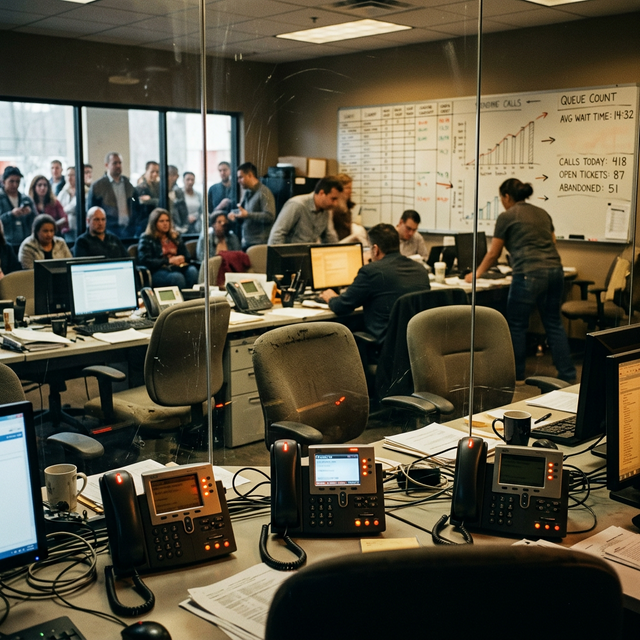
Why So Many Service Business Calls Go Unanswered
Many service business calls never reach a real next step. Here are the five silent signals that predict missed calls, lost bookings, and invisible revenue leaks.

Why Local SEO Underperforms When Calls Go Unanswered
Local SEO does not end when a buyer taps call. If your service business sends high-intent searchers to voicemail, the ranking work is turning into wasted demand.

Why Your Google Ads Are Failing: The Operational Leak Between Click and Customer
Many service business Google Ads campaigns fail after the click. Learn how missed calls, slow intake, weak landing pages, and after-hours gaps waste paid demand.