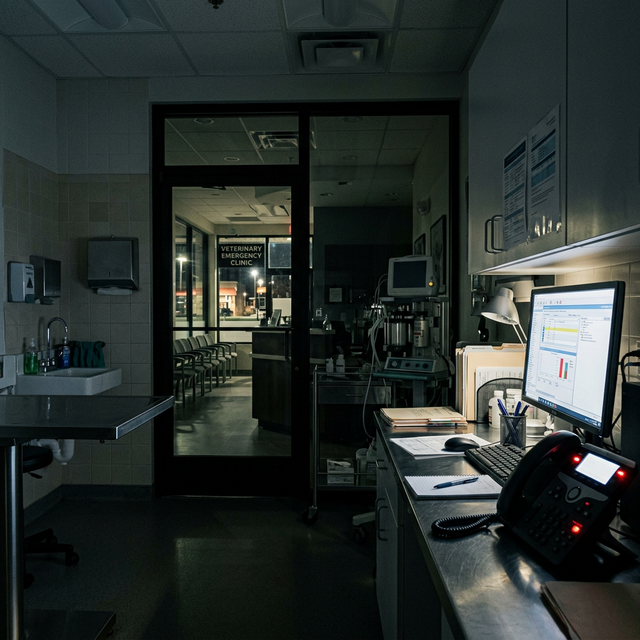

For a veterinary clinic or 24-hour animal hospital,that single answered call represents an average of $850 to $1,500 in immediate emergency revenue.More importantly, if the vet practice provides excellent care during that crisis, data from the American Veterinary Medical Association (AVMA) indicates they have a high probability of capturing that client for lifetime preventive care, which averages over $10,000 per pet.
Treat any number without a nearby source or stated method as a planning assumption, then replace it with your own records.
It is 2:15 AM on a Wednesday. A frantic pet owner wakes up to find their golden retriever violently ill and unable to stand. They grab their phone, search "emergency vet near me," and tap the first number. The phone rings four times. "You have reached the after-hours voicemail for..." They hang up. They do not leave a message. They tap the second number. A live voice answers on the second ring, calmly asks for the dog's breed and symptoms, and says, "Please bring him in immediately, we have a doctor waiting."
For a veterinary clinic or 24-hour animal hospital,that single answered call represents an average of $850 to $1,500 in immediate emergency revenue.More importantly, if the vet practice provides excellent care during that crisis, data from the American Veterinary Medical Association (AVMA) indicates they have a high probability of capturing that client for lifetime preventive care, which averages over $10,000 per pet.
Veterinary medicine is fundamentally different from a standard service business because the emotional stakes are identical to human healthcare. A homeowner might wait until morning for a faulty air conditioner. A pet owner watching their animal suffer will not wait ten minutes. They will drive to whatever clinic answered the phone and confirmed they are open.
The Psychology of the Pet Owner in Crisis
The veterinary emergency caller is operating in a state of acute cognitive overload.Research from dvm360 on client communication during crises highlights that these callers are unable to process complex phone trees, listen through long recorded greetings, or parse detailed instructions about alternative locations. They have one singular objective: finding a human being who can tell them help is available.
When a veterinary clinic implements an after-hours protocol that relies on voicemail or a complex automated attendant ("Press 1 for our hours, press 2 for our address, press 3 if this is an emergency"), they are inducing further anxiety in a client who is already panicking. The abandonment rate on veterinary phone trees during overnight hours exceeds 65 percent. The caller simply hangs up and calls the next hospital on Google.
The most damaging protocol in the industry is thevoicemail-to-pager system.The recording tells the frantic owner to leave a message and the on-call veterinarian will call them back within 15 to 30 minutes. In the context of a perceived life-threatening emergency (like a suspected gastric torsion or poisoning), 15 minutes feels like an eternity. The AVMA notes that over 80 percent of pet owners directed to an emergency callback system will continue calling other clinics while waiting for the return call. If another clinic answers live, that is where they drive.
The Triage and Transfer Gap: Why Standard Answering Services Fail
Many primary care veterinary practices solve the after-hours problem by hiring a generic medical answering service.The operators are polite, they answer quickly, but they lack veterinary specific training. Their protocol is usually rigid: take the owner's name, the pet's name, a brief description of the problem, and page the doctor on call.
This fails on two critical fronts in veterinary medicine: Triage and Reassurance. A generic operator cannot tell the difference between a dog that has been vomiting for three days (urgent) and a cat exhibiting open-mouth breathing (critical, immediate life threat). They cannot advise the owner on safely transporting an injured animal. Most importantly, because they cannot commit the doctor's availability or provide medical reassurance, the pet owner remains in a state of panic.
The "Blind Transfer" problem.If the primary care clinic is not a 24-hour facility, their after-hours recording typically says, "If this is an emergency, please hang up and call the local emergency hospital at..." This is a massive friction point. The frantic pet owner must now memorize or write down a new phone number, hang up, and dial again. This creates a disconnect where the primary veterinarian loses all tracking of that patient's emergency interaction.
The Financial Calculation of the Unanswered Emergency Call
Let us evaluate the math using VetSuccess industry benchmarks.A busy primary care vet practice might receive 15 legitimate emergency or urgent care calls per week outside of normal business hours (nights and weekends). If those calls go to a standard voicemail or a poorly managed answering service recording, and 10 of those callers abandon the call to seek immediate help elsewhere, the revenue loss is compound.
Immediate Loss:10 lost emergency visits per week at an average invoice of $450 (if the clinic handles urgent care) equals $4,500 per week. That is $234,000 in immediate gross revenue lost annually.
Lifetime Value Loss:In emergency situations, clients frequently switch their primary care allegiance to the animal hospital that saved their pet. If even two of those ten weekly lost callers were new clients searching for help, the clinic is losing 104 potential new, highly loyal clients per year. At $10,000 lifetime value per pet, the clinic is bleeding over $1,000,000 in potential lifetime revenue simply because the phone was not answered immediately by a competent voice. The switching cost for a pet owner is virtually zero, but the emotional bond forged during an emergency is permanent. When a veterinary clinic fails to answer the phone, they are not just losing a single late-night invoice, they are actively handing a ten-year relationship to their closest competitor.
For dedicated 24-hour emergency and specialty hospitals, the math is far more severe. An overnight surgery for a gastric dilatation-volvulus (GDV) or an intensive care stay for toxicity easily exceeds $3,500 to $6,000. Missing one of those calls because the front desk staff was busy stabilizing another patient costs the vet practice thousands of dollars in a single ring cycle. Furthermore, boarded specialists at these hospitals rely on primary care referrals; if a referring veterinarian's client cannot get through to the ER desk, the referring relationship itself is damaged.
What a Proper Veterinary Emergency Protocol Requires
A veterinary clinic or animal hospital that wants to capture, calm, and convert after-hours callers must implement a system with four mandatory components.
Requirement 1: Zero-friction live answer.The phone must be answered within 10 seconds. No pressing buttons, no long recorded warnings about payment being due at the time of service. The opening should be immediate and orienting: "Thank you for calling [Hospital Name] Emergency line, is your pet experiencing a life-threatening emergency?" This immediately establishes control and begins the triage process.
Requirement 2: Veterinary-specific protocol.The answering point - whether an in-house night receptionist, a specialized veterinary answering service, or a specifically trained AI voice system - must follow veterinary triage guidelines. They need to ask the right questions: breed, age, exact symptoms, duration. They must be trained to recognize red-flag symptoms (straining to urinate in male cats, pale gums, seizure clusters) that require immediate, bypass-the-wait-list attention.
Requirement 3: Explicit directional confirmation.The caller needs to be told exactly what to do. "We have an emergency veterinarian on site. Please bring Max in immediately. Our address is... We will have a team ready for you." This sentence definitively ends the owner's search for a clinic. They are now focused entirely on transport.
Requirement 4: Smooth integration for primary clinics.If the clinic is not 24/7, the protocol must handle the transfer smoothly. Instead of telling the caller to hang up and dial an emergency center, the system should say, "Our clinic is currently closed, but we partner with [Emergency Hospital]. I am going to connect you to them right now, please stay on the line." A warm transfer or automated immediate routing preserves the relationship and ensures the pet gets care.
The Role of an AI Intake Layer in Veterinary Calls
The staffing crisis in veterinary medicine is acute. Finding qualified night-shift receptionists for a 24-hour hospital is incredibly difficult, and paying them a premium wage compresses hospital margins. Furthermore, a single human receptionist cannot answer two emergency calls simultaneously. If a dog hit by a car comes through the front door, the receptionist must drop the phone to help stabilize the patient, leaving other inbound calls to ring out to voicemail.
This is where configured AI voice systems are transforming veterinary operations.Unlike a generic answering service, a veterinary-configured AI agent can handle multiple concurrent calls at 3 AM. It never places a panicking owner on hold.
When programmed correctly, the AI can ask the critical triage questions: "What kind of animal is it? Are they breathing normally? Have they ingested a known toxin?" Based on these answers, the system can provide the hospital address, alert the clinical team via a pager or overhead system that a critical patient is arriving, and text a pre-registration link to the owner's phone so they can complete paperwork while their spouse drives.
The AI does not replace the veterinarian.It replaces the panic of the ringing, unanswered phone.It bridges the gap between the frantic owner in their living room and the medical team waiting in the treatment area. By providing immediate engagement and clear instructions, the AI secures the patient visit and ensures the hospital captures the revenue necessary to keep their 24-hour operation viable.
Checklist: Testing Your Clinic's After-Hours Protocol
Veterinary practice owners and hospital administrators must audit their current system. The test is simple: call your own clinic at midnight on a Saturday.
1. How long does it take to connect?Measure the time from dialing to hearing a voice capable of helping. If it takes longer than 30 seconds, including recorded greetings, you are losing emergencies.
2. Does the system induce panic?How many hoops did you have to jump through? Did the recording sound welcoming and calm, or bureaucratic and restrictive?
3. Are the instructions clear?If you are a primary care clinic directing to an ER, how easy is that transition? Do you provide the ER's name, location, and a way to connect directly?
4. Is the tone empathetic?In an emergency, the caller is listening to tone as much as words. A robotic, generic answering service operator who sounds bored will drive a protective pet owner to seek care elsewhere.
Veterinary medicine is a profession of profound compassion. That compassion must extend to the very first point of contact, regardless of the hour. A ringing, unanswered phone at 3 AM is not just a lost invoice; it is a failure of care. Fixing the front door of the animal hospital ensures that every patient who needs help can access it, and every hospital gets compensated for being available when no one else is.
The Operating Standard for After-Hours Veterinary Intake
In the context of Veterinary Emergency Clinics: The After-Hours Call Protocol That Protects Urgent Calls and Revenue, we must address the fundamental friction that exists in manual intake. Every 'missed call' is a missed revenue opportunity, but more importantly, it's a signal of operational weakness that high-value prospects detect instantly. By bridging this gap with AI-driven intake, you're not just 'automating.' You're humanizing the interaction by ensuring that your clients get the attention they deserve, instantly. This is the math of responsiveness that wins markets.
Strategic ROI: When we apply the Quiet Protocol math to Veterinary Emergency Clinics: The After-Hours Call Protocol That Protects Urgent Calls and Revenue, the result is always the same: a dramatic reduction in cost-per-acquisition (CAC) and a significant increase in client lifetime value (LTV) through immediate resolution.
Source method: review after-hours call logs, urgent booking notes, triage outcomes, missed-call records, client reviews, and follow-up messages from the last 60 to 90 days. The clinic can usually see where callers needed calm routing, not another voicemail promise.
The loss estimate is basic business math, not a magic claim.
Revenue-leak examples on this site are built from visible operating inputs: inquiry volume, missed-call or slow-response rate, booking rate, average job or client value, repeat value, and follow-up recovery. The fastest way to make the number real is to run the diagnostic for your closest business type, then compare it against your own call log, CRM, booking calendar, form timestamps, and review activity.
The practical questions behind this decision.
Will pet owners trust an AI voice answering the phone during a medical emergency?
Yes, if the AI is fast, accurate, and directs them to immediate help. Pet owners are frustrated by wait times, hold music, and unhelpful answering services. If the AI immediately answers, acknowledges the emergency, asks the relevant triage questions (breed, symptom), and says, "Please bring them to our facility immediately, I am alerting the medical team," the owner feels heard and prioritized. The trust is placed in the swift action, not necessarily the humanity of the voice on the phone.
How does an AI system handle a caller whose pet is in active distress?
A veterinary-configured AI voice system is programmed with "critical bypass" keywords and acoustic analysis. If the caller uses phrases like "not breathing," "unresponsive," or "hit by car," or if the system detects extreme auditory distress, it immediately triggers the highest priority routing. The AI says, "Bring them here immediately, we are open," and simultaneously sends a priority alert (text, overhead page, or emergency screen flash) to the clinical team in the treatment room.
What is the liability of using an answering service or AI instead of a veterinary technician to triage calls?
Neither an answering service nor an AI system is providing medical advice - doing so would constitute practicing veterinary medicine without a license. Their role is strictly logistical and informational: capturing symptoms, determining if the caller needs to come in (in an emergency, the answer is always yes to protect the animal and the animal hospital's liability), directing them to the facility, and alerting the staff. A receptionist doing the same job is following similar non-diagnostic guidelines.
If we refer our after-hours calls to the local emergency hospital, why do we need a better system?
Because a poorly executed referral damages your brand. If your voicemail simply says, "We are closed, call the ER," you create friction for a client already in distress. A better system - whether an AI or a dedicated service - warm-transfers the call directly to the exact animal hospital you partner with, logs the interaction in your Practice Management Software (PIMS), and ensures you receive the treatment records the next morning. This smooth experience maintains your position as the coordinator of your patient's care.
Map how a serious buyer decides in this kind of business.
Use the operating reality of the industry instead of copying a generic lead-generation playbook.
Replace broad industry assumptions with the business's actual inquiry volume, customer value, response time, and booking data.
See how the capability in this article fits into a complete customer journey.
Care, Family & EducationSee the same decision through the language, buyer behavior, and operating reality of this industry.
Client Results & ProofInspect the starting condition, installation, measurement window, and outcome behind real client work.

Professional Firm Client Intake: Earn Trust at First Contact
A practical guide to aligning website clarity, public proof, intake questions, response expectations, and human handoffs for high-trust professional services.

Funeral Home After-Hours Calls: How Missed Calls Fail Families
In compassionate care, the first call determines the relationship. Providers losing 12% of first-call inquiries to voicemail gaps are leaving $238,000 in annual arrangement value on the table.
Why So Many Service Business Calls Go Unanswered
Many service business calls never reach a real next step. Here are the five silent signals that predict missed calls, lost bookings, and invisible revenue leaks.