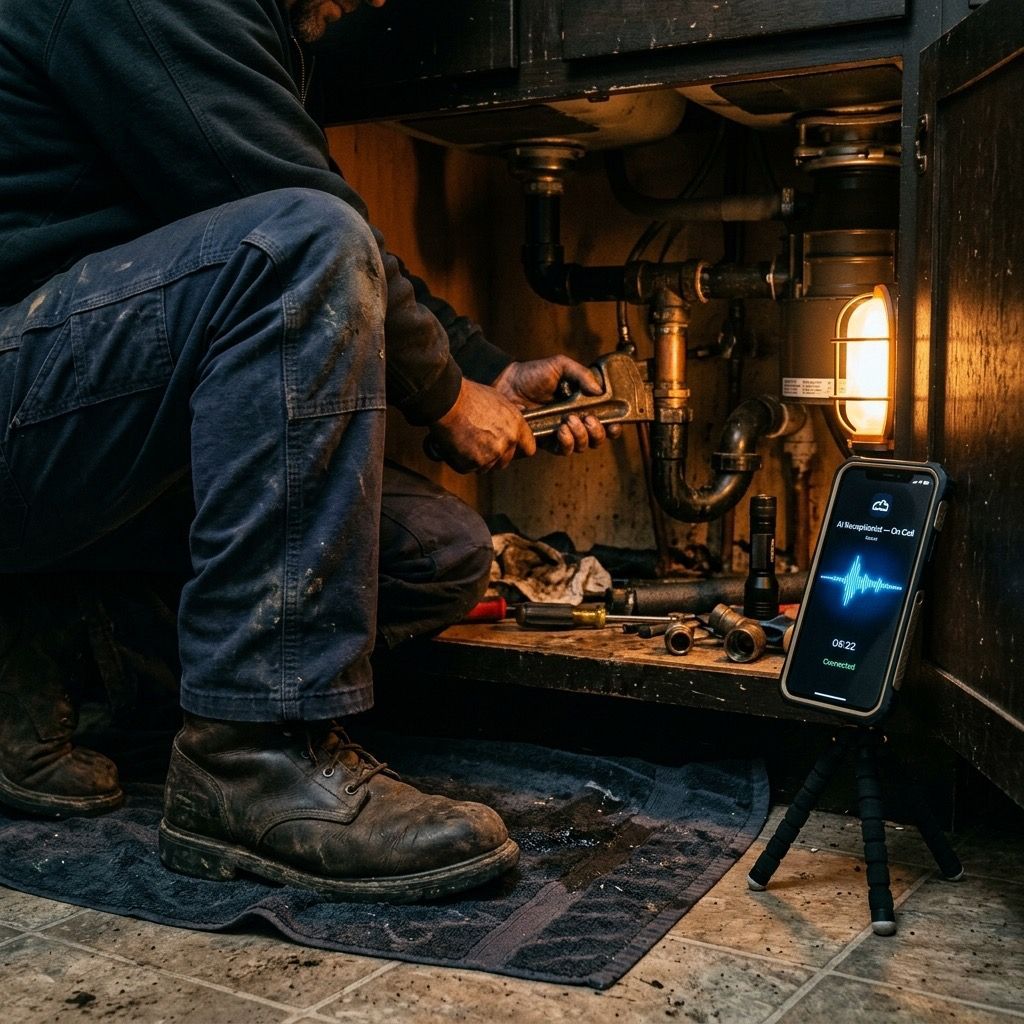

There is a particular kind of frustration that every solo trade contractor knows: your phone rings, you are physically unable to answer it, and somewhere in the back of your mind you know that ring is probably $800 that just went to the next guy on the Google list.
Treat any number without a nearby source or stated method as a planning assumption, then replace it with your own records.
You cannot answer the phone when you are under a sink with your hands in a drain. You cannot take a call when you are mid-installation on a water heater. And you definitely cannot pull out your phone to book an appointment when you are elbow-deep in a crawl space fixing a sewer line.
This is the structural problem of the one-person service operation. You have two jobs: do the work and run the business. Every hour you are doing the work, the business is unattended. And the business is bleeding.
What the Missed Calls Actually Cost
Solo and small plumbing operations typically field between 30 and 60 inbound calls per week depending on their market, their online visibility, and the season. Emergency and urgent calls, which represent the highest per-job revenue, cluster in two windows: before 8 AM and after 5 PM. These are precisely the hours when a solo operator is either starting a job or ending one, not sitting at a desk ready to take calls.
Here is what the missed calls cost at the conservative end.
A plumber taking 40 calls per week who is on jobs for eight hours a day misses roughly 8 to 12 of those calls. Not because the calls came at bad times. Because the calls came at any time and the phone was in a pocket while both hands were busy.
Of those 8 to 12 missed calls, about 70 to 75 percent never leave a voicemail. They hang up and call the next result. Of the 25 to 30 percent who do leave a message, about half have already booked someone else by the time the callback happens, particularly if the callback was 3 or 4 hours after the original call.
Running those numbers conservatively:
- 8 missed calls per week
- 6 never leave a message and are lost immediately
- 1 of the 2 who left messages has moved on before callback
- Net lost conversations per week: 7
At a $700 average job value (blended between emergency service calls and standard jobs) and a 50 percent close rate on answered calls:
- 3.5 jobs lost per week
- Annualized: 182 jobs
- Revenue impact: **$127,400 per year in calls that ring through and disappear**
That is not $127,400 in net profit. But it is $127,400 in revenue that your skills, your reputation, your Google listing, and your years of experience generated demand for, and then lost at the phone.
The Revenue Leak Diagnostic calculator at [thequietprotocol.com/calculators](/calculators) lets you run this for your own numbers. Most solo plumbers who run it see a number between $80,000 and $200,000 depending on call volume and job value.
What Solo Operators Try First (And Why It Usually Does Not Work)
The standard solutions a solo plumber considers when they finally acknowledge the missed call problem:
Option 1: A third-party answering service.These services employ live agents who answer calls on your behalf using a script. The problems are consistent: the agents do not understand plumbing, so they cannot ask the right intake questions; they cannot book into your calendar directly; they often put callers on hold for 2 to 3 minutes before answering; and they typically cost $200 to $500 per month for a limited number of calls. Beyond that limit, you pay per minute.
The biggest issue is context. An answering service agent who does not know the difference between a sewer backup and a water heater leak cannot triage urgency correctly. A caller describing an active pipe burst gets treated the same way as someone calling about a dripping faucet. The intake is generic. The follow-up to you is a message with a name and number and nothing useful.
Option 2: Going to voicemail with a good message.Voicemail with a detailed outgoing message does not fix the problem. It improves the message you leave for the 20 to 30 percent of callers who actually leave a voicemail. The other 70 to 80 percent who hang up immediately are unaffected by how good your voicemail message is.
Option 3: Calling back same-day.This assumes you remember to check missed calls at the end of each job, that the callers are still available when you call, and that they have not already booked. In emergency plumbing, the timeline is compressed. A caller who has water coming through their ceiling is not waiting four hours for a callback. They are calling the next number every five minutes until someone answers.
Option 4: Hiring a part-time admin.A part-time admin helps during business hours. The calls a solo plumber misses most often come at 7:00 AM before the admin arrives, during the 45-minute window when the admin is at lunch, and after 5:00 PM when they have gone home. A part-time hire covers the gaps you did not have. It does not cover the gaps you do.
What Changes When Voice AI Handles the Calls
Here is what the call flow looks like for a solo plumber with a configured voice AI system:
The call comes in at 8:47 AM while you are replacing a shut-off valve.
The voice AI answers immediately: "Thank you for calling [company name]. I am the intake system for [your name]. How can I help you today?"
The caller explains they have no hot water. The AI responds with a structured intake sequence tuned for plumbing:
- "Is this an emergency situation, or is this something you have been dealing with for a few days?"
- "What type of water heater do you have, gas or electric, and roughly how old is it?"
- "What is the address where the service is needed, and are you in [service area]?"
- "What day and time works best for you? We have openings this week."
The caller provides their information. The AI confirms the booking, sends them a confirmation text, and marks the appointment in your calendar. It then sends you a notification: "New job booked. [Name], [address]. No hot water, gas heater, approx 8 years old. Thursday at 10 AM. Phone: [number]."
You finish replacing the shut-off valve. When you check your phone, you see the notification. You know exactly what the next job is, where it is, and what to expect when you get there.
The caller never called your competitor. They do not need to. Their problem is solved.
The Emergency Call Scenario
This is where the difference becomes stark.
A homeowner calls at 6:15 PM on a Friday. Their basement is taking on water through a cracked pipe. This is not a job they will wait until Monday for. They are calling every plumber in their area right now.
Without AI coverage, your phone rings to voicemail. The caller hangs up immediately. They call the next result. If that plumber has coverage, they get the emergency job. The average emergency plumbing call runs $800 to $2,500 depending on the situation. You missed it while you were driving home.
With voice AI coverage:
The call is answered immediately, in under two seconds. The AI identifies this as an emergency based on the caller's description. It asks the address and confirms it is in your service area. It asks whether they can shut off the main water supply (if they can, the immediate damage is contained and you have more time to respond). It lets them know you are available for emergency calls and that you will call them back within 15 minutes. It notifies you instantly.
You see the notification while still in your truck. You call them back within five minutes. You have the job because you were the first plumber who acknowledged them.
This scenario plays out 2 to 4 times per week at most active plumbing operations. Each one represents $800 to $2,500 in emergency revenue that either goes to you or to the next person on the list.
What the System Is Configured to Handle for Plumbing
The voice AI is not a generic call-answering tool. For a plumbing business, it is configured with:
Emergency vs. non-emergency triage.The intake sequence asks about urgency and can differentiate between a dripping faucet inquiry (non-urgent, schedule next available) and an active leak or no water situation (urgent, notify owner immediately).
Service area screening.The AI asks for the address before booking. If the address is outside your service area, it declines politely and suggests they search for a local plumber. You do not waste time on callbacks to jobs you cannot take.
Specific plumbing intake questions.Type of issue, type of system where relevant (slab foundation vs. standard), whether it is an emergency or has been ongoing, owner vs. renter (relevant for access and authorization). You get useful information before you arrive, not just a name and number.
Appointment booking directly into your calendar.The system books into your availability without you needing to call the client. You confirm capacity; the system fills it.
Notification logic based on urgency.Non-emergency calls get batched into a morning summary. Emergency calls trigger an immediate text notification with the key details.
Callback request for situations the AI cannot handle.If a caller's situation is genuinely complex or falls outside the intake parameters, the AI takes a message and commits to a callback within a specific window. It does not try to handle what it cannot handle correctly.
What the System Does Not Do
There are things this system is not designed to handle and should not try to:
It does not provide quotes. An AI cannot assess a job it has not seen and should not try to give a number. If a caller asks for a quote over the phone, the AI responds that pricing depends on the assessment and offers to book an estimate appointment.
It does not handle warranty claims on specific equipment. Manufacturer warranty calls require specific knowledge and documentation. These get taken as a callback request.
It does not replace you when a caller wants to speak directly to the owner about something sensitive, a billing dispute, a damage claim, or a complaint. These are flagged immediately and handled in the callback queue.
It does not manage your inventory, dispatch your routes, or handle your invoicing. It handles the front door: the inbound call, the intake, the booking, and the notification. That is what it is configured for.
What This Costs for a Solo Plumber
The Core Protocol from The Quiet Protocol is $497 per month. There is a one-time setup fee for the niche-specific configuration. The system is live within five business days of onboarding.
There is no per-minute billing. There is no per-call charge. A slow week costs the same as a busy week.
At a $497 monthly cost, the system pays for itself if it captures one additional emergency job per month at an $800 average value. Based on the missed call data, most active solo plumbing operations are missing two to four of those per week.
Annual system cost: approximately $5,964.
Annual revenue recovered on conservative estimates (2 emergency jobs per week at $1,200 average): $124,800.
That is not a guaranteed number. Actual results depend on your call volume, your market, and your average job value. But the math for voice AI ROI in a solo plumbing operation is not close. If you are taking 30 or more calls per week and missing any meaningful portion of them while on jobs, the return on a $497/month system is not a question of whether. It is a question of how many months you have already waited.
How to Know If This Is Your Problem
Before spending anything, run the calculation for your specific numbers. Go to the [revenue leak calculator](/calculators) and input:
- How many calls you take per week
- Your average job value
- Your current close rate on calls you do answer
The calculator will output your estimated annual revenue leak from missed calls. If that number is over $60,000, the case for voice AI coverage is straightforward.
If you want to see what the full system looks like for plumbing specifically, the [plumbing industry page](/industries/plumbing) on The Quiet Protocol's site walks through the 5 Silent Signals for plumbing businesses and how each one gets addressed.
The front door problem for solo trade contractors is real, and it is expensive. The fix is not complicated. It is a system that answers when you cannot.
This post is intended as an illustrative composite based on common patterns among solo and small plumbing operations. Individual results depend on call volume, market conditions, and job values specific to each business.
The Quiet Protocol installs AI intake systems for plumbing companies and home service businesses across the US and Canada. Core Protocol includes voice AI, web intake, and CRM routing. Configured for plumbing and live in five business days.
Voice AI Is One Layer. The Business Operating System Is the Larger Fix.
A voice AI tool answers your phone. That is Layer 1 of a five-layer problem. An AI Business Operating System handles the entire revenue infrastructure: intake, follow-up, reactivation, reputation, and intelligence. The price difference between a standalone voice AI tool and the full operating system is often less than $200 per month. The capability difference is 5x.
The Quiet Protocol installs the full AI Business Operating System at $497 per month. It includes the AI receptionist (Layer 1), a structured follow-up engine for unconverted leads (Layer 2), database reactivation campaigns for dormant contacts (Layer 3), automated Google review requests after every completed job (Layer 4), and a business intelligence dashboard showing recovered revenue across all layers (Layer 5).
Most businesses that buy a standalone voice AI tool wonder, six months later, why their pipeline still leaks. The answer is that answering the phone was never the whole problem. It was the most visible symptom of a system-wide gap.
The loss estimate is basic business math, not a magic claim.
Revenue-leak examples on this site are built from visible operating inputs: inquiry volume, missed-call or slow-response rate, booking rate, average job or client value, repeat value, and follow-up recovery. The fastest way to make the number real is to run the diagnostic for your closest business type, then compare it against your own call log, CRM, booking calendar, form timestamps, and review activity.
The practical questions behind this decision.
What proof should I look for in my own business?
Look for proof in the places where demand either moved forward or stalled: missed calls, short calls, unbooked forms, slow callbacks, no-show recovery, old leads, and reviews that were never requested. If the business cannot see those moments clearly, the first improvement is better tracking and routing.
How do I know whether this is a marketing problem or an operations problem?
If people are already calling, filling forms, asking for prices, requesting appointments, or comparing reviews, the problem is usually operations. More marketing will not fix a front door that lets warm demand wait. The better move is to capture and route the demand already arriving.
What should happen after the first response?
The first response should create a next step: booked appointment, estimate path, intake handoff, callback window, review request, or reactivation sequence. A response that only says someone will get back to you is not enough when the buyer is comparing several providers at once.
Where does The Quiet Protocol fit?
The Quiet Protocol fits when the business already has demand but too much of it depends on manual attention. We connect AI receptionist coverage, web intake, missed-call recovery, booking logic, follow-up, review requests, and reactivation into one managed front-door system.
Turn the article into one week of real numbers.
Use your own call log, form timestamps, calendar, and CRM before accepting any industry estimate.
Use your own operating numbers to see where response, booking, reviews, and follow-up may be costing the business.
See how the capability in this article fits into a complete customer journey.
PlumbingSee the same decision through the language, buyer behavior, and operating reality of this industry.
Client Results & ProofInspect the starting condition, installation, measurement window, and outcome behind real client work.

AI Receptionist Rollout Guide for Service Businesses
A practical operating guide to choosing the first call path, preparing staff, testing real handoffs, and deciding whether an AI receptionist is ready to handle more customer conversations.
Voice AI vs. Hiring a Part-Time Receptionist: The Real Math for Service Businesses
Compare voice AI and a part-time receptionist for service businesses: coverage, cost, consistency, booking, after-hours calls, and the real front-door math.

The Missed Call Problem: How Service Businesses Lose $180,000 Per Year From the Front Door
Missed calls are not harmless. Learn how service businesses calculate the annual revenue leak from unanswered calls, delayed callbacks, and lost buyer intent.

What a $497/Month Business Platform Includes, and What It Does Not
A practical buyer guide to platform access, launch configuration, usage charges, team-owned software, and the point where a custom system becomes a separate engagement.

AI Business Operating System: What the Label Should Mean Before You Buy
A plain-language buyer guide to the category label, the operating path underneath it, and the questions that separate useful systems from inflated software claims.

Five Breakpoints in a Customer System, and What to Fix First
A practical operating guide to finding where a customer journey is losing time, trust, or momentum before the business buys more software or automates the wrong step.