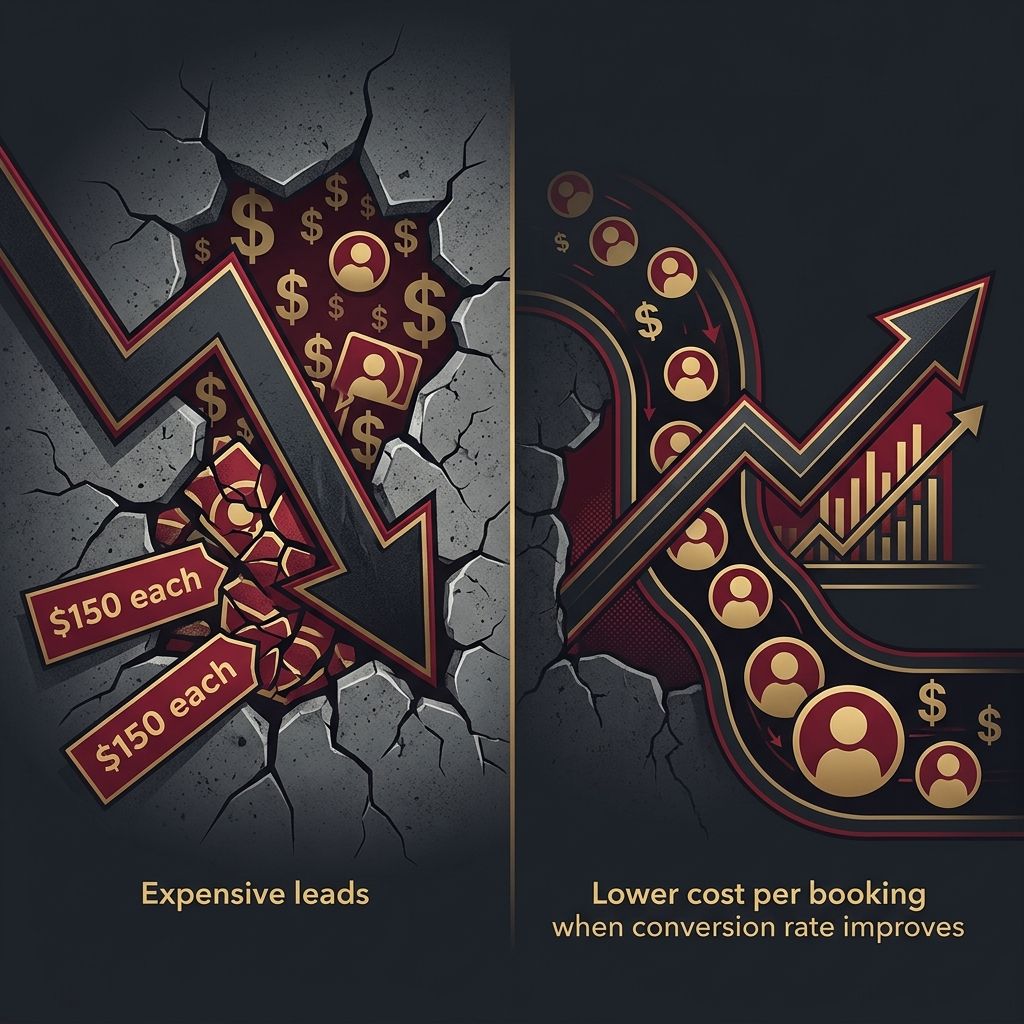

# In a Recession, Every Lead You Paid For Becomes More Expensive. Here's the Only Rational Response.
This article links to 3 external sources beside the claims they support.
The conversation has shifted.
When I started TQP, the service business owners I was talking to were worried about growth. More leads, more jobs, more trucks on the road. The question was always "how do we get more?"
Now they're worried about margins. Fuel costs. Labor. Insurance. And yes, ad costs that keep climbing while the phone seems to ring less.
The conversation has changed. And honestly, it makes the case for what we do even more obvious.
Because when every lead costs more to acquire, losing any of them is a bigger problem than it was 18 months ago.
The Economic Reality Nobody Wants to Say Out Loud
Digital advertising costs have been rising steadily.WordStream's industry benchmarksshow that home services, HVAC, plumbing, electrical, roofing, consistently sit among the most expensive categories in Google Local Services Ads and paid search. And those costs are not going down.
At the same time, consumers are scrutinizing purchases more carefully. They're getting more quotes. They're taking longer to decide. They're more likely to ask "do you have any deals right now?" than they were two years ago.
Small business margins in service industriesrun thin in the best of times. When ad costs go up and close rates go down at the same time, the pressure is real.
So what does a business owner do?
The instinct, and I see it in audit after audit, is to spend more on marketing. More ads. New platforms. Maybe a billboard. Get more leads in the top of the funnel to compensate for the ones that aren't converting.
That instinct is wrong. And I want to show you the math that proves it.
The Math Most Owners Have Never Actually Run
Here is the single most important calculation in your business right now.
Let's say your current cost per lead is$150. That's fairly typical for mid-tier paid search in home services.
And let's say your current conversion rate, the percentage of leads who actually book a job, is35%. That's also fairly typical for businesses without a strong follow-up system.
Your math:
> $150 ÷ 35% =$428 cost per booked customer
Now here's what happens if you spend more on ads instead of fixing conversion:
You increase your ad budget by 30%. You get more leads. But your conversion rate stays at 35% because the underlying system didn't change. Your cost per lead might even creep higher as you push into more competitive ad inventory.
You've spent more money to get the same percentage of leads across the line. Your cost per booked customer hasn't moved.
Now here's the other scenario.
Same $150 cost per lead. But you fix your lead response time, your follow-up sequence, your phone handling during peak hours. Your conversion rate moves from 35% to 60%.
> $150 ÷ 60% =$250 cost per booked customer
That's a42% reduction in acquisition coston the exact same ad spend.
Same budget. Same lead volume. 42% cheaper to acquire each customer.
I've never met a business owner who wouldn't take that deal. The problem is that most of them are optimizing the ad spend instead of optimizing the conversion, because the conversion problem is invisible, and the ad spend is visible.
The $0 Growth Strategy
I want to name what I just described, because it's the counterintuitive promise at the center of everything we do at TQP.
You do not need to spend more money to grow.
You need to stop losing what you're already paying for.
That's it. That's the whole argument.
A business converting 35% of its leads and spending $10,000/month on ads is throwing away $65 worth of lead value for every lead that doesn't book. At 100 leads per month, that's $6,500 in acquired interest that evaporates, not because the customer wasn't interested, but because the business didn't respond fast enough, follow up consistently enough, or make the booking process easy enough.
Fix that, before you spend another dollar on ads, and you've effectively grown without spending a cent more.
That's the $0 growth strategy. And in a tight economy, it's the only rational play.
The Five Conversion Levers (In simple language)
Here are the five places where service businesses lose leads they've already paid for. I see all five in almost every audit I run.
1. Response time
The research is unambiguous.Lead conversion rates drop dramatically the longer you wait to respond. The first business to respond has a significant conversion advantage over everyone else, even if they're not the cheapest.
Most service businesses are not the first to respond. They're the third, or the fourth, or they call back the next morning. By then, the customer has already booked someone else or stopped caring.
We see this in nine out of ten audits. The phone rings after hours. Nobody answers. The customer calls the next business on the list.
2. Follow-up frequency and timing
A lead doesn't convert on the first touch. Most service business owners know this conceptually, but they don't behave like they believe it. They send one follow-up email. They leave one voicemail. Then they move on.
The data on follow-up is clear: most conversions happen between touch 5 and touch 8. Almost no service business gets to touch 3.
A systematic follow-up sequence, automated, personalized, timed correctly, closes a significant percentage of leads that would otherwise go cold. Every lead that comes back off a follow-up is pure efficiency: you already paid to get their attention once.
3. Estimate follow-up
This one is specific and painful. A homeowner requests a quote. You send it. They don't respond. You assume they went with someone cheaper.
Sometimes they did. More often, they got busy, the quote sat in their inbox, and they'd book with whoever followed up first.
An HVAC contractor in the Nashville market we audited had 44 open estimates sitting in their system, all requested within the past 90 days, all with no follow-up after the initial send. We sent a simple reactivation sequence to all 44. Eleven booked within 30 days. At a $2,200 average ticket, that's $24,200 in revenue sitting in their CRM that they assumed was dead.
4. Phone handling at peak times
Most service businesses are busiest between 7 - 9am and 4 - 7pm. Those are also the windows when their phone team is most overloaded or unavailable.
Calls during peak demand that go to voicemail or hold too long don't wait. They hang up and call someone else. If you're running Google ads that fire during these windows and your phone coverage collapses under the volume, you are literally paying to send leads to your competitors.
Fixing phone coverage during peak hours is the highest-leverage, lowest-cost conversion improvement most businesses can make. Sometimes it's as simple as adding an AI voice system to handle overflow. Sometimes it's restructuring who covers the phones and when.
5. The booking process itself
Once a lead is ready to book, how many steps does it take? How long does it take?
If the answer is "they have to call during business hours, wait to speak to someone, give their information, then wait for a confirmation", you are losing customers at the finish line. People who are ready to buy will abandon friction.
Online booking, instant confirmation, minimal steps. Customers who decide at 10pm should be able to book at 10pm. Every hour between intent and booking is an opportunity for doubt.
What 20% Conversion Uplift Does to a $1.5M Business
Let me make this concrete.
A residential service business doing $1.5M in annual revenue, with a $450 average ticket, is completing about 3,333 jobs per year. Call it 278 jobs per month.
Let's say they're converting 35% of their inbound leads and spending $18,000/month on paid advertising and marketing. That's getting them roughly 280 leads per month (at a ~$64 blended cost per lead), converting 98 of them into jobs.
Now they fix the five levers above. Their conversion rate moves from 35% to 55%, a realistic improvement we see in businesses that implement a full follow-up and response system.
At 55% conversion on the same 280 leads: 154 jobs per month.
Difference: 56 additional jobs per month.
At $450 average ticket:$25,200 in additional monthly revenue.
Annualized:$302,400 in additional revenue without increasing the ad budget.
The same $18,000/month in marketing spend produces $302,000 more per year. That's not a rounding error. That's the difference between a business that's scraping margins and one that's actually building.
And in a recessionary environment, where ad costs are rising, customers are being more selective, and margins are compressed, this isn't an optimization. It's survival math.
The Common Objection: "But What About New Customers?"
I've had this conversation in hundreds of audits. The owner hears the conversion math and then says: "Okay, but we still need new customers coming in. We can't just stop advertising."
Nobody said stop advertising.
The argument is about sequence and proportion. If you're converting 35% of your leads, you have a conversion problem. Spending more on ads while you have a conversion problem is the equivalent of pouring water into a bucket with holes in it and buying more water instead of fixing the bucket.
Fix the conversion rate first. Then, if you still want to grow the top of the funnel, scale the ad spend on top of a system that actually converts. At that point, every dollar of ad spend produces dramatically more revenue.
The businesses that thrive in a tight economy are not the ones who out-spent their competition. They're the ones who out-converted them.
A Note on Where This Applies Across Industries
I want to push back on something I hear constantly: "My industry is different."
Yes, different industries have different average tickets, different sales cycles, different customer psychology. The specific numbers in the conversion math change. The logic does not.
Whether you're a plumber averaging $380 per job or a specialty contractor averaging $12,000 per project, the cost of a missed lead goes up when your ad costs go up. The math on conversion improvement vs. increased ad spend holds across all of them.
The lever weights may shift. For high-ticket service, speed of response matters less and quality of follow-up matters more. For commodity services, response time is almost everything. But the levers are the same. The economic logic is the same.
And the $0 growth strategy, stop leaking what you're already paying for before you spend more, applies universally.
The Only Rational Response
The title of this post promises a rational response to economic pressure, so let me deliver it plainly.
When your lead costs go up and your margins compress:
- Do notreflexively spend more on marketing before fixing conversion
- Docalculate your actual cost per booked customer right now
- Doaudit the five conversion levers against your current operation
- Dofind the highest-leverage gap and close it before you do anything else
The $0 growth strategy isn't a gimmick. It's the acknowledgment that most service businesses have a revenue optimization problem hiding inside a marketing problem. They think they need more leads. They actually need to stop losing the leads they already have.
In a good economy, you can afford to be inefficient. In a tight one, you can't.
Run the math on your business right now.
OurRevenue Leak Diagnostic Calculatortakes your lead volume, current conversion rate, and average ticket, and shows you the exact annual revenue sitting in your existing lead flow that you're not capturing.
It takes three minutes. Most owners find a number that surprises them.
Or if you want a full picture of where your business is leaking, not just conversion, but all five revenue gaps, book aRevenue Leak Diagnostic. It's free. It's 45 minutes. And you'll leave with your actual numbers, not estimates.
The loss estimate is basic business math, not a magic claim.
Revenue-leak examples on this site are built from visible operating inputs: inquiry volume, missed-call or slow-response rate, booking rate, average job or client value, repeat value, and follow-up recovery. The fastest way to make the number real is to run the diagnostic for your closest business type, then compare it against your own call log, CRM, booking calendar, form timestamps, and review activity.
Turn the article into one week of real numbers.
Use your own call log, form timestamps, calendar, and CRM before accepting any industry estimate.
Use your own operating numbers to see where response, booking, reviews, and follow-up may be costing the business.
See how the capability in this article fits into a complete customer journey.
Service BusinessesSee the same decision through the language, buyer behavior, and operating reality of this industry.
Client Results & ProofInspect the starting condition, installation, measurement window, and outcome behind real client work.

The Real Cost of a Missed Call for a Service Business: The Math Nobody Runs
A missed call costs more than the immediate job. Here is the full three-layer calculation, immediate value, lifetime client value, and referral chain, and the annual total most owners never see.

What Is a Revenue Leak Diagnostic? The 15-Minute Diagnostic That Reveals Your Service Business Revenue Gap
A Revenue Leak Diagnostic is a structured 15-minute diagnostic that calculates the exact dollar value of revenue a service business is losing at the point of first contact, before a single dollar of marketing is changed.

The Service Business Lead Leak Diagnostic: 10 Questions That Reveal Where Your Leads Are Going
Most service businesses are not losing leads to competitors. They are losing them at the front door. This 10-question diagnostic shows you exactly where.