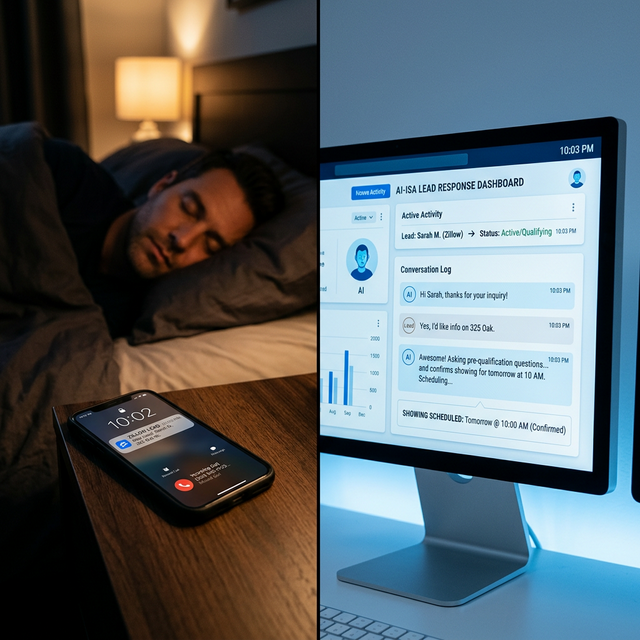

A real estate brokerage that responds at 10:03 PM is reaching a buyer who is still on the phone with the listing's address in their recent searches. A real estate brokerage that responds at 9:17 AM is leaving a voicemail for someone who has, in the intervening eleven hours, mentally processed the listing, discussed it with their spouse, and possibly already toured it through another channel.
Treat any number without a nearby source or stated method as a planning assumption, then replace it with your own records.
A real estate brokerage pays for leads that decay by the minute. If a Zillow, Realtor.com, or website inquiry waits for a human ISA to catch up, another agent can win the conversation first.
The inquiry went to a local brokerage that had a strong Zillow Premier Agent profile and six five-star reviews. The agent was asleep. The form submission generated an automated email confirmation from Zillow and then silence. On Monday at 9:17 AM, the agent saw the notification and called Sarah back.
Sarah had already scheduled a showing. Not with another agent from the same platform. With an agent from a different brokerage entirely - one whose AI-powered inside sales system had texted her at 10:03 PM, engaged her in a brief qualification conversation about her timeline and pre-approval status, and booked a 10 AM Sunday showing for a listing that matched her search criteria. The showing happened. An offer followed. The other brokerage never knew it had lost.
This is not an edge case. Research consistently shows that 35 to 50 percent of internet real estate leads never receive a response at all, and the majority of those that do are contacted outside the five-minute conversion window. In a market where a single closed transaction generates $8,000 to $15,000 in brokerage gross commission income, the passive approach to online lead response is not a minor operational inconvenience. It is the single largest source of preventable revenue loss in the modern residential real estate business.
The Speed-to-Lead Reality in Online Real Estate
The concept of speed-to-lead is not new. Sales researchers at MIT published a study over a decade ago establishing the fundamental relationship between response time and conversion probability. What has changed is the environment. In 2012, a thirty-minute response time was average. In 2026, a thirty-minute response time is the difference between a warm lead and a lead who has already toured a home with your competitor.
The homebuyer who submits a Zillow or Realtor.com form in the evening is in a specific psychological state. They are actively engaged. They have just seen a listing that resonated enough to take the action of submitting a form - which is more deliberate than a passive Zillow save. That action state has a half-life. Within five to ten minutes, if no response arrives, the buyer's attention has moved to the next listing, the next scroll, or simply to sleep. The emotional receptivity that produced the inquiry is gone.
A real estate brokerage that responds at 10:03 PM is reaching a buyer who is still on the phone with the listing's address in their recent searches. A real estate brokerage that responds at 9:17 AM is leaving a voicemail for someone who has, in the intervening eleven hours, mentally processed the listing, discussed it with their spouse, and possibly already toured it through another channel.
The five-minute conversion window is not a preference or a best practice. It is the boundary between a live conversation and a recovery attempt. Everything after five minutes is recovery, and recovery gets harder with every passing hour.
What an AI ISA Actually Does at 10 PM
An ISA - Inside Sales Agent - is the real estate industry's term for the role responsible for lead response, qualification, and appointment setting. Traditionally this is a human position: someone whose entire job is to call and text online leads, qualify them through a series of questions, and hand off appointment-ready prospects to the showing agents. A good human ISA working a full book of leads is a significant operational asset.
A human ISA is also unavailable at 10 PM on a Sunday, requires a salary, benefits, and management overhead, works a fixed schedule, and can only handle one conversation at a time. On a busy Saturday evening, when Zillow form submissions spike across a large metropolitan market, a human ISA is an eight-lane freeway that has been reduced to a single lane.
An AI ISA has none of those constraints. When Sarah submits her form at 10:02 PM, the AI ISA engages her within sixty seconds via text and optionally by voice. It introduces itself as the brokerage's digital concierge, acknowledges the specific listing she inquired about, and begins a natural-language qualification conversation. It asks about her timeline - is she looking to move in the next thirty to sixty days or still in the early research phase? It asks about pre-approval status. It asks whether she would prefer to schedule a showing, request additional information, or have a detailed market analysis on that neighborhood sent to her phone.
Every answer is logged. The qualification profile is built in real time. If Sarah says she is pre-approved and wants to see the home this week, the AI immediately accesses the showing calendar and offers two or three time slots. If she says she is six months out and just browsing, the AI drops her into a long-cycle nurture sequence that will deliver relevant listings and market updates until her timeline becomes active. No lead is discarded. Every lead is engaged at the exactly appropriate depth.
The agent wakes up Monday morning to a prioritized lead list. The hot leads - pre-approved, active timeline, showing requested - are at the top with complete qualification transcripts attached. The warm leads are categorized by estimated timeline. The cold leads are in the nurture queue. The agent begins their week with information, not with a backlog of callbacks to unknown-quality Sunday night form submissions.
The Brokerage-Level Math
The economic case for AI ISA deployment in a real estate brokerage is not built on optimism. It is built on data that every brokerage already has - or can calculate from their Zillow Premier Agent invoices and their closed transaction records.
A mid-size residential brokerage spending $4,000 per month on Zillow Premier Agent leads might receive 80 to 120 inquiries per month from that channel alone. If 30 percent of those inquiries are contacted within five minutes, the brokerage is working with an effective pipeline of 24 to 36 responsive leads per month. If 10 percent of responsive leads convert to closed transactions at an average GCI of $9,000, the brokerage is generating approximately $21,600 to $32,400 per month from Zillow leads.
With an AI ISA that responds to routed inquiries within sixty seconds, the effective pipeline can expand dramatically. The same $4,000 Zillow spend now funds more qualified conversations instead of a stack of delayed callback attempts. If the conversion rate holds at 10 percent - a conservative assumption given that ISA-engaged leads convert at materially higher rates than cold callbacks - the monthly GCI from the same channel can improve materially. The AI ISA does not improve the lead quality. It recovers the yield that was already being paid for and discarded through slow response.
For a real estate brokerage that has already committed to online lead generation as a revenue strategy, the AI ISA is not an additional investment in growth. It is a recovery of the return on an investment already being made.
Qualifying the Lead, Not Just Responding Fast
Speed is the entry requirement for online real estate lead conversion. It is not the complete answer. A lead that is contacted at 10:03 PM but engaged with generic small talk has been reached but not qualified. The value of an AI ISA is not simply that it responds quickly - it is that it initiates a structured qualification conversation at the moment of peak engagement.
The qualification protocol for a residential real estate lead concentrates on four questions. Pre-approval status separates active buyers from aspirational browsers. Timeline separates immediate movers from six-month researchers. Preferred neighborhoods or price ranges calibrate the agent matchup within a multi-agent brokerage. And the motivation question - "What is prompting your search right now?" - surfaces the life event driving the purchase, which is the most powerful piece of information for building a relationship during the showing process.
A real estate brokerage whose agents walk into a first showing already knowing that the buyer has just accepted a job transfer and needs to close in forty-five days is in a fundamentally different competitive position than an agent who learned the buyer's name from a voicemail. The AI ISA delivers that context as a standard deliverable on every lead it handles.
The one-minute window is not a metaphor. It is a measurable behavioral inflection point. A buyer who has not been contacted in the first five minutes of submitting a real estate inquiry is statistically indistinguishable from a buyer who was never contacted at all - at least in terms of conversion outcomes. The AI ISA closes that window permanently, for every lead, at every hour of the day and night.
The $50,000 Text: Why Speed-to-Lead Often Wins the First Zillow Conversation
In a real estate brokerage, a lead is not just a "potential client"-it is a potential $10,000 to $50,000 commission check. When a homebuyer clicks "Inquire" on Zillow or Realtor.com at 9:00 PM on a Thursday, they are in the "Active Search" mindset. They expect an immediate response.
The high-authority brokerage understands that if an agent waits until Friday morning to call back, the lead may already be in conversation with another brokerage. Industry research from NAR, Zillow, and brokerage CRMs points in the same direction: the first credible response often owns the conversation. In online real estate, being second usually means trying to recover a lead that has already cooled.
By answering with a calibrated AI-ISA that provides an immediate text or voice response, you ensure that your brokerage is always the first to connect. You have won the client, secured the future commission, and demonstrated a level of professionalism that human ISAs simply cannot match consistently at scale.
The ISA Math: Why Fractional AI Beats a Full-Time Internal Sales Associate
Scaling a brokerage traditionally requires hiring a human ISA to handle lead scrubbing and qualification. At $4,000 to $6,000 per month (plus overhead), a human ISA is an expensive asset. But the real vulnerability is "Concurrency."
A human ISA can only talk to one person at a time. If 10 Zillow leads hit your system during a peak hour, your ISA is forced to pick one and ignore the other nine. Those nine leads are left "Shopping" for another brokerage.
A Voice AI system acts as an "Infinite ISA." It can handle 10, 100, or 1,000 leads simultaneously, with 0% latency and 100% adherence to your qualifying script. It ensures that every single dollar you spend on marketing is maximized.
The ROI of the AI-ISA is exponential.For a fraction of the cost of a human hire, you get a 24/7/365 lead response engine that never burns out, never calls in sick, and never lets a lead go to a competitor. This is how you scale a brokerage to P0 status.
Predictive Brokerage: Using Intake Data to Forecast Market Demand
Looking toward 2026, the data captured at the "Edge" of your brokerage (the intake call) will become your most valuable asset. By analyzing the sentiment and intent of inbound leads via AI, brokerages can predict shifts in local market demand weeks before they appear in the MLS data.
This allows you to reallocate marketing spend, pivot your agent focus, and advise your sellers with a level of precision that your competitors simply don't have. In real estate, information is currency-and your intake system is the mint.
The "Zillow Vampire": Why Your Agents are Burning Out on Leads
To a brokerage owner, a new batch of Zillow or Realtor.com leads represents growth. To a high-performing agent, it often represents a "Vampire."
Imagine your top agent, Sarah. She just finished a difficult six-hour luxury showing. She sits down for dinner with her family at 7:30 PM. Her phone pings. It's a new lead from a portal-someone wanting to see a $400,000 condo tomorrow morning at 9:00 AM.
Sarah knows the "Speed-to-Lead" statistics. If she doesn't reply in five minutes, the lead is gone. But if she *does* reply, she's signaling to her family that her work never ends. Over months, this "Micro-Interruption Fatigue" turns your best agents into cynical order-takers. They start cherry-picking leads, and your expensive marketing spend goes to waste.
The "Vampire" isn't the lead; it's the expectation of instant availability.In a modern brokerage, you don't need your agents to be the first responders. You need a buffer.
The 2:00 AM Speed-to-Lead Trap
Speed-to-lead is a double-edged sword. Yes, you need to respond instantly to win the portal game. But if your response is a generic "Thanks for your interest, we'll call you tomorrow," you've checked the box but missed the connection.
Real estate is an emotional transaction. When someone is browsing Zillow at 2:00 AM, they are in "Dream Mode." A relatable AI ISA doesn't just "ping" them; it engages them. It asks about their timeline, their non-negotiables, and whether they've been pre-approved-all while maintaining the sophisticated tone of your brokerage.
By the time Sarah wakes up at 7:00 AM, she doesn't have a "lead" to chase. She has a **qualified appointment** with a summary of the client's needs already waiting in her CRM. She can finish her coffee, kiss her kids goodbye, and walk into that 9:00 AM showing feeling like an advisor, not a scavenger. That is how you build a brokerage that attracts-and keeps-the best talent in the market.
Can this system work for agents operating as solo practitioners, not just brokerages?
Solo agents frequently benefit from AI ISA technology more than large brokerages, because the solo agent's response time problem is more acute. A solo producing agent who is in a showing when a new lead comes in cannot step out to call back. An AI ISA handles the immediate response and qualification automatically, ensuring the lead does not go cold while the agent is serving an active client. The solo agent reviews the qualification summary between showings and makes personal contact with the warm prospects. The system essentially gives a solo agent the response capacity of a team without the overhead of hiring a dedicated ISA.
The Authority Standard: ROI and Resonance
When we evaluate the ROI of an intake system like the one described for Real Estate Brokerages: The AI ISA That Follows Up With Zillow Leads After Hours, we look beyond the immediate convenience of automation. We look at the 'Revenue Leak' that occurs in the silence between a prospect reaching out and a business responding. In this vertical, that silence is the biggest competitor you have.
Data Anchor: The average LTV of a client in this space is significantly higher than the cost of a missed intake opportunity. By resolving for 'concurrency'-the ability to handle infinite leads simultaneously-The Quiet Protocol transforms a passive operation into an aggressive revenue engine.
The loss estimate is basic business math, not a magic claim.
Revenue-leak examples on this site are built from visible operating inputs: inquiry volume, missed-call or slow-response rate, booking rate, average job or client value, repeat value, and follow-up recovery. The fastest way to make the number real is to run the diagnostic for your closest business type, then compare it against your own call log, CRM, booking calendar, form timestamps, and review activity.
The practical questions behind this decision.
Will buyers feel uncomfortable being initially engaged by an AI rather than a human agent?
Buyer research consistently shows that the first point of contact in online real estate is primarily evaluated on responsiveness, not on whether a human or AI was the source. A buyer who submits a form at 10 PM and receives a helpful, personalized, professionally worded response within sixty seconds from an AI is more positively impressed than one who waits until morning for a human callback. The AI does not present itself deceptively - it is transparent that it is the brokerage's digital assistant. The key is that it is immediate, relevant, and useful. Those three attributes matter far more than the source at the first point of contact.
How does the AI ISA know which agent to hand a qualified lead to?
Routing logic is configured at the brokerage level. Leads can be routed by geographic farm area, by agent specialization, by current pipeline capacity, or by round-robin assignment across the active agent roster. When a lead is qualified as hot, the AI ISA sends the lead profile, qualification transcript, and recommended next action to the assigned agent via SMS and email simultaneously, with a response-required acknowledgment so the brokerage has a timestamp record of when the handoff was received. If the assigned agent does not acknowledge within a defined window, the lead is escalated to the managing broker.
Can this system work for agents operating as solo practitioners, not just brokerages?
Solo agents frequently benefit from AI ISA technology more than large brokerages, because the solo agent's response time problem is more acute. A solo producing agent who is in a showing when a new lead comes in cannot step out to call back. An AI ISA handles the immediate response and qualification automatically, ensuring the lead does not go cold while the agent is serving an active client. The solo agent reviews the qualification summary between showings and makes personal contact with the warm prospects. The system essentially gives a solo agent the response capacity of a team without the overhead of hiring a dedicated ISA.
Map how a serious buyer decides in this kind of business.
Use the operating reality of the industry instead of copying a generic lead-generation playbook.
Replace broad industry assumptions with the business's actual inquiry volume, customer value, response time, and booking data.
See how the capability in this article fits into a complete customer journey.
Legal, Financial & AdvisorySee the same decision through the language, buyer behavior, and operating reality of this industry.
Client Results & ProofInspect the starting condition, installation, measurement window, and outcome behind real client work.

Custom Home Builders: Nurturing 12-Month Sales Cycles Without a Sales Team
The custom home building sales cycle is not measured in days or weeks. It is measured in seasons. A family that begins their land search in January may not be ready to sign a construction contract until November - if the builder who served them in January is still in their mind by October. The Leaky Bucket problem in custom home building is this: builders invest enormous time and expertise in early-stage prospects, then fail to maintain the relationship across the long middle of the buyer journey where the actual decision gets made. A competitor who touches the prospect at Month 8 with a perfectly timed follow-up often wins the contract that a superior builder earned in Month 2.
Pool Installation: Sifting Window-Shoppers from Ready-to-Dig Buyers
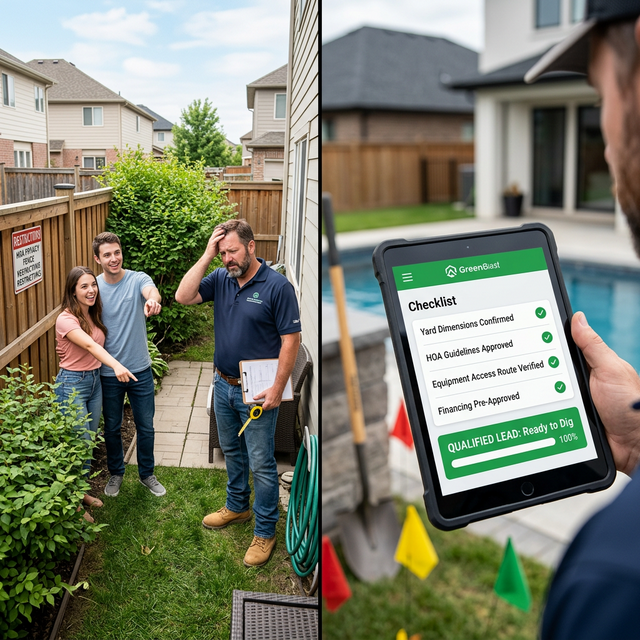
The pool installation business has a very specific site visit problem. Unlike most home service companies where a consultation is relatively low-cost, a pool site assessment is a multi-hour investment requiring a senior estimator, measuring equipment, and sometimes a structural engineer. When that site visit happens on a lot that the HOA prohibits from having a pool, or for a homeowner whose financing conversation reveals they expected a $15,000 project and yours starts at $55,000, the cost is not just the afternoon. It is the spring slot that a qualified buyer needed and did not get because the schedule was full of Dreamers.

Stop Buying Local Service Leads: Fix Your Intake Infrastructure Before You Buy Another Ad
Bad lead quality is not always the problem. Many service businesses lose paid leads because callbacks are slow, after-hours intake is weak, and follow-up is inconsistent.