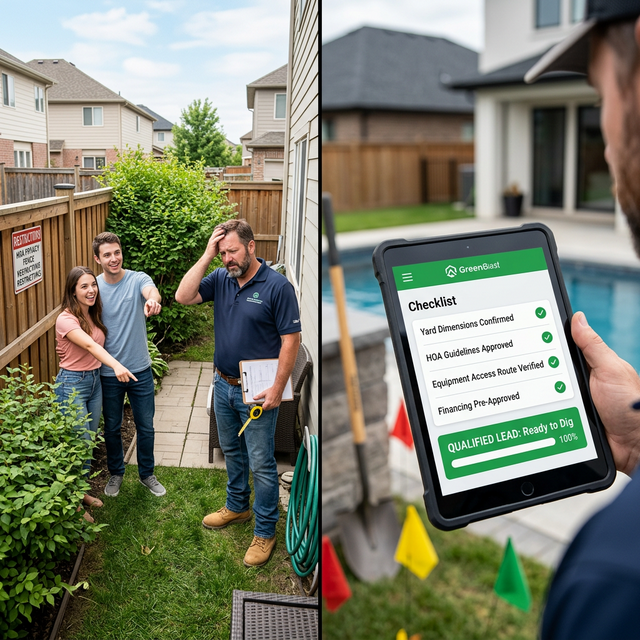

The Dreamer and the Digger make identically enthusiastic phone calls. The pool contractor who cannot distinguish between them before the site visit will fill their spring schedule with Dreamers and send their revenue season into August still fighting to line up closable projects.
Treat any number without a nearby source or stated method as a planning assumption, then replace it with your own records.
Carlos runs a pool installation company in the Phoenix metro. He has twenty-two years of experience, a crew of fourteen, and a subcontractor network that can move from excavation to plaster in eight weeks during peak season. In April, his schedule is so compressed that he is turning away two or three inquiries per week. He cannot afford to waste a site visit.
Last May, he drove ninety minutes to a prospect in Scottsdale. Beautiful home, serious couple, Pinterest board of pool designs on their phone. Three hours into the site assessment, his measurements flagged a problem. The property was in an HOA that had amended its guidelines in 2021 to prohibit any new pool construction on lots under 8,000 square feet. The lot was 7,400 square feet. The couple had no idea. They had bought the house the year before and had never checked the CC&Rs.
Carlos drove home. He billed nothing. He had no mechanism to bill for a site visit that produced no proposal. The assessment cost him half a day, $180 in fuel and mileage, three hours of his senior estimator's time at $65 per hour, and a swim lane in his April schedule that a qualified buyer could have used.
Total cost of that site visit: approximately $375. Revenue: zero. And that was the second unqualified site visit that week.
The HOA restriction is the single most common pool installation deal-killer that survives all the way to an in-person site assessment because nobody asked about it on the phone. The pool contractor qualification problem is not complicated. It is just consistently neglected.
The Dreamer vs. Digger Matrix
Pool company owners have an informal internal classification for the two types of callers they receive throughout the spring inquiry season. Every pool contractor knows the distinction intuitively. The problem is that both types look identical on the phone until someone asks the right questions.
The Dreamer: A homeowner who has wanted a pool for years, has mentally designed it dozens of times, and calls in March because the weather turned warm and the aspiration reached a temporary peak. They are enthusiastic, describe their vision in rich detail, and are very interested in scheduling a site visit. They have not checked their HOA documents, have not spoken to a bank, have not measured the usable yard area, and have not discussed with their spouse whether the project will happen this year or "someday." They are not buyers. They are browsers. They will consume a full site assessment and produce a proposal that sits in their email unread until September, when they decide to revisit it next spring.
The Digger: A homeowner who has decided. They have pulled their HOA documents and confirmed no restrictions apply. They have received a financing pre-approval or have cash ready. They know their backyard dimensions and have confirmed equipment access from the side gate. They have a target completion date tied to a real event - a summer birthday, a graduation party, a return from an extended trip. They need a site assessment to refine scope and lock in a start date. They are a project.
The Dreamer and the Digger make identically enthusiastic phone calls. The pool contractor who cannot distinguish between them before the site visit will fill their spring schedule with Dreamers and send their revenue season into August still fighting to line up closable projects.
The Site Visit Tax: What Unqualified Assessments Actually Cost
Pool company owners rarely calculate the fully-loaded cost of an unqualified site visit because the cost is distributed across staff time, vehicle expense, and schedule displacement rather than appearing as a single line item. When you build the actual number, it is consistently sobering.
A senior pool estimator who drives to a site, conducts a two-to-three hour assessment, returns to the office, and builds a preliminary proposal is consuming a half-day of their most expensive field time. At a loaded cost of $75 to $90 per hour including vehicle and benefits, a single unqualified site assessment costs $300 to $450 in direct labor and expense - before factoring in opportunity cost.
The opportunity cost is the figure that should concern every pool business owner most. During April and May, a pool installation company's site assessment calendar is among the most constrained resources in the business. There are only so many slots. A Dreamer who fills a Tuesday afternoon slot has displaced a Digger who might have been scheduled there instead. If the Digger goes to a competitor because your earliest available slot was two weeks out while their calendar had openings, you have lost a project that was worth $55,000 to lose a site visit that was worth negative $400.
Across a six-week spring surge, a pool contractor running two unqualified site visits per week is absorbing approximately $4,000 to $5,400 in direct waste and an unknown but material amount of lost revenue from schedule displacement. A pool business owner who eliminates or substantially reduces unqualified site visit volume through pre-qualification is not just recovering that waste - they are increasing the yield of their most productive season.
The Five-Question Pool Qualification Protocol
A Voice AI phone intake system for a pool installation company needs to surface the answers to five questions before a site visit is scheduled. Each question has a response path for both qualifying and disqualifying answers, so no caller feels rejected - they are either advanced toward a site visit or redirected toward the next appropriate step.
HOA status: "Is your home part of a homeowners association?" If yes: "Have you confirmed that your HOA guidelines allow pool installation?" A no or uncertain answer immediately triggers a redirect - the AI suggests the homeowner review their CC&Rs and provides a brief explanation of what to look for, then offers to reschedule once the HOA question is resolved. This single question eliminates the Carlos problem entirely.
Yard dimensions and access: "Approximately how much usable backyard space do you have, and do you have equipment access through a gate or side yard?" A pool contractor can establish minimum viable lot requirements specific to their installation type. A yard that is under their minimum is flagged, and the AI redirects the call toward a smaller water feature consultation or a competitor referral for compact installations.
Project timeline: "When are you hoping to have the pool completed?" A vague answer - "this summer" with no specific event tied to it - is a Dreamer signal. A specific answer - "before our daughter's July graduation party" - is a Digger signal. The AI tags the response for the estimator's review.
Budget range: "Pool installations vary significantly in scope and investment. Our inground installations typically start at $55,000 for a standard design. Is that range consistent with what you are planning?" This question, framed around helping the prospect understand what to expect rather than qualifying them out, surfaces budget mismatches before the site visit without creating awkwardness.
Decision-maker status: "Will the primary decision-makers in your household be available for the site visit?" The homeowner who calls without informing their spouse produces the same outcome as a kitchen remodeling consultation where one half of the couple is absent - a site visit that produces a proposal nobody can sign.
Spring Surge: Protecting the Revenue Season
The pool installation industry compresses a significant portion of its annual revenue opportunities into a narrow spring window. The homeowner who wants a pool completed by mid-July needs to sign a contract by early April to give excavation, steel, plumbing, and plaster phases enough runway. A pool contractor who spends March and early April on unqualified site visits arrives at the signing window with fewer confirmed projects than their schedule could have held.
A pre-qualification system that runs before any site assessment is scheduled does not slow down the pipeline - it accelerates it. Qualified prospects receive same-day site visit scheduling because the calendar has not been filled with Dreamers. Dreamers receive genuinely useful information that helps them get ready to become Diggers - in the next spring surge if not the current one. The pool business owner who takes care of both groups well builds a reputation for professional intake that generates referrals from both signed clients and from prospects who were not ready but felt respected in how they were handled.
The pool contractor who consistently qualifies leads before site visits also gains a compounding data advantage. Over one or two spring seasons, the pre-qualification system accumulates enough response data to identify which zip codes produce the highest HOA restriction rates, which financing pre-approval rates correlate with shorter project timelines, and which prospect profile characteristics predict the highest proposal acceptance rates. This data is invisible to the contractor who learns everything for the first time on a Tuesday afternoon site assessment in a backyard that cannot legally have a pool.
The "$50,000 Tire-Kicker": The Hidden Cost of "Free Estimates"
Every luxury pool builder has a "Steve." Steve calls on a Tuesday afternoon. He has a gorgeous half-acre lot in a gated community. He wants an infinity edge, a sunken fire pit, and a smart-lighting system that syncs with his Spotify playlist.
You spend three hours driving to his house and back. Your lead designer spends another four hours drafting a preliminary 3D rendering. You show up for the follow-up presentation with a $150,000 quote.
Steve looks at the quote, smiles, and says: "This looks incredible. We're also talking to three other builders, and we're probably about two years away from actually pulling the permit. We just wanted to see what was possible."
The "Steve" interaction just cost you $1,500 in unbillable labor.In the high-end pool industry, your biggest competitor aren't the other builders-it's the massive volume of homeowners who are "dreaming" but aren't "deploying."
The "Backyard Reality Check": Pre-Qualifying for Intent
Humanizing your intake doesn't mean being "nice" to everyone who calls. It means respecting your own time and the time of your serious clients. A relatable intake process acknowledges the homeowner's dream while firming up the operational reality.
*"We'd love to build your oasis, but we only take on twelve projects a year to ensure every stone is laid perfectly. Before we send our designer to your home, we need to ensure our timelines and investment scales align with your vision."*
By using an automated "Diagnostic Quiz" or an AI-buffered intake, you give the dreaming homeowners a path to educate themselves without burning your designer's weekend. When a lead finally makes it to your desk, you know they aren't just "Steve" looking for a free architectural drawing-they are a client ready to break ground. That is how you scale a luxury brand without scaling your stress levels.
How does the system handle the spring volume surge without adding staff?
The AI runs unlimited concurrent calls. At 9 AM on the first warm Saturday of April, when every homeowner who has been thinking about a pool since January decides to call simultaneously, every caller is answered within one ring. Every caller is taken through the qualification protocol. Every qualified prospect receives a same-day site visit booking confirmation. Every Dreamer receives a helpful redirect. Zero calls go to voicemail. The pool business owner reviews a prioritized queue of confirmed site assessment bookings on Monday morning, organized by qualification score and timeline urgency, rather than a voicemail inbox full of names and numbers to call back blindly.
The Authority Standard: ROI and Resonance
When we evaluate the ROI of an intake system like the one described for Pool Installation: Sifting Window-Shoppers from Ready-to-Dig Buyers, we look beyond the immediate convenience of automation. We look at the 'Revenue Leak' that occurs in the silence between a prospect reaching out and a business responding. In this vertical, that silence is the biggest competitor you have.
Data Anchor: The average LTV of a client in this space is significantly higher than the cost of a missed intake opportunity. By resolving for 'concurrency': the ability to handle infinite leads simultaneously-The Quiet Protocol transforms a passive operation into an aggressive revenue engine.
Use your own records before you decide
Source: start with your call log, CRM notes, booking calendar, missed-call records, web form timestamps, and Google Business Profile. Those records show whether buyers reached you, how fast they heard back, what they asked for, and where the next step broke down.
For seven days, mark each missed call, late reply, unbooked form, stale estimate, and review request that never went out. That small sample gives an owner a practical picture of the front-door gap before they spend more on ads, software, or staff.
The loss estimate is basic business math, not a magic claim.
Revenue-leak examples on this site are built from visible operating inputs: inquiry volume, missed-call or slow-response rate, booking rate, average job or client value, repeat value, and follow-up recovery. The fastest way to make the number real is to run the diagnostic for your closest business type, then compare it against your own call log, CRM, booking calendar, form timestamps, and review activity.
The practical questions behind this decision.
Should we charge for site assessments to filter out unserious prospects?
Some pool contractors use a nominal site assessment deposit - typically $250 to $500, credited against the project if it proceeds - as a qualification mechanism. This is effective but creates friction that also filters out genuine Diggers who are momentarily resistant to any upfront fee before they have seen a proposal. A Voice AI pre-qualification layer serves the same filtering function without the deposit friction. The HOA question alone eliminates the majority of non-viable site visits. The others are caught by the budget and access questions. Most pool business owners find that the AI protocol is a softer and more effective filter than a deposit requirement.
What if the homeowner does not know their HOA status or yard dimensions?
This is common, and the AI is trained to handle it gracefully. A homeowner who does not know their HOA status is directed to check their closing documentation or contact their HOA management company, with a specific checklist of what to look for. A homeowner who does not know their yard dimensions is given a simple measuring guide and offered a call back once they have the number. These redirects are framed as helpful preparation steps, not obstacles. The homeowner who takes the fifteen minutes to gather the information arrives at the site visit with better context, which makes the estimator's job easier and the proposal more accurate.
How does the system handle the spring volume surge without adding staff?
The AI runs unlimited concurrent calls. At 9 AM on the first warm Saturday of April, when every homeowner who has been thinking about a pool since January decides to call simultaneously, every caller is answered within one ring. Every caller is taken through the qualification protocol. Every qualified prospect receives a same-day site visit booking confirmation. Every Dreamer receives a helpful redirect. Zero calls go to voicemail. The pool business owner reviews a prioritized queue of confirmed site assessment bookings on Monday morning, organized by qualification score and timeline urgency, rather than a voicemail inbox full of names and numbers to call back blindly.
Map how a serious buyer decides in this kind of business.
Use the operating reality of the industry instead of copying a generic lead-generation playbook.
Replace broad industry assumptions with the business's actual inquiry volume, customer value, response time, and booking data.
See how the capability in this article fits into a complete customer journey.
Pool & Spa ConstructionSee the same decision through the language, buyer behavior, and operating reality of this industry.
Client Results & ProofInspect the starting condition, installation, measurement window, and outcome behind real client work.
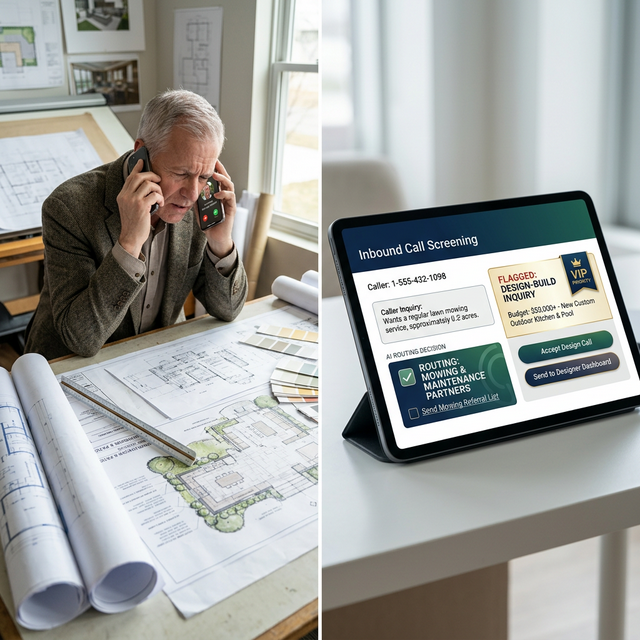
High-End Landscaping: How to Filter $500 Mowing Jobs from $50,000 Hardscape Projects
The design-build landscaping firm is not a lawn care service. It is an architecture firm that works with soil and stone. But the phone does not know that. Every spring, the same cycle repeats: a premium hardscape company spends thousands per month on local SEO and beautiful portfolio photography, only to have their senior designer spend 40 minutes a day fielding calls from homeowners who want a quote on mowing their quarter-acre lot. Every mowing call answered is a design-build proposal not written. Every maintenance quote given is a $50,000 outdoor kitchen conversation that never happened.

Custom Home Builders: Nurturing 12-Month Sales Cycles Without a Sales Team
The custom home building sales cycle is not measured in days or weeks. It is measured in seasons. A family that begins their land search in January may not be ready to sign a construction contract until November - if the builder who served them in January is still in their mind by October. The Leaky Bucket problem in custom home building is this: builders invest enormous time and expertise in early-stage prospects, then fail to maintain the relationship across the long middle of the buyer journey where the actual decision gets made. A competitor who touches the prospect at Month 8 with a perfectly timed follow-up often wins the contract that a superior builder earned in Month 2.
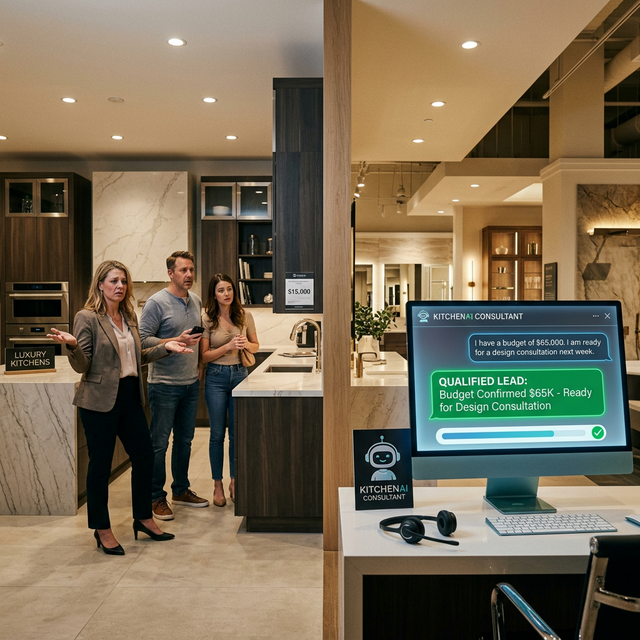
Kitchen & Bath Remodeling: Qualifying $50K Projects Before the Showroom Visit
A kitchen remodeling designer's most valuable and least renewable resource is not their portfolio or their vendor relationships. It is their Saturday. The moment a design-build remodeling company begins scheduling back-to-back showroom visits without pre-qualifying the prospect's budget, timeline, and decision-making authority, they have built an engine that converts designer time into free home renovation consulting for people who will spend $12,000 at a big-box store instead of $65,000 with your firm. The Polite AI Interrogation is the system that stops that conversion before it starts.