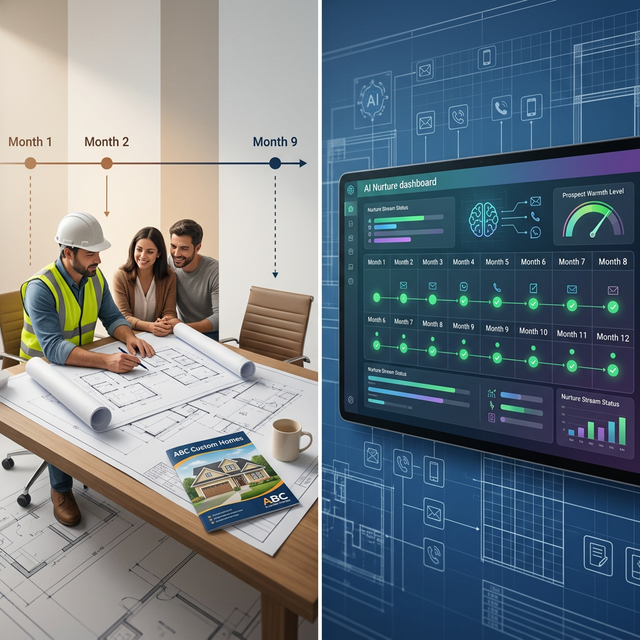

This is the Leaky Bucket. It is the defining revenue loss pattern in custom home building - the prospect who was qualified, interested, and sitting in the pipeline, who silently walked out the bottom of the bucket while the builder's attention was consumed by the active builds already under contract.
Treat any number without a nearby source or stated method as a planning assumption, then replace it with your own records.
Ryan built his first spec home at twenty-six. At forty-one, his custom home building firm has a waiting list, a design-build team of eleven, and an average project value of $680,000. He can walk a client through every phase of a custom build with the patience and depth of a professor. What he cannot do reliably is remember to call the Hendersons in April.
The Hendersons came in the previous October. Initial consultation went three hours. Ryan walked the lot with them, discussed a preliminary floor plan, and explained the timeline for a spring ground-breaking. They were enthusiastic, qualified, and genuinely excited. Ryan's project manager sent a follow-up summary email the next day. The file went into the CRM.
By February, Ryan's team was buried in an active build overrun. March brought a permitting dispute that consumed two weeks. April came and went. Nobody called the Hendersons. In May, the Hendersons signed with a competitor who had sent them a personalized note in January, a market update in February, a land pricing analysis in March, and who called personally in April to ask if they were still thinking about breaking ground.
Ryan lost a $680,000 project. Not to a better builder. Not to a lower price. To a competitor who simply maintained the relationship across the four months when Ryan's team was too busy to remember the Hendersons existed.
This is the Leaky Bucket. It is the defining revenue loss pattern in custom home building - the prospect who was qualified, interested, and sitting in the pipeline, who silently walked out the bottom of the bucket while the builder's attention was consumed by the active builds already under contract.
The Anatomy of the Custom Home Sales Cycle
Understanding where the leak occurs requires understanding how the custom home buying journey actually unfolds for most families. The decision to build a custom home is not a single moment - it is a twelve-to-eighteen month emotional and logistical process that moves through predictable phases, each with its own set of anxieties, decisions, and information needs.
Months 1-2: Initial exploration. The family is dreaming. They are researching builders, visiting model homes, attending open houses. They have not committed to land, have not finalized financing, and have not had the definitive "we are doing this" conversation. They need information, validation, and a builder who feels trustworthy - not a sales pitch.
Months 3-5: Narrowing. Land is becoming more real. Financing conversations are happening. The family is narrowing from five builders to two or three. The builder who stays in contact during this phase - with genuinely useful content, not promotional noise - maintains top-of-mind status when the shortlist gets made.
Months 6-8: The quiet middle. This is where most builders lose prospects without ever knowing it. The family is navigating a land purchase, waiting on a bank appraisal, managing the reality of the financial commitment they are about to make. They are not actively reaching out to builders because they feel they are not ready. If the builder does not reach out to them, the relationship atrophies. The family that once toured a model home with genuine excitement begins to forget the builder principal by name. By Month 8, they may not remember which firm had the better tile package or the more thoughtful energy efficiency standard - they just remember which builder called them last.
Months 9-12: Decision time. The land is secured, the financing is in place, and the family is ready to select their builder. The builder who has been consistently present across the previous nine months enters this phase with a relationship. The builder who dropped out in Month 5 enters it as a cold call. Given two builders of roughly equivalent quality, the one with the established relationship wins every single time. The decision has already been made at an emotional level; the contract signing is simply the formality.
The Human Limit of Long-Cycle Sales
The fundamental problem for custom home builders is that the long nurture cycle requires a kind of consistent, perfectly timed attention that is antithetical to how successful builders actually operate. The builder team's attention is overwhelmingly consumed by active projects - the client who is making tile selections today, the subcontractor who needs a decision on framing lumber by noon, the permit office that needs revised plans by Friday.
Asking a builder principal or project manager to simultaneously manage the emotional journey of a prospect who is still twelve months from ground-breaking is asking them to context-switch between radically different mental states. The active build is urgent, tangible, and immediately consequential. The nurture call to the Hendersons is important but not urgent. In the daily competition for attention, not-urgent loses to urgent every single time.
This is not a discipline failure. It is a structural mismatch between the demands of the long sales cycle and the operational reality of the building business. The solution is not to hire a dedicated salesperson - at $80,000 per year in base plus incentives, a dedicated builder sales representative adds enormous overhead to a business that may only sign twelve to sixteen contracts annually. The solution is to automate the nurture layer.
A well-configured Voice AI system does not replace the builder's relationship with the prospect. It maintains the relationship between the builder's meaningful human touchpoints. It ensures that nobody falls out of the bucket during the months when the team is heads-down on active work.
The analogy that resonates with most builder principals is this: an AI nurture system is not a salesperson. It is the front desk that answers the phone when the owner is on a job site. It does not close deals. It keeps the door open until the owner is ready to walk back through it with their full attention. For a twelve-month sales cycle, keeping that door open is 80 percent of the sale.
What a 12-Month Nurture Sequence Actually Looks Like
A custom home builder nurture system is not a generic drip email campaign. Generic drips are deleted. An effective long-cycle nurture sequence provides value at every touchpoint that is specific to where the prospect is in their journey.
Month 1 post-consultation:An automated follow-up call from the AI, delivered in the builder's voice and persona, summarizing the three key takeaways from the initial meeting and asking if any questions have surfaced since the conversation. This call signals responsiveness and professionalism immediately after the first impression.
Month 3:A land-related check-in. "Hi, this is Alex from Ridgeline Homes - I wanted to check in and see how the land search is progressing. We've seen a few interesting parcels come available in the Clearwater corridor that might match the orientation you mentioned. Would it be useful to have our team pull together a quick site analysis?" This is useful, non-promotional, and demonstrates that the builder remembers the details of the prospect's specific search.
Month 6:A financing-adjacent touch. As the six-month mark approaches, the Voice AI reaches out to ask about the financing timeline. "A lot of our clients find that the six-month mark is when financing conversations start getting real - can I schedule a brief call with you and our construction lending contact to walk through the process so there are no surprises?" This repositions the builder as a guide, not a vendor.
Month 9:A competitive intelligence call. "We wanted to reach out before the fall season gets fully underway - our schedule for spring starts is beginning to fill, and we wanted to make sure we held a spot for your project if the timeline is still on track." This creates genuine urgency from a scarcity position that is real, without being manipulative.
At every touchpoint, the AI is executing the communication - fielding the call, logging the response, tagging the prospect status, and alerting the builder principal when a prospect's response indicates they are entering the active decision phase. The builder engages personally only when the prospect's signal says they are ready. Everything before that is handled by the system.
The Competitive Advantage That Compounds
The custom home builder who implements a structured AI nurture system gains a compounding advantage over competitors who rely on human memory. In Year 1, the system catches the prospects who would have leaked out of the bucket during busy build seasons. In Year 2, the builder begins to see a pattern: the projects that close most smoothly are the ones where the prospect has been nurtured through the full buyer journey and arrives at the contract-signing table already knowing the team, the process, and the builder's values.
A custom home builder operating with a full nurture system rarely competes on price at the contract phase. The prospect who has been consistently engaged over nine months is not still shopping for the lowest bid. They have already made a trust decision. The contract conversation is about logistics and specifications, not about justifying the builder's rate against a competitor's estimate. The closing rate on fully-nurtured prospects is dramatically higher than on cold consultations.
For a custom home builder doing eight to fifteen projects annually with an average contract value above $500,000, capturing just one additional project per year that would otherwise have leaked from the pipeline adds $500,000 to the top line. The nurture system costs a fraction of that. The ROI on the first recovered prospect pays for the system for multiple years.
Beyond the direct revenue recovery, the custom home builder with a systematic nurture protocol develops a reputation in their market for attentiveness that word-of-mouth cannot replicate. Former prospects who were nurtured through a full buyer journey - even those who ultimately did not build, due to life circumstances changing - consistently refer the builder to others, because they experienced a level of professional care that is uncommon in the industry.
The "12-Month Nurture Gap": Why Your CRM is a Ghost Town
In the world of custom home building, a "hot lead" is someone who is planning to break ground... in about fourteen months. Unlike an emergency plumber or a same-day courier, your clients are making the largest financial decision of their lives.
The problem? Most sales systems are built for short-cycle conversions. If an agent calls a lead and hears "We're still interviewing architects," the lead gets marked as "Cold" and forgotten. Six months later, that same lead signs a $2.5 million contract with your competitor because they were the ones who stayed top-of-mind.
The "Nurture Gap" is where multi-million dollar contracts go to die.You don't need more leads; you need a system that can maintain a sophisticated, non-intrusive relationship for a year without requiring your sales manager to manually send 50 "just checking in" emails every Monday.
The Architect Hand-off: Positioning as the Preferred Partner
A relatable builder isn't just a general contractor; they are a consultant. By using an AI-buffered intake, you can capture the specific architectural styles, lot requirements, and "must-have" features of a prospect while they are still in the dreaming phase.
When that prospect finally finishes their plans with the architect, they don't go looking for three bids. They go to the builder who has been providing them with high-value insights and "Quiet Protocol" updates throughout their planning process.
By the time the soil is ready for testing, you aren't "competing" for the project. You are the only logical choice. That is how you build a backlog of premium projects that keeps your crews busy for three years straight, regardless of what the broader economy is doing.
What happens if a prospect goes fully silent for several months?
Silence is data. A prospect who has not responded to three sequential nurture touchpoints is automatically tagged as dormant, and the AI scales back to a quarterly check-in cadence rather than burning the relationship with over-communication. Dormant prospects are reviewed during the builder's quarterly pipeline review. Many dormant prospects re-engage at month twelve or beyond when their circumstances change. The builder who maintained a quiet, patient presence through the silence is the one who receives that re-engagement call.
The Authority Standard: ROI and Resonance
When we evaluate the ROI of an intake system like the one described for Custom Home Builders: Nurturing 12-Month Sales Cycles Without a Sales Team, we look beyond the immediate convenience of automation. We look at the 'Revenue Leak' that occurs in the silence between a prospect reaching out and a business responding. In this vertical, that silence is the biggest competitor you have.
Data Anchor: The average LTV of a client in this space is significantly higher than the cost of a missed intake opportunity. By resolving for 'concurrency': the ability to handle infinite leads simultaneously-The Quiet Protocol transforms a passive operation into an aggressive revenue engine.
Use your own records before you decide
Source: start with your call log, CRM notes, booking calendar, missed-call records, web form timestamps, and Google Business Profile. Those records show whether buyers reached you, how fast they heard back, what they asked for, and where the next step broke down.
For seven days, mark each missed call, late reply, unbooked form, stale estimate, and review request that never went out. That small sample gives an owner a practical picture of the front-door gap before they spend more on ads, software, or staff.
The loss estimate is basic business math, not a magic claim.
Revenue-leak examples on this site are built from visible operating inputs: inquiry volume, missed-call or slow-response rate, booking rate, average job or client value, repeat value, and follow-up recovery. The fastest way to make the number real is to run the diagnostic for your closest business type, then compare it against your own call log, CRM, booking calendar, form timestamps, and review activity.
The practical questions behind this decision.
Does the AI nurture system work for semi-custom builders, or only fully custom?
The system works across the full spectrum of custom and semi-custom construction. The nurture sequence simply shifts in content focus. A fully custom builder nurtures around site-specific design decisions and land considerations. A semi-custom or production-adjacent builder nurtures around floor plan selection, lot availability, and upgrade decision timelines. The AI is configured with the specific decision journey of the builder's typical buyer, not a generic homebuyer.
How does the AI know when to escalate a prospect to a human relationship?
The system is trained on specific trigger phrases and behavioral signals. If a prospect responds to a nurture call by asking about contract timing, requesting a meeting, or mentioning that their land purchase is closing next week, those are escalation signals. The AI flags the prospect as hot, logs the trigger language, and sends an immediate notification to the builder principal with a call summary and a recommended next action. The builder's first personal touchpoint arrives at exactly the right moment in the prospect's journey.
What happens if a prospect goes fully silent for several months?
Silence is data. A prospect who has not responded to three sequential nurture touchpoints is automatically tagged as dormant, and the AI scales back to a quarterly check-in cadence rather than burning the relationship with over-communication. Dormant prospects are reviewed during the builder's quarterly pipeline review. Many dormant prospects re-engage at month twelve or beyond when their circumstances change. The builder who maintained a quiet, patient presence through the silence is the one who receives that re-engagement call.
Locate the point where interested buyers stop hearing from the business.
Review one customer journey from first inquiry through booking, estimate, reminder, and recovery.
Use the diagnostic to locate the handoff where good inquiries, estimates, appointments, or past customers stop moving.
See how the capability in this article fits into a complete customer journey.
Home & Field ServicesSee the same decision through the language, buyer behavior, and operating reality of this industry.
Client Results & ProofInspect the starting condition, installation, measurement window, and outcome behind real client work.
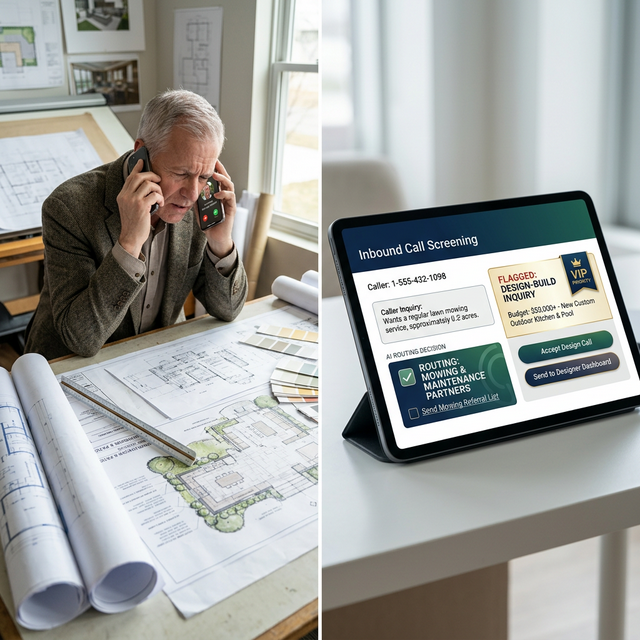
High-End Landscaping: How to Filter $500 Mowing Jobs from $50,000 Hardscape Projects
The design-build landscaping firm is not a lawn care service. It is an architecture firm that works with soil and stone. But the phone does not know that. Every spring, the same cycle repeats: a premium hardscape company spends thousands per month on local SEO and beautiful portfolio photography, only to have their senior designer spend 40 minutes a day fielding calls from homeowners who want a quote on mowing their quarter-acre lot. Every mowing call answered is a design-build proposal not written. Every maintenance quote given is a $50,000 outdoor kitchen conversation that never happened.

Stop Buying Local Service Leads: Fix Your Intake Infrastructure Before You Buy Another Ad
Bad lead quality is not always the problem. Many service businesses lose paid leads because callbacks are slow, after-hours intake is weak, and follow-up is inconsistent.
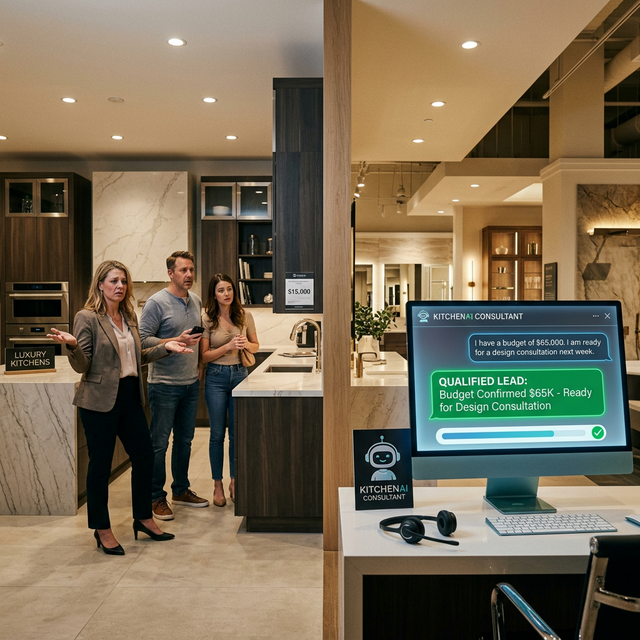
Kitchen & Bath Remodeling: Qualifying $50K Projects Before the Showroom Visit
A kitchen remodeling designer's most valuable and least renewable resource is not their portfolio or their vendor relationships. It is their Saturday. The moment a design-build remodeling company begins scheduling back-to-back showroom visits without pre-qualifying the prospect's budget, timeline, and decision-making authority, they have built an engine that converts designer time into free home renovation consulting for people who will spend $12,000 at a big-box store instead of $65,000 with your firm. The Polite AI Interrogation is the system that stops that conversion before it starts.