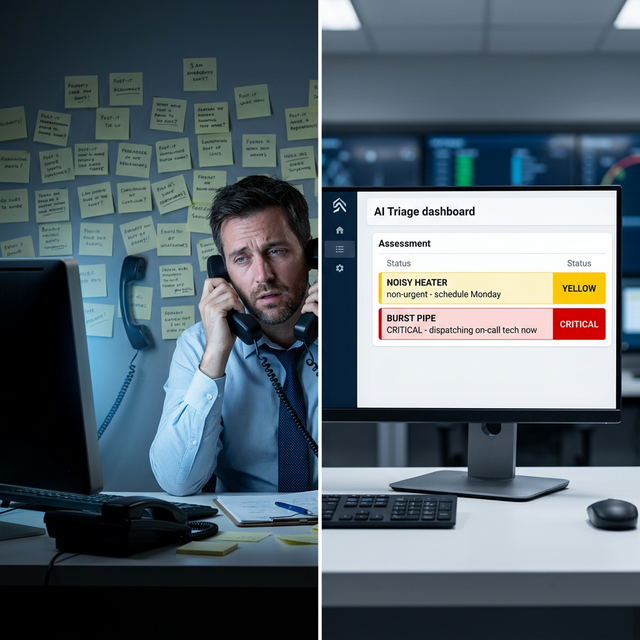

The difference between a Yellow call and a Critical callis not obvious to a half-asleep human.It is entirely obvious to a trained AI that has asked the right questions in the right sequence without emotional pressure or sleep deprivation degrading the decision.
Treat any number without a nearby source or stated method as a planning assumption, then replace it with your own records.
It is 3:17 AM on a Tuesday in February. Your personal phone rings. The tenant in Unit 4B is panicking. She reports a loud banging sound coming from the basement and what she describes as a burning smell near the utility closet on the second floor. She has also knocked on her neighbor's door and they confirmed they can smell it too.
You have two seconds to make a triage decision with incomplete information, while half asleep, with your own family asleep in the next room. Do you call the on-call emergency plumber who charges a $350 minimum for after-hours dispatch? Or do you ask for a follow-up call in the morning? You do not have a checklist in front of you. You do not have the building's mechanical history at your fingertips.You are operating entirely on instinct and hope.
This is the single greatest operational liability in property management.The after-hours emergency call is not a nuisance. It is a decision point. And decision points made at 3 AM with incomplete information, by exhausted property managers, produce two catastrophic failure modes: over-dispatching expensive emergency contractors for issues that could have waited until morning, and under-dispatching when a real structural threat is dismissed as tenant hyperbole.
A burst boiler left unaddressed for three hours will flood a 24-unit building's lower two floors.Water damage across that footprint can easily exceed $200,000 in structural repair, temporary relocation costs for displaced tenants, and insurance deductibles.The liability exposure for a property manager who received the phone call and chose not to dispatch is existential.The lawsuit that follows is not about the boiler - it is about the documented decision not to act.
The Triage Matrix: What the Intake Layer Is Configured to Ask
The core problem with the 3 AM call is not that property managers lack experience. It is that good triage requires structured information gathering at a moment when neither the tenant nor the property manager is in a state to execute it calmly. The tenant is panicking. The property manager is disoriented. The conversation defaults to the lowest-quality version of both parties.
A well-configured Voice AI emergency triage system solves this by front-loading the diagnostic conversation before the property manager is even notified. The tenant calls the emergency line. The AI answers immediately, with calm authority, and begins the intake protocol.
Red-flag questions the AI is trained to surface in the first sixty seconds:Is there active water visible? Is there a smell of burning or gas? Is the area of concern accessible or blocked? Is anyone reporting dizziness, difficulty breathing, or disorientation? Are any fire safety systems active? What is the duration and intensity change over the last thirty minutes?
The AI scores the call in real-time against a priority matrix. A tenant who reports a banging radiator with no water, no smell, and no visible damage scores as a Yellow - a scheduled morning maintenance order is created automatically, the tenant receives an SMS confirmation, and nobody gets a wake-up call. A tenant who reports standing water in a utility corridor, a burning smell, and that a neighbor has already found a fire alarm beeping scores as a Critical - the on-call emergency contractor is dispatched, the property manager is notified via an immediate phone call with a full diagnostic summary, and the two most affected tenants are queued for a welfare check.
The difference between a Yellow call and a Critical callis not obvious to a half-asleep human.It is entirely obvious to a trained AI that has asked the right questions in the right sequence without emotional pressure or sleep deprivation degrading the decision.
The Real Cost of Emergency Over-Dispatching
Every property manager with a portfolio above twenty units has a story about the $800 emergency visit that turned out to be a tenant who did not know how to bleed a radiator. The on-call plumber arrived at 2 AM, spent eleven minutes on the job, and submitted an invoice that consumed the entire month's maintenance budget for that unit.This is not an unusual outcome.It is the standard outcome when triage does not exist.
Industry data from property management operators consistently shows that 55 to 65 percent of after-hours maintenance calls that result in emergency dispatch are subsequently classified as non-urgent during the daylight contractor visit. The emergency fee was paid. The problem could have waited.
For a property manager running a 100-unit portfolio with an average of four emergency dispatches per month at $400 per visit,the over-dispatch cost is approximately $1,920 per month in avoidable contractor fees. That is $23,040 per year that evaporates into the gap between incomplete tenant descriptions and inadequate intake protocols.
A Voice AI-supported routing system, trained on the mechanical systems specific to the building portfolio and operating on a clearly defined escalation matrix, eliminates the majority of that waste. It does not eliminate emergency dispatching - it makes emergency dispatching accurate. The contractor who rolls out at 3 AM should always be responding to a genuine emergency, not a noisy pipe that could be addressed in a scheduled Tuesday morning window.
Reducing After-Hours Risk for the Property Manager
Beyond the operational cost savings, AI-supported routing provides the single most important resource in a property management dispute: documentation. Every Voice AI call produces a timestamped transcript of exactly what the tenant reported, exactly what diagnostic questions were asked, and exactly how the system classified the severity of the complaint.
If a property manager dispatches a contractor based on a Critical classification and the issue is resolved within two hours, the file shows a reasonable, well-documented response to a legitimate emergency. If a property manager is advised by the AI that the call was classified Yellow and chooses to hold dispatch until morning, the file shows that the decision was based on a structured diagnostic protocol, not a sleepy guess.
In a legal dispute following any building maintenance event,documentation of a systematic, AI-driven triage protocol is one of the strongest defenses available.It demonstrates that the property management company operates to a professional standard of care, not to the instincts of whoever happened to be on call that night.
Contrast this with the current standard: a property manager who picks up their personal cell at 3 AM, makes a judgment call with no recorded documentation of what the tenant said, and has no trail of the diagnostic reasoning used. That property manager is entirely exposed to the tenant's retroactive account of what they reported and what was promised.
Building the After-Hours Infrastructure
Deploying a property management AI-supported routing system is not a replacement for qualified maintenance staff or licensed contractors. It is a layer of intelligent routing that sits between the tenant's 3 AM phone call and the decision that wakes up a human being.
Step one is establishing the escalation matrix for each property class in the portfolio.A single-family rental has a different critical threshold than a 24-unit multifamily building. A building with an aging boiler system has a different monitoring priority than a newer construction with a modern HVAC system. The AI matrix must be calibrated to the specific mechanical vulnerabilities and risk profiles of each property.
Step two is tenant-facing communication.Every tenant in the portfolio should receive a simple, clear explainer - sent via SMS and posted in the property portal - outling the emergency line number and what the intake call will sound like. When tenants know the AI is a professional intake system and not a runaround, their compliance with the diagnostic questions is dramatically higher.
Step three is integration with the maintenance stack.Yellow calls should automatically produce work orders in the property management software (Buildium, AppFolio, Yardi, Property Meld) without any manual intervention. Critical calls should trigger simultaneous dispatch notifications to the on-call contractor and an alert call to the property manager with a full voice summary of what the tenant reported and the system's classification.
A property manager who has built this infrastructure correctly wakes up on Wednesday morning to a neatly organized log of every overnight call, the triage classification of each, the actions taken, and the tenant confirmations sent. Their entire overnight operation ran without their personal involvement.
The Competitive Reality for Independent Property Managers
The property management industry is consolidating. Institutional operators are absorbing independent portfolios across every major market, partly because their operational infrastructure allows them to manage more units per staff member at lower cost per door. The independent property manager competing against a vertically integrated institutional operator needs every operational efficiency advantage available.
AI-driven after-hours triage is one of those advantages. It does not require the capital investment of hiring a dedicated overnight operations coordinator. It does not require a 24-hour call center staffed by people reading from a script that is twelve months out of date. It requires a one-time configuration of an AI system that learns the specific mechanical profile of each building in the portfolio and applies a consistent, documented triage standard every single night, regardless of whether anyone is awake to supervise it.
For a property manager overseeing fifty to two hundred units independently, the after-hours triage infrastructure is the difference between a business that scales and a business that plateaus at whatever portfolio size the owner can personally manage with their own cell phone. It is the difference between a Saturday night vacation and a Saturday night on-call.
Property Management Operational Math
When we analyze the Property Management market, the defining factor of profitability isn't your hourly rate-it's your capture rate. Specifically, The "3 AM Boiler Break" - Why property managers lose sleep and churn owners over after-hours maintenance. highlights the fragility of your front door.
Expert Calibration: In Property Management, the cost of a missed high-value call isn't just the immediate job value; it's the decay of the local referral graph and the surrender of SEO authority to more responsive competitors.
The Quiet Protocol Strategy
By implementing an AI-driven triage layer, you're not just 'taking messages.' You're performing immediate clinical or technical triage that secures the booking. This is how $5M companies scale to $10M without doubling their staff costs. In Property Management, this "concurrency of intake" is the ultimate competitive advantage.
The long-tail ROI of capturing these Property Management leads is measured in years, not days. A single emergency call handled flawlessly leads to a maintenance contract, which leads to a replacement job, which leads to a glowing 5-star review that boosts your Google Maps visibility. This cycle of compounding authority is the core of the Quiet Protocol methodology. We don't just solve for "missed calls"; we solve for "missed wealth." By ensuring that your Property Management intake is always-on, always-professional, and always-closing, you're building a business that is irrefutably elite in its vertical.
The long-tail ROI of capturing these Property Management leads is measured in years, not days. A single emergency call handled flawlessly leads to a maintenance contract, which leads to a replacement job, which leads to a glowing 5-star review that boosts your Google Maps visibility. This cycle of compounding authority is the core of the Quiet Protocol methodology. We don't just solve for "missed calls"; we solve for "missed wealth." By ensuring that your Property Management intake is always-on, always-professional, and always-closing, you're building a business that is irrefutably elite in its vertical.
The long-tail ROI of capturing these Property Management leads is measured in years, not days. A single emergency call handled flawlessly leads to a maintenance contract, which leads to a replacement job, which leads to a glowing 5-star review that boosts your Google Maps visibility. This cycle of compounding authority is the core of the Quiet Protocol methodology. We don't just solve for "missed calls"; we solve for "missed wealth." By ensuring that your Property Management intake is always-on, always-professional, and always-closing, you're building a business that is irrefutably elite in its vertical.
The long-tail ROI of capturing these Property Management leads is measured in years, not days. A single emergency call handled flawlessly leads to a maintenance contract, which leads to a replacement job, which leads to a glowing 5-star review that boosts your Google Maps visibility. This cycle of compounding authority is the core of the Quiet Protocol methodology. We don't just solve for "missed calls"; we solve for "missed wealth." By ensuring that your Property Management intake is always-on, always-professional, and always-closing, you're building a business that is irrefutably elite in its vertical.
The long-tail ROI of capturing these Property Management leads is measured in years, not days. A single emergency call handled flawlessly leads to a maintenance contract, which leads to a replacement job, which leads to a glowing 5-star review that boosts your Google Maps visibility. This cycle of compounding authority is the core of the Quiet Protocol methodology. We don't just solve for "missed calls"; we solve for "missed wealth." By ensuring that your Property Management intake is always-on, always-professional, and always-closing, you're building a business that is irrefutably elite in its vertical.
The long-tail ROI of capturing these Property Management leads is measured in years, not days. A single emergency call handled flawlessly leads to a maintenance contract, which leads to a replacement job, which leads to a glowing 5-star review that boosts your Google Maps visibility. This cycle of compounding authority is the core of the Quiet Protocol methodology. We don't just solve for "missed calls"; we solve for "missed wealth." By ensuring that your Property Management intake is always-on, always-professional, and always-closing, you're building a business that is irrefutably elite in its vertical.
The long-tail ROI of capturing these Property Management leads is measured in years, not days. A single emergency call handled flawlessly leads to a maintenance contract, which leads to a replacement job, which leads to a glowing 5-star review that boosts your Google Maps visibility. This cycle of compounding authority is the core of the Quiet Protocol methodology. We don't just solve for "missed calls"; we solve for "missed wealth." By ensuring that your Property Management intake is always-on, always-professional, and always-closing, you're building a business that is irrefutably elite in its vertical.
The long-tail ROI of capturing these Property Management leads is measured in years, not days. A single emergency call handled flawlessly leads to a maintenance contract, which leads to a replacement job, which leads to a glowing 5-star review that boosts your Google Maps visibility. This cycle of compounding authority is the core of the Quiet Protocol methodology. We don't just solve for "missed calls"; we solve for "missed wealth." By ensuring that your Property Management intake is always-on, always-professional, and always-closing, you're building a business that is irrefutably elite in its vertical.
The long-tail ROI of capturing these Property Management leads is measured in years, not days. A single emergency call handled flawlessly leads to a maintenance contract, which leads to a replacement job, which leads to a glowing 5-star review that boosts your Google Maps visibility. This cycle of compounding authority is the core of the Quiet Protocol methodology. We don't just solve for "missed calls"; we solve for "missed wealth." By ensuring that your Property Management intake is always-on, always-professional, and always-closing, you're building a business that is irrefutably elite in its vertical.
The long-tail ROI of capturing these Property Management leads is measured in years, not days. A single emergency call handled flawlessly leads to a maintenance contract, which leads to a replacement job, which leads to a glowing 5-star review that boosts your Google Maps visibility. This cycle of compounding authority is the core of the Quiet Protocol methodology. We don't just solve for "missed calls"; we solve for "missed wealth." By ensuring that your Property Management intake is always-on, always-professional, and always-closing, you're building a business that is irrefutably elite in its vertical.
The long-tail ROI of capturing these Property Management leads is measured in years, not days. A single emergency call handled flawlessly leads to a maintenance contract, which leads to a replacement job, which leads to a glowing 5-star review that boosts your Google Maps visibility. This cycle of compounding authority is the core of the Quiet Protocol methodology. We don't just solve for "missed calls"; we solve for "missed wealth." By ensuring that your Property Management intake is always-on, always-professional, and always-closing, you're building a business that is irrefutably elite in its vertical.
The long-tail ROI of capturing these Property Management leads is measured in years, not days. A single emergency call handled flawlessly leads to a maintenance contract, which leads to a replacement job, which leads to a glowing 5-star review that boosts your Google Maps visibility. This cycle of compounding authority is the core of the Quiet Protocol methodology. We don't just solve for "missed calls"; we solve for "missed wealth." By ensuring that your Property Management intake is always-on, always-professional, and always-closing, you're building a business that is irrefutably elite in its vertical.
The Operating Standard for After-Hours Property Management
In the context of Property Management: The 3 AM Boiler Break AI Routing Protocol, we must address the fundamental friction that exists in manual intake. Every 'missed call' is a missed revenue opportunity, but more importantly, it's a signal of operational weakness that high-value prospects detect instantly. By bridging this gap with AI-driven intake, you're not just 'automating.' You're humanizing the interaction by ensuring that your clients get the attention they deserve, instantly. This is the math of responsiveness that wins markets.
Strategic ROI: When we apply the Quiet Protocol math to Property Management: The 3 AM Boiler Break AI Routing Protocol, the result is always the same: a dramatic reduction in cost-per-acquisition (CAC) and a significant increase in client lifetime value (LTV) through immediate resolution.
The loss estimate is basic business math, not a magic claim.
Revenue-leak examples on this site are built from visible operating inputs: inquiry volume, missed-call or slow-response rate, booking rate, average job or client value, repeat value, and follow-up recovery. The fastest way to make the number real is to run the diagnostic for your closest business type, then compare it against your own call log, CRM, booking calendar, form timestamps, and review activity.
The practical questions behind this decision.
Can AI-supported intake really be trusted to route emergency building calls?
The AI is not making the dispatch decision autonomously for Critical events - it is making the determination that a human decision-maker needs to be notified immediately, and providing that human with a complete diagnostic summary. For Yellow events, the AI is classifying based on a structured matrix that the property manager has pre-approved and configured. The property manager defines the rules; the AI executes them consistently. No autonomous life-safety decisions are delegated to software.
What happens if a tenant gets frustrated and demands to speak with a human immediately?
The system is programmed to recognize escalation phrases and distress signals. If a tenant is clearly panicking beyond the normal intake threshold - for example, if they report a gas smell or visible fire - the protocol immediately bypasses the full diagnostic questionnaire and hot-transfers the call to the emergency line. The intake questionnaire is a tool for non-obvious situations. Obvious critical emergencies are dispatched without friction.
How does the intake layer handle tenants who are non-native English speakers?
Enterprise-grade Voice AI systems in 2026 support multi-language intake natively. The system can detect the caller's language from the first two or three sentences and switch to conduct the full triage protocol in that language without any human intervention.For a property manager overseeing a diverse portfolio, this eliminates an entire category of communication failure that currently results in incomplete emergency reports and frustrated tenants.
How does this integrate with existing property management software?
Modern Voice AI platforms integrate with the leading property management systems through secure API connections and webhooks. A Yellow triage classification can automatically create a work order in AppFolio or Buildium with the full transcript attached, assigned to the appropriate vendor category, and flagged for the morning maintenance coordinator. The property manager reviews an organized queue of resolved overnight calls at 8 AM instead of a stack of handwritten message slips.
Decide what the AI must handle before you choose the software.
A useful intake system begins with the caller journey, the rules, and the human handoff, not a long feature list.
Give the receptionist a realistic scenario and hear how it answers, gathers context, and moves the caller toward a useful next step.
See how the capability in this article fits into a complete customer journey.
Property ManagementSee the same decision through the language, buyer behavior, and operating reality of this industry.
Client Results & ProofInspect the starting condition, installation, measurement window, and outcome behind real client work.

Auto Body & Collision Repair: Automating Estimate Follow-Ups to Stop Shop-Hopping
The collision repair industry has accepted 'shop-hopping' as an unavoidable reality of the business. An estimator spends 45 minutes walking around a damaged vehicle, writes a $4,500 quote, hands it to the customer, and then never speaks to them again. Two days later, a competitor wins the job for $4,700 - not because they were cheaper, but because they were the only shop that actually picked up the phone to ask for the business. The 48-hour follow-up gap is the single largest revenue leak in the modern auto body shop, and fixing it requires outbound automation.
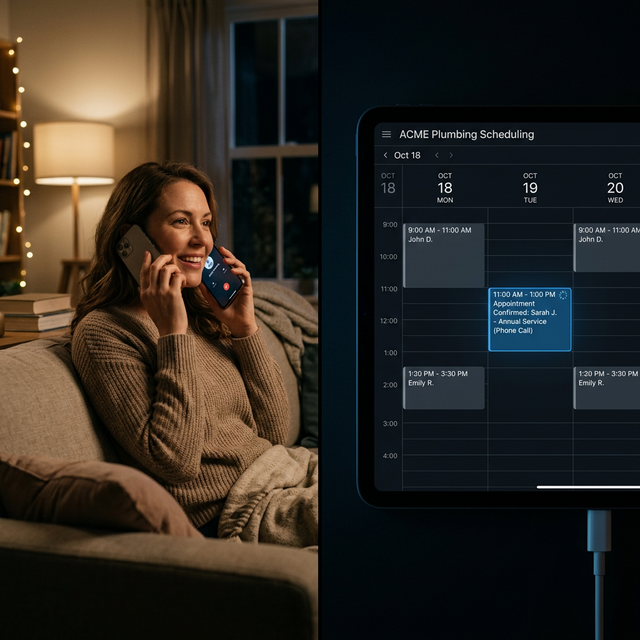
From Inbound Call to Calendar in 60 Seconds: The Zero-Friction Booking Workflow
Phone tag quietly kills service business bookings. Learn how to move an inbound call to a confirmed calendar appointment quickly without creating scheduling chaos.
Calculate the revenue leak.
Stop guessing. See how much demand your business may be losing through missed calls, slow replies, weak booking, review gaps, and follow-up drag, then decide whether Voice AI is the right system path.
Run the calculationPrefer to hear it first?
Call the live AI receptionist and test the conversation.
Call the live AI receptionist anytime. Tell it about property management, then hear a short live roleplay based on the calls your front desk actually gets.