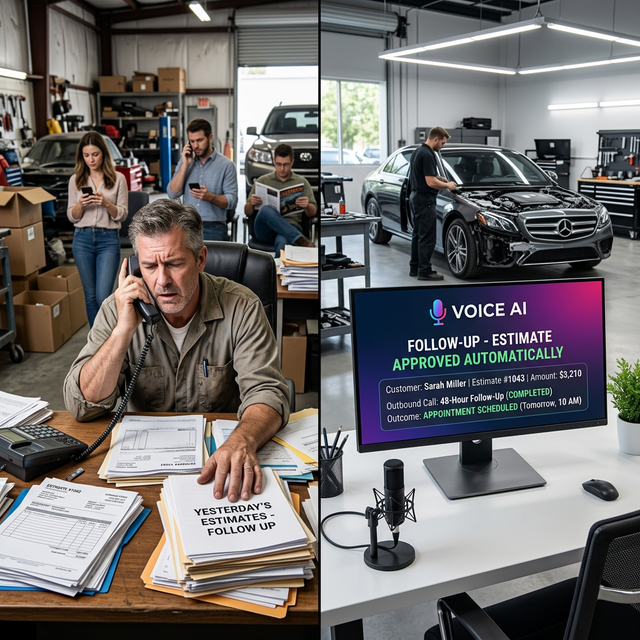
When an estimator spends 45 minutes walking around a vehicle, writes a detailed quote, hands it over in a manila folder, and says, "Let us know when you are ready," they have just committed the cardinal sin of high-ticket sales: they have left the emotional resolution entirely up to the buyer.
Treat any number without a nearby source or stated method as a planning assumption, then replace it with your own records.
Walk into any independent auto body shop in the country and ask the owner about their close rate on written estimates. The answer is almost universally steeped in frustration. They will tell you that customers take the physical estimate, drive down the street to the next collision center, and use it to negotiate a price that is fifty dollars cheaper. They will tell you that the modern automotive consumer is entirely price-driven and entirely lacking in loyalty.
This is the myth of shop-hopping. The reality is far less malicious and entirely operational. The modern automotive consumer is not inherently price-driven; they are inherently anxiety-driven. A collision repair is a grudge purchase. The customer did not want to spend this money. They are stressed about insurance claims, stressed about rental cars, and stressed about being taken advantage of by mechanics.
When an estimator spends 45 minutes walking around a vehicle, writes a detailed quote, hands it over in a manila folder, and says, "Let us know when you are ready," they have just committed the cardinal sin of high-ticket sales: they have left the emotional resolution entirely up to the buyer.
The customer drives away. Forty-eight hours pass. The estimate sits on their kitchen counter. In that 48-hour gap, the customer is vulnerable. If a competing shop owner calls them to simply say, "Hi Sarah, I wanted to review that estimate with you and see if your insurance company had any pushback," that shop wins the job. They do not win because they are cheaper. They win because they took control of a stressful situation.
The 48-Hour Revenue Leak
The gap between a written estimate and a signed repair order is where the majority of an auto body shop's profit margins bleed out. In a shop writing twenty estimates a week, a failure to follow up effectively can easily result in $50,000 of lost top-line revenue every single month. For a multi-shop operator, that failure compounds into millions of dollars in localized revenue capture that simply walks out the door.
Why does the follow-up fail? Because the people writing the estimates are also the people managing the technicians, ordering the parts, dealing with the insurance adjusters, and answering the inbound phone calls. The modern collision center is a masterclass in controlled chaos. Asking a shop manager or estimator to meticulously track and call twenty unconverted estimates from two days ago is an exercise in futility. It simply does not happen. The shop owner assumes that if the customer was serious, they would have called back.
This assumption is fatal. It completely ignores the friction of the automotive repair process. Customers do not call back because they are waiting on a supplemental check from State Farm. They do not call back because they lost the paperwork under a pile of mail on their kitchen counter. They do not call back because they are overwhelmed by the logistics of coordinating a rental car while their vehicle is in the bay. The shop that reaches out and offers to proactively navigate that friction is the shop that captures the keys.
When a customer receives absolute silence from the facility that just quoted them $6,000, the perceived value of that quote drops to zero. They assume the shop is too busy to care, too disorganized to manage their repair, or simply indifferent to their business. That silence is the exact moment they open Google Maps, search for "auto body near me," and drive to the competitor who is actively answering the phone.
The Outbound Follow-Up System
The traditional solution to this problem was to hire a dedicated service advisor or BDC (Business Development Center) representative just to manage the follow-up pipeline. For a $10M collision franchise, this makes sense. For a $2M independent shop, adding $60,000 in dedicated payroll for outbound dials is rarely sustainable. The result in most local shops is that estimators are told to "make their calls" during downtime, but in a busy shop, downtime does not exist.
Enter Voice AI. The fundamental shift in 2026 is that autonomous outbound dialing has reached human parity in conversational pacing and empathy. It is no longer a robotic dialer leaving a pre-recorded voicemail. It is an intelligent agent capable of recognizing objections, answering technical scheduling questions, and pushing updates directly into the shop's management system without a human touching a keyboard. The AI operates with mechanical precision, executing the follow-up cadence perfectly every single time, without the emotional fatigue that limits human callers.
Consider the automated 48-hour protocol: A customer receives an estimate on Tuesday at 10 AM. If the status in the shop's CRM has not changed to "Approved" by Thursday at 10 AM, the Voice AI automatically initiates an outbound call. There is no manual prompting required. The system recognizes the state change and acts.
The conversation sounds exactly like a top-tier service writer: "Hi David, this is Alex calling from Apex Auto Body. Mike wrote an estimate for your Camry a couple of days ago. I just wanted to reach out and see if you had navigated the insurance approval yet, or if you needed us to handle that supplement process for you?"
In this scenario, the AI is doing the emotional heavy lifting. If the customer says they are waiting on the adjuster, the AI logs the timeline and schedules a follow-up for next week. If the customer says they are ready to proceed, the AI immediately books the drop-off appointment, sends the digital authorization forms via SMS, and alerts the parts department to initiate the initial parts order. The entire transaction is secured before the customer even considers calling another shop.
Out-Organizing the Cheapest Bidder
There is a persistent, industry-wide belief among independent shop owners that they are losing jobs solely on price. This is pure confirmation bias. You only hear from the customers who have the audacity to call back to complain about the price. You never explicitly hear from the customers who simply went to the shop that followed up with them. The invisible losses are almost entirely driven by operational logistics, not hourly labor rates.
In high-ticket, high-stress transactions like collision repair, organization is a proxy for competence. When an auto body shop follows up exactly when they said they would, the customer subconsciously assumes that the repair quality will be handled with the exact same level of precision. Conversely, if a shop cannot even organize a phone call to ask for a $5,000 job, why would the customer trust them to reassemble the complex advanced driver-assistance systems (ADAS) in the front end of their vehicle safely?
Trust in the automotive industry is not built on glossy brochures or sterile waiting rooms. It is built on predictable, proactive communication. When an automated system reaches out to solve a problem before the customer has to ask, that shop is no longer just a vendor; they are a partner in the repair process.
Automating the estimate follow-up process allows a premium auto body shop to charge premium labor rates without losing market share. They are no longer competing in a race to the bottom on price. They are competing on friction. The shop with the lowest friction wins the authorization, regardless of whether their quote was visually fifty dollars higher than the shop down the street.
Auditing Your Follow-Up Pipeline
If you are an auto body shop owner looking to measure exactly how much revenue is leaking out through your front door, you need to pull your estimating software numbers for the last ninety days and look at exactly two metrics. These numbers represent the delta between the work your team actually performed and the revenue your business actually captured.
The Written-to-Captured Ratio: Of the physical estimates printed and handed to a customer in the lobby, what percentage return the vehicle for repair? If this number is under 60 percent for non-totaled vehicles, you have a massive follow-up deficiency. You are operating as a free, highly skilled estimating service for your competitors. The industry standard "capture" rate often hides the fact that walk-in estimates convert at a demonstrably lower rate than direct-repair program (DRP) tows.
The Outbound Dial Velocity: Look at your phone system records. How many outbound calls were made specifically to unconverted estimate holders between 48 and 72 hours after the quote was written? In 90% of independent shops, this number is an absolute zero. The outbound calls that do happen are purely logistical - calling customers whose cars are already in the bay to tell them the vehicle is ready or that a part is on backorder. Sales-focused outbound calling is practically nonexistent.
The math is undeniable. If you write $200,000 in unconverted estimates every month, and an automated Voice AI follow-up protocol captures just 15 percent of that lost pipeline, you have added $30,000 in monthly gross revenue without spending a single additional dollar on marketing or Google Ads. You have simply stopped the operational bleeding that was already occurring inside your four walls.
The Cost of Inaction in the Local Market
The consumer expectation for communication has fundamentally shifted across every sector of the modern economy. When a customer orders a $15 pizza, they are given real-time digital updates on when it goes in the oven and when it leaves the store. When they authorize a $10,000 structural frame repair, they often hear absolute silence for two solid weeks. That disconnect is no longer acceptable to the buyer.
The auto body shops that refuse to modernize their communication infrastructure will not go out of business overnight. They will simply be slowly choked out by the shops that do. The competitor down the street who implements an aggressive, automated, empathetic follow-up system will steadily siphon away the most profitable jobs. They will capture the high-margin, out-of-pocket restorations and the high-severity insurance claims, leaving the disorganized shop owner to fight over the scraps of severely price-sensitive scavengers.
Your estimates are the lifeblood of your operation. Every quote written represents the physical time of your staff, the expertise of your estimators, and the overhead of your facility. Handing that expensive estimate to a stressed customer and passively hoping the phone rings is not a business strategy. It is gambling with your payroll.
Automating the 48-hour follow-up is the only way to ensure you control the close. It removes the human variable of "forgetting to call" and replaces it with a relentless, perfectly polite system that refuses to let qualified revenue walk out the front door without a fight.
Every estimate that expires unconverted is a direct donation to a competitor who simply picked up the phone. The modern auto body shop owner can no longer afford to operate as a free estimating service for their local market. By deploying Voice AI to manage the follow-up gap, you reclaim control of your pipeline, neutralize the threat of shop-hopping, and finally capture the full value of the leads you have already paid to acquire.
Use your own records before you decide
Source: start with your call log, CRM notes, booking calendar, missed-call records, web form timestamps, and Google Business Profile. Those records show whether buyers reached you, how fast they heard back, what they asked for, and where the next step broke down.
For seven days, mark each missed call, late reply, unbooked form, stale estimate, and review request that never went out. That small sample gives an owner a practical picture of the front-door gap before they spend more on ads, software, or staff.
The loss estimate is basic business math, not a magic claim.
Revenue-leak examples on this site are built from visible operating inputs: inquiry volume, missed-call or slow-response rate, booking rate, average job or client value, repeat value, and follow-up recovery. The fastest way to make the number real is to run the diagnostic for your closest business type, then compare it against your own call log, CRM, booking calendar, form timestamps, and review activity.
The practical questions behind this decision.
Can Voice AI integrate with standard collision estimating software like CCC ONE or Mitchell?
Yes. Through secure webhook integrations and modern API gateways, enterprise-grade Voice AI can read estimate statuses in real-time. If an estimate in CCC ONE shifts to a specific stage without an attached signed work order, that trigger can push the customer data to the AI for an immediate outbound follow-up protocol. This prevents the AI from calling customers who have already dropped off their keys.
What happens if the customer asks highly technical questions about the repair process?
The AI is programmed with strict operational boundaries. It is designed to secure the commitment to the repair process and navigate logistical friction (insurance, rental cars, scheduling). If a customer demands a highly technical explanation of how a quarter panel is being sectioned or what type of seam sealer is being applied, the AI acknowledges the question, confirms that the lead estimator needs to answer it directly, and either schedules a callback window or hot-transfers the call to the shop floor immediately. The AI does not guess at structural repair procedures.
Will customers get annoyed by an automated follow-up call?
Customers get annoyed by robotic, value-less spam. They do not get annoyed by a polite, professionally paced check-in regarding a major impending expense. Because the Voice AI mimics human empathy and pacing, the customer views the call as a premium customer service touchpoint. It feels like the shop actually cares about their vehicle, which is the exact emotion required to win the job over a cheaper, silent competitor.
Locate the point where interested buyers stop hearing from the business.
Review one customer journey from first inquiry through booking, estimate, reminder, and recovery.

Vikram Roy is the founder of The Quiet Protocol, a Toronto-based systems firm serving service businesses across the Greater Toronto Area, Canada, and the United States. He works directly with professional firms, home service companies, dental practices, clinics, and local businesses to connect websites, customer intake, booking, reviews, follow-up, and practical AI into a clearer digital front door. All content is written from Toronto, Ontario. See the editorial method →
Use the diagnostic to locate the handoff where good inquiries, estimates, appointments, or past customers stop moving.
See how the capability in this article fits into a complete customer journey.
Auto & Mobility ServicesSee the same decision through the language, buyer behavior, and operating reality of this industry.
Client Results & ProofInspect the starting condition, installation, measurement window, and outcome behind real client work.

The Real Cost of a Missed Call for a Service Business: The Math Nobody Runs
A missed call costs more than the immediate job. Here is the full three-layer calculation, immediate value, lifetime client value, and referral chain, and the annual total most owners never see.

The Speed to Lead Equation: Why the First Five Minutes Decide the Job
In emergency services, the first company to answer wins. Not the best company. Not the cheapest. The fastest. Here is the math that proves it.

The Med Spa Booking Leak: Why Your Marketing Works But Your Calendar Doesn't Fill
Med spas spend thousands attracting new clients, then quietly lose 40 to 60 percent of them at the phone. Here is where the leak is, how much it costs, and what the fix looks like.