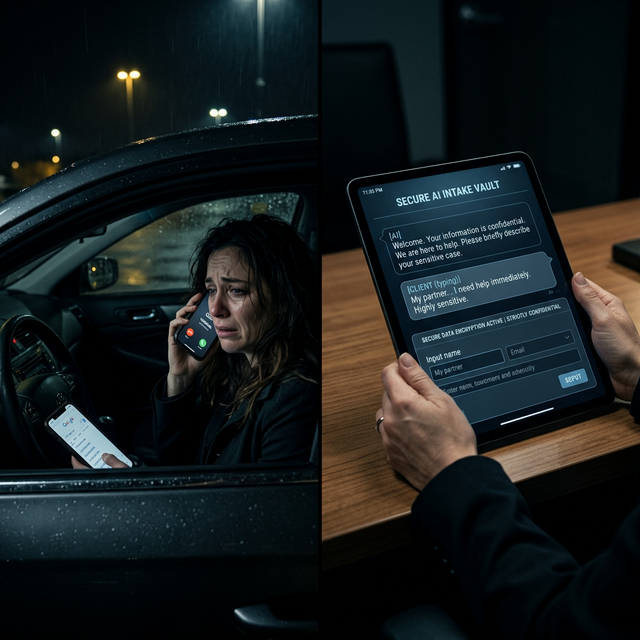

They may be calling from a car, a hallway, a hotel room, a workplace, or somewhere they do not feel fully private.
Treat any number without a nearby source or stated method as a planning assumption, then replace it with your own records.
Private investigator intake is not normal service-business intake.
The caller is often not calm.
They may be embarrassed.
They may be afraid.
They may be suspicious.
They may be calling from a car, a hallway, a hotel room, a workplace, or somewhere they do not feel fully private.
They may not want their real name in the first sentence.
They may not want a callback.
They may not want a text.
They may not know whether it is safe to leave a voicemail.
That makes the front door different.
A missed call for a PI agency is not just a missed sales opportunity.
It can be a caller deciding that the agency is not discreet enough to trust.
That is a much harder loss to recover.
The First 30 Seconds
The first 30 seconds of a private investigation call should lower anxiety.
Most service businesses open by asking for a name.
That may be wrong here.
The better first question may be:
"Are you in a safe place to speak?"
That question tells the caller the agency understands discretion.
It also protects the agency from treating a sensitive call like a routine booking request.
Then the intake path should establish communication preferences.
Is this number safe to call?
Is this number safe to text?
Is there a safer email?
Should the agency use a first name, initials, or another reference?
What times are safe?
Should voicemail be avoided?
These questions are not cosmetic.
They are the beginning of trust.
Three Call Scenarios
Scenario 1: Domestic Concern
The caller suspects a partner is hiding something.
They may be emotional, embarrassed, angry, or afraid of being overheard.
The intake path should not push for names immediately.
It should establish safe contact, broad context, timeline, and whether the caller is in a safe place.
The investigator can gather sensitive identifiers later.
Scenario 2: Corporate Concern
A business owner or attorney calls about theft, fraud, employee misconduct, or litigation support.
This caller may be calmer, but they still need discretion.
The intake path should capture organization type, matter category, urgency, decision maker, evidence already available, and safe follow-up method.
It should not promise investigative strategy before the investigator reviews the facts.
Scenario 3: Missing Person or Safety Concern
This is where guardrails matter most.
If the caller describes immediate danger, active harm, or an emergency, the system should stop normal intake.
It should direct the caller to emergency services or the agency's emergency escalation rule.
AI intake should never pretend to be crisis response.
Knowing when not to continue is part of competent intake.
Why Voicemail Fails
Voicemail is weak for most service businesses.
For private investigators, it can feel unsafe.
The caller may not know who checks the voicemail.
They may worry the voicemail is transcribed.
They may worry a callback will expose them.
They may worry a text will appear on a shared device.
They may not want to say details out loud after the beep.
So they hang up.
From the agency side, that looks like a missed call.
From the caller's side, it was a failed trust test.
They needed a discreet path.
They reached a generic recording.
They moved on.
What AI Should Do in PI Intake
AI should not investigate.
It should not give legal advice.
It should not promise outcomes.
It should not decide strategy.
It should not pressure a distressed caller.
A useful AI intake layer for a PI agency should do a narrower job:
- Answer immediately.
- Establish whether the caller can speak safely.
- Confirm safe contact preferences.
- Let the caller use a limited identifier if needed.
- Identify the broad matter type.
- Capture urgency and risk signals.
- Gather enough context for the investigator.
- Book or request the right consultation.
- Escalate active danger or out-of-scope situations.
- Create a clean, secure brief for the human investigator.
That is the value.
The AI protects the moment until the investigator can bring human judgment.
Matter Type Triage
Private investigator calls are not interchangeable.
A domestic surveillance inquiry is different from a corporate fraud inquiry.
A child custody concern is different from a missing-person concern.
A background check is different from litigation support.
The intake system should classify the matter without forcing the caller to overshare.
Start broad.
Domestic.
Corporate.
Legal support.
Background check.
Missing person.
Asset search.
Digital or online concern.
Other.
Then ask only the questions needed to route the inquiry.
The system should not demand sensitive names, exact addresses, or unnecessary details before trust is established.
Good intake gathers enough to move the case forward.
Bad intake asks for everything because the script says so.
The Safe Contact Layer
Safe contact is the most important operational detail.
Many PI agencies lose trust by following up the wrong way.
A caller says something sensitive at night.
The agency texts the next morning.
The text appears on a shared phone, family tablet, vehicle screen, or work device.
The caller now sees the agency as a risk.
A secure intake process should document:
Safe call number.
Safe text permission.
Safe email.
Safe callback window.
Words to avoid in subject lines or messages.
Whether voicemail is allowed.
Whether the caller wants a neutral sender name if possible.
This is not paranoia.
It is respect for the caller's situation.
The agency that handles safe contact well signals competence before the investigation begins.
Channel Handling
PI agencies should be more careful than most businesses about channels.
Phone can be useful because it is immediate and allows the caller to explain quickly.
Text can be dangerous if the wrong person sees it.
Email can be safer for some callers and unsafe for others.
Voicemail may be explicitly forbidden.
The right answer depends on the caller.
That is why the system should not assume.
It should ask.
The intake record should include channel permission, not just contact information.
"Phone number" is not enough.
The agency needs to know how that phone number can be used.
That is a small operational detail that creates a large trust signal.
The Human Handoff
The AI handoff should give the investigator a useful brief.
Not a transcript dump.
A brief.
Matter type.
Caller reference name.
Safe contact rules.
Urgency level.
General situation.
Known constraints.
What the caller is afraid of.
What they want to accomplish.
What they have authorized.
What should not happen.
That last item matters.
Sometimes the most important note is:
"Do not call before 10 AM."
Or:
"Do not leave voicemail."
Or:
"Caller did not want to provide spouse name yet."
The investigator can then open the human conversation with care:
"I have your intake notes. I understand this number is safe until 11 AM and that you prefer not to receive voicemail. We can keep this first conversation general until you are comfortable sharing specifics."
That is a premium handoff.
Where AI Must Stop
Private investigation has boundaries.
AI must stop when:
The caller indicates immediate physical danger.
The caller describes a crime in progress.
The caller needs emergency services.
The matter requires legal advice.
The request appears unethical or unlawful.
The caller asks for tactics the agency cannot discuss without human review.
The matter involves a minor or custody issue requiring careful handling.
The caller is highly distressed and needs a person.
These are escalation triggers.
The system should not improvise.
It should route clearly, advise emergency resources where appropriate, and protect the agency from making commitments it should not make.
Strong guardrails are part of the product.
The Revenue Leak
PI agencies often underestimate missed-call cost because call volume can be lower than other service categories.
But the average value of a retained case can be high.
Even a few missed high-intent calls per month can matter.
Use simple math.
After-hours or missed inquiry calls x qualified percentage x consultation booking rate x average retainer.
If the agency misses 12 calls per month.
Half are real prospective cases.
One-third would have booked a consultation if handled discreetly.
Average initial retainer is $3,500.
12 x 50% x 33% x $3,500 = about $7,000 per month.
Annualized, that is about $84,000.
The assumptions can be made more conservative.
The point remains:
These calls are not worth zero.
And many of them happen at times when the investigator is busy doing investigation work.
Retainer Readiness
The first intake call should not try to close the whole case.
It should determine whether the caller is ready for a serious consultation.
Useful readiness signals include:
The caller has a clear situation.
The caller understands the matter may require paid investigation.
The caller has authority to hire.
The caller can communicate safely.
The caller has a timeline.
The request is lawful and within the agency's scope.
The caller is willing to speak with the investigator.
These signals help the investigator prioritize follow-up.
A distressed caller with a legitimate matter and safe contact window should not sit behind a routine background-check inquiry.
The front door should help sort that.
What the Caller Should Feel
The caller should not feel sold.
They should feel contained.
That is the word I would use.
Contained means the agency has received the situation without making it bigger, louder, or riskier.
The voice is calm.
The questions are careful.
The contact rules are respected.
The next step is clear.
The caller knows what will happen and what will not happen.
That is very different from a generic answering-service script.
It is also different from a chatbot that tries to sound clever.
Discretion is the product before investigation begins.
Forms Are Not Always Safer
Some agencies assume a secure web form is better than a phone call.
Sometimes it is.
But not always.
A long form can make the caller hesitate.
They may not know which details are safe to enter.
They may worry the form submission will create a record they cannot control.
They may abandon the form halfway through.
The better approach is usually layered.
Use voice to establish safety, contact rules, and matter type.
Use a secure form only when the caller is ready to provide documents or structured details.
Do not make the first anxious contact depend on a long form.
That is often too much friction at exactly the wrong moment.
The first job is trust.
The second job is documentation.
Do them in that order.
That order protects both the caller and the agency from avoidable risk.
It also makes the first human consultation cleaner.
The Revenue Leak Diagnostic for PI Agencies
Pull 30 days of calls, forms, and emails.
Look at:
How many inquiries arrived after hours.
How many calls went unanswered.
How many callers left voicemail.
How many did not.
How many forms asked for too much sensitive information.
How many inquiries received same-day response.
How many converted to consultations.
How many consultations converted to retainers.
How often safe contact preferences were documented.
How often the investigator had to re-ask basic details.
This audit will show whether the agency has a lead problem, a trust problem, a response problem, or a handoff problem.
Those are different fixes.
A 30-Day Fix
Week 1: Rewrite the First Contact Path
Change the opening questions.
Lead with safety and discretion.
Do not demand sensitive details too early.
Week 2: Define Matter Types and Boundaries
Create broad categories and escalation rules.
Write what the AI can ask and what must wait for the investigator.
Week 3: Build Safe Contact Preferences
Make safe contact fields mandatory.
No inquiry should move forward without knowing how the caller can safely be reached.
Week 4: Review Handoffs
Look at the briefs the investigator receives.
Are they useful?
Are they too thin?
Are they too detailed?
Do they protect safe contact?
Tune from there.
Can AI handle private investigator intake safely?
Yes, if its role is narrow and well configured. It should answer, establish safe contact, classify the matter, gather limited context, and escalate to the investigator. It should not investigate, advise, or promise outcomes.
Should PI callers be asked for their full name immediately?
Not always. Some callers may need to begin with a first name, initials, or another reference. The intake process should balance practical case needs with the caller's discretion concerns.
What is the most important PI intake question?
"Are you in a safe place to speak?" is often more important than a name. It signals discretion and helps the system choose the right pace.
What if the caller is in immediate danger?
The system should stop normal intake and direct the caller to emergency services or an emergency escalation path, depending on the agency's rules and jurisdiction.
Is AI better than a live answering service for PI agencies?
It depends on the setup. A generic answering service may not understand discretion, safe contact, or matter-type triage. A well-configured AI intake system can be more consistent, but it must have strict guardrails and human escalation.
The Bottom Line
Private investigation intake is a trust test.
The caller is not only asking whether the agency can help.
They are asking whether the agency can be discreet from the first second.
A good AI intake layer can protect that moment.
It answers when the investigator cannot.
It asks safer first questions.
It records safe contact preferences.
It routes sensitive matters correctly.
It prepares the investigator without forcing the caller through a generic script.
That is how AI belongs in PI intake.
Not as a replacement for investigator judgment.
As a quiet, secure front door that keeps high-discretion callers from disappearing into voicemail.
*If your PI agency receives calls after hours or while investigators are in the field, run a Revenue Leak Diagnostic on missed calls and safe contact handling. The leak may be hidden in the calls nobody felt safe leaving.*
Use your own records before you decide
Source: start with your call log, CRM notes, booking calendar, missed-call records, web form timestamps, and Google Business Profile. Those records show whether buyers reached you, how fast they heard back, what they asked for, and where the next step broke down.
For seven days, mark each missed call, late reply, unbooked form, stale estimate, and review request that never went out. That small sample gives an owner a practical picture of the front-door gap before they spend more on ads, software, or staff.
The loss estimate is basic business math, not a magic claim.
Revenue-leak examples on this site are built from visible operating inputs: inquiry volume, missed-call or slow-response rate, booking rate, average job or client value, repeat value, and follow-up recovery. The fastest way to make the number real is to run the diagnostic for your closest business type, then compare it against your own call log, CRM, booking calendar, form timestamps, and review activity.
Decide what the AI must handle before you choose the software.
A useful intake system begins with the caller journey, the rules, and the human handoff, not a long feature list.
Give the receptionist a realistic scenario and hear how it answers, gathers context, and moves the caller toward a useful next step.
See how the capability in this article fits into a complete customer journey.
Legal, Financial & AdvisorySee the same decision through the language, buyer behavior, and operating reality of this industry.
Client Results & ProofInspect the starting condition, installation, measurement window, and outcome behind real client work.

Stop Buying Local Service Leads: Fix Your Intake Infrastructure Before You Buy Another Ad
Bad lead quality is not always the problem. Many service businesses lose paid leads because callbacks are slow, after-hours intake is weak, and follow-up is inconsistent.
Plastic Surgery Clinics: Discretion and Speed in High-Ticket Intake
Cosmetic procedure demand in 2025 and 2026 has reached historic highs. Post-pandemic, the category of elective aesthetic investment has normalized across income brackets that were previously not in the market. The demand exists. The prospects are searching. What the research on high-ticket cosmetic intake consistently shows is that the loss is almost never happening at the surgeon quality level - it is happening at the first contact point, in the first ninety seconds of an inquiry, when a called-on-hold prospect or a cold clinical voice produces the friction that sends a $12,000 rhinoplasty inquiry to a competitor. The plastic surgery clinic that has solved intake has solved the most solvable problem in its revenue stack.
Calculate the revenue leak.
Stop guessing. See how much demand your business may be losing through missed calls, slow replies, weak booking, review gaps, and follow-up drag, then decide whether AI Receptionist is the right system path.
Run the calculationPrefer to hear it first?
Call the live AI receptionist and test the conversation.
Call the live AI receptionist anytime. Tell it about legal, financial & advisory, then hear a short live roleplay based on the calls your front desk actually gets.