Within twenty-four to thirty-six months,AI-powered intake will be the expected baseline for any aesthetic medicine practice that competes at the $3M-plus annual revenue level.The clinics that implement in the current window will have the inquiry volume data, the conversion rate benchmarks, and the operational muscle memory that late adopters will have to purchase at premium cost from consultants who built case studies on exactly these early implementations.
Treat any number without a nearby source or stated method as a planning assumption, then replace it with your own records.
Cosmetic procedure bookings in 2025 hit a volume the industry had not seen in its history. The normalization that began post-pandemic - where aesthetic investment shifted from a luxury category to a wellness category in the minds of millions of consumers - is now running at full speed. The waiting room of a high-performing plastic surgery clinic in 2026 is not full of a narrow demographic. It is full of teachers, accountants, business owners, nurses, and software engineers who have been quietly researching procedures for months and finally made the call.
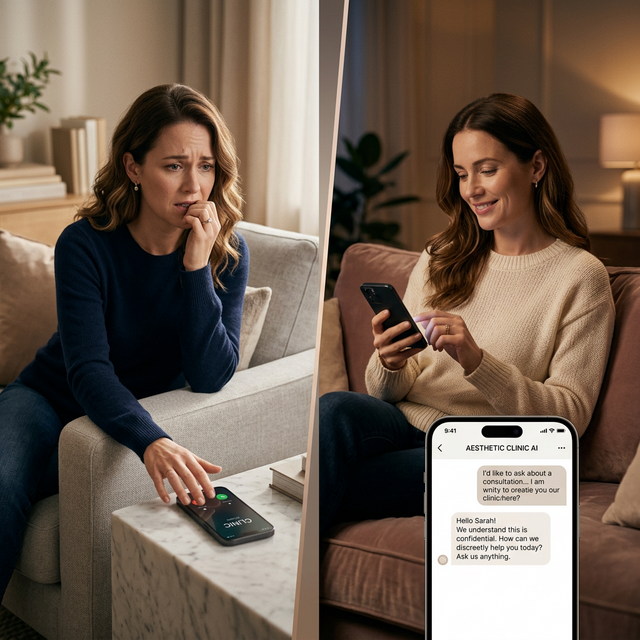
Most of them are making that call at 9 PM. Or 10 PM. Or on a Tuesday lunch break when nobody from work can overhear.
A plastic surgery clinic that is not set up to receive that inquiry at 9 PM on a Tuesday - warmly, immediately, and without any social friction - is losing a patient who was ready to book to a competitor who was available when the prospect was emotionally ready to act. This is not a marketing problem. It is not a surgeon credentialing problem. It is an intake architecture problem. And in 2026, it is one of the most solvable operational problems in the entire aesthetic medicine category.
The Embarrassment Barrieris the specific friction mechanism that drives cosmetic procedure inquiries to abandonment. It operates differently than the intake friction in home services or legal intake. A prospect calling about a broken furnace is not embarrassed. A prospect calling about a breast augmentation, a rhinoplasty, or a body contouring procedure frequently is - not because they are conflicted about the decision, but because the act of stating it out loud to an unknown human voice, potentially amid office noise and interruptible conversations, involves a social exposure they are not ready for in that moment.
When that moment of social exposure meets a hold queue, a distracted front desk voice, or a receptionist who sounds bored or curt, the prospect's embarrassment converts to avoidance. They hang up. They tell themselves they will call back. Most of them do not call back. The ones who do call back are calling a different clinic. They find a clinic whose website has a chat widget, or whose Google listing shows a text option, or whose competitor answered at 9 PM because they had an AI assistant handling after-hours intake.
The clinic owner who Googles "how to reduce cosmetic surgery consultation no-show rate" or "why are my rhinoplasty inquiries not converting" is rarely looking at an intake problem - they are looking at a marketing problem. Paid ads. SEO. Budget allocation. The search behavior is understandable because marketing spend is visible and measurable. But for most plastic surgery practices, the inquiry volume is not the constraint. The conversion of existing inquiries is where the revenue is being lost. The Embarrassment Barrier is not a marketing problem. It is an intake architecture problem, and it has an architectural solution.
The 2026 Competitive Window in Aesthetic Medicine Intake
The current moment in AI-powered patient intake is particularly significant for plastic surgery clinics for a specific reason. Awareness of AI-supported intake technology is now widespread - most clinic owners have heard the pitch. But implementation is still relatively rare outside of large multi-location aesthetic medicine groups. This creates the widest possible competitive gap between the first-mover clinics and the rest of the market.
In 2023, a plastic surgery clinic with an AI-supported intake assistant was an early adopter. In 2025 and 2026, the window of genuine competitive advantage - where the technology is proven, affordable, and accessible, but most competitors have not yet deployed it - is at its peak width. The clinic that implements now is not paying an early adopter tax. It is capturing the early majority advantage before the technology becomes table stakes.
Within twenty-four to thirty-six months,AI-powered intake will be the expected baseline for any aesthetic medicine practice that competes at the $3M-plus annual revenue level.The clinics that implement in the current window will have the inquiry volume data, the conversion rate benchmarks, and the operational muscle memory that late adopters will have to purchase at premium cost from consultants who built case studies on exactly these early implementations.
What High-Ticket Cosmetic Intake Actually Requires
The intake requirements for a plastic surgery clinic are materially different from a general medical practice or a home service business. Understanding those specific requirements is the difference between a generic AI deployment that might reduce hold times and a purpose-built intake system that measurably increases consultation bookings.
Immediate warmth before information:The first ten seconds of a cosmetic inquiry interaction set the emotional tone for the entire relationship. A prospect who hears "thank you for contacting us, Dr. Martinez's office is committed to your comfort and privacy" is in a fundamentally different emotional state than one who hears "please hold." The AI is trained to open every interaction with language that explicitly signals safety, discretion, and care - before asking a single qualifying question.
Confidentiality signaling:A significant percentage of cosmetic procedure inquiries come from patients who have not yet told their spouse, their family, or their close friends about their consideration. The intake system needs to actively acknowledge this reality. "Everything you share with us is completely confidential - our team handles all consultations with full privacy protection." This single sentence converts hesitant inquiries into completed intake forms at a dramatically higher rate. A plastic surgery clinic whose AI omits this signal is leaving conversion on the table.
Procedure education before qualification:Unlike service business intake where budget and availability are the primary qualifiers, cosmetic procedure intake benefits from a brief educational moment at the beginning of the conversation - one or two clarifying questions about what procedure the prospect is considering, followed by a short affirming statement about what the consultation will cover. This reduces the prospect's anxiety about being "sold to" and repositions the consultation as an educational experience they are in control of.
Time-of-day flexibility without judgment:A prospect who inquires at 10:30 PM is not aberrant. They chose that time deliberately because it offers privacy. The AI available at 10:30 PM who treats that inquiry with the same warmth and professionalism as a 2 PM business-hours call delivers a signal that this clinic understands and respects the emotional complexity of the aesthetic decision. That signal converts.
The Economics of Conversion at High Ticket Size
For most plastic surgery clinics, a single converted consultation represents a potential patient relationship with a lifetime value measured in the tens of thousands of dollars. The initial procedure may range from $3,000 for a minor injectable treatment plan to $25,000 for a complex surgical case. But the patient who arrives for their first cosmetic consultation and has a positive experience is not a one-procedure patient. They are a five-to-seven year relationship that includes touch-up procedures, additional treatment categories, and referrals to their immediate social network.
A plastic surgery clinic operating at $4M in annual revenue with a consultation-to-booking rate of 45 percent and an average first-procedure value of $9,000 is closing approximately $1.8M in new patient revenue per year from consultations alone. If the clinic's AI-supported intake system improves inquiry-to-consultation booking rate by 20 percent - by capturing the after-hours inquiries that previously went unanswered and eliminating the Embarrassment Barrier drop-off - the incremental revenue is approximately $360,000 in additional first-procedure bookings annually. This calculation does not include lifetime patient value or referral cascade.
The cost of the AI-supported intake system is orders of magnitude smaller than this number.The plastic surgery clinic owner who is evaluating AI-supported intake on the basis of the monthly subscription cost is asking the wrong question. The right question is: how many $9,000 consultations am I losing per month to inquiry friction that an AI-supported intake system would have captured?
Even a conservative answer - two additional converted consultations per month - represents $18,000 in incremental first-procedure revenue and potentially $60,000 to $90,000 in lifetime patient value. Per month. The math of cosmetic intake improvement is among the most compelling in any service business category.
A plastic surgery clinic that implements AI-powered intake is not automating a transactional interaction. It is removing a friction point at the most emotionally charged moment of the patient acquisition journey. The prospect who successfully navigates the inquiry phase - warmly received, immediately acknowledged, questions answered without judgment - arrives at the consultation in a fundamentally different emotional state than one who fought through hold queues and hesitant front desk energy. They arrive already trusting. They arrive already decided. The conversion is a formality. The plastic surgery clinic that understands this does not evaluate AI-supported intake as a cost. They evaluate it as the highest-leverage conversion investment in their entire patient acquisition system.
The Discreet Consultation: Why Privacy Is Part of the Intake Experience
In a cosmetic surgery practice, you aren't just selling a procedure; you are selling a feeling of renewed confidence. But that confidence can be fragile. Many prospective patients spend months-or even years-researching a procedure before they ever pick up the phone.
When they finally do call, they are often in a state of high vulnerability. If they are met with a loud, distracted receptionist who asks personal medical questions while checking in another patient in the lobby, the "Luxury Bridge" is broken. The prospect feels like a number, not a patient.
The real cost of a generic intake is the "Trust Attrition."High-net-worth patients expect a white-glove experience from the very first interaction. They need to know that their data is secure, their inquiry is private, and their surgeon is world-class.
The Price-Shopper Versus the Serious Consultation
Every practice owner is plagued by the "Price-Shopper"-the caller who asks "How much for a rhinoplasty?" before they even say hello. A traditional front desk team often gets frustrated by these calls, viewing them as a waste of time.
A relatable, AI-driven intake doesn't dismiss the price-shopper. It pivots them. By using a "Patient Education Portal" or a "Virtual Consultation Assistant," you can provide the baseline pricing information they want while simultaneously educating them on why your specific surgical technique justifies a $5,000 premium over the discount clinic down the street.
By the time the patient walks in for their in-person consultation, they aren't looking at the price tag anymore. They are looking at the pre-and-post photos your AI assistant already sent them. They've already "seen" the result. That is how you transform a cold inquiry into a scheduled procedure without sacrificing your staff's time or your brand's prestige.
What should AI-supported intake sound like for a high-end cosmetic practice?
The voice and language register of the AI-supported intake system should be calibrated to match the clinic's brand positioning. A boutique surgical practice competing on exclusivity and personalized care needs an AI that sounds like a warm, knowledgeable patient coordinator - not a generic virtual assistant. The language should be warm but precise, confident but never clinical, and should explicitly reinforce the values of discretion, expertise, and personal attention throughout. The plastic surgery clinic's AI-supported intake is brand representation. It should be configured with the same attention to tone that goes into the clinic's website copy and consultation room design.
The Operating Standard for High-Ticket Cosmetic Intake
In the context of Plastic Surgery Clinics: Discretion and Speed in High-Ticket Intake, we must address the fundamental friction that exists in manual intake. Every 'missed call' is a missed revenue opportunity, but more importantly, it's a signal of operational weakness that high-value prospects detect instantly. By bridging this gap with AI-driven intake, you're not just 'automating.' You're humanizing the interaction by ensuring that your clients get the attention they deserve, instantly. This is the math of responsiveness that wins markets.
Strategic ROI: When we apply the Quiet Protocol math to Plastic Surgery Clinics: Discretion and Speed in High-Ticket Intake, the result is always the same: a dramatic reduction in cost-per-acquisition (CAC) and a significant increase in client lifetime value (LTV) through immediate resolution.
The loss estimate is basic business math, not a magic claim.
Revenue-leak examples on this site are built from visible operating inputs: inquiry volume, missed-call or slow-response rate, booking rate, average job or client value, repeat value, and follow-up recovery. The fastest way to make the number real is to run the diagnostic for your closest business type, then compare it against your own call log, CRM, booking calendar, form timestamps, and review activity.
The practical questions behind this decision.
Is AI-supported intake appropriate for a medical practice? Are there compliance considerations?
AI-supported intake in a plastic surgery clinic operates exclusively at the scheduling and inquiry layer - it books consultations, answers questions about procedure categories, explains what to expect at a consultation, and collects basic contact information. It does not provide medical advice, does not review medical history, and does not make any clinical assessment. HIPAA compliance is maintained because the AI does not handle protected health information during intake - clinical data collection happens within the clinic's compliant systems during and after the consultation. The AI is a scheduling assistant, not a clinical tool.
How does the intake layer handle inquiries about procedures the clinic does not offer?
This is one of the highest-value configuration scenarios in cosmetic medicine AI-supported intake. A prospect who inquires about a procedure outside the clinic's specialization is not a dead lead - they are a trust opportunity. The AI can be trained to explain the clinic's focus areas, acknowledge the prospect's interest in the other procedure, and offer to refer them to a respected colleague while booking a consultation for what the clinic does offer. A plastic surgery clinic that handles "out of scope" inquiries with professional warmth rather than a dead-end "we don't do that" generates referrals even from prospects who never become patients.
How quickly should the clinic expect to see a measurable lift in consultation bookings?
Most plastic surgery clinics implementing AI-supported intake see a measurable lift in consultation bookings within the first thirty days. The primary source of early lift is after-hours inquiry capture - the inquiries that previously went to voicemail and were never actioned. Secondary lift comes from the reduction of same-day inquiry abandonment, where prospects were previously placed on hold and disconnected before the intake conversation was completed. Clinics with a high volume of weekend and evening inquiries typically see the largest and fastest improvement in booking rate.
What should AI-supported intake sound like for a high-end cosmetic practice?
The voice and language register of the AI-supported intake system should be calibrated to match the clinic's brand positioning. A boutique surgical practice competing on exclusivity and personalized care needs an AI that sounds like a warm, knowledgeable patient coordinator - not a generic virtual assistant. The language should be warm but precise, confident but never clinical, and should explicitly reinforce the values of discretion, expertise, and personal attention throughout. The plastic surgery clinic's AI-supported intake is brand representation. It should be configured with the same attention to tone that goes into the clinic's website copy and consultation room design.
Decide what the firm needs to know before the first useful conversation.
A useful intake path protects the buyer's time and the firm's capacity by connecting fit, booking, preparation, reminders, and human handoff.
Give the receptionist a realistic scenario and hear how it answers, gathers context, and moves the caller toward a useful next step.
See how the capability in this article fits into a complete customer journey.
Plastic SurgerySee the same decision through the language, buyer behavior, and operating reality of this industry.
Client Results & ProofInspect the starting condition, installation, measurement window, and outcome behind real client work.
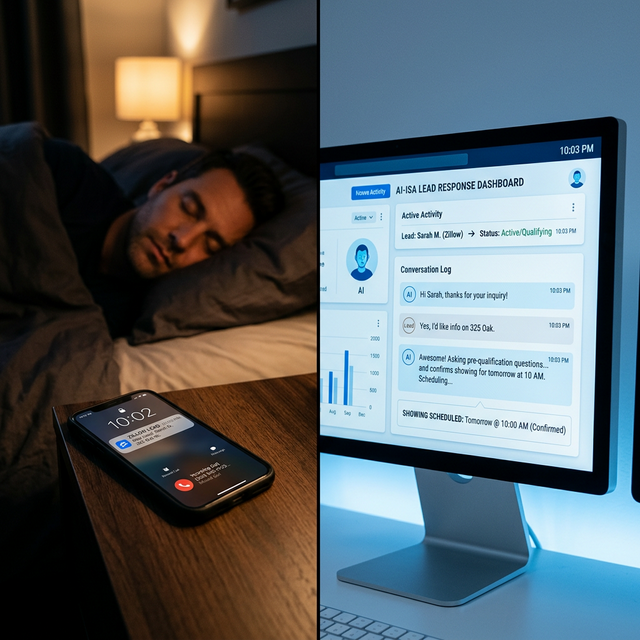
Real Estate Brokerages: The AI ISA That Follows Up With Zillow Leads After Hours
The research on real estate lead response is unambiguous and has been replicated across hundreds of studies. A prospect who submits an online inquiry and is contacted within five minutes is eight times more likely to convert than one contacted thirty minutes later. A prospect contacted on Monday morning for a Sunday night submission is, for the majority of brokerages, already lost. The math of online lead conversion in real estate is not complicated - it is just brutally unforgiving, and it operates equally aggressively at 10 PM on a Sunday as it does at 2 PM on a Tuesday. Most real estate brokerages are built for 2 PM on a Tuesday.

Stop Buying Local Service Leads: Fix Your Intake Infrastructure Before You Buy Another Ad
Bad lead quality is not always the problem. Many service businesses lose paid leads because callbacks are slow, after-hours intake is weak, and follow-up is inconsistent.
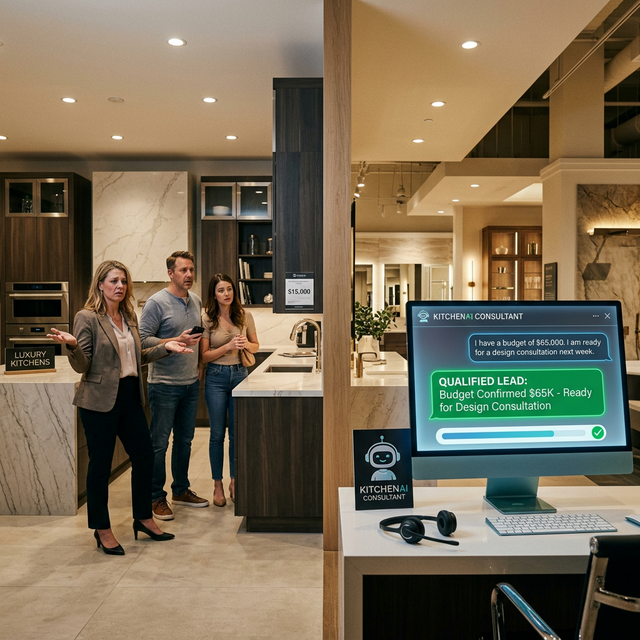
Kitchen & Bath Remodeling: Qualifying $50K Projects Before the Showroom Visit
A kitchen remodeling designer's most valuable and least renewable resource is not their portfolio or their vendor relationships. It is their Saturday. The moment a design-build remodeling company begins scheduling back-to-back showroom visits without pre-qualifying the prospect's budget, timeline, and decision-making authority, they have built an engine that converts designer time into free home renovation consulting for people who will spend $12,000 at a big-box store instead of $65,000 with your firm. The Polite AI Interrogation is the system that stops that conversion before it starts.