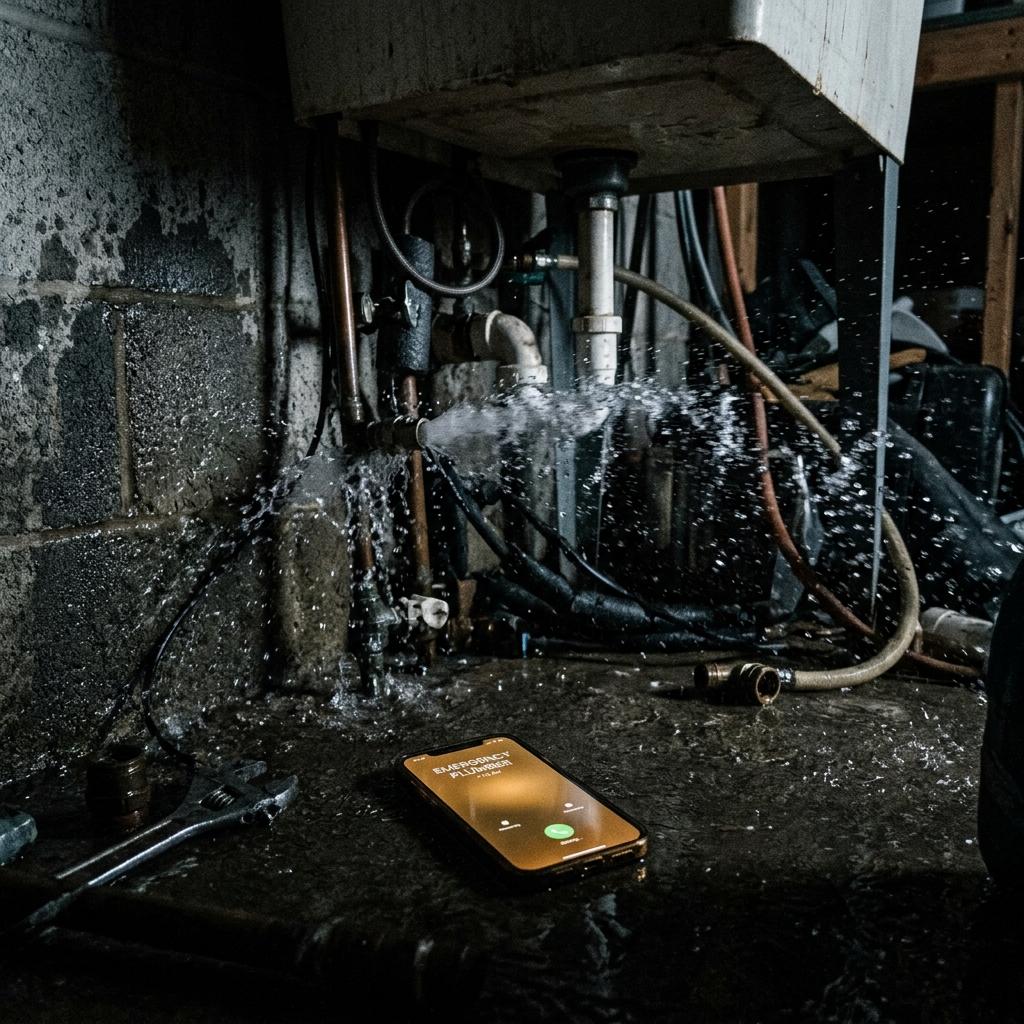

They shut the main valve. Now they are standing in wet socks with a phone in their hand, searching "emergency plumber near me."
Treat any number without a nearby source or stated method as a planning assumption, then replace it with your own records.
Saturday, 7:12 AM
The pipe under the basement utility sink has been leaking slowly for weeks. Last night it finally let go. The homeowner woke up to the sound of rushing water, got downstairs, and found two inches of standing water spreading across the concrete floor.
They shut the main valve. Now they are standing in wet socks with a phone in their hand, searching "emergency plumber near me."
They are not reading reviews. They are not comparing pricing pages. They are not checking whether your trucks have a good logo. They are calling the first number that looks credible and hoping someone picks up.
This is the single highest-intent moment a plumbing lead will ever be in. They need help right now. They will pay for emergency service. They are not going to negotiate. They are not calling three companies to compare quotes. The first plumber to answer and give them a clear "I can be there" gets the job.
And for most plumbing companies, that call rings out to voicemail.
The Weekend Blackout Problem
Plumbing companies that operate Monday through Friday, 8 AM to 5 PM, cover 45 hours out of 168 in a week - about 27 percent of the available window. During those 45 hours, they are fully staffed, responsive, and competitive.
The remaining 73 percent of the week - evenings, all day Saturday and Sunday, early mornings - is effectively a blackout. Calls arrive, hit voicemail or a ring-no-answer, and the prospect moves to the next company.
This is not a fringe problem. Plumbing calls do not distribute evenly across the week. Emergency calls in particular are heavily concentrated in windows that fall outside business hours:
- **Early morning (6-9 AM):** Homeowners discover problems when they wake up, shower, and start the day. A shower that won't drain, a water heater that isn't heating, a pipe that ran all night.
- **Evening (6-10 PM):** Dinner preparation reveals a backed-up kitchen drain. A toilet overflow that was being ignored becomes impossible to ignore.
- **Weekends:** This is the highest-volume emergency window of the entire week. Homeowners who noticed a problem during the week but delayed it finally deal with it. DIY attempts fail. New emergencies emerge from weekend home projects gone wrong.
Industry patterns for residential plumbing consistently show that 40 to 55 percent of emergency calls arrive outside of standard Monday-to-Friday business hours. For companies operating traditional hours, this means nearly half of their highest-value leads are going unanswered.
Why Weekend Calls Are Worth More Than Weekday Calls
This is the counterintuitive truth that most plumbing company owners understand intuitively but have never quantified: a weekend emergency call is worth significantly more than the same call during business hours.
There are three reasons:
Reason 1: The job value is higher.
A homeowner calling on a Tuesday afternoon about a slow drain is usually not in crisis. They want it fixed, but they have time. They may ask for a quote. They may call two or three companies. They are more likely to push back on pricing.
A homeowner calling on Saturday morning with water actively flooding their basement is not in a position to push back on pricing. The average emergency call - burst pipe, sewer backup, water heater failure, flooded basement - carries a job value between $800 and $1,800 for the initial service, compared to $250 to $500 for non-emergency weekday calls. The work is also more likely to include follow-on services: pipe replacement, water damage assessment referrals, fixture upgrades once the emergency is resolved.
Reason 2: The close rate is higher.
When a prospect calls during business hours, there is competition. Your competitors are also answering their phones. The prospect may call three companies, get quotes, and choose.
When a prospect calls on Saturday morning in an emergency, their first call is often their last call. They need someone now. If you answer and can give them a realistic arrival window, they book. The close rate on answered emergency calls is materially higher than the close rate on non-emergency calls - industry estimates consistently put emergency weekend close rates at 70 to 80 percent versus 40 to 50 percent for weekday non-emergency calls.
Reason 3: The lifetime value is highest.
A homeowner who called you in a crisis, got an answer immediately, and had their emergency resolved professionally does not go back to Google next time they need a plumber. They have your number in their phone. They call you for the annual water heater flush, the slow drain in the guest bathroom, the outdoor hose bib that needs replacing before winter.
The plumber they couldn't reach during their Saturday crisis is forgotten by Monday. The one who answered at 7:12 AM is remembered for years.
The Math on What This Costs You
Let us build a specific model for a 3-to-5 technician plumbing company operating in a mid-size market.
Assumptions:
- 60 inbound calls per week during active season (spring and fall)
- 45% of those arrive outside business hours = 27 calls per week
- Answering service or voicemail captures roughly 10% = 2-3 leads recovered
- 24-25 calls per week are completely lost
At an average emergency job value of $950 and a weekend emergency close rate of 75%, each answered weekend call is worth approximately $712 in expected revenue (0.75 × $950).
Losing 24 to 25 calls per week therefore costs approximately$17,000 to $18,000 in weekly revenue potential- or roughly $75,000 per month during peak season.
That number is worth interrogating. Not every missed call would have been an emergency. Not every answered call would have closed. But even at 50% of that estimate, the gap is $37,500 per month in missed revenue from calls that were already coming in.
No amount of additional advertising spend fixes this. You cannot market your way past a structural intake failure. The leads are already arriving. They are hitting voicemail and leaving.
What Happens When an AI Intake Layer Handles the 7:12 AM Call
The homeowner calls. Instead of four rings and a voicemail greeting, an AI answers on the second ring.
"Hi, this is [Company Name] - what's going on?"
The homeowner explains: burst pipe, water in the basement, main valve is shut.
The AI identifies this immediately as a water emergency. It asks three qualifying questions: the address, whether the water is still running or contained, and whether the homeowner has already shut off the main. These questions are not arbitrary - they determine dispatch priority and which technician to route.
The AI confirms: "We have emergency availability this morning. A technician can reach you between 8:30 and 9:30 AM. Can I get your name and confirm that address?"
The homeowner provides the information. They receive an SMS confirmation within 60 seconds: "Confirmed: Emergency service at [Address] - arrival 8:30-9:30 AM Saturday. [Company Name] - [Phone Number]."
Simultaneously, the owner or dispatcher receives a text: "New emergency booking - [Name], [Address] - burst pipe, basement flooding, water contained, booked for 8:30-9:30 AM. Lead in CRM."
The homeowner does not call competitor number two. They have a confirmed appointment. They go back to managing the water damage while waiting for the technician.
Total time from call to confirmation: under four minutes. The homeowner's stress level dropped measurably because they have a plan. The plumbing company captured a $950-plus job at 7:12 AM on a Saturday without the owner being woken up.
The Five Failure Patterns That Lose Weekend Calls
Most plumbing companies are losing weekend leads through one or more of these structural gaps:
Voicemail as a primary intake tool.Voicemail was designed for non-urgent communication. Using it as your primary after-hours intake captures, at most, 15 to 20 percent of callers - the ones who are patient enough, trusting enough in your brand, and calm enough to leave a coherent message with contact information. Emergency callers are rarely any of these things. They hang up within 8 seconds of hearing the voicemail prompt.
Answering services with generalist operators.Third-party answering services often create as many problems as they solve. Operators reading generic scripts cannot reliably qualify plumbing emergencies, cannot determine dispatch priority, cannot integrate with your scheduling system, and frequently deliver leads with incomplete information. A homeowner calling about a gas smell gets the same intake script as one calling about a slow drain, which is both a safety and a business failure.
Owner personal phone as overflow.Owners who take emergency calls on their personal phones are operating a system that scales to exactly one person and burns out reliably. It also introduces inconsistency: when the owner is available and engaged, intake is excellent. When they are at a kid's soccer game or asleep, intake fails completely. The business's revenue ceiling is directly tied to the owner's personal availability, which is not a sustainable growth model.
Ring-no-answer with no fallback.Some companies simply ring out. No voicemail, no forwarding, no automated response. The caller experiences a dead end and immediately calls the next number. These companies have no idea how many leads they are losing because there is no data trail.
Delayed callback workflows.A company that captures voicemails and returns calls Monday morning is returning calls to homeowners who have already had their emergency resolved by a competitor who answered on Saturday. The callback converts at under 10 percent. The opportunity cost of a 48-hour callback delay on a plumbing emergency is almost always a permanently lost client.
What It Costs to Fix This
The Core Protocol from The Quiet Protocol is $497 per month with a $297 setup fee. For plumbing companies, the implementation includes:
- Voice AI with a plumbing-specific knowledge base covering common emergency types, service area qualification, and dispatch priority logic
- Emergency escalation detection - the AI recognizes gas smell, sewage backup, structural flooding, and carbon monoxide language and flags these for immediate owner notification regardless of time
- Direct booking into your scheduling software
- SMS confirmation to clients and dispatch notifications to the owner or office manager
- Missed call text-back for any calls that ring through and go unanswered before the AI can respond
- Web chat intake for prospects who prefer to text than call (a growing segment, particularly for non-emergency service requests)
The system is live within five business days. It handles calls 24 hours a day, seven days a week, without additional cost for weekend or after-hours volume.
Payback at one additional emergency booking per weekend: $950 job value against $497 monthly subscription. The system pays for itself from the second booking in any given month. Most plumbing companies report materially more than one additional weekend booking once after-hours intake is closed.
What This System Does Not Do
Being direct about scope:
It does not dispatch technicians.The AI captures and books. Routing decisions - which tech goes where, how to handle overlapping emergency requests - remain with your dispatcher or owner.
It does not provide repair estimates over the phone.Any company quoting plumbing repairs without a site visit is creating liability. The AI is explicit with callers that pricing is confirmed after the technician assesses on-site. It does not make up numbers.
It does not manage complex commercial service agreements.The Core Protocol is designed for residential and light commercial intake. Multi-site commercial contracts with specific SLA requirements need a bespoke build.
It does not replace a trained office manager.During business hours, your office team handles the full complexity of client management, scheduling logistics, and relationship continuity. The AI is infrastructure for the hours they are not there - not a replacement for the hours they are.
The Self-Diagnostic for Plumbing Companies
Check three things:
Your Saturday inbound call log.Pull last Saturday's call data from your phone system or CRM. How many calls came in? How many were answered? What was the disposition of the ones that weren't? If you cannot answer this question because your system does not log it, that is the first gap to address.
Your voicemail on Monday morning.How many messages are from over the weekend? How many are from people who called, started to leave a message, and then either ran out of things to say or hung up mid-message? Each of those is a lost emergency.
Your Saturday revenue versus your Friday revenue.For plumbing companies that do have some after-hours coverage, Saturday is often their highest single-day revenue day of the week - because every job booked on Saturday is an emergency at premium value. If your Saturday revenue is lower than your average weekday, the weekend coverage gap is the most likely explanation.
The Competitive Advantage Is Operational
The plumbing company that wins on weekends does not necessarily have better technicians, lower prices, or a more recognizable brand. They win because they answered.
In emergency service businesses, availability is the product. The homeowner in a crisis does not have the luxury of evaluating quality - they have the urgency of resolving the immediate problem. The first company that can credibly say "we can be there by 9 AM" wins the job.
The companies that capture this structural advantage consistently outgrow their competitors not because they out-market them, but because they out-respond them. Every answered weekend call is a potential 5-star review, a repeat client relationship, and a referral source. Every missed weekend call is a direct gift to whoever picks up next.
The technology to close this gap is not experimental. It is not expensive relative to the revenue it recovers. And it is available today to independent plumbing companies at a price point that makes the ROI calculation obvious within the first month.
The only question is how many more Saturdays you want to leave uncovered before you fix it.
If you want to see your specific number - based on your call volume, your market, and your average emergency job value - the Front Door Diagnostic calculates it in about 15 minutes. Most plumbing owners find the number clarifying in a way that makes the decision straightforward.
The loss estimate is basic business math, not a magic claim.
Revenue-leak examples on this site are built from visible operating inputs: inquiry volume, missed-call or slow-response rate, booking rate, average job or client value, repeat value, and follow-up recovery. The fastest way to make the number real is to run the diagnostic for your closest business type, then compare it against your own call log, CRM, booking calendar, form timestamps, and review activity.
The practical questions behind this decision.
What proof should I look for in my own business?
Look for proof in the places where demand either moved forward or stalled: missed calls, short calls, unbooked forms, slow callbacks, no-show recovery, old leads, and reviews that were never requested. If the business cannot see those moments clearly, the first improvement is better tracking and routing.
How do I know whether this is a marketing problem or an operations problem?
If people are already calling, filling forms, asking for prices, requesting appointments, or comparing reviews, the problem is usually operations. More marketing will not fix a front door that lets warm demand wait. The better move is to capture and route the demand already arriving.
What should happen after the first response?
The first response should create a next step: booked appointment, estimate path, intake handoff, callback window, review request, or reactivation sequence. A response that only says someone will get back to you is not enough when the buyer is comparing several providers at once.
Where does The Quiet Protocol fit?
The Quiet Protocol fits when the business already has demand but too much of it depends on manual attention. We connect AI receptionist coverage, web intake, missed-call recovery, booking logic, follow-up, review requests, and reactivation into one managed front-door system.
Turn the article into one week of real numbers.
Use your own call log, form timestamps, calendar, and CRM before accepting any industry estimate.
Use your own operating numbers to see where response, booking, reviews, and follow-up may be costing the business.
See how the capability in this article fits into a complete customer journey.
PlumbingSee the same decision through the language, buyer behavior, and operating reality of this industry.
Client Results & ProofInspect the starting condition, installation, measurement window, and outcome behind real client work.

The Missed Call Problem: How Service Businesses Lose $180,000 Per Year From the Front Door
Missed calls are not harmless. Learn how service businesses calculate the annual revenue leak from unanswered calls, delayed callbacks, and lost buyer intent.
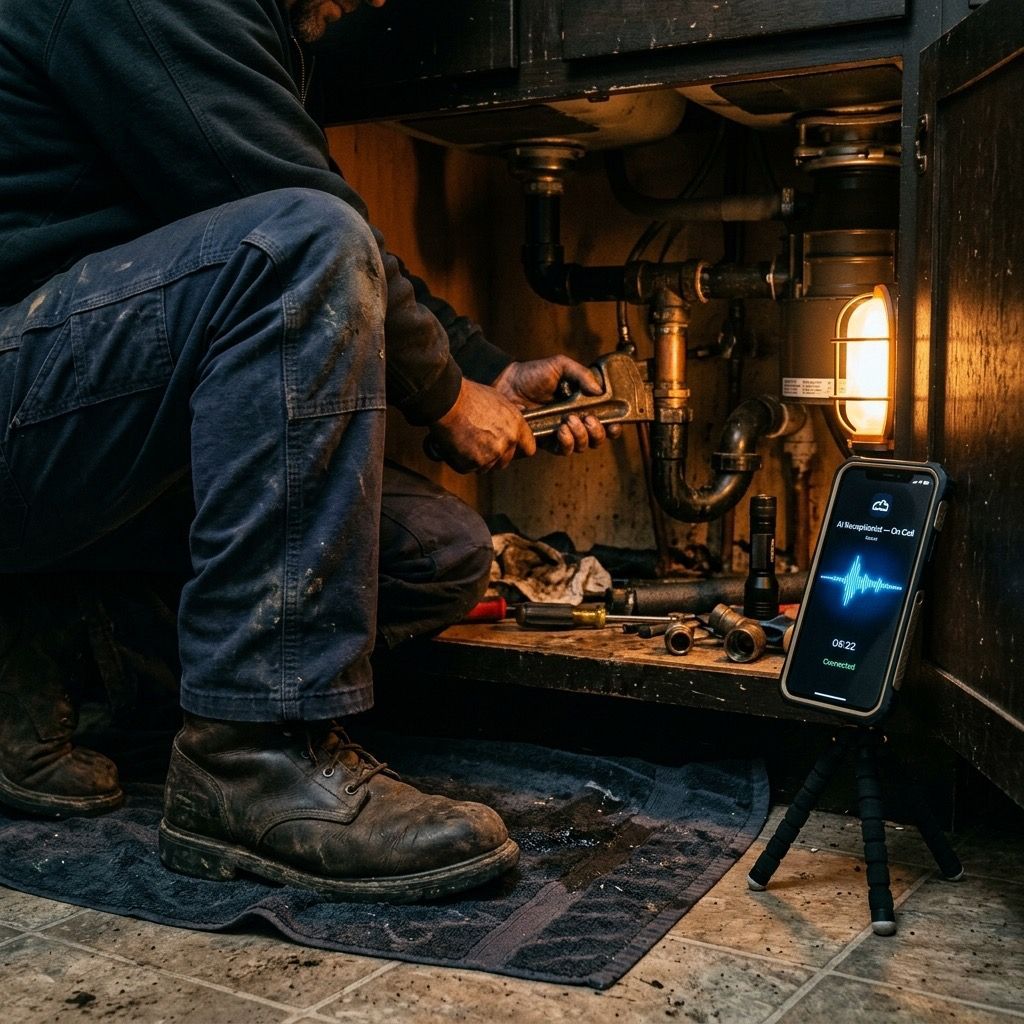
Solo Plumber, Fewer Missed Calls: How a One-Person Plumbing Business Protects More Leads With AI
A solo plumber cannot answer the phone mid-job. Here is exactly how an AI voice receptionist fills that gap - how it works, what it costs, and what a real implementation looks like.

Your Leads Call After 5PM: What Happens to Them If You Are Not There
The highest-intent service calls arrive after business hours. Here is exactly what happens to those leads, why most are never recovered, and what to do about it.