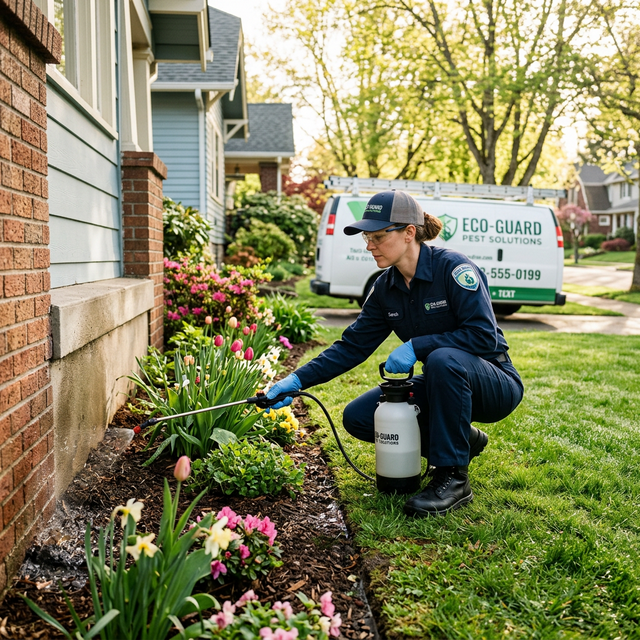
What most pest control operators do not fully account for is how concentrated this demand window is.
Treat any number without a nearby source or stated method as a planning assumption, then replace it with your own records.
Ask any pest control business owner what their busiest month of the year is and the answer is almost always the same: April, sometimes May. The reasons are predictable. Soil temperatures cross the threshold that activates ant colonies, termite swarmers emerge, mosquito populations explode with the first warm rains, and homeowners who spent the winter ignoring their perimeter suddenly notice a line of ants crossing the kitchen counter or a winged termite on the windowsill and reach for their phone.
What most pest control operators do not fully account for is how concentrated this demand window is.
According to the National Pest Management Association's annual State of the Industry report, approximately 41 percent of all new residential pest control service agreements are initiated between March 15 and May 31. The pest control business that captures the highest volume of inbound calls during this window does not just have a better April. It establishes a recurring revenue base that compounds through every subsequent service visit, renewal, and referral for the next 12 to 36 months. The one that lets those calls go to voicemail, or routes them through an intake system too slow to respond before the homeowner calls the next number, is not just losing an April job. It is losing annual contract value, renewal revenue, and the referral network that comes with a satisfied recurring customer.
The spring surge is not a marketing opportunity. It is an operational test. The pest control companies that win it every year are not the ones spending the most on ads in April. They are the ones who built the intake infrastructure to handle peak volume before the volume arrived.
The Pest Control Spring Call Surge: What the Numbers Look Like
Call volume concentration: PCT Magazine's 2024 industry benchmarking data for residential pest control found that companies serving suburban markets see inbound call volume spike by 180 to 340 percent between February and April. This is not a gradual increase. It arrives within a 3 to 6 week window and requires infrastructure that can absorb it without degrading the customer experience for any individual caller.
The nature of spring pest control calls: Unlike emergency electrical or plumbing calls, spring pest control calls are not single-event emergencies. They are often the beginning of an annual service relationship. The homeowner calling about ants in April and agreeing to a quarterly service agreement is worth $400 to $900 per year indefinitely, with renewal rates for satisfied customers averaging 78 percent according to NPMA benchmarks. This makes the spring intake conversation the highest-LTV acquisition moment in the pest control business calendar.
The competitive window: When multiple pest control companies are running spring promotions and advertising simultaneously, the first company to answer has a decisive conversion advantage. Angi research found that home service customers who initiate contact with one provider and receive a prompt, professional response convert to that provider at 74 percent, regardless of whether they planned to get multiple quotes. The spring pest control market, where demand is high and intent is strong, is where this first-mover advantage is most pronounced.
Why Pest Control Companies Lose Spring Revenue They Should Win
The staffing mismatch problem: Most pest control service businesses that have operated for more than three years know that April is busy. What they consistently underestimate is how fast the call volume ramps. A business that handles 15 to 20 inbound calls per day in January can see that number jump to 60 to 90 per day by the second week of April. Without a corresponding expansion of intake capacity, the answer rate drops, callbacks pile up, and the business that was competitive in the winter becomes operationally overwhelmed during its most valuable month.
The voicemail trap: BIA Advisory research found that 80 percent of callers who reach a voicemail on a service business call do not leave a message. In the pest control context, the homeowner who sees ants in the kitchen on a Tuesday morning, calls the first company they find, hears a voicemail, and hangs up is not going to call back in an hour. They are going to call the next pest control number in their search results immediately. The business that answered second gets the contract. This is not a hypothetical. It is the daily economic reality of spring intake season for pest control companies.
The slow follow-up trap: For pest control companies that do have some form of intake process, the second most common failure is a 24 to 48-hour callback window on web form or contact page submissions. Spring pest control inquiries are high-intent but not single-sourced. A homeowner who submits a contact form on a Tuesday and receives a callback on Thursday has almost certainly already booked with a competitor who had a faster response time. Hatch research across home service verticals found that web-based pest control leads contacted within 5 minutes convert at 391 percent the rate of those contacted after 60 minutes.
The Pre-Season Intake Build: What to Have Ready Before March 15
Step 1: Audit your current answer rate. Call your own business from an unknown number on a Monday morning, a Wednesday at lunchtime, and a Friday afternoon. Note how many rings before someone picks up, what the hold experience is like if applicable, and whether the person who answers has the knowledge and authority to book a new service agreement in a single call. If any of these tests reveal gaps, you have approximately 8 to 12 weeks before the surge arrives to close them.
Step 2: Build overflow capacity. Every pest control service business entering the spring surge should have a documented answer for the question: "What happens when all of our people are on current calls and a new inbound call arrives?" The options are a live overflow answering service with booking authority, an AI voice system that can capture information and commit to a callback window, or a dedicated intake team member whose sole responsibility during peak hours is answering new inbound calls. The worst answer to this question is voicemail.
Step 3: Pre-build the spring intake script. The spring pest control intake call has a predictable structure: the caller describes what they saw, the intake team asks qualifying questions (type of pest, severity, home size), commits to a first treatment window, and closes the service agreement. This conversation should be scripted, practiced, and measured before the surge. A business owner who trains the intake team on this script in February will see meaningfully higher conversion rates in April than one whose team is improvising under volume pressure.
Step 4: Set up the missed-call SMS intercept. Every missed spring inbound call should receive an automated text within 90 seconds: "Hi, this is [Company Name]. We missed your call but we have spring availability this week. Reply to this text or click here to book a free inspection." This single automation, configured in an afternoon for $50 to $100 per month, recovers a meaningful percentage of lost spring leads that would otherwise convert to competitor bookings.
Converting the Spring Pest Control Call Into an Annual Agreement
The business owner who thinks about spring calls as one-time jobs is leaving 70 percent of the available revenue unrealized. The conversion opportunity is not a single pest control treatment. It is a quarterly or monthly service agreement with an 18 to 36 month average tenure.
The agreement conversation: Every spring intake call should include a natural transition to the service agreement option before the booking is confirmed. "We can take care of that ant problem this week. Most customers find that our quarterly protection plan actually works out to less per visit than a one-time treatment, and it keeps the house protected all year. Would you like me to walk you through what that looks like?" This ask, inserted as a natural part of the intake conversation rather than a hard sale at the end, converts at 45 to 65 percent according to NPMA member benchmarks.
The first-visit upsell: The technician who visits a home for the first time in April has a significant opportunity to identify additional service needs (mosquito control, termite prevention, wildlife exclusion) and propose them on-site. Businesses that train technicians to conduct a brief property assessment during the first visit and communicate additional findings to the homeowner see 28 to 35 percent higher average contract values than those that complete the initial service without assessment.
The referral ask: A satisfied customer who signed a spring service agreement and had a positive first visit is the highest-probability referral source available to a pest control company. A brief text or email after the first service, asking for a Google review and offering a referral credit, generates both review velocity (critical for spring search visibility) and referral leads at near-zero acquisition cost. NPMA data shows that referred pest control customers have a 23 percent higher one-year retention rate than those acquired through advertising.
Building Spring Search Visibility That Feeds the Intake System
For a service business competing on local spring pest control searches, the intake infrastructure and the search visibility need to be built in parallel. An intake system ready to handle 90 calls per day produces zero results if the business is not visible enough to generate 90 calls.
Google Business Profile for spring pest control: Update your hours to reflect any extended spring availability before March 15. Add spring-specific service photos (perimeter treatments, ant gel bait, exterior sprays) during February and early March when search volume is beginning to build. Request reviews from your fall and winter customers now, so the profile has fresh review velocity entering the spring crawl season.
The seasonal content advantage: Pest control content that mentions specific spring pest species (carpenter ants, termite swarmers, stink bugs, mosquitoes) with local geographic context ranks significantly higher for spring intent searches than generic pest control content. A simple FAQ page on the website answering "When does ant season start in [state or city]" or "Are termites a problem in spring in [region]" captures a high-intent research query that a general pest control service page typically misses.
The pest control business owner who enters April with optimized search visibility, pre-built intake overflow capacity, a tested intake script, and an automated missed-call recovery system has fundamentally separated their operation from the majority of local competitors who are handling the spring surge with the same infrastructure they had in January.
The Authority Standard: High-Resonance Scaling
In the context of Pest Control Spring Surge: Why April Is the Month You Win or Lose the Season, we must address the fundamental friction that exists in manual intake. Every 'missed call' is a missed revenue opportunity, but more importantly, it's a signal of operational weakness that high-value prospects detect instantly. By bridging this gap with AI-driven intake, you're not just 'automating.' You're humanizing the interaction by ensuring that your clients get the attention they deserve, instantly. This is the math of responsiveness that wins markets.
Strategic ROI: When we apply the Quiet Protocol math to Pest Control Spring Surge: Why April Is the Month You Win or Lose the Season, the result is always the same: a dramatic reduction in cost-per-acquisition (CAC) and a significant increase in client lifetime value (LTV) through immediate resolution.
The loss estimate is basic business math, not a magic claim.
Revenue-leak examples on this site are built from visible operating inputs: inquiry volume, missed-call or slow-response rate, booking rate, average job or client value, repeat value, and follow-up recovery. The fastest way to make the number real is to run the diagnostic for your closest business type, then compare it against your own call log, CRM, booking calendar, form timestamps, and review activity.
The practical questions behind this decision.
How early should a pest control business start preparing for the spring surge?
February 1 is the practical start line for most markets. This gives 6 to 8 weeks to implement intake improvements, train staff, optimize the Google Business Profile, and run the intake audit described above before the surge arrives. Pest control companies in warmer climates (Florida, Texas, the Gulf Coast) should start in January, as their spring surge arrives 4 to 6 weeks earlier than northern markets. The business owner who waits until April to realize the intake system is not ready is solving a problem that should have been anticipated in February.
Is running spring promotions a good strategy, or does it just attract price-sensitive customers?
Spring promotions attract volume, which is valuable during a competitive search window. The risk the question identifies is real: a heavily discounted first treatment can attract customers who churn at renewal when the discount is no longer available. The better model is a first-visit free inspection with a presentation of the annual agreement option, rather than a discounted treatment. This approach attracts customers who are evaluating a long-term relationship, not just the lowest price on a single visit. It also filters for customers with higher retention rates and higher lifetime value.
Our area has three large national pest control franchises. Can a local independent compete for spring search visibility?
Yes, and the spring surge timing actually favors the local operator. National franchises optimize at the national level and are often slower to produce locally relevant seasonal content. A local pest control service business that publishes city-specific spring pest content, accumulates local Google reviews, and maintains a complete Google Business Profile with accurate spring hours frequently outranks regional franchises for "[city] pest control" and "[city] emergency pest" queries. The local business is also faster to implement the intake improvements described in this post, where a franchise location may be waiting on corporate approval for operational changes. Local speed is a genuine competitive advantage over national scale in the local search environment.
Decide what the firm needs to know before the first useful conversation.
A useful intake path protects the buyer's time and the firm's capacity by connecting fit, booking, preparation, reminders, and human handoff.

Vikram Roy is the founder of The Quiet Protocol, a Toronto-based systems firm serving service businesses across the Greater Toronto Area, Canada, and the United States. He works directly with professional firms, home service companies, dental practices, clinics, and local businesses to connect websites, customer intake, booking, reviews, follow-up, and practical AI into a clearer digital front door. All content is written from Toronto, Ontario. See the editorial method →
Give the receptionist a realistic scenario and hear how it answers, gathers context, and moves the caller toward a useful next step.
See how the capability in this article fits into a complete customer journey.
Pest ControlSee the same decision through the language, buyer behavior, and operating reality of this industry.
Client Results & ProofInspect the starting condition, installation, measurement window, and outcome behind real client work.

Spring 2026 Revenue Forecast: 5 Service Industries About to Lose Millions to Overflow Calls
Spring is the single most concentrated revenue window in the service business calendar. Five industries will collectively generate over $200 billion in service demand between March and June. Most of that revenue will be captured by the businesses that answer the phone. Here is what the data says about where the money is going in 2026, and which operators are positioned to lose it.

Summer Surge Playbook: How Home Service Companies Handle 3X Call Volume Without Hiring
Between Memorial Day and Labor Day, the typical home service business receives two to three times its normal inbound call volume. Most handle it by working longer hours and apologizing to customers. The companies that capture their full share of summer revenue built systems before June that made the surge manageable. This is how they did it.

The Revenue Leak Diagnostic: A Free 15-Minute Diagnostic Any Service Business Can Run Today
Run a 15-minute Revenue Leak Diagnostic for your service business. Score after-hours calls, missed-call recovery, form response, reviews, and booking friction.