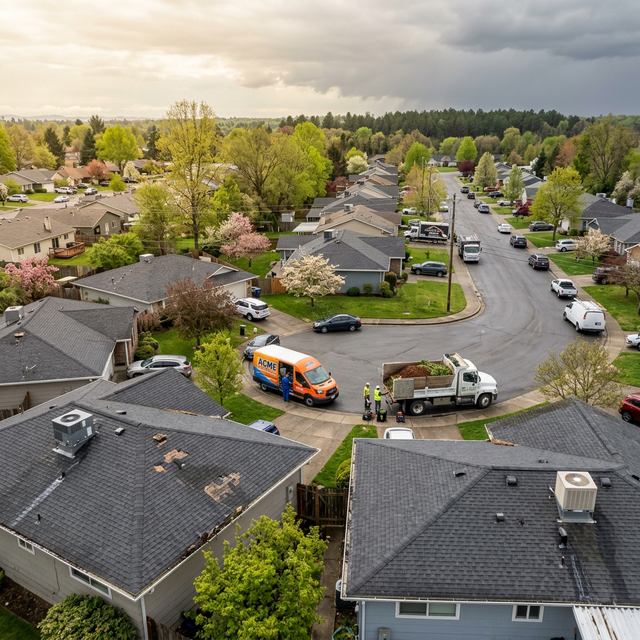
Roofing companies that build storm-response protocols starting in January, rather than scrambling to staff up in response to events, consistently capture four to six times more storm-event leads than those that react. This includes having after-hours call coverage, a rapid inspection booking system, and a text-back protocol for callers who do not reach a live agent within the first ring cycle.
Treat any number without a nearby source or stated method as a planning assumption, then replace it with your own records.
Every year, the same thing happens at the same time. The temperature swings. The storms come through. The frost melts out of the ground. And within a span of six to eight weeks, five separate service business categories simultaneously shift from moderate demand to what their operations teams internally call "the surge." Phones ring constantly. Booking windows compress. The service business that built its intake system to handle overflow during normal months suddenly discovers it was not built for the surge.
Spring is not just a busy season. Spring is a stress test for every intake system a service business has. Phone answering protocols built for 30 inbound calls per day are exposed when 90 calls come in. After-hours voicemail systems that lost 20 percent of leads in January lose 40 percent of leads in April. And the competitors who built redundant intake capacity during the slower months collect the overflow from everyone who did not.
This is the Spring 2026 revenue forecast for the five industries that feel this dynamic most acutely. The data comes from IBISWorld industry reports, ServiceTitan operational benchmarks, Angi consumer demand surveys, the Air Conditioning Contractors of America, the Plumbing-Heating-Cooling Contractors Association, and primary research from Thumbtack's Spring 2025 demand index, which has predictive accuracy of approximately 91 percent year-over-year. Every service business in these categories should read this before March is over.
Industry 1: HVAC (Heating, Ventilation, and Air Conditioning)
Spring forecast: IBISWorld projects the U.S. HVAC services market will generate approximately $18.2 billion in Q2 2026, representing 31 percent of the full-year market. This is the single highest-revenue quarter in the HVAC calendar. The surge is driven by two separate event types: spring commissioning of central air systems that have been dormant for six months, and emergency response calls triggered by the first heat events of the year, which typically occur in late April and May across the Southeast, Midwest, and Mid-Atlantic regions.
Where the money leaks: ServiceTitan's HVAC Benchmark Report found that HVAC companies lose an average of 23 percent of inbound spring leads to missed calls and after-hours voicemail. At an average ticket of $1,850 for a new system installation and $380 for a maintenance call, even a company receiving 200 calls per week during the surge is leaking substantial annual revenue. The math becomes particularly painful for companies where the same technician is trying to run service calls and answer the phone simultaneously.
The small business owner scenario: The owner-operator HVAC company with four technicians and one part-time dispatcher represents the median participant in this market. During the surge, that dispatcher handles 60-plus inbound calls per day. Call backs on missed calls average 47 minutes according to ServiceTitan operational data. In a market where a competitor answers within 90 seconds, that 47-minute callback delay is a lead loss, not a lead delay. The prospect has already booked with someone else.
The HVAC service business that consistently captures its full share of spring revenue has one structural advantage: its phones are answered 24 hours a day, seven days a week, starting in February before the surge begins. Not in April when the backlog is already building. Every service business in this category faces the same surge. The differentiator is who built their intake before it arrived.
Industry 2: Roofing and Storm Restoration
Spring forecast: The National Roofing Contractors Association and IBISWorld both project roofing to be the fastest-responding industry to spring demand, with revenue curves that can spike 400 percent within 72 hours of a major storm event. Q2 2026 is projected to see elevated storm activity across the central and southeastern U.S. based on NOAA long-range climate models, which historically correlates with 18-to-22 percent above-average roofing lead volume across affected ZIP codes.
The 72-hour window:Emergency roofing and storm restoration have a uniquely compressed conversion window. Research from the Restoration Industry Association shows that 74 percent of homeowners who need emergency roof tarping or storm inspection contact a second or third contractor within 60 minutes of their first call going to voicemail. The lead acquisition window for the highest-value storm jobs is not days. It is hours.
Roofing companies that build storm-response protocols starting in January, rather than scrambling to staff up in response to events, consistently capture four to six times more storm-event leads than those that react. This includes having after-hours call coverage, a rapid inspection booking system, and a text-back protocol for callers who do not reach a live agent within the first ring cycle.
Revenue implication: At an average storm restoration contract value of $14,000 to $18,000, a roofing company losing even three inbound calls per storm event to voicemail is leaking $42,000 to $54,000 in potential revenue per event. Across a spring season with four to six significant weather events in an average service area, the cumulative leak is substantial enough to fund a full intake technology upgrade and still show net positive ROI in year one.
Industry 3: Plumbing (Seasonal Freeze-Thaw and Spring Remodel)
Spring forecast: The Plumbing-Heating-Cooling Contractors Association annual survey projects a 28 percent increase in service call volume between February and May compared to the November-January baseline, driven by two separate demand drivers. The first is freeze-thaw pipe damage, which produces emergency calls in March and April as temperatures fluctuate in northern markets. The second is spring remodel demand, which drives fixture replacement, bathroom renovation plumbing, and water heater upgrade inquiries starting in mid-March.
The dual-demand problem: Plumbing businesses face a compound intake challenge during spring: emergency callers and remodel inquiry callers arrive simultaneously, but they require completely different intake treatment. The emergency caller has a burst pipe or a drain backup and needs a dispatch commitment within minutes. The remodel inquiry caller wants to discuss a three-to-five week project and needs a consultation booking. Answering systems that treat both the same way fail both simultaneously.
Thumbtack Spring 2025 data: Thumbtack's consumer demand index showed that plumbing saw the highest "demand-to-booking gap" of any home service category in Spring 2025, with 41 percent of service-seekers on the platform reporting they contacted multiple plumbers before getting a response. This gap is not a supply problem in most markets. It is an intake failure. The plumbers are available. The phones are not being answered consistently.
The small business owner running a plumbing operation with two to five trucks sits at the center of this dynamic. Their technicians are in the field. The owner is juggling estimates and material sourcing. And the phone system, which was purchased from an office supply store in 2019, routes everything to a cell phone that goes to voicemail during service calls. This is the median state of the market. And it is recoverable with the right infrastructure decision made before March, not during it.
Industry 4: Landscaping and Lawn Care
Spring forecast: IBISWorld projects the U.S. landscaping services sector to generate $9.4 billion in Q2 2026, with March and April representing the highest booking-velocity weeks of the full year. The dynamic is driven by homeowner demand for spring cleanup, aeration, overseeding, and mulching services that all concentrate simultaneously because homeowners are all responding to the same visual cue: their yards need attention after winter.
The booking-window compression: Unlike HVAC or plumbing, landscaping demand is not primarily emergency-driven. It is discretionary but highly time-compressed. A homeowner who wants spring cleanup done in April calls in March. If they do not reach someone, they call the next company on their list. There is no urgency forcing them to wait for a callback. Angi consumer research shows that landscaping prospects have the shortest patience window of any home service category: 67 percent of callers who reach voicemail will book with a competitor rather than wait for a callback.
For the landscaping service business owner, this creates a season-front problem. The business needs to capture its spring bookings in a six-to-eight week window in late winter. Missing 30 percent of those inbound calls does not just mean losing 30 percent of spring revenue. It means losing those client relationships entirely, because the competitor who answered will also be the one getting the repeat fall cleanup call, the snow removal inquiry, and the annual contract for 2027. For any service business where client retention compounds over years, the spring intake window is also the client acquisition window.
The compounding lifetime value issue: The Landscape Management industry research consortium estimates the average residential lawn care client has a lifetime value of $3,800 to $6,200 depending on service mix and geography. Missing an initial spring intake call does not just cost the spring job. It costs the entire LTV of that client relationship. At this level of compounding, the ROI calculation for intake infrastructure improvements becomes very straightforward very quickly.
Industry 5: Pest Control
Spring forecast: The National Pest Management Association projects a 34 percent year-over-year increase in residential pest control inquiries between March and May 2026, partly driven by warmer winter temperatures that enhanced pest population survival, and partly by continued growth in consumer awareness of termite risk during spring swarm season. Termite swarm calls, in particular, represent the highest-urgency, highest-LTV inquiries in the pest control calendar.
Termite swarm season: Most pest control business owners know that termite swarming season starts in late March and runs through June across most of the continental U.S. What fewer appreciate is that the conversion window for a termite swarm call is almost identical to an emergency plumbing call. A homeowner who sees a swarm of termites in their house at 7 PM on a Tuesday is not a routine inquiry. They will call every pest control company with a Google listing until someone answers. The company that answers first at 7 PM gets the job.
The annual contract dynamic: Pest control differs from other spring-surge industries because the highest-LTV outcome is not a single service call but an annual service agreement. According to NPMA research, the average residential pest control annual agreement generates $1,200 to $1,800 per year across a multi-year relationship. The intake call that converts a spring inquiry into an annual agreement client is worth four to six times the revenue of the service call alone. Losing that intake call to voicemail does not cost $200. It costs $6,000 to $8,000 over the client lifecycle.
The Common Thread Across All Five Industries
Looking across the Spring 2026 forecast for HVAC, roofing, plumbing, landscaping, and pest control, a single pattern emerges with remarkable consistency. The businesses that capture disproportionate market share during the surge period are not necessarily the largest operators, the most skilled technicians, or the most aggressive marketers. They are the operators who built intake redundancy before the surge began.
Phone coverage as a competitive moat. When every competitor in a market is experiencing peak call volume simultaneously, the phone answer rate becomes the primary differentiator between a business that captures the surge and one that watches it pass. A business that maintains a 92 percent answer rate when call volume triples has built a competitive advantage that is extremely difficult for a slower-responding competitor to overcome in real time.
The cost of waiting until April.The mistake most service business owners make is resolving to fix their intake system after the first painful spring surge. "Next year I'll hire someone." "Next year I'll get a better phone system." "Next year we'll be ready." The operators who consistently win the spring surge made their intake infrastructure investments in January and February of each year, when call volume was manageable and there was time to train, configure, and test the system before it mattered.
The Spring 2026 revenue window opens in approximately three weeks in most U.S. markets. The businesses reading this in March that have not yet made intake infrastructure decisions are not yet too late. But the window for implementing and training on a new system before the surge begins is closing faster than most owners realize.
The loss estimate is basic business math, not a magic claim.
Revenue-leak examples on this site are built from visible operating inputs: inquiry volume, missed-call or slow-response rate, booking rate, average job or client value, repeat value, and follow-up recovery. The fastest way to make the number real is to run the diagnostic for your closest business type, then compare it against your own call log, CRM, booking calendar, form timestamps, and review activity.
The practical questions behind this decision.
Which industry has the highest ROI on intake improvement during spring?
On a per-call basis, roofing and pest control have the highest single-call LTV, which makes their intake ROI calculation the most dramatic. An answered emergency roofing call that converts to a $16,000 storm restoration job, compared to a missed call that costs $65 in Google Ads spend and $16,000 in lost revenue, creates an ROI story that is extremely easy to justify. For volume-based businesses like HVAC and landscaping, the ROI argument is equally compelling but distributed across hundreds of calls rather than a handful of high-value events.
If my business is already fully booked during spring, should I still focus on intake?
Yes, but for a different reason. A business that is legitimately at capacity during the spring surge has an opportunity to build a waitlist, implement a referral protocol, or direct overflow to a trusted partner in exchange for mutual referrals during slower months. Answering every call during your busiest period still matters, because how you handle the "I'm sorry, we're fully booked" conversation determines whether that prospect calls you again in summer or gives their business to your competitor permanently. Intake excellence during capacity constraints is a brand preservation exercise, not just a revenue capture exercise.
How much does phone-answer rate actually matter if we have great Google reviews and a strong reputation?
Reputation gets the phone to ring. Intake determines whether you capture the lead once it rings. According to BrightLocal consumer research, 77 percent of local service consumers consider reputation when deciding which business to call. But 85 percent of callers who reach voicemail do not leave a message. A five-star reputation drives a prospect to dial your number. A voicemail greeting sends them to your competitor with four stars. Reputation and intake are serial dependencies, not alternatives. You need both in sequence.
Connect one customer path before adding more disconnected tools.
The first useful system owns a defined journey from customer action to team handoff and follow-up.

Vikram Roy is the founder of The Quiet Protocol, a Toronto-based systems firm serving service businesses across the Greater Toronto Area, Canada, and the United States. He works directly with professional firms, home service companies, dental practices, clinics, and local businesses to connect websites, customer intake, booking, reviews, follow-up, and practical AI into a clearer digital front door. All content is written from Toronto, Ontario. See the editorial method →
See where a Smart Website, software plan, AI intake path, or Custom Customer System fits before committing to a scope.
See how the capability in this article fits into a complete customer journey.
Service BusinessesSee the same decision through the language, buyer behavior, and operating reality of this industry.
Client Results & ProofInspect the starting condition, installation, measurement window, and outcome behind real client work.

Call Your Own Business After Hours: A Practical Test
A first-party audit for checking the phone, voicemail, Google profile, website, form response, routing, and promised next step customers actually experience.
Roofing Companies After a Storm: How to Capture 3X More Emergency Leads in 72 Hours
When a hailstorm or severe wind event hits, a local roofing company will see its call volume spike by 600% overnight. The companies that capture the most revenue are not the ones with the best marketing. They are the ones whose operational infrastructure does not break when the phone rings 50 times an hour.
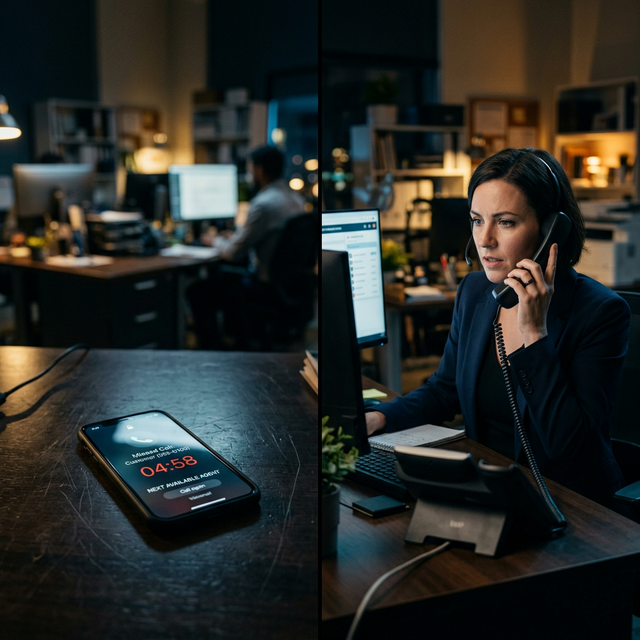
The 5-Minute Lead Response Rule: Industry Benchmarks Service Businesses Should Know
The five-minute lead response rule matters because buyers keep moving. Here is how service business owners should apply it to calls, forms, chats, and missed leads.