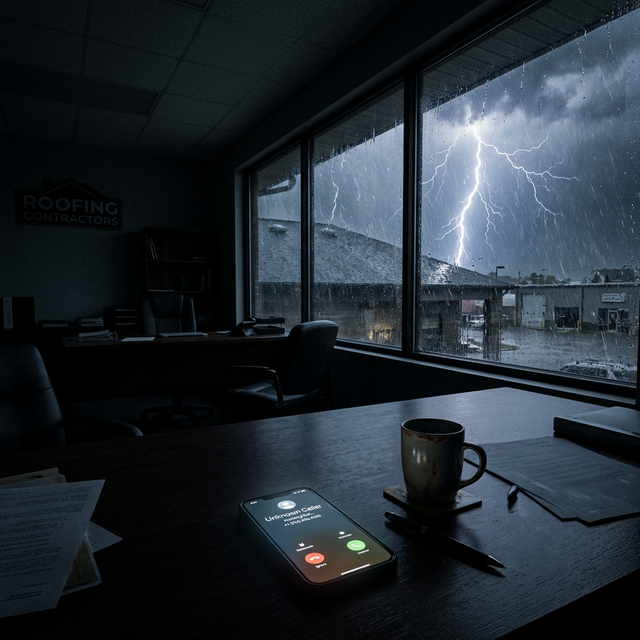
When the surge hits, the immediate reaction of most roofing company owners is to throw bodies at the problem. They pull project managers, sales estimators, and administrative staff into the office, hand them a phone, and tell them to "just answer the calls."
Treat any number without a nearby source or stated method as a planning assumption, then replace it with your own records.
At 4:00 PM on a Tuesday, a severe supercell drops golf-ball-sized hail across three affluent suburban zip codes. By 5:00 PM, the storm has passed. By 5:15 PM, the event begins for the local roofing industry. A regional roofing company that typically averages 15 inbound calls a day suddenly sees its phone system light up with 40 calls per hour. Homeowners are emerging from their houses, finding shingles in their yards, and immediately searching Google for emergency tarping and damage inspection.
The next 72 hours dictate the revenue trajectory of the entire quarter for that roofing business. A major weather event concentrates a year's worth of demand into a three-day window. The average roof replacement generated from severe hail or wind damage exceeds $12,000 to $18,000 depending on the market. In standard operating conditions, acquiring those leads requires significant marketing spend. After a storm, the leads are free. They are actively begging to give a roofing contractor their money.
The problem is not demand generation. The problem is operational capacity. Most roofing businesses, even those operating at $5M to $10M in annual revenue, run their office with one or two people at the front desk. When the storm hits, that front desk breaks. The resulting chaos causes the vast majority of those high-intent, high-value leads to leak out of the system and into the hands of competitors who answer the phone.
The Operational Failure Rate During a Weather Event
The failure is mathematical. If a roofing contractor has two people answering phones, they can effectively handle, at maximum capacity, about 12 to 15 intake calls per hour. If call volume spikes to 40 or 50 calls per hour during a storm event, the excess 35 callers are placed on endless hold, routed to an automated directory, or dumped into a full voicemail box.
The psychology of the storm caller. A homeowner panicked about a leaking ceiling or missing shingles is not patient. They want a tarp on their roof before the next rain, and they want an insurance inspection scheduled immediately. According to ServiceTitan data on emergency service trades, if a homeowner does not reach a live person within two rings during a weather event, 82 percent will hang up and call the next roofing company on their Google search list. They do not leave voicemails.
Therefore, a roofing business that misses 30 calls per hour during a 10-hour surge period is missing 300 highly qualified leads. If even 20 percent of those calls converted to a $15,000 roof replacement, the operational failure of a busy front desk is actively costing the company $900,000 in gross revenue in a single day. The marketing department did its job perfectly; the company ranked high in the search results. The operations department dropped the ball.
The callback promise operates on the flawed assumption that emergency leads are exclusive. They are not. Storm leads are highly perishable and completely non-exclusive. The homeowner is not shopping for the cheapest price or the best brand; they are shopping for the first available contractor who can guarantee a specific arrival time. A promise to call back offers zero comfort to a homeowner in distress, so they continue their search until they find someone who can commit.
Why "All Hands on Deck" Is a Flawed Strategy
When the surge hits, the immediate reaction of most roofing company owners is to throw bodies at the problem. They pull project managers, sales estimators, and administrative staff into the office, hand them a phone, and tell them to "just answer the calls."
This "all hands on deck" strategy creates secondary failures that are often as damaging as missing the calls entirely:
Failure 1: Inconsistent Data Capture. A project manager abruptly handed a ringing phone is not a trained intake specialist. They grab a sticky note, jot down a name and a general area ("John, leaking roof, somewhere in Oakwood"), and hang up. The CRM is bypassed entirely. Two days later, a salesperson is trying to decipher a pile of sticky notes with incomplete phone numbers and missing email addresses.
Failure 2: Lack of Triage. Not all storm calls are equal. A caller with a massive leak actively destroying drywall requires emergency tarping (immediate high margin). A caller who just wants someone to "take a look because my neighbor has damage" requires a scheduled inspection. When everyone is answering phones in a panic, there is no standardized triage. The emergency tarping job gets scheduled for next week, and the unconfirmed inspection gets priority.
Failure 3: The "Wait and See" Commitment. Unprepared staff answering overflow calls often resort to non-committal language: "We are really busy right now, but someone will call you back to schedule." As discussed, storm callers have zero loyalty. If a roofing contractor promises a callback, the homeowner immediately hangs up and calls a competitor to secure a hard commitment.
The 72-Hour Capture Infrastructure
Capturing 3X more leads during a weather event does not require hiring temporary staff or spending more on Google Ads. It requires building a surge-resistant intake infrastructure before the storm hits. This infrastructure relies on decoupling the act of answering the phone from the physical constraints of the front desk.
Step 1: The Automated Intake Funnel. A roofing contractor must have a system that can handle infinite concurrent calls. When a storm hits and 40 calls come in simultaneously, a specialized AI voice agent or an elastic answering service provider must instantly absorb the overflow. If the front desk is busy, the system answers on the first ring: "Thank you for calling [Roofing Company]. We are currently receiving high call volume due to the storm. Are you calling to report active leaking or roof damage?"
Step 2: Standardized Triage Routing. The overflow system must be programmed to separate the critical from the routine. If the caller indicates active leaking, the system captures their exact address, cell phone number, and dispatches an emergency notification to the tarping crew. If the caller needs an inspection, the system moves to Step 3.
Step 3: Direct Calendar Injection. This is the most critical element of surge capture. The system must not promise a callback. It must take the appointment. By integrating the AI voice agent or online intake form directly with the sales team's routing software (like JobNimbus, AccuLynx, or ServiceTitan), the system can say, "I have secured a spot for an inspector to visit exactly at 2:00 PM on Thursday. You will receive a text confirmation right now." The homeowner stops calling competitors because they have a hard appointment on the calendar.
Step 4: The SMS Safety Net. During extreme surges, even the best systems benefit from an omnichannel approach. Update your Google Business Profile and website prominently with "Text Us for Fastest Response." Storm callers who text avoid the voice queue entirely. An automated SMS system can instantly reply: "Thanks for reaching out to [Roofing Company]. To get you on the inspection schedule immediately, please reply with your street address and whether you have active leaking inside the home."
Step 5: Data Hygiene and CRM Integration. The fastest intake system in the world is useless if the data is trapped in a silo. A proper surge infrastructure must push the parsed lead data (Name, Phone, Address, Damage Type, Appointment Time) directly into the roofing company's CRM in real-time. This eliminates the need for manual dual-entry by the front desk staff, preventing address typos that send sales estimators to the wrong neighborhood. When the field reps wake up the next morning, their route is already optimized, digitally mapped, and fully populated with the storm leads captured automatically overnight.
The Economics of Triage and Outsourcing
Many roofing company owners balk at the idea of paying for advanced AI intake systems or premium answering services, arguing that it represents an unnecessary fixed cost during the dry months. This fundamentally misunderstands the economics of storm events.
In the roofing industry, the revenue curve is not steady; it is characterized by severe spikes followed by long plateaus. A roofing business must build its infrastructure to capture the spike.
Assume a premium AI voice intake system or specialized call center costs $1,500 a month to maintain. Annually, that is $18,000. If that system successfully captures and schedules just two emergency tarping jobs or one full roof replacement during a single severe weather event that would have otherwise gone to voicemail, the system has paid for itself for the entire year. Every lead captured after that break-even point is pure gross profit on the intake side.
Furthermore, protecting your in-house staff from the chaotic burnout of a phone surge allows them to focus on what actually drives revenue: confirming the generated appointments, verifying insurance claims, and deploying the sales estimators efficiently. When the front desk is no longer the bottleneck, the entire roofing contractor operation scales.
The Post-Storm Nurture Protocol
The intake surge typically subsides after 72 hours, but the revenue capture is not complete. Many homeowners who requested inspections will ultimately not have enough damage to warrant an insurance claim for full replacement. In a chaotic system, these leads are discarded as "dead." In a structured system, they represent a significant secondary revenue stream.
The "Near Miss" Database. Homeowners with some damage but no approval for a new roof are highly sensitive to future weather events. The roofing company now has a categorized list of targeted addresses. By feeding this data into a structured CRM follow-up sequence, the company can deploy automated touchpoints: "We inspected your roof last May and noted minor hail bruising. The recent wind storm likely worsened it. Click here to schedule a rapid reinspection before winter."
This database reactivation strategy turns the leads that did not yield a massive insurance replacement into a steady stream of repair work and future replacements, effectively doubling the long-term ROI of the initial weather event surge.
The loss estimate is basic business math, not a magic claim.
Revenue-leak examples on this site are built from visible operating inputs: inquiry volume, missed-call or slow-response rate, booking rate, average job or client value, repeat value, and follow-up recovery. The fastest way to make the number real is to run the diagnostic for your closest business type, then compare it against your own call log, CRM, booking calendar, form timestamps, and review activity.
The practical questions behind this decision.
Should a roofing company use a call center in another country to handle storm overflow?
Cost-saving offshore call centers often backfire during local emergencies. The operators usually cannot pronounce local street names or subdivisions, which immediately alerts the caller that they are not speaking to a local roofing contractor. This destroys trust. In an industry plagued by "storm chaser" scams, homeowners prioritize local presence. If using third-party humans, they must be onshore and rigorously trained. This is why many roofing businesses are shifting to sophisticated, localized AI voice agents that exhibit no language barriers and can access regional maps and scheduling software instantly.
How do we handle callers asking if we work with their specific insurance company?
The intake system (whether human or AI) must be scripted to handle this smoothly without causing friction. "Yes, we work with all major insurance carriers including State Farm, Allstate, and USAA to ensure your claim is handled properly. The first step is getting our inspector on the roof to securely document the damage for the adjuster. I have a spot open on Thursday at 2 PM or Friday at 10 AM. Which works better for you?" Deflect the complex insurance discussion to the sales estimator and focus entirely on booking the inspection.
If we automate intake, will we lose the personal touch our local roofing business is known for?
A caller listening to a busy signal or an unanswered voicemail has received zero personal touch. Giving a homeowner in a crisis an immediate, competent response that results in a booked appointment is the ultimate demonstration of good service. Automation does not replace the personal touch of your sales estimator on the roof or your project manager communicating during the build; it merely ensures that the homeowner actually makes it into your pipeline to experience that service.
What is the best way to handle calls that come in while our crews are actively doing tarping in the rain?
This is precisely why decoupling intake from field operations is critical. A roofing company owner or project manager should never be answering the main intake line while standing on a wet roof holding a tarp. The automated overflow system acts as the digital front desk, capturing the lead and securing the appointment, while the field crew executes the emergency work safely. The crew receives a digital dispatch alert when a new emergency is verified, allowing them to route directly from one job to the next without playing phone tag.
Do these automated intake systems integrate with standard roofing CRMs?
Yes. The most effective surge capture systems are built specifically to API-integrate with the dominant roofing software platforms like AccuLynx, JobNimbus, and Roofr. When a lead is captured by an AI agent or a specialized answering service, the data is not just emailed to a generic inbox. It is mapped directly into your CRM, creating a new contact record, logging the intake conversation, and placing the lead in the correct "New Lead - Storm Damage" pipeline stage automatically.
Map how a serious buyer decides in this kind of business.
Use the operating reality of the industry instead of copying a generic lead-generation playbook.

Vikram Roy is the founder of The Quiet Protocol, a Toronto-based systems firm serving service businesses across the Greater Toronto Area, Canada, and the United States. He works directly with professional firms, home service companies, dental practices, clinics, and local businesses to connect websites, customer intake, booking, reviews, follow-up, and practical AI into a clearer digital front door. All content is written from Toronto, Ontario. See the editorial method →
Replace broad industry assumptions with the business's actual inquiry volume, customer value, response time, and booking data.
See how the capability in this article fits into a complete customer journey.
Roofing & ExteriorSee the same decision through the language, buyer behavior, and operating reality of this industry.
Client Results & ProofInspect the starting condition, installation, measurement window, and outcome behind real client work.

Why Service Businesses Lose Inbound Leads Before the Phone Rings
It is not a traffic problem. Many service businesses lose revenue because the front door breaks before the buyer reaches a real conversation.

HVAC Missed Calls: Where Summer Revenue Leaks Before Dispatch
When an AC unit fails in July, the homeowner wants a truck dispatched, not a callback tomorrow. Here is the math behind why HVAC companies consistently lose mid-summer revenue despite full schedules.

After-Hours Call Intake for Water Damage Restoration
How restoration companies can capture water-damage calls, identify safety and urgency signals, route trained people, set accurate expectations, and audit the handoff.