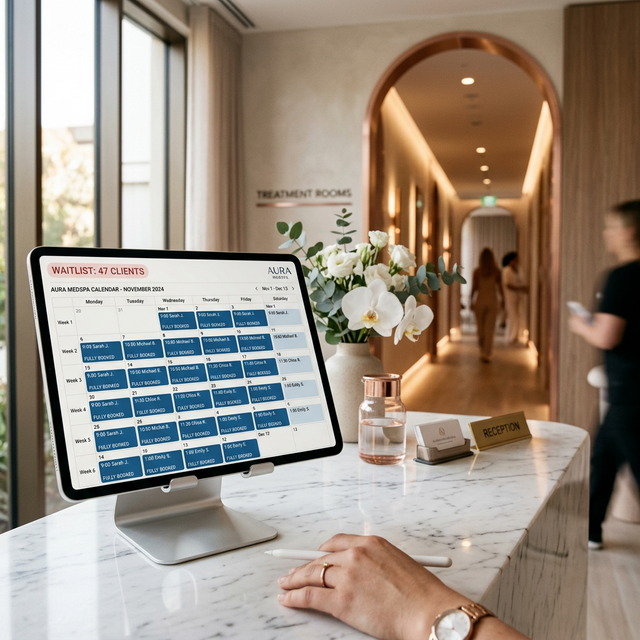

That empty 105-minute block representsapproximately $1,400 to $2,200 in billable injector timeat a mid-market aesthetic clinic. Do this math five times per month and the passive waitlist management approach costs the practice $7,000 to $11,000 in preventable monthly revenue loss.
Treat any number without a nearby source or stated method as a planning assumption, then replace it with your own records.
The injector finished her last Botox appointment at 4:30 PM, packed her syringes, and left for the evening. The treatment room sat empty from 2:15 PM to closing because the 2:15 PM appointment had canceled that morning. The front desk coordinator checked the printed waitlist sheet, called two numbers, got voicemails on both, and marked the slot as lost.
That empty 105-minute block representsapproximately $1,400 to $2,200 in billable injector timeat a mid-market aesthetic clinic. Do this math five times per month and the passive waitlist management approach costs the practice $7,000 to $11,000 in preventable monthly revenue loss.
Medical spa owners and aesthetic clinic managers understand conceptually that a strong waitlist acts as a revenue buffer. What they fail to implement is the operational system that converts that waitlist from a passive list of names into an active, time-sensitive revenue capture mechanism.
The Difference Between a Waitlist and a Revenue Buffer
The passive waitlist.Most medical spa practices maintain a waitlist by having the front desk coordinator add names to a shared Google Sheet or a notes section in their booking software when a patient requests an earlier appointment. When a cancellation occurs, the coordinator works down the list sequentially, leaving voicemails until someone responds. This approach has a 15 to 35 percent fill rate on canceled slots because the notification lag is too long and the communication method is too passive.
The active revenue buffer.High-performing aesthetic clinics treat the waitlist as an on-call activation system. Every patient added to the waitlist is explicitly told during intake what to expect: "We will send you a text within two minutes of any cancellation that matches your treatment preferences. You will have 15 minutes to confirm before we move to the next person." This explicit expectation sets behavioral norms, drives rapid response rates, and regularly fills canceled slots within 20 to 40 minutes of opening.
The distinction between the two approaches is not technology. It is operational architecture. The medical spa that fills 80 percent of its canceled slots is not using better software than the one that fills 20 percent. It is running a fundamentally different patient communication protocol from the moment the waitlist entry is created.
Why Medical Spa Patients Do Not Respond to Voicemails
The waitlist activation failure is not a demand problem. Medical spa patients waiting for a lip filler or Botox appointment are not indifferent to the opening. They are simply unreachable through the wrong communication channel at the wrong time of day.
The voicemail death zone.Aesthetic clinic patients are predominantly professionals and working adults. They cannot answer unknown numbers during business hours, and they rarely check voicemail. A voicemail from a medical spa calling about an available 2 PM appointment on Tuesday goes unheard until 6 PM, at which point the appointment has long since been given to someone else. The patient calls back, finds the slot gone, and the clinic has wasted communication effort on a zero-conversion interaction.
SMS converts at seven times the rate of voicemail.Consumer communication research consistently shows that SMS open rates exceed 98 percent, with an average read time of under three minutes. A text message notification about an available med spa appointment is read almost immediately, regardless of whether the patient is in a meeting or picking up their children from school. The response can be a single tap. The friction is microscopic compared to listening to a voicemail, finding a quiet moment, and calling back a business phone number.
Elite medical spas that fully migrate their waitlist activation to SMS-first, voice-second protocols regularly report slot fill rates of 70 to 85 percent, a dramatic improvement over the 15 to 35 percent fill rates achieved through traditional phone-first approaches.
Building the Waitlist Intake Protocol
The waitlist activation success rate is determined at the moment the patient is added to the waitlist, not at the moment the cancellation occurs. The information gathered during the initial registration determines how targeted and fast the activation can be.
Required waitlist data fields.Every medical spa waitlist entry must capture the following: the patient's preferred treatment type and approximate units or volume, their available days and times broken into morning, midday, and afternoon blocks, their preferred provider if they have a strong injector preference, and their mobile phone number confirmed for SMS notifications. Any entry missing the mobile number field is operationally useless for rapid activation.
The Tiered Waitlist Architecture.Rather than maintaining a single undifferentiated list, the highest-performing aesthetic clinics segment their waitlist into treatment-specific pools: Botox and neurotoxins, dermal fillers, body contouring, advanced skin treatments, and consultations. When a 60-minute filler block opens, the coordinator activates only the filler pool, dramatically reducing the noise and increasing the relevance of the outreach. Patients who are waitlisted for a Morpheus8 treatment do not receive a notification about a Botox opening, keeping message fatigue low and response rates high.
The Activation Sequence That Recovers More Canceled Slots
The operational sequence matters as much as the communication channel. Aesthetic clinics that achieve the highest fill rates follow a precise, time-boxed activation protocol that creates urgency without creating pressure.
Step 1: The two-minute text.The moment a cancellation is recorded in the booking system by the front desk coordinator, an automated SMS fires simultaneously to the top five patients on the relevant treatment waitlist. The message reads: "Hi [First Name], a [Treatment Type] appointment opened up with [Provider Name] on [Day] at [Time]. Reply YES to claim it. This slot closes in 15 minutes." The two-minute send window and the 15-minute claim window create real urgency without fabrication because the claim window is real.
Step 2: The 15-minute hard close.If no confirmation arrives within 15 minutes, the original five notifications expire and a second batch of five texts fires to the next group on the waitlist. This batch-expiry approach prevents the coordinator from managing a chaotic, overlapping queue of partial commitments. At any given moment, only one active offer batch is in circulation. The first patient to respond with a YES confirmation gets the appointment automatically locked in the booking software.
Step 3: The phone fallback.If two activation rounds fail to fill the slot within 40 minutes, the coordinator shifts to voice calls for the remaining high-priority waitlist patients. These are typically long-waiting patients who have been on the list for three or more weeks and whose emotional investment in finally getting an appointment makes them more likely to rearrange their day to accept a same-day opening.
Medical spa practices that deploy this three-step protocol consistently convert 75 to 85 percent of their canceled appointments into productive billable sessions, eliminating the largest single source of preventable revenue loss in the aesthetic clinic operation.
The Waitlist as a Patient Loyalty Signal
A well-managed medical spa waitlist has a secondary benefit that most owners overlook: it is one of the strongest patient retention tools available. A patient who has waited three weeks to get an earlier appointment and is then activated quickly with a personalized text notification has a qualitatively different emotional relationship with the practice than one who simply scheduled six weeks out and waited.
The "they thought of me" effect.When a medical spa texts a waitlisted patient within minutes of an opening and that patient successfully claims the appointment, it creates a strong positive impression of operational excellence and attentiveness. The clinic demonstrates to that patient that they are known, tracked, and valued. This impression has a measurable impact on patient lifetime value. According to AmSpa survey data, patients who have successfully been called off a waitlist are 67 percent more likely to refer a new patient to the practice within 90 days of that experience than patients who scheduled normally.
The waitlist activation protocol is not purely a revenue recovery tool. It is also a patient relationship management instrument that deepens loyalty and drives organic referral behavior.
Automating Waitlist Management Without Losing Patient Judgment
Integrating with practice management software.The automation of the waitlist activation sequence requires integration between the booking software and an SMS communications platform. Booking systems like Zenoti, Boulevard, or Vagaro allow webhook triggers that fire the moment a cancellation status is applied to an appointment. The webhook connects to an SMS platform which automatically pulls the next eligible patient from the relevant segment of the waitlist and sends the time-boxed notification without any manual coordinator involvement.
The coordinator oversight role.Full automation handles the mechanics, but the medical spa coordinator retains a supervisory role: reviewing activation outcome reports daily, managing waitlist hygiene by removing stale entries, and personally calling high-value VIP patients for premium treatments like full-face filler or fat dissolving procedures where a personal touch carries higher conversion weight than an automated text. Automation handles the volume; humans handle the VIPs.
The investment in a properly integrated automation stack for waitlist management typically involves a one-time setup cost of $1,500 to $3,000 for the integration build-out, plus the monthly cost of the SMS platform. In most cases, a single recovered cancellation slot per week entirely funds the system. For a medical spa doing $1.5M or more in annual revenue, the return on this investment is dramatic. A clinic averaging $850 per appointment slot that fills four additional canceled slots per month through automation is generating over $40,000 in incremental recovered revenue per year from a system that costs under $3,000 annually to operate.
The Operating Standard for Waitlist Revenue Capture
When we evaluate the ROI of an intake system like the one described for Your Med Spa Waitlist is Leaking: How to Convert It Into Recoverable Revenue, we look beyond the immediate convenience of automation. We look at the 'Revenue Leak' that occurs in the silence between a prospect reaching out and a business responding. In this vertical, that silence is the biggest competitor you have.
Data Anchor: The average LTV of a client in this space is significantly higher than the cost of a missed intake opportunity. By resolving for 'concurrency': the ability to handle infinite leads simultaneously-The Quiet Protocol transforms a passive operation into an aggressive revenue engine.
The loss estimate is basic business math, not a magic claim.
Revenue-leak examples on this site are built from visible operating inputs: inquiry volume, missed-call or slow-response rate, booking rate, average job or client value, repeat value, and follow-up recovery. The fastest way to make the number real is to run the diagnostic for your closest business type, then compare it against your own call log, CRM, booking calendar, form timestamps, and review activity.
The practical questions behind this decision.
How many patients should a medical spa aim to have on its active waitlist at any given time?
Industry benchmarks from AmSpa suggest that a healthy aesthetic clinic should maintain a waitlist depth of two to four patients per available weekly appointment slot. A clinic with 30 bookable appointments per week should aim to hold 60 to 120 active waitlist entries across all treatment categories. If the waitlist consistently falls below this ratio, the marketing engine is not delivering enough demand. If it consistently exceeds this ratio, the clinic may need to add provider hours or hire an additional injector.
Should a medical spa charge a waitlist registration fee?
Some high-demand medical spa practices charge a $25 to $50 waitlist registration fee that applies to the first treatment upon activation. This approach works in markets where the clinic has strong brand authority and demonstrable waitlist length. The fee filters out the most casual inquiries, ensuring the active waitlist is populated with serious, committed patients. For newer aesthetic clinics or those in competitive markets, the registration fee can suppress waitlist enrollment enough that the filtering benefit is outweighed by the volume loss.
How long should a medical spa keep a patient on the waitlist before removing them?
Patient engagement data suggests a clear drop-off in waitlist responsiveness beyond 45 to 60 days for most aesthetic treatments. A patient who was waitlisted for a Botox appointment six months ago has almost certainly already visited a competitor. The practice should run a bi-weekly hygiene audit, automatically removing entries older than 45 days unless the patient has explicitly re-confirmed their interest through a simple SMS check-in. An automated text asking "Are you still interested in being contacted about openings for [Treatment]? Reply YES to stay on the list" takes seconds to set up and keeps the waitlist clean and actionable.
What is the best way to handle a patient who repeatedly claims waitlist spots but then cancels again?
This is an operational red flag that requires human intervention, not automation. A patient who has claimed a waitlist opening twice and then re-canceled is now occupying a slot in the activation queue that could benefit a more committed patient. The coordinator must call the patient personally, acknowledge their history, and transition to a deposit-backed booking for any future appointments. If the patient is unwilling to provide a deposit to secure a future slot, they should be removed from the active waitlist entirely.
How do you measure whether your med spa waitlist system is actually converting?
Track two numbers weekly: the slot fill rate and the time-to-fill rate. Slot fill rate is the percentage of canceled appointments successfully filled from the waitlist. A healthy aesthetic clinic should target 70 percent or higher. Time-to-fill is the average number of minutes between a cancellation being recorded and a confirmed replacement booking. Best-in-class medical spa operations achieve a time-to-fill under 30 minutes with a properly structured SMS activation system. If your fill rate is below 50 percent or your time-to-fill exceeds 90 minutes, there is a structural failure in either your waitlist data quality or your communication channel.
Map how a serious buyer decides in this kind of business.
Use the operating reality of the industry instead of copying a generic lead-generation playbook.
Replace broad industry assumptions with the business's actual inquiry volume, customer value, response time, and booking data.
See how the capability in this article fits into a complete customer journey.
Aesthetics & Med SpaSee the same decision through the language, buyer behavior, and operating reality of this industry.
Client Results & ProofInspect the starting condition, installation, measurement window, and outcome behind real client work.

Funeral Home After-Hours Calls: How Missed Calls Fail Families
In compassionate care, the first call determines the relationship. Providers losing 12% of first-call inquiries to voicemail gaps are leaving $238,000 in annual arrangement value on the table.
Medical Spa Consultation Booking: Why Online Forms Leak High-Value Procedures
Aesthetic clinics spend thousands on Instagram ads to drive high-intent leads to a "Contact Us" form. When the patient coordinator finally replies four hours later, the prospect has already booked a consultation with the med spa down the street.
Med Spa Cancellation Policy: Why It Fails at the Front Desk
A written cancellation policy on your website offers zero financial protection if your front desk lacks the operational infrastructure to enforce it. The secret to eliminating the $500 last-minute Botox cancellation lies entirely in how the initial intake call is handled.