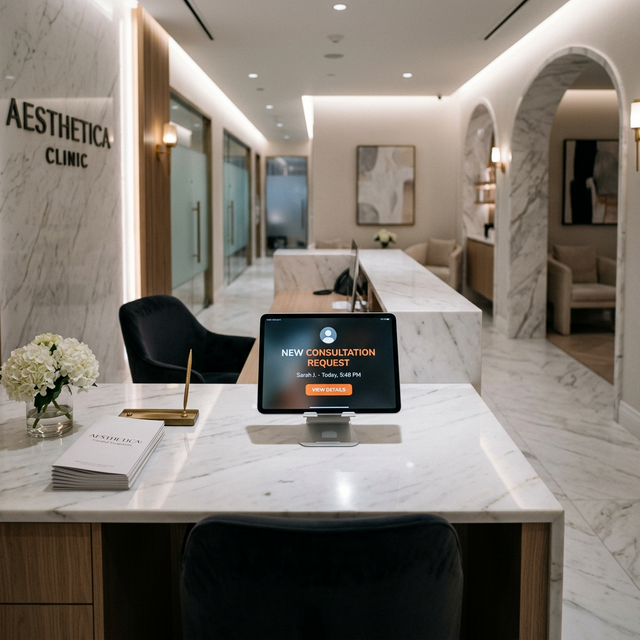
A med spa can lose a high-value consultation before the patient ever reaches the chair. Pricing questions, treatment anxiety, slow callbacks, and weak follow-up all create space for the buyer to book somewhere else.
Treat any number without a nearby source or stated method as a planning assumption, then replace it with your own records.
The marketing strategy is sophisticated, but the conversion mechanics are broken. When a prospective patient clicks through that expensive Instagram ad, they are almost universally directed to a passive web form. They are asked to submit their name, email, phone number, and area of interest. Then, they wait.
In a high-ticket, emotionally driven market, waiting is the enemy of conversion. By the time a patient coordinator at the medical spa finishes their current in-clinic duties and replies to that web form submission three or four hours later, the psychological impulse that drove the click has dissipated. Or worse, the prospect simply googled another aesthetic clinic, called them directly, and booked a consultation on the spot.
The 5-Minute Rule in Aesthetic Medicine
The data regarding lead response time is unforgiving. Research from PatientPop indicates that medical practices that respond to online inquiries within five minutes are materially more likely to connect with the prospect than those who wait 30 minutes. In the highly competitive world of aesthetic medicine, where the services are elective and the options are plentiful, the 5-minute rule is the absolute ceiling for competitive viability.
Consider the psychology of the aesthetic consumer. A prospect researching a $3,000 laser skin resurfacing package or a $1,200 neurotoxin treatment is making a highly discretionary, emotionally charged purchase decision. They are often acting on a momentary spike of motivation. When they fill out a form on a medical spa website, they are effectively raising their hand and saying, "I am ready to buy this right now."
If the aesthetic clinic answers that signal with silence, the prospect interprets it as a lack of premium service. They expect the responsiveness of the clinic to match the high price point of the procedure. If they cannot get a consultation booked easily, they assume the medical care itself will be equally difficult to navigate. A swift response from a patient coordinator is the first clinical indicator of competence the patient receives.
The Math of the Med Spa Revenue Leak
Let us quantify the cost of web form dependency using industry averages. The American Med Spa Association (AmSpa) reports that the average patient at a successful medical spa spends roughly $500 per visit and returns three times per year. The average lifetime value of a loyal aesthetic patient easily exceeds $5,000 to $10,000 when factoring in recurring injectables, skincare products, and major laser or body contouring procedures.
The Leakage Scenario: A mid-sized medical spa spends $3,000 per month on digital ads, generating 100 web form leads for consultations. Because the front desk is busy checking out current patients, the average response time to these forms is four hours. Due to this delay, the patient coordinator only successfully connects with and books 30 percent of those leads (30 consultations).
The Capture Scenario: If that same medical spa implements an immediate response protocol (calling the lead within five minutes or providing instant AI scheduling), the connection rate jumps to 70 percent, resulting in 70 booked consultations from the exact same ad spend.
The difference is 40 lost consultations per month. If the medical spa closes 50 percent of their consultations into paying procedures, that may be 20 lost new-patient opportunities every month. At a conservative first-year value of $1,200 per patient, the medical spa is losing $24,000 a month in unrealized new patient revenue. Annually, that becomes a serious modeled revenue leak. The medical spa is literally spending money on ads to generate leads for the aesthetic clinic down the street that answers the phone faster.
Why the Patient Coordinator Cannot Fix This Alone
When medical spa owners recognize this conversion gap, their first instinct is often to blame the front desk staff or mandate that the patient coordinator respond to emails faster. This is an operational misdiagnosis. The patient coordinator is structurally incapable of functioning as both an in-clinic concierge and an immediate-response inbound sales agent at the same time.
The dual-role conflict. A premium medical spa experience requires white-glove treatment for the patients physically present in the clinic. When a patient finishes a $1,500 filler appointment, the patient coordinator must provide post-care instructions, process the high-value payment, schedule the two-week follow-up, and offer retail skincare products. This checkout process takes 10 to 15 minutes of undivided attention.
If an online consultation request comes in during that 15-minute window, the patient coordinator cannot pause a high-end client checkout to respond to an email. By the time they finish, wipe down the counter, and check their inbox, the critical 5-minute response window has already closed. The operational structure of a busy aesthetic clinic makes delayed response times to digital leads.
The Fix: Fast Engagement and Omnichannel Intake
To plug this massive revenue leak, a medical spa must remove the delay between the prospect's impulse and the consultation booking. Web forms that send emails to a general inbox must be replaced or augmented with systems that provide immediate, friction-less booking.
Immediate Phone Follow-Up Protocols.The most effective lead capture mechanism is a direct phone call. If a prospect fills out a lead capture form on a landing page, an automated system should instantly ring the clinic's phone. When the patient coordinator answers, the system whispers, "New web lead from Sarah, press 1 to connect." The system then dials the prospect automatically. The prospect receives a call while they are still looking at the medical spa website. This "speed to lead" capability typically doubles consultation booking rates overnight.
Smart Chat and SMS Integration.Many aesthetic consumers, particularly younger demographics, prefer texting to phone calls. Implementing an immediate SMS auto-responder that opens a two-way conversational thread ("Hi Sarah, we received your request for Botox availability. Would you like to come in Tuesday at 2 PM or Thursday at 10 AM?") forces a micro-commitment and keeps the lead engaged until the patient coordinator can fully take over the conversation.
Direct Calendar Booking.The ultimate friction-reducer is allowing the prospect to bypass the "request" phase entirely. By embedding a verified scheduling calendar directly into the ad funnel or website, the prospect can select their own consultation time, input their credit card to hold the reservation (which drastically reduces no-shows), and finalize the process in two minutes without ever waiting for a human to reply.
The Role of an AI Intake Layer in Medical Spa Growth
The most rapidly growing medical spa operations are currently replacing static web forms and overloaded front desks with specialized AI voice and chat agents. These systems act as a digital concierge, available 24 hours a day, executing immediate intake protocols without human limitation.
After-Hours Capture.Aesthetic clinics receive a significant volume of inquiries during the evenings and weekends when prospects are browsing Instagram. An AI voice agent or intelligent SMS bookingbot can answer these inquiries at 11 PM on a Saturday, answer basic questions about downtime or pricing ranges, and secure a consultation slot on the clinic's calendar for the following Monday. The clinic opens its doors on Monday morning to a schedule filled with pre-qualified consultations that occurred while the staff was sleeping.
Handling Overflow Calls.During peak hours, when the patient coordinator is occupied with physical checkouts, an AI voice system can automatically pick up overflow inbound calls. Instead of sending a high-value prospect to voicemail, the AI answers on the second ring: "Thank you for calling [Med Spa]. Our coordinators are assisting patients in the clinic, but I can help you schedule a consultation or answer questions about our treatments."
This is not a theoretical future state.It is the current operational baseline for $10M+ aesthetic clinics.They do not rely on hope as a conversion strategy. They build infrastructure that guarantees every single marketing dollar is met with an immediate, customized response.
A Checklist for Auditing Your Intake Pipeline
Medical spa owners and aesthetic clinic directors must actively test their own conversion funnels. Do not assume the system is working just because the ads are running and the schedule looks busy. You must measure the leakage.
1. The Mystery Shop.Fill out a consultation request form on your own website. Note the exact day and time. Start a stopwatch. How long does it take for your front desk to contact you? If it is longer than 15 minutes, you have a severe revenue leak.
2. The After-Hours Test.Call your med spa at 8 PM. What is the experience? Are you told to leave a message? Does the voicemail greeting sound premium and reassuring, or robotic and dated? How easy is it for a caller to take the next step toward booking?
3. The Lead-to-Consult Ratio.Open your ad platform dashboard (Meta, Google). Look at how many "leads" or "conversions" the platform claims it generated last month. Now look at your practice management software. How many actual, physical consultations took place from those specific marketing channels? The gap between those two numbers is your operational failure rate.
Every medical spa offers similar neurotoxins. Most offer similar laser platforms. The machines and the injectables are commoditized. The true competitive advantage in the aesthetic industry is the operational capacity to capture demand faster and more elegantly than anyone else in the local market. The med spa that answers first, wins.
The loss estimate is basic business math, not a magic claim.
Revenue-leak examples on this site are built from visible operating inputs: inquiry volume, missed-call or slow-response rate, booking rate, average job or client value, repeat value, and follow-up recovery. The fastest way to make the number real is to run the diagnostic for your closest business type, then compare it against your own call log, CRM, booking calendar, form timestamps, and review activity.
The practical questions behind this decision.
Should we require patients to put a credit card on file to book a consultation?
Yes. While it adds a slight point of friction during the initial booking, requiring a credit card to hold a consultation slot (even if the consultation itself is free) is the single most effective way to eliminate no-shows. In the medical spa industry, a no-show for a 30-minute block costs the clinic hundreds of dollars in lost treatment time. The prospects who refuse to put a card on file are statistically the least likely to convert to high-ticket procedures anyway. You are filtering out window-shoppers and reserving your patient coordinator's time for serious buyers.
Does allowing direct online scheduling cause calendar chaos for the providers?
Only if the software is poorly configured. Modern medical spa practice management systems allow you to create specific "Consultation Only" blocks that are the only times exposed to the public calendar. The patient cannot book a two-hour Morpheus8 treatment online, they can only book a 15-minute or 30-minute consultation slot within predefined parameters. This keeps the aesthetic clinic tightly controlled while still offering the convenience of instant booking to the consumer.
How quickly should a patient coordinator follow up with an online lead without auto-dialing software?
If you must rely on manual follow-up, the absolute maximum window is 15 minutes. To achieve this, the patient coordinator must have email or CRM notifications pushed directly to their phone or smartwatch, alerting them the second a form is submitted. They must be empowered to excuse themselves from non-critical tasks to make an immediate phone call. If the clinic volume prevents this, the med spa must invest in automated SMS or AI booking systems to handle the top of the funnel.
Can an AI handle complex questions about aesthetic procedures or pricing?
A medical spa should carefully constrain what an AI is allowed to discuss. An AI should never provide medical advice or guarantee specific outcomes. However, it can be programmed with the clinic's official FAQs: "While exact pricing requires an in-person assessment, our lip filler treatments typically range from $650 to $850 depending on the product used. I can schedule a consultation with our nurse injector to give you an exact quote. Would you prefer morning or afternoon?" This provides enough information to satisfy the caller and drive them toward the booking.
Is email marketing dead for medical spa lead follow-up?
Not dead, but it has shifted from a primary booking tool to a long-term nurturing tool. You should not rely on email to confirm a consultation requested 10 minutes ago; you should use a phone call or SMS for that. Email is best used for the 70 percent of leads who do not book immediately. A monthly newsletter featuring before-and-after photos, seasonal promotions, and educational content keeps the medical spa top-of-mind so that when the prospect is finally ready to proceed six months later, they remember your aesthetic clinic.
How do we handle high-profile or VIP patients who demand an immediate response?
Aesthetic clinics in competitive luxury markets frequently deal with high-net-worth or celebrity clients who expect instantaneous, concierge-level service. When your standard operating procedure involves a 4-hour delay on web forms, these VIPs will simply text the mobile number of a competing injector they found on Instagram. By implementing dedicated SMS booking lines or AI voice systems that answer on the first ring, a medical spa guarantees that every patient, from the first-time Botox client to the high-profile VIP, receives the immediate attention that a luxury price point demands. This operational consistency is how a medical spa builds a reputation for exclusivity and flawless service.
Decide what the firm needs to know before the first useful conversation.
A useful intake path protects the buyer's time and the firm's capacity by connecting fit, booking, preparation, reminders, and human handoff.

Vikram Roy is the founder of The Quiet Protocol, a Toronto-based systems firm serving service businesses across the Greater Toronto Area, Canada, and the United States. He works directly with professional firms, home service companies, dental practices, clinics, and local businesses to connect websites, customer intake, booking, reviews, follow-up, and practical AI into a clearer digital front door. All content is written from Toronto, Ontario. See the editorial method →
See how qualification, booking, reminders, documents, and team handoff can become one clearer client journey.
See how the capability in this article fits into a complete customer journey.
Aesthetics & Med SpaSee the same decision through the language, buyer behavior, and operating reality of this industry.
Client Results & ProofInspect the starting condition, installation, measurement window, and outcome behind real client work.

Why Service Businesses Lose Inbound Leads Before the Phone Rings
It is not a traffic problem. Many service businesses lose revenue because the front door breaks before the buyer reaches a real conversation.

Speed to Lead: Why Slow Response Turns Demand Into Leakage
A service business that responds slowly to inbound inquiries loses buyers to whoever answers first. Here is the speed-to-lead math and how to close the gap.

Professional Firm Client Intake: Earn Trust at First Contact
A practical guide to aligning website clarity, public proof, intake questions, response expectations, and human handoffs for high-trust professional services.