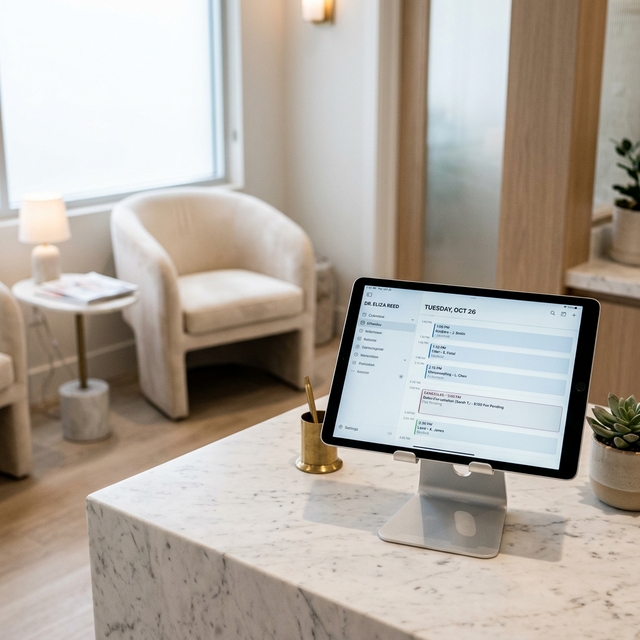

When the patient is forced to put skin in the game, their likelihood of a last-minute cancellation can drop materially.
Treat any number without a nearby source or stated method as a planning assumption, then replace it with your own records.
Every medical spa owner experiences the daily frustration of the 9:00 AM text message: "So sorry, something came up, I need to reschedule my lip filler appointment for today." The aesthetic injector, who is paid based on production, now has a gaping two-hour hole in their schedule. The $700 of projected revenue vanishes instantly.
The medical spa inevitably points to the fine print. They have a strict 24-hour cancellation policy posted on their website, printed in their intake forms, and listed at the bottom of their automated appointment reminder emails. Yet, when the patient coordinator actually attempts to charge the $100 cancellation fee to the credit card on file, the transaction declines. Or worse, the charge goes through, the client furious leaves a one-star review, and the clinic loses a patient whose lifetime value was projected at $10,000.
The problem is not the policy itself. The problem is the point of enforcement. By the time the patient cancels, the battle is already lost. A successful cancellation policy requires structural friction built directly into the initial phone call.
The Psychology of the Soft Booking
Patients treat time differently when there is no financial commitment attached to it.When a patient coordinator at an aesthetic clinic books an appointment over the phone by simply asking for a name and a phone number, they are creating a "soft booking." The patient feels no financial obligation to attend. To the patient, canceling a soft booking is no different than deciding not to go to the gym that day. It feels consequence-free.
The Card-on-File Mandate. The most effective medical spas do not possess magical cancellation verbiage. They simply operate under an uncompromising rule: No appointment is booked, under any circumstance, without a valid credit card securely vaulted in the practice management software. The friction of reading the sixteen-digit number aloud over the phone instantly transforms a soft booking into a firm commitment.
When the patient is forced to put skin in the game, their likelihood of a last-minute cancellation can drop materially.
The Intake Script Pivot
The failure point for most med spas is the patient coordinator's reluctance to ask for the card. Staff members often feel that demanding financial information before the patient has even walked through the door feels aggressive or "salesy," creating an uncomfortable dynamic.
Blame the Software. High-performing aesthetic clinic staff use systemic language to remove the personal pressure. Instead of saying, "I need to take your credit card to reserve this spot," the script changes to: "Our scheduling system requires a card on file to hold the provider's time. The card is not charged today, it is strictly to secure your appointment under our 24-hour cancellation guidelines."
This script pivots the blame from the coordinator to the "system." It establishes the boundary while maintaining the premium, white-glove tone expected at a high-end medical spa. If a caller fiercely refuses to provide a card on file to book a consultation, the system is doing its job. You have just identified a higher-risk, lower-intent caller before they reached the calendar before they could burn an hour of your injector's time.
The Pre-Paid Deposit Strategy
For high-value, high-consumable treatments like Morpheus8, CoolSculpting, or heavy dermal filler sessions, a simple card on file is often insufficient protection. These appointments block out massive portions of the schedule and require the medical spa to hold expensive inventory.
Transitioning to the Consultation Deposit. The gold standard for premium aesthetic clinics is the non-refundable consultation deposit. Charging $100 or $150 at the time of the phone booking creates real commitment. The coordinator explains: "We take a $100 deposit to secure your consultation time with our senior injector. That deposit is directly applied to any treatment you choose to purchase today, or it covers the cost of the medical assessment if you decide not to proceed."
This materially reduces the uncommitted shopper problem. If the patient attempts to cancel two hours before the appointment, the medical spa does not have to hunt down a declined credit card to enforce a penalty fee; they already hold the deposit.
Automated Enforcement and the Grace Period
Even with perfect intake protocols, life happens. Children get sick, cars break down, and meetings run late. The goal of a cancellation policy is not to punish loyal patients, but to protect the clinic's revenue floor.
The "One-Time Waiver" Tactic. When a loyal, high-spending patient calls to cancel at the last minute, the front desk must acknowledge the policy while granting grace. "Mrs. Smith, I know you have been coming to us for years. Our system normally automatically processes a $100 late-cancellation fee because the provider's time was reserved, but I am going to have the manager waive that for you today as a one-time courtesy. Let's get you rescheduled."
This interaction achieves two crucial goals. First, the patient feels valued and grateful to the medical spa for the exception. Second, they are explicitly reminded that the policy is real, enforced, and that they cannot abuse it a second time. It preserves the relationship while actively preventing future bad behavior.
Architecting the Infrastructure
Fixing the cancellation problem requires auditing your clinic's technology stack. A medical spa cannot enforce a card-on-file policy if their phone systems and booking software are not integrated securely. The clinic must utilize a HIPAA-compliant CRM (like Boulevard, Zenoti, or PatientNow) that allows the front desk to vault a card securely during the initial intake call without writing it down on a sticky note.
The Production Gap: Quantifying the Loss of a 2-Hour Filler Slot
In a high-end medical spa, your most valuable asset isn't your laser machine or your inventory of neurotoxins-it's the "Injector Time." A senior aesthetic injector typically generates between $600 and $1,200 in gross revenue per production hour. When a patient late-cancels or no-shows for a two-hour "Full Face Restoration" appointment at 9:00 AM, that revenue is gone forever.
Most Med Spa owners view this as "annoying." High-authority owners view it as a "Production Crisis." If you have one no-show per week for your top injector, you are losing approximately $40,000 in annualized revenue. This isn't just "lost money"-it's high-margin profit that was already accounted for in your overhead modeling.
The 'Cancelation Leak' is often hidden by busy-ness.Your front desk might fill the slot with a small Botox touch-up, but the "Opportunity Cost" of the original high-value service is never recovered. You are effectively working twice as hard for half the yield.
The Credit Card Friction Fallacy: Why Premium Clients Expect Premium Boundaries
A common fear among Med Spa owners is that requiring a credit card on file at the time of booking will "scare away" potential patients. We call this the "Friction Fallacy." While "price shoppers" and "uncommitted leads" might balk at a deposit, your ideal high-lifetime-value patients actually appreciate it.
A deposit or a card-on-file requirement is a signal of "Value." It tells the patient that your time is in high demand and that your practice is run with professional rigor. By removing this friction at the intake layer, you are accidentally signaling that your time is worth zero.
A relatable AI intake system handles this conversation with "Polite Persistence." It explains: "To ensure our injectors can dedicate their full attention to your aesthetic goals, we require a card on file to secure your 90-minute slot." Most serious patients will relent because they value the "Exclusivity" of the appointment as much as the "Expertise" of the provider.
The $1,500 No-Show Impact
Let's look at the specific data points: Med Spas that do not enforce a 24-hour cancellation policy with a financial penalty typically experience a "Churn Rate" on appointments of 18-22%. For a practice with $1.5 million in annual revenue, this leakage represents over $300,000 in uncaptured potential.
Conversely, practices that use an "Always-On" AI intake engine to send automated, multi-channel reminders (Voice + SMS) and enforce the card-on-file protocol see their no-show rates drop to under 4%. The "Quiet Protocol" doesn't just "save" money-it stabilizes your cash flow and allows you to plan your inventory and staffing with surgical precision.
When the operational infrastructure forces the collection of payment data at the exact moment of peak patient desire - the intake call - the cancellation policy transforms from an unenforceable threat into a highly effective revenue protection mechanism.
The Missed-Appointment Protocol
In the Med Spa world, "Ghosting" is a recurring nightmare. A patient confirms their appointment on Tuesday, but when Thursday at 2:00 PM rolls around, they are nowhere to be found. Your front desk staff spends twenty minutes calling and texting, while the injector sits in the breakroom.
A high-authority intake system doesn't react to ghosting-it prevents it. By using a "Tiered Confirmation Strategy," the AI confirms the appointment 48 hours out via SMS, 24 hours out via Voice, and 2 hours out via a "Final Check-in" notification. If the patient doesn't respond to the 24-hour voice confirmation, the AI automatically marks the slot as "High Attrition Risk" and notifies your team to move a waitlisted patient into that potential gap.
The 'Ghosting Protocol' turns a reactive loss into a proactive win.You don't wait for the empty room to realize you have a problem. You identify the problem while there is still time to solve it.
Operating Example: A Med Spa No-Show Reduction Pivot
Consider a multi-location aesthetic clinic in Miami. They were struggling with an 18% no-show rate, specifically for high-value laser hair removal and coolsculpting consultations. Their staff was overwhelmed, and their cancellation policy was "on the website" but never enforced.
After implementing the "Quiet Protocol" for medical spas, including automated card-on-file capture and a "Polite Persistence" voice AI, their no-show rate dropped to 3% within sixty days. More importantly, the practice saw a 14% increase in "Treatment Conversion" because the patients who arrived were already pre-qualified and committed to the process.
The difference wasn't in the clinical results-those remained excellent. The difference was in the "Operational Integrity" of the intake layer. They stopped being a "convenience store" for filler and started being a "Destination Clinic" for transformation.
Beyond Injectables: Keeping High-Value Consults From Slipping Through
While neurotoxins and dermal fillers are the "Bread and Butter" of recurring Med Spa revenue, surgical consultations (e.g., Blepharoplasty, thread lifts) are the "High-Margin Dividends." These leads require a completely different level of intake sophistication.
A surgical lead has more questions, more anxiety, and a longer decision-making cycle. An AI that can handle the "Pre-Clinical Screening"-asking about medical history, previous procedures, and realistic goals-provides the patient with an immediate sense of "Safety." It shows them that your practice takes their health as seriously as their aesthetics.
The Concierge Standard: Earning the Right to Enforce the Policy
Charging a cancellation fee is a right that is earned through the quality of the "Booking Experience." If your intake process is chaotic, slow, or impersonal, a cancellation fee feels like an "Adversarial Tax." But if the intake process is smooth, highly informative, and feels like a "White-Glove Concierge" service, the fee feels like a "Professional Commitment."
By using Voice AI to provide the patient with immediate answers to their pre-service questions-explaining the difference between various filler brands or providing pre-treatment instructions-the AI builds a "Value Bridge." When the patient finally provides their card info, they aren't doing it because they are forced; they are doing it because they trust that this practice is the absolute authority in their aesthetic journey.
This is the "Quiet Protocol" for medical spas. It is the tactical decision to stop competing on "Price" and start competing on "Operational Excellence." When you secure your schedule, you secure your profit. When you secure your profit, you have the resources to provide the world-class clinical results that keep patients coming back for years.
The Exit From the Cancellation Cycle
The medical spa industry is entering a "Maturity Phase." In 2026, the practices that win will not be the ones with the flashiest Instagram ads, but the ones with the most robust "Inbound Infrastructure." A cancellation policy that is enforced by a system, rather than a person, is the first step toward that maturity.
Stop the bleed of the 9:00 AM no-show. Stop the awkward front-desk confrontations. Start building a practice that values its time, its providers, and its patients enough to set clear, professional boundaries. That is how you build an authority brand that is ready for organic growth, affiliate interest, and long-term valuation.
Does automated intake remove the personal touch of a boutique spa?
On the contrary, it enhances it. By automating the "Transaction" (scheduling, policies, deposits), you allow your human staff to focus on the "Relationship." When the patient walks through the door, your concierge isn't asking for a credit card-they are offering a glass of water and asking how the patient's day is going. That is the true boutique experience.
How should we handle a first-time caller who refuses to provide a card on file?
Polite but firm decline. The coordinator should say: "I completely understand the hesitation. Unfortunately, our scheduling system cannot reserve the provider's time without a card on file to enforce our 24-hour policy. Whenever you are ready to move forward, we would love to get you on the schedule." The overwhelming majority of serious patients will relent and provide the card, realizing that premium clinics operate with premium boundaries.
The Operating Standard for Cancellation Policy Enforcement
In the context of Why Your Med Spa Cancellation Policy Is Failing (And How to Fix It), we must address the fundamental friction that exists in manual intake. Every 'missed call' is a missed revenue opportunity, but more importantly, it's a signal of operational weakness that high-value prospects detect instantly. By bridging this gap with AI-driven intake, you're not just 'automating.' You're humanizing the interaction by ensuring that your clients get the attention they deserve, instantly. This is the math of responsiveness that wins markets.
Strategic ROI: When we apply the Quiet Protocol math to Why Your Med Spa Cancellation Policy Is Failing (And How to Fix It), the result is always the same: a dramatic reduction in cost-per-acquisition (CAC) and a significant increase in client lifetime value (LTV) through immediate resolution.
Use your own records before you decide
Source: start with your call log, CRM notes, booking calendar, missed-call records, web form timestamps, and Google Business Profile. Those records show whether buyers reached you, how fast they heard back, what they asked for, and where the next step broke down.
For seven days, mark each missed call, late reply, unbooked form, stale estimate, and review request that never went out. That small sample gives an owner a practical picture of the front-door gap before they spend more on ads, software, or staff.
The loss estimate is basic business math, not a magic claim.
Revenue-leak examples on this site are built from visible operating inputs: inquiry volume, missed-call or slow-response rate, booking rate, average job or client value, repeat value, and follow-up recovery. The fastest way to make the number real is to run the diagnostic for your closest business type, then compare it against your own call log, CRM, booking calendar, form timestamps, and review activity.
The practical questions behind this decision.
Is it legal to enforce a cancellation fee without the patient's physical signature or in-person form?
Yes, provided the terms are explicitly stated during the collection of the credit card information. When the patient coordinator vaults the card on the phone, they must verbally state the 24-hour policy. Additionally, your HIPAA-compliant CRM should immediately send an automated SMS and email confirmation that requires the patient to digitally click "Accept" on the terms. The combination of the verbal disclosure and the digital footprint provides complete protection against most credit card chargeback disputes.
Will requiring a deposit for high-value treatments scare off new patients?
It will scare off shoppers, but it will not scare off buyers. A patient who is fully prepared to spend $3,000 on a Morpheus8 package does not balk at a $150 deposit that applies directly to their treatment cost. The only patients who fight the deposit requirement are the ones who are highly likely to cancel anyway. You are not losing revenue; you are actively protecting your provider's schedule from low-intent bookings.
Can an AI intake layer handle sensitive patient history?
Yes. Professional AI systems designed for medical spas are fully HIPAA-compliant and trained to handle the nuance of medical screening with extreme discretion. In fact, many patients feel more comfortable answering "Preliminary" health questions with a non-judgmental AI before speaking with a human clinical coordinator.
How do I handle negative reviews from patients who were charged a cancellation fee?
Reputation management starts at the intake. If the AI clearly explains the policy and gains the patient's verbal and digital consent at the time of booking, the probability of a "revolt" over a charged fee is nearly zero. Professionalism prevents complaints. If a complaint does arise, your digital logs prove that the patient was informed and agreed to the terms of the practice.
Does automated intake remove the personal touch of a boutique spa?
On the contrary, it enhances it. By automating the "Transaction" (scheduling, policies, deposits), you allow your human staff to focus on the "Relationship." When the patient walks through the door, your concierge isn't asking for a credit card-they are offering a glass of water and asking how the patient's day is going. That is the true boutique experience.
How should we handle a first-time caller who refuses to provide a card on file?
Polite but firm decline. The coordinator should say: "I completely understand the hesitation. Unfortunately, our scheduling system cannot reserve the provider's time without a card on file to enforce our 24-hour policy. Whenever you are ready to move forward, we would love to get you on the schedule." The overwhelming majority of serious patients will relent and provide the card, realizing that premium clinics operate with premium boundaries.
See whether the website can move interest into a useful next step.
A credible website still fails when a buyer cannot recognize the right service, trust the business, or complete the next action.
See how website clarity, public proof, and structured business facts support human trust and machine credibility.
See how the capability in this article fits into a complete customer journey.
Aesthetics & Med SpaSee the same decision through the language, buyer behavior, and operating reality of this industry.
Client Results & ProofInspect the starting condition, installation, measurement window, and outcome behind real client work.

Dental No-Shows: How to Measure the Loss and Fix the Patient Journey
A practical way to calculate empty-chair loss, find the weak handoff, improve reminders and rescheduling, and recover missed appointments.
Medical Spa Consultation Booking: Why Online Forms Leak High-Value Procedures
Aesthetic clinics spend thousands on Instagram ads to drive high-intent leads to a "Contact Us" form. When the patient coordinator finally replies four hours later, the prospect has already booked a consultation with the med spa down the street.