Home/Intelligence/Operations
Pillar Report

Lawn Care and Landscaping: How to Book 200 Spring Clients Before April Without Hiring

The homeowner who decides who cuts their lawn in 2026 makes that decision in February or March, not in May. By the time the grass is growing too fast to ignore, the best lawn care routes are full. The landscaping and lawn care businesses that dominate their market every summer are not better at marketing in April. They are better at capturing intent in February and converting it into booked seasonal agreements before the surge arrives.

March 3, 2026Updated March 24, 20269 min read
E
Elias ThorneDirector of Revenue Protocol
Share This ArticleALL INTELLIGENCE

Most lawn care and landscaping businesses handle spring the same way every year. They wait for the phones to start ringing in late March or early April, do their best to answer them, scramble to hire additional help when the call volume exceeds what the current team can service, and end up turning away work during the busiest weeks of the year because the route is full and the labor is not available.

The businesses generating $800K to $2M per year in residential lawn care revenue do not operate this way. They fill their spring route in February.

The National Association of Landscape Professionals annual industry survey found that lawntreament and maintenance agreements booked before March 31 have a 34 percent higher first-year retention rate than those booked in April or May. The reason is straightforward: a homeowner who commits to a seasonal agreement in February during the planning phase of their year is a more deliberate buyer than one who books in a panic because the grass is knee-high. Deliberate buyers renew. Panic buyers evaluate every season.

This post builds the complete pre-season intake and marketing system that allows a lawn care and landscaping service business to fill the spring route before April without increasing headcount, spending more on advertising, or burning out the current team during the peak window.

The February Decision Window: Why Most Lawn Care Businesses Miss It

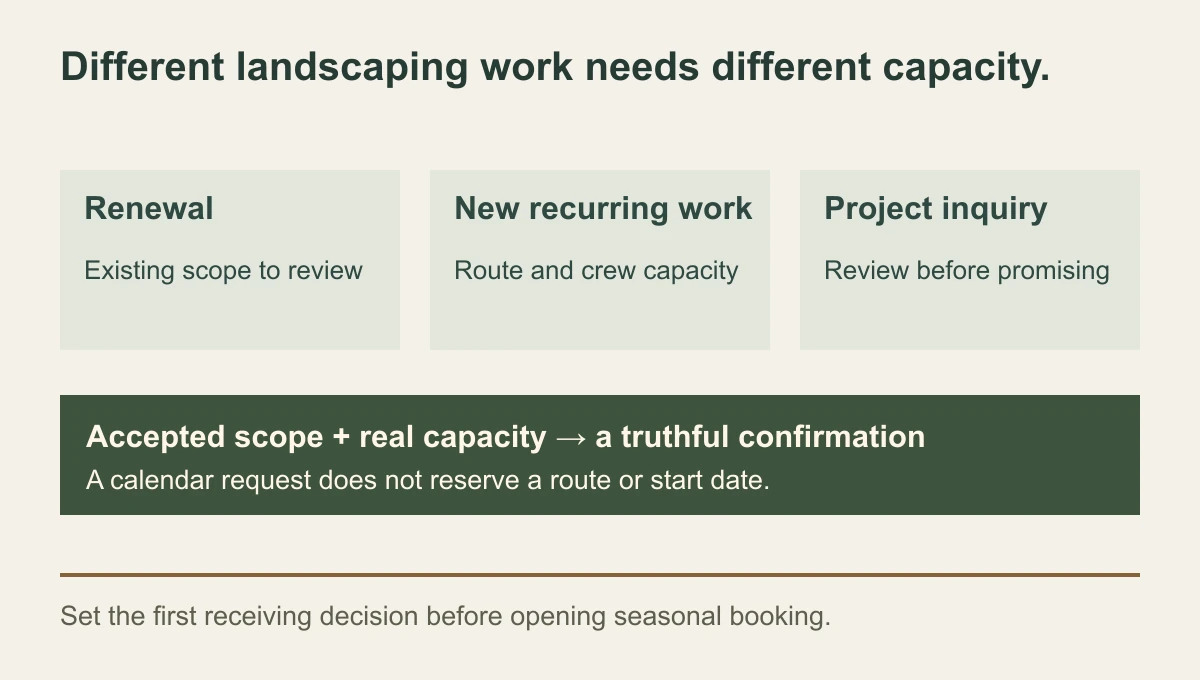
Landscaping Spring Surge: Visualizing $52K in captured seasonal revenue.

Search data from Google Trends shows that queries for "lawn care service [city]," "lawn mowing company near me," and "spring lawn treatment" begin rising in mid-January in warmer markets and hit their first significant spike nationwide in the last two weeks of February. This is when homeowners are planning their spring calendars, not when they are reacting to a lawn that needs immediate attention.

The intent behind February searches is different from April intent. A homeowner searching for lawn care in February is in evaluation mode. They are comparing options, reading reviews, looking for a company they want a relationship with, and willing to commit to a seasonal schedule. A homeowner searching in April is in reaction mode. They need help now, they are less likely to comparison shop, and their decision is driven primarily by who can come this week. Both are valuable customers, but the February customer has meaningfully higher lifetime value because they planned the relationship rather than reacting to urgency.

The annual call window: Lawn and Landscape Magazine research found that 53 percent of new residential lawn care service agreements in competitive suburban markets are initiated before April 15. The service business that captures a disproportionate share of February and March inquiries is not just having a better start to the season. It is locking in recurring monthly revenue for the next 7 to 8 months while competitors are still trying to fill their routes in April.

The Three Intake Failures That Cost Lawn Care Companies Their Best Customers

Failure 1: No system for capturing and following up on off-season inquiries. The homeowner who calls a lawn care company in February is frequently met with a message that says something like "We are not taking new clients for the season yet, but please call back in March." This response converts a warm, early-stage prospect who was willing to commit in February into a cold outreach target in March, competing with every other lawn care company that is now also returning calls. The business owner who tracks every off-season inquiry and has a documented follow-up system converts 3 to 4 times more of these contacts than one who relies on the prospect calling back.

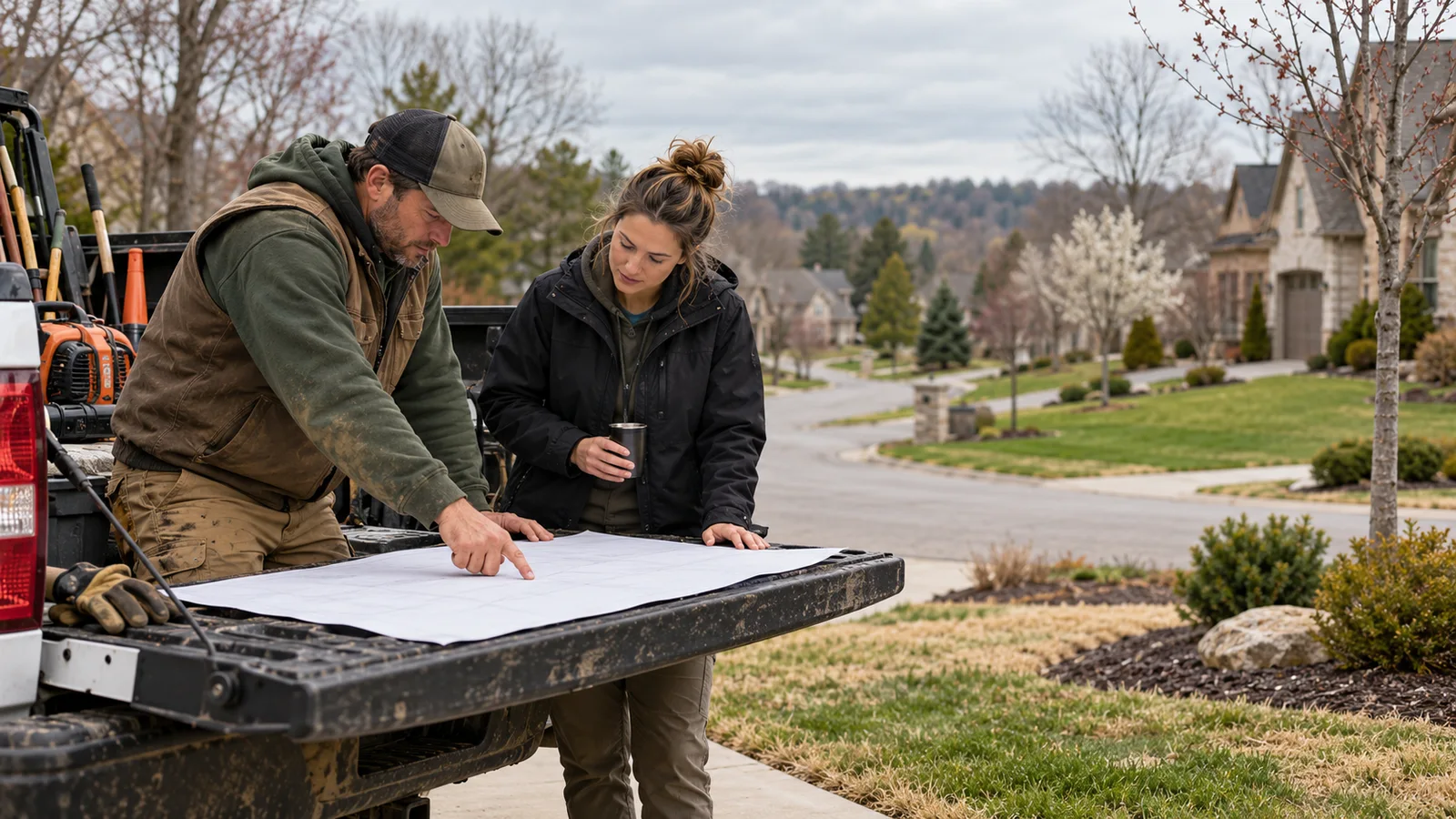
The Manicured Result: Cinematic lawn edge with a new service contract notification.

Failure 2: No online or text-based quoting option. The February lawn care prospect is frequently a dual-income household researching services outside of business hours. They are not going to call at 9 AM on a Tuesday. They are going to fill out a form or start a chat on a Sunday evening. Angi research found that 44 percent of lawn care service inquiries arrive outside standard business hours in the February to March window. The business that has no online quoting mechanism or after-hours response capability is invisible to this segment of the market during the highest-value planning window of the year.

Failure 3: Quoting in person before the season for small residential accounts. Sending a technician out to measure and quote a standard residential lawn in February when the property could be assessed with satellite imagery and square footage databases is an inefficiency that makes pre-season booking operationally unscalable. Platforms like Google Earth, county parcel databases, and purpose-built lawn measurement tools allow a lawn care service business to generate accurate quotes for standard residential properties remotely. This capacity to quote quickly and remotely is the foundation of a pre-season booking surge that does not require proportional labor input.

Building the Pre-Season Booking Machine

Component 1: The January outreach to past customers. The highest-conversion pre-season marketing available to a lawn care company costs nothing beyond time and a basic CRM. A personal outreach to every customer from the previous season in January, offering early reservation of their service slot and a modest early-commit incentive (a free spring cleanup or a 5 percent discount on the first month), fills a significant portion of the route before new customer acquisition is even necessary. NALP member data shows that lawn care businesses with a documented January renewal campaign retain 71 percent of prior-year customers versus 52 percent for those with no proactive outreach.

Component 2: The remote quote system. Implement an online quote tool that allows a prospective customer to enter their address and receive an instant or next-business-day price estimate for standard residential mowing and maintenance services. This tool captures the after-hours, research-mode prospect who is ready to commit but not ready to wait for a callback. Many CRM platforms used by lawn care companies (Jobber, HouseCall Pro, Service Autopilot) include this functionality as a standard feature.

Visualization for landscaping-lawn-care-seasonal-booking-intake

Component 3: The February and March intake staffing plan. Pre-season is the only period in the lawn care business calendar where intake demand significantly outpaces service demand. Every business owner who treats February and March intake capacity for their service business as a scheduling and staffing question, not just a marketing question, fills the route before the crew is ready to execute it. This may mean adding intake hours for an existing office team member, using an answering service specifically during February and March, or implementing a text-response system for inbound contacts during high-volume periods.

Component 4: The booking confirmation and onboarding sequence. A new spring client who books a service agreement in February and then does not hear from the company again until the first mow in April has had 6 to 8 weeks to wonder whether their booking was real, experience buyer's remorse, or get a better offer from another company. A simple 3-touch sequence (booking confirmation text, pre-season check-in in late March, day-before appointment reminder) dramatically reduces the pre-season cancellation rate that quietly costs lawn care companies 8 to 15 percent of their new agreements before the first blade of grass is cut.

The Route Optimization That Makes 200 Clients Achievable Without New Hires

The "200 spring clients without hiring" target in the title of this post is not arbitrary. It represents the upper boundary of what a 3-crew lawn care operation running 5-day weeks can service efficiently with optimized routing. The business that reaches this client count in a geographically dense suburban market without adding headcount does so through route density, not raw volume.

Route density over raw client count: A lawn care service business that adds 200 new spring clients spread across a 40-mile service radius is adding vehicles, fuel, and drive time that erodes margin significantly. The same 200 clients concentrated in 8 to 12 tight geographic clusters are serviceable by the same crew in fewer hours. Pre-season marketing that focuses on specific neighborhoods, zip codes, or subdivisions where the company already has 5 to 10 accounts produces route-dense additions that increase service capacity without proportional cost increases.

The neighbor referral mechanism: Every existing customer in a dense neighborhood is a referral opportunity for adjacent properties. A simple "refer a neighbor" message sent to current February bookings, offering a service credit for each neighbor who signs a spring agreement, is the highest-ROI pre-season marketing tool available to a service business in a dense residential market. BrightLocal research shows that neighbor referrals in lawn care convert at 3.5 times the rate of internet search leads and have a 65 percent higher first-year retention rate.

Setting Up the Phone and Text System for Spring Volume

The pre-season booking machine described above generates inquiry volume. That volume requires an intake system that can handle it without creating the bottlenecks and missed opportunities that characterize most lawn care businesses during peak booking weeks.

The spring intake standard: Every inbound call during the February to April window should reach a person with the authority to book a seasonal agreement or commit to a same-day remote quote turnaround. Every text inquiry should receive an automated acknowledgment within 90 seconds followed by a human response within 15 minutes during business hours. Every online quote request should be responded to within 4 business hours with a specific price and a booking offer.

The missed-call recovery for lawn care: A homeowner who calls a lawn care company during peak booking season and reaches voicemail is not a lost lead if the business has a real-time SMS intercept configured. "Hi, this is [Company Name]. We missed your call. We'd love to get you on our spring route. Reply here or click to get an instant quote for your home." This message, arriving within 90 seconds of the missed call, recovers a significant percentage of contacts that voicemail alone would permanently lose to a competitor that answered.

Common Questions

We are a small lawn care operation with one crew. Is the "200 clients" goal realistic for us?

The 200-client target assumes a 3-crew operation with optimized routing. For a single-crew business owner, the relevant question is: what is the maximum route density achievable for your crew's actual capacity, and how can you fill it through pre-season booking rather than mid-season scrambling? For a single crew efficiently routed in a dense suburban market, a target of 65 to 85 weekly recurring clients is typically a capacity ceiling. Building a waiting list beyond that capacity and having a referral relationship with a complementary company for overflow work is a better strategy than over-booking and under-delivering.

Should we raise prices for new spring customers compared to returning customers?

Yes, in most markets and for most service configurations. Returning customers who renew in January and February have earned a continuity price that reflects their loyalty and the low acquisition cost of re-booking them. New customers acquired through spring marketing have a higher acquisition cost (advertising, intake effort, remote quoting time) and should be priced to reflect that. A business owner who prices all spring customers identically is subsidizing new customer acquisition with the margin that efficient returning customers generate. Tiered pricing, where returning customers receive a modest loyalty rate and new customers are priced at full market rate, is the correct model for a lawn care business optimizing for profitability rather than raw client count.

Visualization for landscaping-lawn-care-seasonal-booking-intake

What is the most important thing a lawn care business can do right now if spring is 6 weeks away?

Call your prior-year customers this week. Not an email, not a text blast: a personal call or voicemail from a person they recognize, offering their service slot back for this season. The payback on time spent in January and February calling last year's clients is the highest available in the business calendar. Every retained renewal is a slot that does not need to be filled with a new customer, which means lower acquisition cost, higher margin, and a more stable route entering the season. The business owner who does this first builds a renewal base that anchors the spring route before any new customer acquisition begins. Do that first, then build the online quote tool and the referral campaign once the renewal base is secured.

The Authority Standard: ROI and Resonance

When we evaluate the ROI of an intake system like the one described for Lawn Care and Landscaping: How to Book 200 Spring Clients Before April Without Hiring, we look beyond the immediate convenience of automation. We look at the 'Revenue Leak' that occurs in the silence between a prospect reaching out and a business responding. In this vertical, that silence is the biggest competitor you have.

Data Anchor: The average LTV of a client in this space is significantly higher than the cost of a missed intake opportunity. By resolving for 'concurrency'—the ability to handle infinite leads simultaneously—The Quiet Protocol transforms a passive operation into an aggressive revenue engine.
E
Written by
Elias Thorne
Director of Revenue Protocol · The Quiet Protocol

The Quiet Protocol is an AI systems firm that installs voice AI, smart websites, and business automation for service businesses through the 5 Silent Signals™ methodology. Learn more about the team →

landscapinglawn careservice businessbusiness ownerspring bookingseasonal intake lawn care
Monthly Intelligence

The Front Door Report

One real case study. One industry benchmark. One tactical fix. No filler. Service business owners read it because it is the only email that shows them exactly where their revenue is leaking.

No spam. Unsubscribe anytime. By subscribing you agree to our Privacy Policy.

Live Install
HVAC · Brampton, ON$11,340 recovered in month 1 from after-hours calls alone.

30-minute session

Front Door Audit

A live diagnostic where we identify which of the 5 Silent Signals are bleeding your revenue, calculate your leakage, and walk through exactly what a custom installation would look like. No obligation.