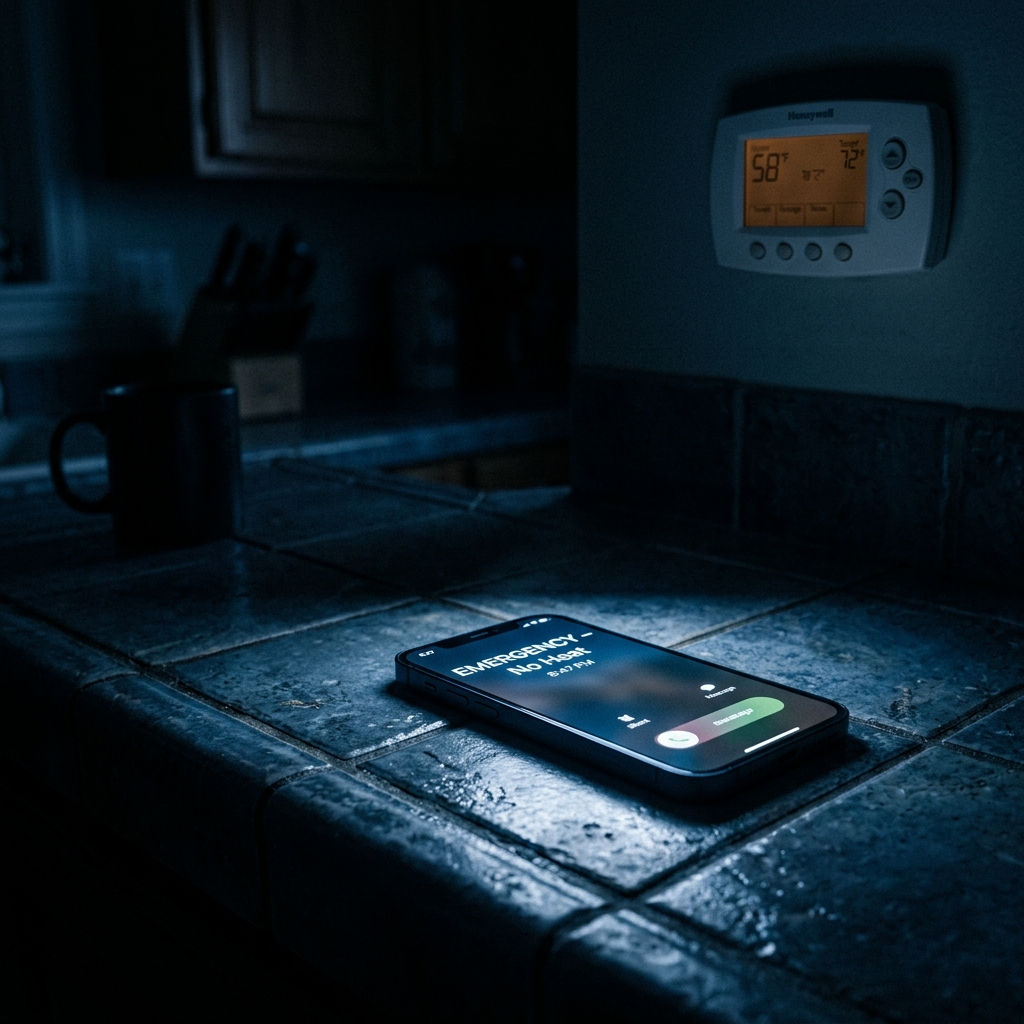
Your company was probably that first number. And it is probably happening 15 to 20 times per week.
Treat any number without a nearby source or stated method as a planning assumption, then replace it with your own records.
The 8:47 PM Call
It is January. The furnace stopped working two hours ago. The house is 58 degrees and dropping. There are two kids in the back bedroom.
The homeowner opens Google and searches "HVAC emergency near me." They call the first number. It rings four times and goes to voicemail. They hang up without leaving a message - nobody calls back an unknown service company at 8:47 PM to leave a voicemail.
They call the second number. A real person answers. Books them for first thing tomorrow morning. Takes a credit card to hold the slot.
That second call is worth somewhere between $800 and $4,000 depending on what the furnace needs. The company that answered it did not earn it through better marketing or a lower price. They earned it because they picked up.
Your company was probably that first number. And it is probably happening 15 to 20 times per week.
Why Most HVAC Companies Miss After-Hours Calls
This is not a laziness problem. It is a structural one.
HVAC is an inherently after-hours business. Heating systems fail when they are under maximum load - on the coldest nights in winter and the hottest afternoons in summer. Homeowners notice the failure when they get home from work, when they wake up at 2 AM too hot, when they sit down for dinner and realize the house is getting cold.
That means call volume spikes precisely when your staff is not there to answer it.
A 3-technician HVAC company operating normal business hours covers roughly 45 hours per week. There are 168 hours in a week. That leaves 123 hours - 73% of the week - where calls go unanswered unless the owner is fielding them personally.
Most owners try. They run their phone nights and weekends during peak season. They burn out. They start letting calls go to voicemail because they cannot take another booking call while they are eating dinner. And then those leads - which are some of the warmest, most urgent leads their business will ever receive - are simply gone.
The caller does not leave a voicemail. Research on consumer behavior consistently shows that fewer than 20% of people will leave a voicemail for a business they do not have a prior relationship with. The rest will call the next number on the list.
The Actual Volume You Are Missing
Let us run the math for a typical 3-to-5 technician HVAC operation.
During peak season - July and August for cooling, November through February for heating - it is reasonable for a company this size to receive between 40 and 60 inbound calls per week. Based on industry estimates for after-hours call distribution in HVAC, roughly 35 to 45 percent of those calls arrive outside normal business hours.
That gives you 14 to 27 calls per week arriving when nobody picks up.
At an average first-job value of $850 (a conservative estimate that blends diagnostic calls, tune-ups, and repair work), missing 14 calls per week costs you approximately $11,900 per week in potential revenue. Over a 16-week peak season, that is $190,000 in jobs your competitors are taking because they answered first.
That number will feel too large to be real. But consider: you do not need to close every after-hours call to see significant impact. If answering 60% of your missed after-hours calls results in bookings at your normal close rate, even a modest improvement compounds significantly over a full season.
The tool for calculating your specific number is available at our revenue leak calculator - the inputs are your call volume, average job value, and after-hours miss rate.
What the Data Actually Shows About When HVAC Calls Come In
The distribution of inbound calls for residential HVAC companies follows a consistent pattern across markets and seasons.
The morning window - 7 AM to 9 AM - captures homeowners who discovered a problem overnight and are calling the moment they consider it socially acceptable to reach out. These are not comparison-shopping calls. They have already decided they need help. They are calling to book.
The afternoon taper runs from 1 PM to 4 PM. These are often less urgent calls - annual tune-up inquiries, questions about system age, comparing prices. This is the window where most of your staff are fully engaged and responsive.
The evening spike - which typically runs from 5 PM to 9 PM - is the highest-volume and highest-urgency window of the day. Homeowners who got home from work, turned on the AC or the heat, and discovered it was not working. These are emergency calls. They have a problem right now. They need someone right now. If you do not answer, they will find someone who does.
The overnight window (9 PM to 7 AM) has lower volume but extremely high intent. If someone calls at 11:30 PM, something is genuinely wrong. They do not call that late because they are price shopping. They call because the situation is urgent enough that they are willing to wake someone up.
Your current business hours coverage captures the afternoon taper reasonably well. It misses nearly everything else.
What Happens When an AI Intake Layer Handles That Call Instead
At 8:47 PM, the phone rings.
Instead of going to voicemail, a voice AI system picks up on the second ring. The caller hears a natural, conversational voice: "Hi, you've reached the team at [Company Name]. I can help you get that taken care of - can you tell me what's going on?"
The caller explains: furnace stopped working, house is cold, need someone tomorrow morning.
The voice AI identifies this as a heating emergency. It confirms the caller's address, asks which type of system they have (forced air, heat pump, boiler), and confirms whether the system is gas or electric. This qualification data is not just useful for the owner's notification - it determines which technician to dispatch and whether they need to bring specific parts.
The AI offers two appointment windows for tomorrow morning, the caller picks one, and the system texts them a confirmation with the company name and a callback number. The caller now has a concrete appointment. They do not call competitor number two.
Simultaneously, the system sends the owner a text: "New booking - [Name], [Address] - furnace emergency, forced air gas, confirmed for 7:30 AM. Full details in your dashboard."
The owner gets that text at 8:49 PM. They did not have to take the call. They did not miss the lead. They find out tomorrow's first job in two minutes, and they go to bed.
That entire exchange took four minutes. The caller has a confirmed booking. The company has a new job. Nothing slipped.
The Five Failure Modes This Eliminates
Most HVAC companies operate with some combination of these five structural gaps:
Gap 1: No after-hours answer.The phone rings, nobody picks up, voicemail takes over, caller hangs up. This is the most common and most expensive failure. It requires zero negligence - just a business model that assumes calls only arrive during business hours.
Gap 2: Inconsistent answering service quality.Many HVAC companies use an answering service for overflow and after-hours. The problem is that answering services are staffed by generalists reading scripts. They cannot qualify emergency vs. non-emergency, cannot book directly into your scheduling system, and frequently deliver leads with incomplete information. A voice AI trained on HVAC-specific intake logic will outperform a generic answering service on qualification accuracy every time.
Gap 3: Owner burnout on personal coverage.When the owner personally takes all after-hours calls, the business grows precisely to the point where the owner can no longer personally sustain it, then stalls. Technicians max out their schedule but revenue does not grow because leads are being lost at the front door. Removing the owner from after-hours call intake is not a luxury - it is a prerequisite for the next phase of the company's growth.
Gap 4: Voicemail false confidence.Some owners believe that leaving a quality voicemail message ("We appreciate your call and will get back to you first thing in the morning!") captures the lead. The data does not support this. Fewer than one in five callers to a service business will leave a voicemail, and the ones who do are typically returning callers who already have a relationship. A first-time caller with an emergency will not leave a message - they will call the next company.
Gap 5: Missed callbacks.Even when voicemails are left, they require someone to sort through them in the morning, return calls in priority order, and hope the caller has not already booked with a competitor overnight. A voice AI eliminates this lag entirely by capturing and booking at the moment of intent.
What This System Costs for an HVAC Company
The Core Protocol from The Quiet Protocol - which includes voice AI intake, web chat, missed call text-back, CRM lead tracking, and the booking integration - is priced at $497 per month with a $297 one-time setup fee.
For HVAC, the setup includes:
- A voice AI knowledge base trained specifically on HVAC services, common failure modes, seasonal service differences, and your company's specific service area
- Emergency vs. non-emergency call routing logic
- Appointment booking directly into your scheduling system
- Automated new lead notifications to the owner or dispatcher
- Escalation logic for situations that genuinely require immediate human intervention (gas leaks, carbon monoxide concerns, flooded basements)
The system is live and taking calls within five business days of setup.
The payback math is not complex. If your average job value is $850 and the system books one additional job per week by capturing calls you were previously missing, the monthly revenue gain is approximately $3,400. Against the $497 monthly cost, the system pays for itself from the first additional booking each month.
Most HVAC companies using voice AI report capturing significantly more than one additional job per week during peak season.
What This System Does Not Do
Because scope honesty is how you make a real decision:
It will not dispatch a technician.The AI can book an appointment and notify your team. It cannot make operational decisions about which technician goes where. That coordination still happens on your end.
It will not quote a job.Pricing in HVAC is diagnostic - you cannot quote a furnace repair before you see the furnace. The AI is explicit with callers that pricing is confirmed after the technician visits. It will not make up numbers.
It will not handle complex warranty or insurance claims.If a caller is trying to navigate a manufacturer warranty dispute or coordinate with their home warranty provider, the AI will capture their information and flag it for human follow-up. Warranty logic is too variable to automate reliably without building a bespoke system.
It will not replace a dispatcher for multi-location operations.If you are running three locations with crews across different territories, you need a bespoke build with location-specific routing logic. The Core Protocol is designed for single-location HVAC companies with up to 15 technicians.
If your operation is more complex than that, the Revenue Leak Diagnostic is the right first step - it maps your specific intake gaps and determines whether you need the Core Protocol or a more custom build.
The Compounding Effect: What Answering More Calls Does to Your Business
The financial impact of capturing more after-hours calls is not limited to the revenue of those specific jobs.
Each successfully booked emergency call has several downstream effects that the simple revenue calculation does not capture.
Repeat customer conversion.A homeowner who needed emergency heating service last January and had a great experience is extremely likely to call you first for their spring tune-up, annual maintenance agreement, and eventual system replacement. The lifetime value of a residential HVAC customer who trusts you is not $850 - it is $4,000 to $12,000 over the relationship.
Review volume.Homeowners who had an emergency resolved quickly leave reviews. They have a story to tell: the furnace failed at 9 PM, called one company that didn't pick up, called yours, got a real response, had heat by next morning. That is a five-star review with specific details that Google and AI search engines will cite when someone nearby searches for emergency HVAC service. More after-hours bookings means more high-emotion reviews, which means better local search positioning.
Referral pipeline.The family member, neighbor, or coworker who hears about the emergency furnace story in January is a future caller. Emergency service that exceeds expectations generates word-of-mouth at a rate that routine annual maintenance never does.
Technician capacity utilization.When after-hours calls are captured and booked into next-morning slots, your technicians start the day with a full schedule rather than arriving at the shop and waiting for the morning dispatch. Better scheduling means more jobs completed per technician per week without adding headcount.
How to Know If Your HVAC Company Has This Problem
Here are the indicators that after-hours call loss is a meaningful revenue gap in your specific operation:
You cannot tell me with confidence how many calls came in last Tuesday between 6 PM and 10 PM. If your current system does not log unanswered calls, you have no visibility into the problem - which does not mean the problem is not there.
Your voicemail has messages from unknown callers who did not leave their name or callback number. These are the people who called, heard the voicemail prompt, decided not to leave one, and then accidentally let the call record anyway because they hesitated before hanging up. Each of those is a potential booking you lost.
You personally take calls on nights and weekends during peak season and you resent it. The resentment is data - it tells you the volume is high enough to be burdensome and that your current system is extracting personal time as the cost of not missing leads.
Your competitors have higher Google review volume than you despite similar service quality. Reviews are a lagging indicator of answered calls. If they are outpacing your review count, they are probably answering more calls.
If any of these apply, the revenue diagnostic at our HVAC intake calculator will give you a specific number for your situation - based on your call volume, your average job value, and your current after-hours coverage.
The Decision Is Structural, Not Philosophical
HVAC companies do not lose after-hours calls because they do not care about the business. They lose them because their intake infrastructure was built for a world where customers called during business hours and waited.
That world is over. Consumers now expect immediate response regardless of when they call. The company that answers at 8:47 PM gets the job. The company that does not answer loses the job and the customer relationship, permanently, to whoever picked up.
The fix does not require hiring anyone. It does not require the owner to be available 24 hours a day. It requires installing a system that handles intake consistently, collects the right information, books the appointment, and notifies the right people - regardless of what time the call comes in.
That system exists. It takes five days to set up. It costs less per month than one missed job.
The question is not whether you can afford to install it. The question is how much longer you want to operate without it.
If you are ready to see the specific number for your company, start with the Revenue Leak Diagnostic. Fifteen minutes of data collection produces a revenue leak estimate calibrated to your market, your call volume, and your average job value. Most HVAC owners see a number that changes how they think about their business.
Voice AI Is One Layer. The Business Operating System Is the Larger Fix.
A voice AI tool answers your phone. That is Layer 1 of a five-layer problem. An AI Business Operating System handles the entire revenue infrastructure: intake, follow-up, reactivation, reputation, and intelligence. The price difference between a standalone voice AI tool and the full operating system is often less than $200 per month. The capability difference is 5x.
The Quiet Protocol installs the full AI Business Operating System at $497 per month. It includes the AI receptionist (Layer 1), a structured follow-up engine for unconverted leads (Layer 2), database reactivation campaigns for dormant contacts (Layer 3), automated Google review requests after every completed job (Layer 4), and a business intelligence dashboard showing recovered revenue across all layers (Layer 5).
Most businesses that buy a standalone voice AI tool wonder, six months later, why their pipeline still leaks. The answer is that answering the phone was never the whole problem. It was the most visible symptom of a system-wide gap.
The loss estimate is basic business math, not a magic claim.
Revenue-leak examples on this site are built from visible operating inputs: inquiry volume, missed-call or slow-response rate, booking rate, average job or client value, repeat value, and follow-up recovery. The fastest way to make the number real is to run the diagnostic for your closest business type, then compare it against your own call log, CRM, booking calendar, form timestamps, and review activity.
The practical questions behind this decision.
What proof should I look for in my own business?
Look for proof in the places where demand either moved forward or stalled: missed calls, short calls, unbooked forms, slow callbacks, no-show recovery, old leads, and reviews that were never requested. If the business cannot see those moments clearly, the first improvement is better tracking and routing.
How do I know whether this is a marketing problem or an operations problem?
If people are already calling, filling forms, asking for prices, requesting appointments, or comparing reviews, the problem is usually operations. More marketing will not fix a front door that lets warm demand wait. The better move is to capture and route the demand already arriving.
What should happen after the first response?
The first response should create a next step: booked appointment, estimate path, intake handoff, callback window, review request, or reactivation sequence. A response that only says someone will get back to you is not enough when the buyer is comparing several providers at once.
Where does The Quiet Protocol fit?
The Quiet Protocol fits when the business already has demand but too much of it depends on manual attention. We connect AI receptionist coverage, web intake, missed-call recovery, booking logic, follow-up, review requests, and reactivation into one managed front-door system.
Decide what the AI must handle before you choose the software.
A useful intake system begins with the caller journey, the rules, and the human handoff, not a long feature list.

Vikram Roy is the founder of The Quiet Protocol, a Toronto-based systems firm serving service businesses across the Greater Toronto Area, Canada, and the United States. He works directly with professional firms, home service companies, dental practices, clinics, and local businesses to connect websites, customer intake, booking, reviews, follow-up, and practical AI into a clearer digital front door. All content is written from Toronto, Ontario. See the editorial method →
Give the receptionist a realistic scenario and hear how it answers, gathers context, and moves the caller toward a useful next step.
See how the capability in this article fits into a complete customer journey.
HVAC Emergency ServiceSee the same decision through the language, buyer behavior, and operating reality of this industry.
Client Results & ProofInspect the starting condition, installation, measurement window, and outcome behind real client work.

The Missed Call Problem: How Service Businesses Lose $180,000 Per Year From the Front Door
Missed calls are not harmless. Learn how service businesses calculate the annual revenue leak from unanswered calls, delayed callbacks, and lost buyer intent.
Voice AI vs. Hiring a Part-Time Receptionist: The Real Math for Service Businesses
Compare voice AI and a part-time receptionist for service businesses: coverage, cost, consistency, booking, after-hours calls, and the real front-door math.

Your Leads Call After 5PM: What Happens to Them If You Are Not There
The highest-intent service calls arrive after business hours. Here is exactly what happens to those leads, why most are never recovered, and what to do about it.

What a $497/Month Business Platform Includes, and What It Does Not
A practical buyer guide to platform access, launch configuration, usage charges, team-owned software, and the point where a custom system becomes a separate engagement.

AI Business Operating System: What the Label Should Mean Before You Buy
A plain-language buyer guide to the category label, the operating path underneath it, and the questions that separate useful systems from inflated software claims.

Five Breakpoints in a Customer System, and What to Fix First
A practical operating guide to finding where a customer journey is losing time, trust, or momentum before the business buys more software or automates the wrong step.
Calculate the revenue leak.
Stop guessing. See how much demand your business may be losing through missed calls, slow replies, weak booking, review gaps, and follow-up drag, then decide whether Voice AI is the right system path.
Run the calculationPrefer to hear it first?
Call the live AI receptionist and test the conversation.
Call the live AI receptionist anytime. Tell it about hvac emergency service, then hear a short live roleplay based on the calls your front desk actually gets.