

A chiropractic clinic running a $29 new patient special is, on a direct revenue basis, losing money on every single new patient acquisition. The cost of the promotion - whether it is paid in discounted treatment value, advertising spend to fill the incoming appointments, or staff time spent processing new patient paperwork - routinely exceeds the $29 collected at the front desk.
Treat any number without a nearby source or stated method as a planning assumption, then replace it with your own records.
Search queries about chiropractic care have increased consistently for five consecutive years. The specific categories driving that growth tell a precise diagnostic story: "tech neck treatment," "work from home back pain," "how to fix rounded shoulders," "chiropractor for posture." These are not emergency injury searches. They are chronic condition searches from a population that has spent years hunched over laptops and phones and is now, belatedly, taking action.
A chiropractic clinic in 2026 that is running any form of new patient promotion - a $29 first visit, a free adjustment, a discounted initial consultation - is not struggling to get people in the door. The demand is there. The problem that is quietly compressing chiropractic clinic revenue across the country is happening on Day 2.
Day 2 is when the new patient decides whether they are going to be a patient or a one-visit statistic.The adjustment happened. The patient walked out feeling some relief, or at minimum feeling that they did something proactive for their body. They went home. They slept. They woke up on Day 2 and they either felt meaningfully better, meaningfully worse, or about the same - and in any of those three scenarios, they are thinking about their spine.
If someone from the clinic calls that patient at 9 AM on Day 2 - not to upsell, not to book their next appointment, but simply to ask how they are feeling and whether they have any questions - the conversion rate to a follow-up visit and ultimately to a care plan is dramatically higher than any other follow-up mechanism the clinic has available to it. The research on chiropractic patient retention is consistent: the 24-hour post-adjustment window is when the patient's motivation is highest and when the relationship is most easily strengthened.
Every chiropractic clinic knows this. Most of them do not do it. Not because they do not care about their patients. Because their front desk has forty other things to do before noon and the Day-2 call is the one that gets pushed to tomorrow, and then the day after, and then never.
The Math on New Patient Special Economics
A chiropractic clinic running a $29 new patient special is, on a direct revenue basis, losing money on every single new patient acquisition. The cost of the promotion - whether it is paid in discounted treatment value, advertising spend to fill the incoming appointments, or staff time spent processing new patient paperwork - routinely exceeds the $29 collected at the front desk.
The economics only work if the new patient converts to a care plan. This is not a secret. Every chiropractic clinic that runs new patient specials knows that the promotion is a loss leader. The expected conversion rate varies widely by clinic and by the quality of the Day-2 follow-up system, but the industry average for new patient special conversion to at least a second visit hovers between 40 and 55 percent. Conversion to a structured corrective care plan - typically four to twelve weeks of visits at a combined value of $1,500 to $3,000 - is substantially lower at many clinics: in the 15 to 25 percent range.
Every percentage point of improvement in care plan conversion rate from a new patient special is worthsignificant money at the clinic level.A chiropractic practice seeing 50 new patients per month through a new patient special promotion, at an average care plan value of $2,000, with a current conversion rate of 20 percent is closing $20,000 per month in care plan revenue from that channel. Moving that conversion rate to 30 percent - adding 5 converted care plans per month - adds $10,000 in monthly revenue from the same patient volume and the same promotional spend.
The Day-2 AI follow-up is the single mechanism most likely to move that conversion number, because it closes the gap at the exact moment where the gap exists: the 24-hour window after the first adjustment that the front desk never has time to address.
What the Automated Day-2 Wellness Check-In Actually Does
The Day-2 follow-up is not a sales call. A chiropractic clinic that deploys an AI system and has it lead with "would you like to book your next appointment?" is missing the entire mechanism by which follow-up converts new patients to care plans. The follow-up that works is a genuine wellness check.
The message structure:A text message sent between 8:30 and 9:30 AM the morning after the patient's first visit, from the clinic's number, worded something like: "Good morning, Marcus - this is Dr. Reyes's office checking in. How are you feeling after yesterday's adjustment? Any soreness or questions about what we discussed?" That is it. That is the entire outbound message.
What happens next is where the conversion lives. Marcus replies. He might say he feels great. He might say he is a bit sore. He might ask a question about something the chiropractor mentioned. Every one of those replies opens a conversation that the AI continues naturally, answers if within scope, and escalates to a human if a clinical question requires it. And in the context of that conversation - warm, professional, initiated by the clinic without any sales pressure - the topic of a care plan recommendation arises organically.
Research on chiropractic patient communication consistently shows that patients who feel their provider is personally interested in their progress outside of scheduled appointments have higher retention rates, higher care plan acceptance rates, and higher referral rates. The AI Day-2 check-in creates that experience of personal investment at scale. It sends the message that this clinic is the kind of practice that follows up. Not the kind of practice that waits for you to call back.
The volume implication is what makes this transformative at the practice level:A clinic seeing 10 new patients per week through a promotion has 10 Day-2 follow-ups to execute every single morning. For a human front desk, 10 personal outreach calls while simultaneously managing incoming calls, check-ins, rescheduling, and billing represents a material operational burden. Many clinics handle this by converting the follow-up to a prerecorded voicemail drop or not doing it at all. The AI executes all 10 as personalized, responsive text conversations simultaneously, for zero additional labor cost.
The Modern Neck-Pain Opportunity
The specific patient population entering chiropractic clinics through the "tech neck" and posture correction pathway in 2025 and 2026 has a characteristic that makes the Day-2 follow-up even more valuable: they are chronic condition patients, not acute injury patients.
An acute injury patient - someone who came in because they threw out their back moving furniture - has a definite recovery arc. They want to feel better, they get better, they stop coming. The conversion to a long-cycle corrective care plan is lower for this population regardless of follow-up quality.
A tech neck or chronic posture patient is in a fundamentally different category. Their condition developed over years. It will not resolve in two or three adjustments. They are, by the nature of their condition, candidates for extended corrective care - and more importantly, they know this. When they walk into a chiropractic clinic for the first time to address neck pain they have been managing with ibuprofen for eighteen months, they are not looking for a quick fix. They are looking for someone to tell them what is actually happening and what the path to genuine improvement looks like.
The Day-2 follow-up for this patient is not just a retention mechanism.It is the first step in a clinical relationship.When the AI check-in opens a conversation and Marcus says "actually, I've been dealing with this for over a year," that reply is the data point that triggers the escalation to the chiropractor or clinic coordinator to have the corrective care plan conversation. Not in a month. Not when Marcus comes in for his second visit. The morning after his first adjustment.
The chiropractic clinic owner who searches "how to improve new patient retention" is typically looking at social proof strategies, re-engagement email campaigns, or post-care review requests. Those tools all have value, but they operate downstream of the primary loss event. The primary loss happens on Day 2, before the patient has made any conscious decision to leave. They have not decided not to come back. They are simply in the gap between their first visit and any subsequent communication from the clinic, and in that gap, the motivation that carried them through the door of a chiropractic clinic for the first time slowly dissipates. Closing that gap is an operational problem first, and a marketing problem never.
The Free Adjustment Trap: Why Discount Marketing Attracts Uncommitted Patients
Every chiropractor has seen the "Groupon Ghost." These are the patients who show up for a $29 initial consultation and a free adjustment, only to disappear the moment you suggest a comprehensive 12-week wellness plan.
The problem isn't your clinical skill; it's your intake positioning. If your marketing lead magnet is "Free," you are training the market to value your time at zero. When a patient enters your practice with a "discount" mindset, they are fundamentally less likely to commit to the long-term corrective care that actually drives your clinic's revenue and their health outcomes.
The "Quiet Protocol" for clinics is to replace the discount with "Discovery."Instead of a free adjustment, offer a high-value "Neuromuscular Functional Assessment" or a "Spinal health audit." By changing the language from a "freebie" to a "diagnostic," you attract patients who are looking for a solution, not a handout.
The Wellness Retention Churn
A successful chiropractic clinic isn't built on a constant stream of new patients; it's built on retention. But keeping a patient engaged for 24 months requires more than just a good bedside manner-it requires a communication system that never skips a beat.
A relatable AI-intake and nurture system doesn't just "schedule" appointments. It follows up on "Drop-offs"-those patients who missed their Wednesday adjustment and haven't called back. By reaching out with a personalized, non-intrusive reminder about their specific health goals, you show the patient that they are more than just a chart number.
When your intake system handles the "Persistence" layer of patient retention, your staff can focus on the "Care" layer. You end the day with a full schedule of committed patients and an office that feels like a center of wellness, not a high-volume processing plant. That is how you build a practice that serves your life as much as it serves your community.
The Day-2 check-in system operates at the scheduling and wellness communication layer, not the clinical record layer. Text messages sent by the system do not contain clinical information - they are general wellness check-ins. Patient consent for text message communication is collected as part of the standard new patient intake process, which the chiropractic clinic already handles. The AI system processes the patient's name and appointment date to personalize the message, but does not store or transmit protected health information through the messaging channel. Compliance review with the clinic's existing HIPAA policies is recommended before deployment, but the functional architecture is designed to operate within standard outreach compliance parameters.
The chiropractic clinic that implements automated Day-2 follow-up is not investing in a new marketing channel. It is closing an operational gap that has existed since the first new patient special was ever run. The revenue that flows from closing that gap does not require new patients, new advertising spend, or new care plan pricing. It requires a system that reliably makes the contact that the front desk would make if it had unlimited capacity - but no human front desk ever will.
The Operating Standard for Chiropractic Patient Nurture
When we evaluate the ROI of an intake system like the one described for Chiropractic Clinics: Reducing the Free Adjustment Drop-Off With Better Follow-Up, we look beyond the immediate convenience of automation. We look at the 'Revenue Leak' that occurs in the silence between a prospect reaching out and a business responding. In this vertical, that silence is the biggest competitor you have.
Data Anchor: The average LTV of a client in this space is significantly higher than the cost of a missed intake opportunity. By resolving for 'concurrency': the ability to handle infinite leads simultaneously-The Quiet Protocol transforms a passive operation into an aggressive revenue engine.
Use your own records before you decide
Source: start with your call log, CRM notes, booking calendar, missed-call records, web form timestamps, and Google Business Profile. Those records show whether buyers reached you, how fast they heard back, what they asked for, and where the next step broke down.
For seven days, mark each missed call, late reply, unbooked form, stale estimate, and review request that never went out. That small sample gives an owner a practical picture of the front-door gap before they spend more on ads, software, or staff.
The loss estimate is basic business math, not a magic claim.
Revenue-leak examples on this site are built from visible operating inputs: inquiry volume, missed-call or slow-response rate, booking rate, average job or client value, repeat value, and follow-up recovery. The fastest way to make the number real is to run the diagnostic for your closest business type, then compare it against your own call log, CRM, booking calendar, form timestamps, and review activity.
The practical questions behind this decision.
Should the Day-2 follow-up come from the doctor or from the clinic?
In testing, the highest response rates come from messages that appear to originate from the clinic by name, with the doctor's name included as the reference point - "Dr. Reyes's office checking in" rather than a message that appears to come from Dr. Reyes personally. This framing is accurate (the clinic is checking in, the AI is acting on behalf of the practice) and it also sets the appropriate expectation that the patient may be responding to a coordinator rather than directly to the doctor. If a clinical question arises in the conversation that requires the doctor's direct input, the system flags it for escalation. The initial check-in framing balances warmth with accuracy.
How should AI-supported follow-up handle patients who report feeling worse after the first adjustment?
Post-adjustment soreness is extremely common after a first chiropractic visit, and many patients who experience it are alarmed without understanding that it is a normal part of the adjustment process. The AI is trained to recognize expressions of soreness or discomfort and respond with normalized educational language: "Some soreness after the first adjustment is completely normal as your body adapts - most patients find it resolves within 24 to 48 hours. If you have more significant discomfort or any sharp pain, we want to know. Would it help to schedule a brief check-in call with Dr. Reyes?" This response does three things simultaneously: it provides education that reduces patient anxiety, it normalizes the experience so the patient does not become a dropout, and it opens the door to an additional touchpoint.
Locate the point where interested buyers stop hearing from the business.
Review one customer journey from first inquiry through booking, estimate, reminder, and recovery.
Use the diagnostic to locate the handoff where good inquiries, estimates, appointments, or past customers stop moving.
See how the capability in this article fits into a complete customer journey.
Chiropractors & Chiropractic ClinicsSee the same decision through the language, buyer behavior, and operating reality of this industry.
Client Results & ProofInspect the starting condition, installation, measurement window, and outcome behind real client work.

Stop Buying Local Service Leads: Fix Your Intake Infrastructure Before You Buy Another Ad
Bad lead quality is not always the problem. Many service businesses lose paid leads because callbacks are slow, after-hours intake is weak, and follow-up is inconsistent.
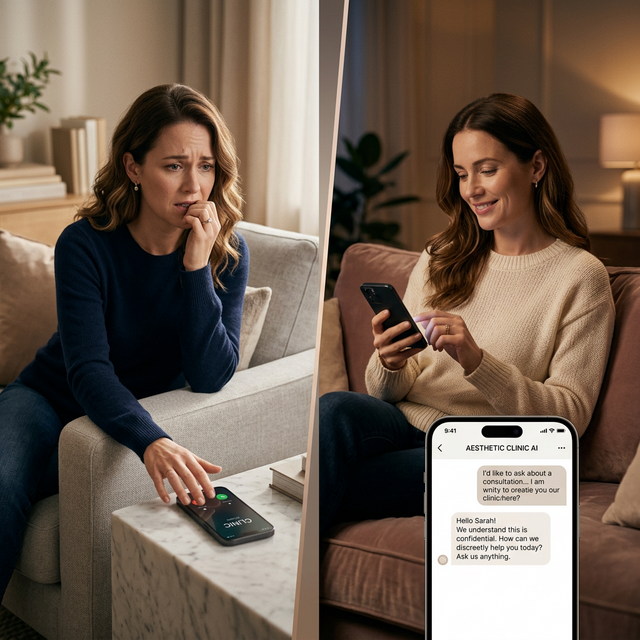
Plastic Surgery Clinics: Discretion and Speed in High-Ticket Intake
Cosmetic procedure demand in 2025 and 2026 has reached historic highs. Post-pandemic, the category of elective aesthetic investment has normalized across income brackets that were previously not in the market. The demand exists. The prospects are searching. What the research on high-ticket cosmetic intake consistently shows is that the loss is almost never happening at the surgeon quality level - it is happening at the first contact point, in the first ninety seconds of an inquiry, when a called-on-hold prospect or a cold clinical voice produces the friction that sends a $12,000 rhinoplasty inquiry to a competitor. The plastic surgery clinic that has solved intake has solved the most solvable problem in its revenue stack.