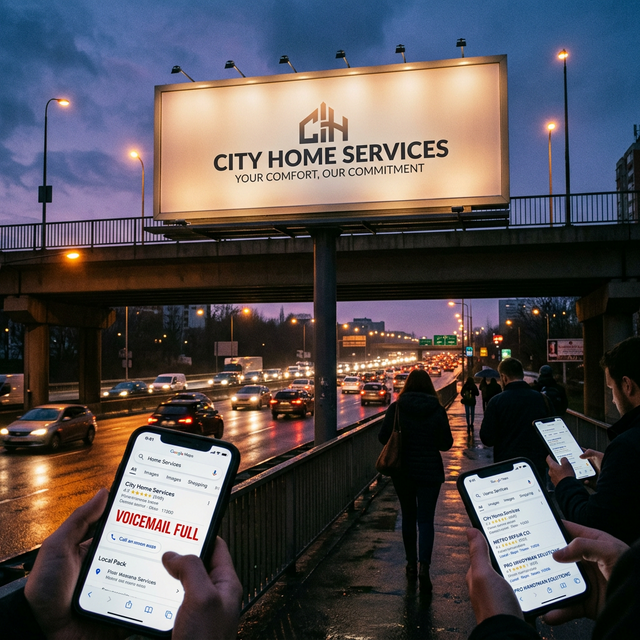
If your business rings out, goes to voicemail, responds tomorrow, or sends the buyer into a slow form path, the awareness you paid for may only increase category demand.
Treat any number without a nearby source or stated method as a planning assumption, then replace it with your own records.
Brand awareness is not bad.
But brand awareness without intake is dangerous.
That is the part many local service businesses miss.
The billboard works.
The van wrap works.
The radio spot works.
The social campaign works.
The homeowner remembers the name.
Then the problem happens.
They search.
They tap the phone number.
The call goes to voicemail.
They call the next business.
Your brand created the moment.
Your competitor captured it.
That is the brand awareness trap.
Awareness Is Not Revenue
Awareness is only the first step.
It means the buyer recognizes you, remembers you, or feels familiar with your name.
That has value.
But awareness does not book the job by itself.
The buyer still has to reach you.
They still need a next step.
They still need confidence.
They still need a callback, appointment, quote path, dispatch, or consultation.
If the front door fails at that moment, awareness turns into expensive leakage.
The marketing did its job.
The intake system did not.
Owners often blame the campaign because the campaign is visible.
But the failure may be downstream.
The ad made the phone ring.
The business did not answer well enough.
How Awareness Funds Competitors
This is the painful part.
A buyer sees your trucks around town.
They hear your name from a neighbor.
They see your ad.
They remember you when they need help.
Then they search your category.
Maybe your business appears.
Maybe a competitor appears above you.
Maybe the buyer calls you first.
Maybe they call the competitor first.
Either way, the first business that creates a useful next step has the advantage.
If your business rings out, goes to voicemail, responds tomorrow, or sends the buyer into a slow form path, the awareness you paid for may only increase category demand.
The competitor with the better front door captures it.
This is why awareness spend can feel frustrating.
The market knows you.
The phone is busier.
Revenue does not rise proportionally.
That usually means the business has a front-door problem.
A Simple Example
Imagine a plumbing company running local radio, truck wraps, and social ads.
The owner sees the brand everywhere.
Friends mention the ads.
The team feels momentum.
Search volume rises.
The phone rings more often.
But the office still has one person answering.
Lunch hour still sends calls to voicemail.
After-hours calls still wait until morning.
Forms still get checked twice per day.
Now the business has more demand hitting the same weak door.
Some of the new calls book.
Enough to make the campaign feel promising.
But many disappear.
The owner sees the wins and misses the leakage.
That is why the campaign feels "kind of working" while the ROI feels disappointing.
The problem is not that awareness has no value.
The problem is that the business cannot capture all the value it created.
The 7-Figure Plateau
The trap often appears after the business passes the early founder-led stage.
At $300,000, the owner may answer most calls personally.
The close rate is strong because the founder is close to every opportunity.
At $1 million, the business has more staff, more vehicles, more jobs, and more marketing.
The owner is no longer the front desk.
Calls go to whoever is available.
Forms sit longer.
After-hours calls wait until morning.
The office gets busy.
The brand grows faster than the intake system.
That is the plateau.
The owner invests in awareness because it feels like the next stage of growth.
But the business is still handling demand with a front door built for an earlier stage.
The result is more attention than the operation can capture.
Different Awareness Channels, Same Front Door
The channel changes.
The front-door requirement does not.
Billboards and Vehicle Wraps
These build memory.
The buyer may not act today.
But when the need appears, they search or call.
If the phone fails then, the impression still helped create demand, but not necessarily for you.
Radio and Local Sponsorships
These create familiarity and trust.
But they also create delayed action.
The listener may search later, compare options, and call whoever answers first.
Social Reach Campaigns
These create attention at odd hours.
If the buyer clicks at night and the first response waits until morning, the campaign is pushing demand into an empty room.
Direct Mail
Direct mail often drives phone calls from older or higher-intent buyers.
If the phone is covered poorly, the mailer can generate calls that the team cannot catch.
SEO and Branded Search
Even branded search needs intake.
Someone searching your name is warm.
But warm demand still cools if the business is slow.
Across every channel, the same rule applies:
Awareness creates opportunity.
Intake captures it.
The Four Leaks
Brand awareness usually leaks through four places.
1. Missed Calls
The buyer calls and nobody answers.
They may not leave voicemail.
They may not call back.
They may call a competitor immediately.
This is the most obvious leak and often the largest.
2. Slow Forms
The buyer fills out a form after seeing an ad or searching the brand.
The form sits.
By the time the business responds, the buyer has contacted someone else.
The website technically converted.
The business did not.
3. After-Hours Gap
Awareness does not respect office hours.
People see ads, trucks, signs, and social posts at all hours.
They often act when they are home, stressed, or finally available.
If intake stops at 5 PM, awareness keeps creating demand the business cannot catch.
4. Weak Booking
The buyer reaches the business but does not leave with a next step.
They are told someone will call back.
They are asked to wait.
They are transferred.
They are not booked.
That is still a leak.
The call was answered, but the opportunity was not moved.
The Metric Owners Need
Do not measure brand awareness only by impressions, reach, or branded searches.
Those are useful, but incomplete.
Measure the path from awareness to intake outcome.
Track:
Inbound calls.
Answered calls.
Missed calls.
After-hours calls.
Form response time.
First-conversation booking rate.
Revenue from awareness-influenced leads.
Lost opportunities by source.
If the business cannot connect awareness to booked next steps, it cannot know whether awareness is working.
It can only know that people saw the brand.
That is not enough.
The Agency Reporting Gap
Many marketing reports stop too early.
They show impressions.
They show reach.
They show clicks.
They show calls.
They may even show cost per lead.
But they often do not show what happened after the buyer reached the business.
Was the call answered?
Was the form answered quickly?
Was the appointment booked?
Was the buyer qualified?
Did the lead require callback?
Did the callback happen?
Did the buyer disappear?
This is not always the agency's fault.
Many agencies cannot see the intake layer unless the business gives them access.
But the owner needs the full picture.
Marketing performance and intake performance should be reviewed together.
Otherwise, both sides can tell a story that is technically true and operationally incomplete.
The Awareness-to-Intake Calculator
Use a simple version first.
Awareness-influenced contacts x missed or mishandled percentage x qualified percentage x average job value.
Example:
The campaign produces 80 extra calls and forms per month.
Thirty percent are missed, delayed, or mishandled.
Half of those are real qualified opportunities.
Average first job value is $700.
80 x 30% x 50% x $700 = $8,400 per month.
Annualized, that is $100,800.
That number is not the whole campaign ROI.
It is the portion of campaign-created demand likely leaking at the front door.
If that number is larger than the cost of fixing intake, the sequence is obvious.
Fix capture before increasing reach.
The Revenue Leak Diagnostic Before Awareness Spend
Before increasing awareness budget, run a Revenue Leak Diagnostic.
Call your own business during business hours.
Call after hours.
Submit the form.
Use the chat.
Click from Google Business Profile.
Check how fast the response arrives.
Listen to the first 60 seconds.
Look at whether the buyer receives a real next step.
Then pull 30 days of data.
How many calls came in?
How many were missed?
How many forms arrived?
How fast were they answered?
How many booked?
How many required callback?
How many after-hours contacts converted?
This audit tells you whether the business is ready for more awareness.
If the front door is weak, more awareness only makes the leak louder.
If Campaigns Are Already Running
Do not panic.
Do not turn everything off without looking.
Instead, protect the current spend.
Add call tracking if it is missing.
Audit response time.
Add missed-call recovery.
Add after-hours coverage.
Prioritize the highest-intent channels first.
Make sure form fills receive a fast call or text.
Then compare campaign performance before and after the intake patch.
This gives the business a cleaner read.
Sometimes the campaign was weak.
Sometimes the campaign was fine and the intake system was quietly wasting it.
Before the Next Campaign
Before launching the next awareness push, answer these questions.
Who answers the phone?
What happens after hours?
How fast do forms receive a response?
Can the first responder book?
What happens if two calls arrive at once?
How are missed calls recovered?
How are campaign leads tagged?
Who reviews lost opportunities?
If those answers are unclear, the campaign is premature.
When Awareness Does Work
Awareness works when the business can capture the demand it creates.
The buyer remembers the brand.
They call.
The business answers.
The caller is qualified.
The appointment is booked.
The confirmation is sent.
The team receives the notes.
The follow-up happens.
That is the full path.
Awareness plus intake becomes powerful.
Awareness without intake becomes waste.
This distinction matters because many owners think the choice is marketing or operations.
It is not.
The sequence is operations before scale.
Build the front door.
Then push more people toward it.
Where AI Fits
AI helps when awareness creates more demand than the team can handle consistently.
It can answer overflow calls.
It can cover after hours.
It can qualify callers.
It can book routine appointments.
It can send confirmation texts.
It can recover missed calls.
It can respond to forms quickly.
It can route high-value or complex calls to humans.
This does not replace brand.
It protects brand.
If a buyer recognizes the name and then reaches a responsive, organized front door, the brand promise feels real.
If they reach voicemail, the brand weakens in the moment it matters.
The Owner Decision Rule
Use this rule before approving more awareness spend.
If the business cannot answer, route, or acknowledge demand consistently, do not scale awareness yet.
If the business cannot measure missed calls and form response time, do not scale awareness yet.
If the business cannot book routine calls during the first interaction, do not scale awareness yet.
If the business has no after-hours path but buys campaigns that run after hours, do not scale awareness yet.
This does not mean stop marketing forever.
It means fix the path before increasing traffic.
The owner should be able to say:
"If we create more demand next month, our front door can handle it."
If that sentence is not true, the next best dollar probably belongs in intake, not reach.
What Good Looks Like
A healthy awareness campaign creates demand the business can actually see and handle.
The phone rings.
It is answered.
If the team is busy, overflow catches it.
If it is after hours, intake still captures it.
If the buyer uses a form, the response is fast.
If the buyer is ready, the next step is booked.
If the buyer is not ready, follow-up is structured.
If the buyer is high-value, the right human gets the handoff.
That is the operating standard.
When that standard exists, awareness becomes worth more.
Without it, awareness mostly makes the leak easier to notice.
A 30-Day Fix
Week 1: Audit Current Demand
Pull calls, forms, chats, and bookings.
Separate awareness campaigns, paid search, organic, referrals, and Google Business Profile if possible.
Week 2: Fix the First Response
Add missed-call recovery, faster form response, and after-hours acknowledgment.
Do not let interested buyers sit.
Week 3: Fix Booking
Give the front door a real next step.
Appointment.
Estimate.
Dispatch.
Consult.
Human escalation.
Week 4: Recheck Campaign ROI
Now look at awareness spend again.
Did more calls book?
Did form leads move faster?
Did after-hours demand convert?
Did fewer callers disappear?
Only then decide whether to scale awareness.
Is brand awareness bad for local service businesses?
No. Brand awareness can be valuable. The problem is scaling awareness before the business has intake infrastructure that can capture the demand awareness creates.
How does awareness send revenue to competitors?
A buyer may remember your brand, call you, reach voicemail, and then call the next provider. Your marketing created intent, but the competitor captured it by answering.
What should I fix before increasing brand spend?
Fix missed calls, after-hours coverage, form response time, booking authority, and follow-up. The business should be able to turn attention into a next step.
What metrics matter beyond impressions?
Track calls answered, missed calls, form response time, first-conversation booking rate, after-hours conversions, and booked jobs from awareness-influenced demand.
Where does AI help?
AI helps cover overflow, after-hours calls, missed-call recovery, fast form response, qualification, booking, and routing. It makes awareness easier to capture.
The Bottom Line
Brand awareness is only useful if the business can receive the buyer when awareness turns into action.
A local service business does not win because people vaguely know the name.
It wins when the buyer remembers the name, reaches out, and gets a clear next step faster than they can call someone else.
That is the front-door test.
Before buying more awareness, make sure the door opens.
*If your brand campaigns are creating calls but revenue is not moving the way it should, run a Revenue Leak Diagnostic before increasing spend. The campaign may be working. The intake may be leaking.*
Use your own records before you decide
Source: start with your call log, CRM notes, booking calendar, missed-call records, web form timestamps, and Google Business Profile. Those records show whether buyers reached you, how fast they heard back, what they asked for, and where the next step broke down.
For seven days, mark each missed call, late reply, unbooked form, stale estimate, and review request that never went out. That small sample gives an owner a practical picture of the front-door gap before they spend more on ads, software, or staff.
The loss estimate is basic business math, not a magic claim.
Revenue-leak examples on this site are built from visible operating inputs: inquiry volume, missed-call or slow-response rate, booking rate, average job or client value, repeat value, and follow-up recovery. The fastest way to make the number real is to run the diagnostic for your closest business type, then compare it against your own call log, CRM, booking calendar, form timestamps, and review activity.
Decide what the AI must handle before you choose the software.
A useful intake system begins with the caller journey, the rules, and the human handoff, not a long feature list.

Vikram Roy is the founder of The Quiet Protocol, a Toronto-based systems firm serving service businesses across the Greater Toronto Area, Canada, and the United States. He works directly with professional firms, home service companies, dental practices, clinics, and local businesses to connect websites, customer intake, booking, reviews, follow-up, and practical AI into a clearer digital front door. All content is written from Toronto, Ontario. See the editorial method →
Give the receptionist a realistic scenario and hear how it answers, gathers context, and moves the caller toward a useful next step.
See how the capability in this article fits into a complete customer journey.
Legal, Financial & AdvisorySee the same decision through the language, buyer behavior, and operating reality of this industry.
Client Results & ProofInspect the starting condition, installation, measurement window, and outcome behind real client work.

Why Service Businesses Lose Inbound Leads Before the Phone Rings
It is not a traffic problem. Many service businesses lose revenue because the front door breaks before the buyer reaches a real conversation.

Why So Many Service Business Calls Go Unanswered
Many service business calls never reach a real next step. Here are the five silent signals that predict missed calls, lost bookings, and invisible revenue leaks.

Stop Buying Local Service Leads: Fix Your Intake Infrastructure Before You Buy Another Ad
Bad lead quality is not always the problem. Many service businesses lose paid leads because callbacks are slow, after-hours intake is weak, and follow-up is inconsistent.

Why Your Google Ads Are Failing: The Operational Leak Between Click and Customer
Many service business Google Ads campaigns fail after the click. Learn how missed calls, slow intake, weak landing pages, and after-hours gaps waste paid demand.
Calculate the revenue leak.
Stop guessing. See how much demand your business may be losing through missed calls, slow replies, weak booking, review gaps, and follow-up drag, then decide whether Voice AI is the right system path.
Run the calculationPrefer to hear it first?
Call the live AI receptionist and test the conversation.
Call the live AI receptionist anytime. Tell it about legal, financial & advisory, then hear a short live roleplay based on the calls your front desk actually gets.