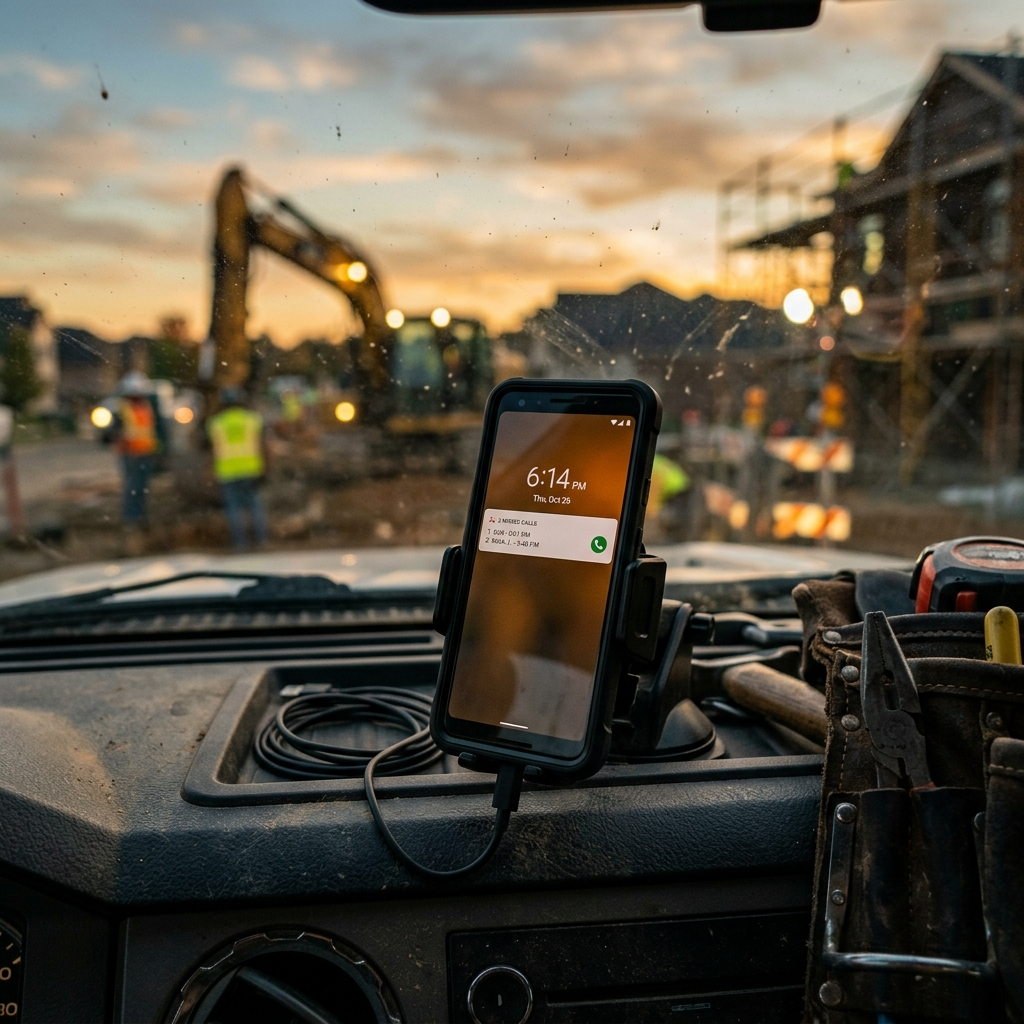

Most owners have tried to solve that leak with an answering service, a rotating on-call phone, or by carrying the business home every night. Those fixes can help, but they often create a second problem: messages pile up without qualification, urgent calls are not routed cleanly, and good opportunities still wait too long.
Treat any number without a nearby source or stated method as a planning assumption, then replace it with your own records.
Most trade owners do not need a lecture about missed calls. They have lived it. The phone rings while a tech is under a sink, while the owner is driving between estimates, or after the office has closed. The expensive part is not the ring. The expensive part is that the caller was often ready to book. For HVAC, plumbing, and electrical companies, the front door is usually both the most valuable asset and the easiest place to leak revenue..
Most owners have tried to solve that leak with an answering service, a rotating on-call phone, or by carrying the business home every night. Those fixes can help, but they often create a second problem: messages pile up without qualification, urgent calls are not routed cleanly, and good opportunities still wait too long.
The useful question is simple: what does a voice AI intake layer cost, how many recovered opportunities does it need to pay for itself, and what should the owner measure before deciding whether it is working?
The Cost of the Problem: Missing the "Golden Hour"
Before looking at what AI costs, we have to look at what *not* having it costs.
In the service trades, there is a "Golden Hour" for leads. For HVAC emergencies (AC out in summer, heat out in winter) or plumbing disasters (burst pipe, backup), the customer has a high-intent problem that needs an immediate solution.
If you don't answer the phone, the "Golden Hour" is actually a "Golden Five Minutes." Our data shows that 80% of emergency callers will not leave a voicemail. They simply hang up and call the next business in their search results.
The Math of a Missed HVAC Lead
- **Average Emergency HVAC Repair**: $800.
- **Average HVAC System Replacement**: $8,500 - $15,000.
- **Conversion Rate on Answered Emergencies**: ~40%.
- **Cost of One Missed Call**: ~$320 (conservative estimate of repair value x conversion).
If your business misses just three of these calls a week (which is common for after-hours and weekends), you are losing about $960 a week, or nearly $50,000 a year, in potential revenue.
The Investment: What Voice AI Actually Costs
At The Quiet Protocol, we’ve standardized the pricing for our Core Protocol-the "AI Front Door"-to make it accessible for businesses from $500k to $10M in revenue.
The TQP Pricing Model
1.One-Time Setup Fee: $999.
- Includes: Industrial-grade configuration of your voice AI agent, niche-specific knowledge base (e.g., HVAC system types, plumbing services), CRM integration, web chat setup, and missed-call text-back logic.
2.Flat Monthly Subscription: $497.
- Includes: Unlimited call handling, 24/7 availability, no per-minute overages, mobile app access, and automated SMS follow-ups.
Traditional Comparison
A human answering service might cost $150/month base plus $2.50 per minute. If you get 500 minutes of calls a month (which isn't much), your bill is$1,400/month. And that person still doesn't book the job into your calendar.
The ROI: Calculating the Payback Period
The "Payback Period" is the amount of time it takes for an investment to pay for itself through increased revenue or decreased costs.
Scenario: A 3-Tech Plumbing Company
- **Monthly Investment**: $497.
- **Average Ticket Value**: $650.
- **Jobs Captured by AI (After-Hours/Weekends)**: If the AI captures just **one** job per month that the owner would have otherwise missed, the system has paid for itself and generated a profit.
For most service businesses, the payback period for the $999 setup fee isless than 14 days. Once the system is live, it captures 5-15 additional leads per month that previously went to voicemail (and thus were lost).
What Payback Looks Like by Trade
The payback story changes by trade because the value of a booked call changes by trade. HVAC usually has the widest spread. A no-heat or no-cooling call may start as a repair, but the same conversation can reveal an aging system, a maintenance agreement opportunity, or a replacement timeline. Plumbing is more immediate. The buyer usually has water moving somewhere it should not be, a drain backing up, or a fixture that has stopped the house from functioning normally. Electrical sits between the two: some calls are simple repairs, while panel, generator, EV charger, and renovation work can turn one first conversation into a much larger project.
That is why the right question is not whether voice AI can answer the phone. The right question is which calls are worth protecting first. A three-truck plumbing company might only need two recovered weekend jobs a month to justify the system. An HVAC company in peak season may cover the monthly cost with one recovered replacement consultation. An electrical contractor may see the clearest return from faster estimate booking and cleaner pre-qualification, especially when the owner is also the estimator.
In a real front-door audit, I would separate the math into three buckets: emergency calls that need immediate routing, estimate requests that need qualification and scheduling, and existing-customer calls that need a clean next step. If those buckets are mixed together, the team treats everything as interruption. If they are separated, the owner can see which part of the phone is actually producing revenue and which part is simply creating noise.
The Booking Rules Matter More Than the Voice
A cheap AI voice that answers quickly but books the wrong calls is not an operating system. It is a faster way to create confusion. For HVAC, plumbing, and electrical companies, the value comes from rules: what counts as an emergency, when to offer the next available slot, when to collect photos, when to escalate to the owner, when to route to dispatch, and when to tell the caller that a human will confirm the appointment.
The rules should match the business, not a generic demo script. A plumbing shop may want main-line backups escalated immediately and faucet replacements placed into a normal queue. An HVAC company may want no-cooling calls prioritized differently during a heat wave than during mild weather. An electrical contractor may want panel questions, burning smells, and power-loss calls routed differently from fixture installation requests. The intake layer earns its keep when it respects those differences.
This is also where flat monthly billing matters. If the owner is worried that every extra call creates a surprise usage bill, the system gets used carefully instead of fully. The better model is to let the front door handle the messy volume, then measure whether booked jobs, response time, and follow-up quality improve. The cost should be predictable enough that the owner can judge the system like a technician, truck, or dispatch process, not like a novelty subscription.
The First 30 Days Should Be Measured
The first month should not be judged by whether the voice sounds impressive. It should be judged by whether the company can finally see the leak. Track missed calls before and after launch. Track how many after-hours callers receive a response. Track how many estimate requests turn into scheduled visits. Track how many urgent calls are routed correctly. Track how many calls still require manual cleanup from the owner or dispatcher.
The most useful early number is recovered opportunities, not total conversations. If twenty low-value calls are answered but no meaningful jobs are booked, the system is busy but not profitable. If three high-intent calls are recovered, routed, and booked without the owner carrying the phone all evening, the payback picture is clearer. That is the operating standard: not automation for its own sake, but a calmer front door that protects the revenue the business already earned the right to receive.
Beyond the Numbers: "Internal ROI"
The financial return is only half the story. There is also a massive "Quality of Life ROI" for the business owner.
1.Stop Carrying the Phone at Dinner: You can finally put the phone down during family time, knowing the AI is answering, qualifying, and booking the leads.
2.No More "Message Cleanup": Most owners spend an hour every Monday morning calling back voicemails from the weekend. With AI, those leads are already segments in your CRM and scheduled on your calendar.
3.Data Integrity: You get a text summary of every call. You know exactly what the lead needs before you even see them.
Why Flat Monthly Billing Matters
Most voice AI providers bill on a "token" or "per minute" basis. This creates a "success tax." If your marketing works and your phone starts ringing, your AI bill explodes.
The Quiet Protocol uses a flat $497/month model. We want our clients to get more calls, more leads, and more jobs without worrying about their software bill. This transparency allows for better financial planning and higher profit margins.
The Front Door Investment Decision
Your website and your phone are the "front door" of your business. If the door is locked when customers knock, they leave.
Investing $999 once and $497 a month to ensure that door is open 24/7-with a professional, knowledgeable "person" behind it-is the single highest-leverage move a service business can make in 2026.
Ready to find your "Revenue Leak Diagnostic"?Our calculator shows you exactly how much your current "missed call" rate is costing you. [Run the math here](/calculator).
*The Quiet Protocol Core Protocol is a managed AI front-door system for service businesses. Includes 24/7 voice AI, web chat, missed-call text-back, CRM, and reputation automation. Flat monthly pricing at $497 with a one-time $999 setup fee. No per-call fees. The system goes live within 5 business days of signup.*
What to check before you choose a fix
Before buying another answering service, chatbot, phone tree, or AI receptionist, look at the actual path a no-cooling, no-heat, maintenance, replacement, or emergency caller takes when they reach your business. The first question is not whether the tool sounds impressive. The first question is whether the buyer gets a clear next step while they still care. In HVAC company operations, that usually means a fast answer, a useful question, a booked appointment or estimate path, and a follow-up record that does not rely on memory.
A strong system should make the business feel easier to choose. It should reduce the waiting, repeating, guessing, and manual chasing that make a buyer keep searching. If the current setup answers only during business hours, takes a message without qualifying intent, or leaves the follow-up to whoever remembers first, the problem is not only staffing. It is front-door design.
The Week-One Diagnostic
Run this review over the last seven days before making a decision. Pull the call log, website form submissions, chat history, booking calendar, CRM notes, missed-call list, and Google Business Profile activity. Do not start with opinions. Start with timestamps and outcomes. A small sample is enough to show whether the leak is response speed, qualification, booking friction, review weakness, or follow-up failure.
- Count every missed call and every call that lasted under 20 seconds. Those are often buyers who never became visible in the CRM.
- Count every form or chat that waited more than 10 minutes for a real next step. This is where high-intent demand starts cooling off.
- Mark every inquiry that needed a human callback before booking. That tells you whether the website is explaining the next step clearly enough.
- Review the last five reviews buyers can see publicly. Recency matters because buyers compare proof before they commit.
This is the source method for the article: use your own call log, CRM, booking calendar, form inbox, and Google Business Profile review activity. Public research can explain the pattern, but your own records show where money is escaping in this business.
Where the revenue usually leaks
The leak usually appears in one of four places. First, the buyer calls when the team is busy or closed. Second, the buyer reaches the business but is not qualified clearly enough to book. Third, the buyer receives a polite response but no firm next step. Fourth, the buyer finishes the job or visit but no review, referral, or reactivation path happens after the work is done. Each leak looks small by itself. Together, they decide whether marketing produces booked revenue or only more noise.
For a HVAC company, the most valuable fix is the one that protects dispatch speed, booked calls, estimate quality, and after-hours capture. That is why voice AI for HVAC, plumbing, and electrical should be judged by business outcomes, not by novelty. A phone feature that sounds clever but does not improve booked appointments is not enough. A website widget that collects contact details but does not trigger follow-up is not enough. A review tool that asks once and disappears is not enough.
What a stronger system should do
A stronger front door answers quickly, asks the right questions, captures the reason for contact, separates urgent from routine demand, books when rules are clear, sends confirmations, updates the follow-up path, and asks for reviews after the work is done. The system should make the owner less dependent on heroic callbacks and make the buyer feel that the business is organized from the first touch.
The Quiet Protocol treats this as an operating system, not a single widget. Calls, web forms, missed-call text-back, appointment booking, CRM handoff, review requests, and reactivation all need to point in the same direction. When those pieces are connected, a HVAC company can capture more demand without turning the team into a bigger manual call center.
How to judge whether it is working
Do not judge the system by how futuristic it feels on day one. Judge it by what changes in the business. Useful measurements include missed-call recovery rate, average response time, booked appointment rate, no-show recovery, review request volume, review recency, reactivated past-customer conversations, and the number of leads that have a clear next action in the CRM.
The best early sign is calm. Fewer loose callbacks. Fewer mystery leads. Fewer buyers waiting for a reply. More conversations with a clear status. That is what good automation should feel like to the owner and to the customer.
The loss estimate is basic business math, not a magic claim.
Revenue-leak examples on this site are built from visible operating inputs: inquiry volume, missed-call or slow-response rate, booking rate, average job or client value, repeat value, and follow-up recovery. The fastest way to make the number real is to run the diagnostic for your closest business type, then compare it against your own call log, CRM, booking calendar, form timestamps, and review activity.
The practical questions behind this decision.
Is this just a 24/7 answering service?
No. A traditional answering service usually takes a message. A properly designed AI receptionist and front-door system captures intent, qualifies the buyer, routes the request, books when possible, triggers follow-up, and supports reviews after the work is done. Message-taking is coverage. Revenue capture is a fuller operating path.
What should an HVAC company fix first?
Fix the first place buyers disappear. For some businesses that is after-hours calls. For others it is slow website follow-up, weak booking logic, old leads, or stale reviews. The right first move comes from the seven-day diagnostic, not from guessing.
Will AI make the business feel less human?
Bad automation feels colder than a person. Good automation feels like the business is paying attention. It answers quickly, uses plain language, collects the right information, and hands the buyer to a human when judgment or empathy is needed. The goal is not to remove people. The goal is to stop making buyers wait for basic next steps.
How fast should we expect improvement?
The first lift should come from visibility and speed: fewer missed opportunities and cleaner routing. Deeper gains come after the system has enough real conversations to tune scripts, booking rules, follow-up timing, and review requests. Treat the first month as deployment and calibration, not a magic switch.
Decide what the AI must handle before you choose the software.
A useful intake system begins with the caller journey, the rules, and the human handoff, not a long feature list.
Give the receptionist a realistic scenario and hear how it answers, gathers context, and moves the caller toward a useful next step.
See how the capability in this article fits into a complete customer journey.
HVAC Emergency ServiceSee the same decision through the language, buyer behavior, and operating reality of this industry.
Client Results & ProofInspect the starting condition, installation, measurement window, and outcome behind real client work.

HVAC Peak Season Preparation: How to Stop Losing Summer Jobs Before the Heat Hits
HVAC peak season exposes every weak intake system. Here is how HVAC companies prepare before the heat hits, capture more summer calls, and avoid owner burnout.

AI Receptionist for Dallas HVAC Companies: How DFW Contractors Capture Summer Calls
Dallas HVAC companies do not lose summer calls because demand is weak. They lose them because DFW homeowners call until someone answers. Here is how AI intake changes that.
Calculate the revenue leak.
Stop guessing. See how much demand your business may be losing through missed calls, slow replies, weak booking, review gaps, and follow-up drag, then decide whether Voice AI is the right system path.
Run the calculationPrefer to hear it first?
Call the live AI receptionist and test the conversation.
Call the live AI receptionist anytime. Tell it about hvac emergency service, then hear a short live roleplay based on the calls your front desk actually gets.