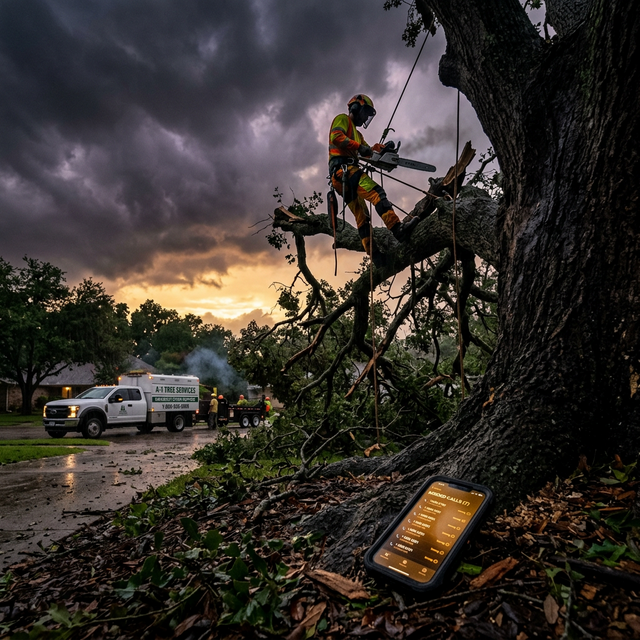

Not all missed tree service calls are equal. During a storm surge, the calls break into three distinct categories, each with its own value and urgency:
Treat any number without a nearby source or stated method as a planning assumption, then replace it with your own records.
Tree service companies that solve The Front Door Problem win the storm. The Front Door Problem is the gap between the lead calling and the job being confirmed. During a storm surge, this gap costs tree companies more than any other vertical because the lead is urgent, the premium is real, and the window to capture it is measured in minutes, not hours.
The storm call nobody answered. It is 4 PM on a Thursday. A line of severe thunderstorms has just ripped through your service area. A massive oak split across a homeowner's driveway. They need it gone today. Their car is trapped. Their kids cannot get out for school in the morning. The job is worth $4,800 in removal and stump grinding.
They pull up Google. They call the first tree service they see. The phone rings. And rings. And rings. Your crew lead is 40 feet up in a white oak three miles away, chainsaw running at full throttle, harness secured, absolutely zero ability to reach into his pocket and take that call.
By the time your truck pulls back to the yard at 6 PM and someone checks the missed calls,the homeowner has already scheduled with your competitor.The call took 45 seconds to book. The job paid $4,800. You missed it because your front door was unmanned during the only window that mattered.
This is The Front Door Problem for the tree service industry.The better your crew is in the field, the more revenue you lose.The work that makes you good at your job is the exact same work that prevents you from answering the calls that grow your business.
Why Storm Days Are Your Most Profitable and Most Dangerous Days
Storm response is the single highest-margin category in tree service. When a tree comes down on a structure, blocks a driveway, or punches through a fence, the homeowner is not looking for the cheapest arborist on the block. They need someone with the equipment to remove a dangerous tree today. That urgency in the customer's voice translates directly into premium pricing tolerance.
The Storm Premium.Emergency storm removal commands a 40% to 80% premium over standard tree work. A job that would normally run $2,500 for a controlled removal becomes a $4,000 to $5,000 job when the customer has a 50-year-old red maple sitting on their garage. The insurance claim is already in progress. Price is secondary to speed.
But here is the paradox every tree service owner knows: storm days are the days your crew is the most unreachable. Every truck is deployed. Every climber is active. Phones are left in the cup holder, the cab, or the tailgate. The crew lead cannot stop a complex rigging operation to answer a call from a new homeowner.
The result?The storm creates the leads. Your operational reality destroys them.Every 20-minute window where your phones go unanswered during a surge event is a $3,000 to $5,000 job window that closes forever.
The Crew Bottleneck Explained
The Crew Bottleneck is what we call the specific front-door failure that tree companies face during high-volume periods. It is not laziness. It is not poor customer service. It is a fundamental structural problem: the people doing the work cannot simultaneously be the people selling the work.
The Five-Crew Problem.A tree service running five crews at peak capacity might have 12 to 18 people in the field on a storm day. None of them are in a position to take a detailed intake call, quote a job, and commit to a start time. The person who could normally handle those calls, the owner or the office manager, is probably also in the field or dispatching trucks in real time.
At the exact moment your business is performing at its highest potential, your intake system collapses. The calls come in. The voicemail box fills. The homeowners, who are in a high-distress, first-come-first-served mindset, call the next company on the list.
The Google Business Profile Consequence.Here is a secondary effect most owners never consider. When a homeowner calls your business profile during a storm and no one answers, Google tracks that interaction. A high volume of unanswered calls against your Google Business Profile during your busiest day of the year silently signals to Google that your business is unreliable. This can slowly erode your Local Pack ranking precisely when you need it most.
The Crew Bottleneck is The Front Door Problem in its most acute, high-stakes form.Every dollar you leave on the table during a storm event is a dollar you will never recapture.Those customers chose a competitor and will use that competitor for the next decade of tree work.
The Three Types of Storm Leads You Are Losing
Not all missed tree service calls are equal. During a storm surge, the calls break into three distinct categories, each with its own value and urgency:
Category 1: The Emergency Structural.Tree on the house. Tree blocking the driveway. Tree on a car. These are immediate, high-value, premium-priced jobs. Average value: $3,500 to $8,000. These callers are calling every number on the first page of Google simultaneously. The first company to pick up owns the job. Miss this call, and it is gone in under 90 seconds.
Category 2: The Hazard Assessment.A large limb is hanging. A root ball is lifting. A tree is leaning toward a fence. These callers want someone to come look and give them a quote before the next storm. They are still in the "assessment" phase but are highly motivated. Average job value: $1,200 to $3,500. These callers will hold for a callback, but only for about 4 hours before the urgency fades.
Category 3: The Preventive Inquiry.The storm scared the homeowner into thinking about the other trees on their property. They want pruning, inspection, or cable bracing. These are the systematic, recurring revenue jobs that build your winter book. Average job value: $800 to $2,000. These callers have a 24 to 48 hour window before they forget the concern entirely.
A single storm event can generate 20 to 50 calls across all three categories in a 4-hour window. If your front door is automated, you capture all three. If your front door is unmanned,you capture zero of them while you are in the field.The storm is generating the lead pipeline for you. The only question is whether your intake system can keep up.
Why Your Current Answering Setup Is Failing During Surges
Most tree service companies have tried one of three solutions to the after-hours and surge-period missed call problem. None of them are working the way they need to.
The Forwarding-to-Personal-Phone Solution.The owner or operations manager carries the business line on their personal cell. This creates burnout, 24/7 obligation, and still results in missed calls when you are in the field, on another call, or physically unable to stop the work. It is not a system. It is a personal sacrifice that does not scale.
The Third-Party Answering Service Solution.These services take messages and promise to relay them. But a message is not a booking. A relay is not a commitment. A homeowner who called at 4 PM and got a "we will have someone call you back" message is already on the phone with your competitor by 4:10 PM. The answering service took the friction of the missed call and moved it one layer further away from resolution. It did not eliminate it.
The "Call Us Back When We Are Available" Voicemail.This is the most expensive solution of all, because it costs nothing and generates nothing. A voicemail box during a storm surge is a waiting room for leads who are going to leave before you recover the door.
None of these solutions address the root problem:the intake has no decision-making capability.A human answering service can take a name. A voicemail records a problem. Only a smart system can qualify the job, quote the urgency window, and commit to a start time in real time.
The Voice AI Storm Routing Solution
What Custom Infrastructure Looks Like.At The Quiet Protocol, we design custom Voice AI front doors for tree service companies that are built specifically for the storm routing environment. When the storm surge hits, our system does not collapse. It scales.
Here is what the first 90 seconds of a storm call looks like when your front door is automated:
The homeowner calls at 4:17 PM. The AI answers on the first ring. It identifies the emergency type (structural hazard, downed tree, blockage), establishes the address and access situation, asks about the urgency level (is the structure compromised?), and confirms availability for an assessment window.
If the job qualifies as an emergency structural removal, the AI confirms a same-day or next-morning assessment window based on your crew availability, gives the homeowner a callback confirmation from the crew lead, and logs the job directly into your CRM. The homeowner hangs up feeling like they have already hired someone.
By the time your crew lead checks his phone at the end of the day,the job is already in the system with a time window committed.You captured a $4,800 job from 40 feet up in a tree. That is what a closed front door looks like.
Storm Routing Playbook: How to Set Up Your Voice AI for Surge Events
A properly designed tree service Voice AI system is not a generic answering bot. It is calibrated specifically for how your company operates, what your crew capacity looks like during surge events, and what your qualifying criteria are for emergency versus standard bookings.
The Triage Logic.The system needs to be trained on three core questions: What is the situation? (structural hazard, fallen tree, hanging limb); Is there immediate risk to life or property? (this triggers the emergency dispatch protocol); and What is the service address and access situation? (this determines truck and equipment routing). These three questions take 60 to 90 seconds and capture everything your crew lead needs to prioritize the job.
The Capacity Signal.During storm events, your AI can be programmed to "know" your current capacity window. If you have four crews committed, the AI holds new emergency bookings to a 6-hour window instead of a same-day window. It communicates this naturally to the caller so they feel managed rather than rejected.
The Callback Protocol.For non-emergency calls (the Category 2 and Category 3 leads), the AI captures the details, sets a callback expectation of "within 2 business hours," and sends an immediate SMS confirmation to the homeowner so they feel their inquiry was received and valued. This prevents the 4-hour urgency decay window from closing the lead.
The goal is for every caller to hang up having receiveda commitment, a timeline, and a confirmation.That is the experience that converts a storm lead into a signed job, regardless of whether a human was available to take the call.
The Lifetime Value Problem: What You Lose Beyond the Storm Job
The missed storm call is not just a missed $4,800 job. It is a missed relationship with a homeowner who now has 10 trees on their property and will need recurring service for the next 20 years.
The Recurring Revenue Math.A tree service homeowner relationship, once established, generates recurring revenue through annual pruning (average $600 to $1,200 per year), hazard removal as trees age (average $1,500 to $3,000 per incident), and stump grinding and debris removal. A homeowner who stays with your company for 10 years represents $8,000 to $15,000 in total lifetime revenue.
Every missed storm call is not a $4,800 loss. It is a potential $10,000 to $15,000 lifetime client loss. It is a referral loss. It is a neighborhood relationship loss. In residential tree service, one job on a cul-de-sac often generates three to five additional estimates from neighbors who saw your truck. Miss the first one, and you miss the neighborhood.
The Crew Bottleneck is not a minor operational inconvenience.It is the most expensive structural flaw in the tree service business model.And it is entirely solvable with the right front door infrastructure.
How to Audit Your Own Storm Capture Rate
Before you can fix the Chainsaw Bottleneck, you need to see it clearly. Here is the three-step storm capture audit we run with every tree service company before we build their system:
Step 1: Pull the Storm Day Call Log.Look at any day in the past 12 months where you had a high-call-volume day (typically after a weather event). Count every call that lasted under 30 seconds or went directly to voicemail. That is your miss count.
Step 2: Calculate the Average Job Value.Take your total emergency job revenue from the last 12 months and divide by the number of emergency jobs. This is your per-job Revenue Leak Diagnostic input.
Step 3: Multiply.Missed calls x average job value x estimated close rate = your Chainsaw Bottleneck annual cost. For most 3 to 6 truck tree services, this number ranges from $180,000 to $600,000 per year in permanently lost storm job revenue.
If you want a precise number for your specific operation, the Revenue Leak Diagnostic we run at The Quiet Protocol produces your exact Revenue Leak Diagnostic in 15 minutes, using your real call logs and real revenue data. Most owners who see this number stop using their current intake system the same day.
The Operating Standard
In the context of The Crew Bottleneck: How Tree Services Lose $5,000 Storm Jobs While the Crew Is in the Field, we must address the fundamental friction that exists in manual intake. Every 'missed call' is a missed revenue opportunity, but more importantly, it's a signal of operational weakness that high-value prospects detect instantly. By bridging this gap with AI-driven intake, you're not just 'automating.' You're humanizing the interaction by ensuring that your clients get the attention they deserve, instantly. This is the math of responsiveness that wins markets.
Strategic ROI: When we apply the Quiet Protocol math to The Crew Bottleneck: How Tree Services Lose $5,000 Storm Jobs While the Crew Is in the Field, the result is always the same: a dramatic reduction in cost-per-acquisition (CAC) and a significant increase in client lifetime value (LTV) through immediate resolution.
The loss estimate is basic business math, not a magic claim.
Revenue-leak examples on this site are built from visible operating inputs: inquiry volume, missed-call or slow-response rate, booking rate, average job or client value, repeat value, and follow-up recovery. The fastest way to make the number real is to run the diagnostic for your closest business type, then compare it against your own call log, CRM, booking calendar, form timestamps, and review activity.
The practical questions behind this decision.
Can Voice AI actually handle the complexity of a tree service emergency call?
Yes, when it is built correctly. The custom systems we design for tree service companies are trained on the specific vocabulary, urgency scoring, and triage logic of the industry. The AI knows the difference between a tree that fell on a roof and a tree that needs seasonal pruning, and it routes them entirely differently.
What CRM tools does the Voice AI connect to?
Our systems are built to integrate with the modern field service management platforms that tree companies use, including ArboStar and Jobber, which both offer API connectivity for automated job entry. The goal is always zero manual data entry between the call and the dispatch.
How does the system handle the commitment window when my crew is at full capacity?
You define the capacity logic. We build it in. If your crew is fully committed for the next 8 hours, the AI communicates a realistic assessment window to the caller and gives them the option to hold that slot or request a callback. It never overpromises and never loses the lead to a disconnected "call us back" message.
Is this system only useful during storm events?
No. The commercial benefit during storm events is the highest and the most visible, but tree service companies using our Voice AI front door see improved capture rates year-round across seasonal promotions, summer canopy work, and fall and winter hazard removal quotes. The front door works 24/7, 365 days per year. The storm is just the moment where the cost of a closed front door becomes impossible to ignore.
Map how a serious buyer decides in this kind of business.
Use the operating reality of the industry instead of copying a generic lead-generation playbook.
Replace broad industry assumptions with the business's actual inquiry volume, customer value, response time, and booking data.
See how the capability in this article fits into a complete customer journey.
Tree Service & RemovalSee the same decision through the language, buyer behavior, and operating reality of this industry.
Client Results & ProofInspect the starting condition, installation, measurement window, and outcome behind real client work.

The Real Cost of a Missed Call for a Service Business: The Math Nobody Runs
A missed call costs more than the immediate job. Here is the full three-layer calculation, immediate value, lifetime client value, and referral chain, and the annual total most owners never see.

The Speed to Lead Equation: Why the First Five Minutes Decide the Job
In emergency services, the first company to answer wins. Not the best company. Not the cheapest. The fastest. Here is the math that proves it.

The Med Spa Booking Leak: Why Your Marketing Works But Your Calendar Doesn't Fill
Med spas spend thousands attracting new clients, then quietly lose 40 to 60 percent of them at the phone. Here is where the leak is, how much it costs, and what the fix looks like.