
To understand the cost of a lost lead, look at what you paid to get the inquiry and what a completed job could have earned after materials and labour. These are separate amounts, so do not add them together and call the total lost profit. The revenue potential of unconverted home service leads depends on whether you could serve the customer, how likely they were to book and what it would cost to do the work.
An unanswered estimate for an $800 repair is not automatically an $800 loss. The customer may have chosen someone else. The job may have needed $480 in materials and labour. Your crew may already have been full. Multiplying every unanswered inquiry by the invoice value makes an impressive number and a poor buying decision.
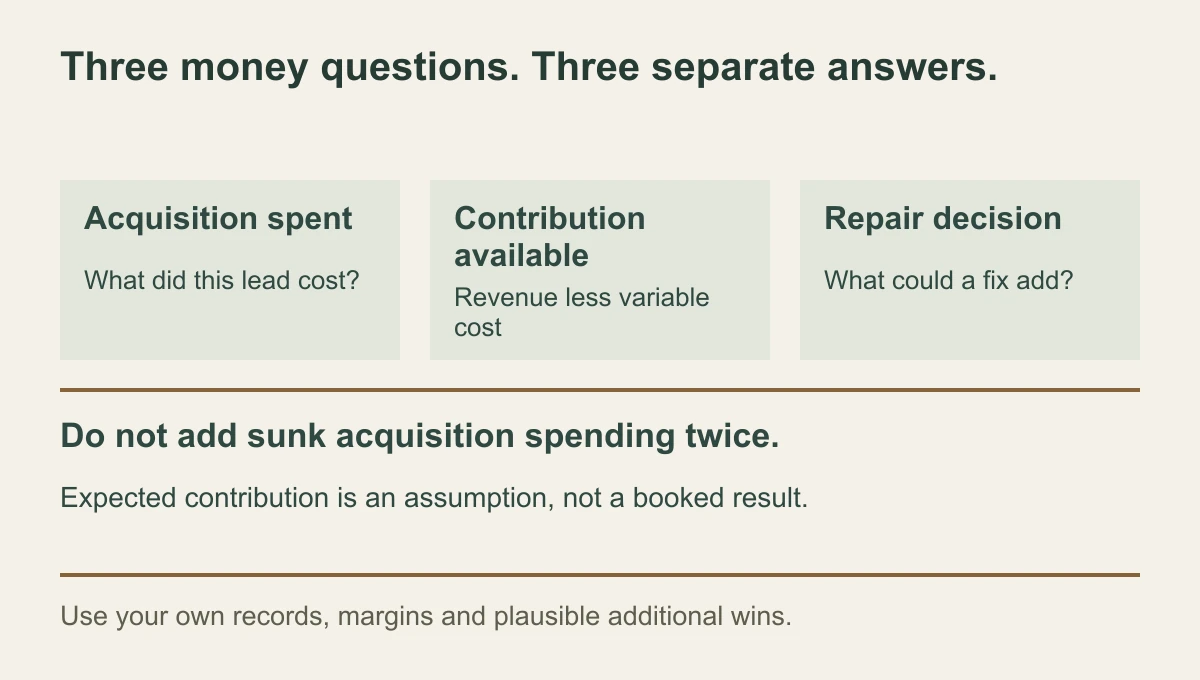
I would put three amounts on the desk: what you spent acquiring the inquiries, the contribution those opportunities might have produced, and the additional contribution a specific repair could create. Keep them separate. They answer different questions.
That is how we approach Workflow, CRM & Automation at The Quiet Protocol. We connect the inquiry record, responsible person, follow-up and next decision so you can see what happened and act on it. Where open estimates are the gap, our Estimate Follow-Up System starts at US$2,500 setup plus US$995 per month, with no contract and call minutes included. We map and test the process, then monitor delivery, replies, stage movement and the agreed human handoffs. The purchase should solve the gap your numbers reveal.
Start with the leads you could actually serve
Choose one service and one period. For example, residential plumbing repair inquiries received during a completed month. Count unique requests, not calls, emails or form submissions. Someone who calls twice and submits a form is still asking for one repair.
Set aside spam, existing-job questions, duplicate requests, work outside your service area and jobs you do not offer. Record them separately so they can inform a different repair, such as clearer website wording. An unqualified request should not inherit the value of a qualified one.
Next, distinguish a known decision from an unfinished conversation. “Customer declined because the work was postponed” is useful evidence. “We have not heard anything” is an unresolved state. It does not explain whether the price, timing, service fit or your response caused the outcome.
Keep opportunities at different stages separate too. A suitable caller who never received a callback has a different remaining journey from a customer holding a written estimate. If you use a completion probability, it must start at the same stage as the requests you are valuing.
For the stage-by-stage investigation, use the lead leak diagnostic. For unanswered calls specifically, use the missed-call cost guide. This worksheet covers unconverted opportunities across the receiving and sales process.
Three amounts. Three decisions.
- Acquisition spend already incurred
- What did it cost to generate these inquiries? Use this to review channels and spending. It is not new income a follow-up system can create.
- Expected contribution at risk
- What might the suitable, unresolved opportunities have contributed if they became completed work? This is a scenario with a probability, not a measured loss.
- Incremental contribution from a repair
- What extra completed work could the proposed change create, after delivery costs and the full cost of the change? Use this to evaluate the purchase.
Do not add all three and call the result lost profit. Some are historical spending; others are overlapping views of an uncertain future.
The invoice is not the amount available to pay for a fix
For one additional job, subtract the costs that rise because you do that job: materials, subcontract work, genuinely additional labour, travel and relevant transaction costs. The remainder is the contribution per additional completed job toward fixed costs and profit. It is not the business's final net profit.
Use an average from comparable jobs, or build a range if job size varies. Routine maintenance and major replacements deserve separate lines. BDC's costing guidance starts with defining the service or project being assessed and understanding which costs belong to it. BDC: understanding your costs
Do not assume every labour dollar is variable or every salary is fixed for this decision. A crew with spare time and a crew requiring overtime have different incremental costs. If extra work needs another van, another employee or additional supervision, include that capacity cost in the repair scenario. Your accountant can help check the classification when it changes the decision.
The SBA's break-even guidance uses selling price less variable cost in its unit calculation. The same distinction is useful here: additional invoices must first pay for the additional work.
An illustrative lead worksheet, with the assumptions visible
Suppose a fictional repair business reviews 40 unique, suitable but unconverted inquiries. Assume, for this example only, that a comparable opportunity at the same stage has a 25% chance of becoming a completed first job. The assumed average first-job revenue is US$800, with US$480 of incremental delivery cost.
These are chosen inputs to explain the calculation. They are not a TQP client result, an industry benchmark or evidence that this business lost ten jobs.
The first-job calculation
| Line | Calculation | Meaning |
|---|---|---|
| Contribution per job | $800 − $480 = $320 | Available toward fixed costs and profit |
| Expected first jobs | 40 × 25% = 10 | A hypothetical expected count |
| First-job revenue at risk | 10 × $800 = $8,000 | Revenue scenario before delivery costs |
| Contribution at risk | 10 × $320 = $3,200 | The same opportunity after delivery costs |
| Acquisition spend | 40 × $75 = $3,000 | Assumed allocated spend already incurred, shown separately |
The $8,000 and $3,200 describe the same possible jobs. The $3,000 acquisition line does not make the repair's opportunity worth $6,200 or $11,000.
That last line needs care. If you spent US$7,500 generating 100 comparable unique inquiries, US$75 is an allocated cost per inquiry: your cost per lead for that defined campaign and inquiry group. Assigning US$3,000 to the 40 unconverted inquiries helps describe channel economics. It does not mean you could recover that money by repairing follow-up, or that all the spending was avoidable.
For a whole campaign's profitability, count its full acquisition spending once against the contribution generated by the campaign's completed jobs. For a decision about fixing inquiries already acquired, compare the new repair cost with the additional contribution it could create. Do not charge the same acquisition bill again merely because you are looking at the opportunity from another angle.
Put marketing ROI on the same contribution basis
For a campaign review, define the attributed inquiry group, the marketing spend included and the observation window before calculating a return. One useful planning measure is contribution-based marketing ROI = (marketing-attributable completed-job contribution − attributable marketing spend) ÷ attributable marketing spend. The denominator is that campaign's marketing spend, which must be greater than zero. Contribution here means completed-job revenue less its incremental delivery costs, before fixed overhead; it is not invoice revenue or final net profit.
For example, suppose a separate fictional campaign costs US$2,000 during May and its attributed inquiries produce US$3,000 of completed-job contribution by an agreed July 31 cutoff. That defined measure is ($3,000 − $2,000) ÷ $2,000 = 50%. Show the campaign dates, completion cutoff, attribution method and costs beside the result. If several channels touched the same customer, state how credit is assigned; an unanswered call alone cannot establish marketing attribution, a completed sale or repeat customer value. Count acquisition spend once and keep later customer-value scenarios separate.
Ask what the proposed change could add
The 25% scenario above describes possible value among the 40 opportunities. It does not say a new process will recover all ten expected jobs.
Instead, estimate additional completed jobs attributable to the change. You can compare two completion rates for comparable inquiries, or estimate how many genuinely additional jobs a specific repair might produce. Choose one method and show its assumptions. Do not apply a recovery percentage and then another improvement percentage to the same opportunity without defining distinct stages.
For example, an assumed improvement of eight percentage points across 40 comparable inquiries produces an expected 3.2 additional jobs. At US$320 contribution each, that is US$1,024 before the repair's cost. The fractional job is an expected average for planning, not a booking you can dispatch.
Now assume the change costs US$1,200 in the month being assessed. This is an illustrative all-in cost, not a TQP quote. The working scenario produces US$176 less contribution than the change costs. A useful model is allowed to disappoint you.
For a different view, divide US$1,200 by US$320. The change needs 3.75 additional completed jobs, or at least four whole jobs, to cover that month's assumed cost. That is the operational question to take to the team: what would have to change for four more suitable requests to become work we can deliver?
List setup, monthly fees, usage, staff review, extra callbacks and any added capacity in the cost of the change. Show setup cash when it is paid. If you also spread setup over several months for a planning comparison, label that view and do not add the full setup payment a second time. Check a low, working and high scenario rather than presenting one convenient forecast.
Repeat work deserves its own line
A repair customer may book maintenance later. An accounting prospect may become a recurring client. Neither makes every unconverted lead worth four times its first invoice.
Use first-job contribution as the base case. Add a separate future-work scenario only when you can identify the period, the chance of returning, expected work and its delivery cost. If your customer-value figure already includes the first job, remove that first job before adding it to this worksheet.
Referrals need the same discipline. A referred inquiry that is already counted among next month's leads cannot also be added as a bonus to last month's lost opportunities. Future revenue also arrives in the future. It will not pay a bill due this week.
If you lack reliable repeat or referral records, leave the number out. You can still explain that a better customer experience matters. It does not need a fictional multiplier to deserve attention.
Use the result to choose the work
If the unconverted group contains good inquiries with no useful response, repair receiving and ownership. If customers receive estimates but nobody manages replies, implement the estimate process. If many decline for a known capacity or service-fit reason, fix that constraint before forecasting recovered jobs.
This is the advantage of having us implement the process. We turn the stage you have identified into a working route, with the record, timing, stop rules and person who takes over. A spreadsheet can expose a forgotten estimate. Our Estimate Follow-Up System is built to keep the agreed follow-up and reply handoffs running.
Compare the next cohort using the same service, stage definitions and completion window. Record changes in demand, price, advertising and capacity so you do not attribute every improvement to the new process. A small before-and-after group can reveal an operating problem; it does not establish causation on its own.
Bring us the rows you can explain, including the ones marked uncertain. We will help turn the actual gap into a scoped implementation. Buy the repair your business can use, and require a process you can follow from inquiry to completed work. That is a better use of the numbers than printing a large loss on a dashboard and hoping it frightens everyone into being more organised.
Frequently asked questions
What is the true cost of an unconverted lead?
Separate the revenue the inquiry might have produced, acquisition spending already incurred and the first-job contribution available after delivering the work. A full invoice is not automatically the amount lost or the budget available for a repair.
Should a lead-cost worksheet include guessed lifetime value?
Keep the base case grounded in work and costs the business can explain. Treat later repeat work or referrals separately unless there is evidence for them. A large guessed multiplier can hide a poor repair decision.
How does TQP help with unconverted inquiries?
We trace where requests stop, then connect the approved intake, response and follow-up work. The business buys an implemented path with responsible people behind it, rather than a dashboard that makes the lost-opportunity number look larger.
Bring one group of unconverted inquiries and the stage where they stopped. We map the records, responsible person, timing, replies and human handoffs, then implement and maintain the agreed process.
Build the follow-up process behind your numbers