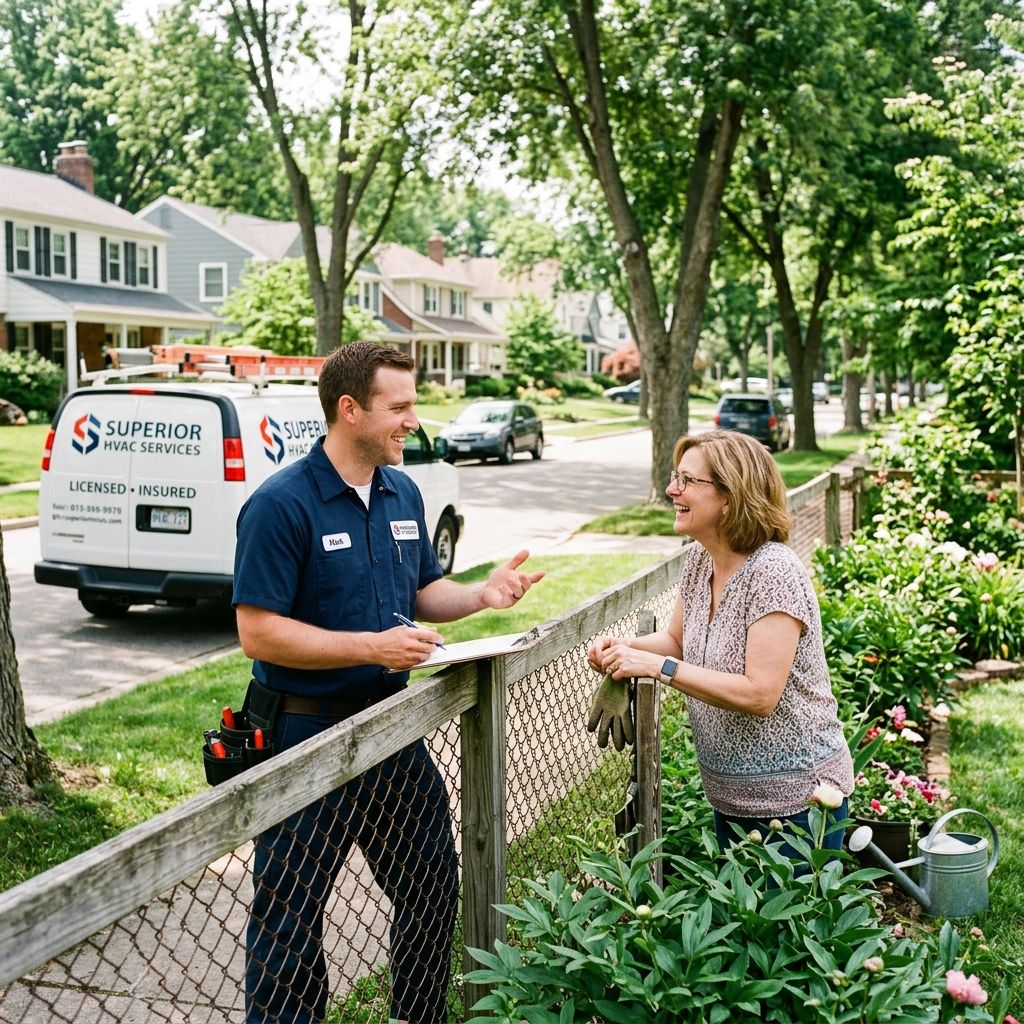

When a customer already mentions someone: ‘If they want, you can share the link or introduce us in a group message. We will not contact them unless they have asked for the connection.’
This article links to 4 external sources beside the claims they support.
A technician referral program should transfer trust, not turn a technician into a salesperson. The technician finishes the work well, asks whether the customer wants an easy way to introduce someone, records permission, and hands the next step to the office. The customer controls the introduction. The office owns fit, consent, follow-up, attribution, and any reward.
That operating boundary matters. A technician may be the person who earns the trust, but the referral system is the path that preserves it. Without a defined handoff, promising conversations disappear into job notes, personal texts, business cards, or a vague source label called word of mouth.
This guide is for established home and field service businesses that want a repeatable referral channel without cold door knocking, review manipulation, pressure scripts, or private customer data living on a technician's phone. If the opportunity begins with an additional need observed during the job, use the separate technician observation and upsell guide. This page stays focused on customer introductions and the field-to-office referral handoff.
The short answer: build the handoff before offering a bonus
A referral program is ready when five questions have clear answers: Who may be invited? What exactly is the customer being asked to do? How is permission recorded? Who contacts the referred person? What event earns a reward? If any answer depends on memory, the channel is not operational yet.
Start with one service line and one referral route. Give the technician one natural sentence. Give the customer a shareable link or introduction option. Give the office one queue with a response owner. Give every referral a visible status. Then test the experience with actual jobs before expanding it.
Three moments that should never be mixed together
A service observation
The technician notices something relevant to the customer's property or equipment. The job record should capture the observation, its urgency, the evidence, and whether the issue is inside the company's scope. That is a technical closeout process, not a customer referral.
A customer introduction
A satisfied customer chooses to introduce a friend, neighbor, relative, or colleague who may need the service. The referrer controls whether an introduction happens. The business receives contact details only through an agreed path. This is the referral channel covered here.
A public review
A review describes the customer's own experience on a public platform. It should be requested separately and without conditioning an incentive on a positive rating. Google's current Maps policy prohibits incentivized or biased reviews and warns businesses not to pressure customers or selectively solicit only positive feedback. A referral reward is not permission to buy a review.
Why the customer should control the introduction
The strongest referral begins with context the prospect recognizes. A customer can send the link, start a group text, forward an email, or ask the business to contact someone who has explicitly agreed. In each case, the relationship enters the conversation before the sales message.
The distinction is practical, not merely polite. The technician does not need to store a stranger's number or persuade an uninvolved neighbor. The office does not receive an unexplained name with uncertain permission. The prospect understands who shared the business and why the company is contacting them.
Referral research supports treating the channel as a managed system instead of casual word of mouth. A Journal of Marketing study followed 5,181 referred and 4,633 non-referred customers at one German bank for up to 33 months. The referred group showed higher retention, contribution margin, and customer value in that setting. The authors also warn that referral effects vary by segment and that programs need active management and controls. It is useful evidence for the mechanism, not a home-services conversion benchmark.
Six handoffs from a finished job to a welcomed introduction
The technician owns the moment. The customer owns the relationship. The office owns the commercial follow-through.
- 01 · Earn
Was the job completed well enough to invite a referral?
In the fieldConfirm the customer understands the work, has no unresolved concern, and knows how to get help if something changes.
At the officeKeep complaints, callbacks, warranty issues, and incomplete jobs out of the referral invitation queue.
Trust guardrailDo not use a referral ask to rush past a service problem or manufacture a moment of satisfaction.
- 02 · Invite
Would the customer like an easy way to introduce someone?
In the fieldAsk one low-pressure question and offer a shareable link only when the customer is comfortable.
At the officeProvide one approved message and referral route instead of making each technician invent a pitch.
Trust guardrailA no ends the ask. The technician does not request a contact list, inspect the customer's phone, or chase a quota.
- 03 · Introduce
How will permission travel with the referral?
In the fieldLet the customer share the link, start the introduction, or confirm that the prospect asked to be contacted.
At the officeStore the referrer's name, relationship, permission note, source code, and introduction channel in the record.
Trust guardrailDo not call or text a third party merely because someone supplied a number without confirming permission and applicable rules.
- 04 · Qualify
Is this a real service fit with a useful next step?
In the fieldThe technician makes no price, timing, scope, or availability promise outside the approved boundary.
At the officeConfirm service, location, urgency, ownership, and the right appointment or estimate path before assigning follow-up.
Trust guardrailA referral is not automatic acceptance. Poor-fit or unsafe requests still follow the normal qualification policy.
- 05 · Follow up
Who owns the next action and when does it stop?
In the fieldThe technician can see that the handoff was received without becoming responsible for repeated sales follow-up.
At the officeUse a named owner, dated task, respectful contact sequence, reply handling, and a clear stop rule.
Trust guardrailThe referred person receives context, identity, and an easy way to decline further contact.
- 06 · Recognize
What outcome earns a reward or team credit?
In the fieldThe technician sees a transparent status and receives credit under the written program rule.
At the officePay or record the reward only after the defined qualified, booked, completed, or paid event is verified.
Trust guardrailDisclose material incentives when a recommendation could be understood as an endorsement, and never tie referral rewards to public review sentiment.
The technician's role should fit on one card
A technician needs less language than most referral programs provide. The purpose is to make the next step easy, not to create a field sales presentation. A useful script is specific, optional, and short enough to sound human.
After a clean closeout: ‘I'm glad we could get this handled. If someone you know ever asks who you used, I can text you a link that explains what we do and lets them request the right kind of help. Would that be useful?’
When a customer already mentions someone: ‘If they want, you can share the link or introduce us in a group message. We will not contact them unless they have asked for the connection.’
The technician should also know the words not to use. Do not promise a discount the office has not approved. Do not imply that a neighbor's system is failing because nearby homes are a similar age. Do not borrow the current customer's service details as social proof. Do not make the customer feel responsible for the technician's bonus.
Why cold neighbor knocking should not be the default
A uniform and a truck do not automatically create permission. Door-to-door activity can trigger local solicitation rules, employer safety concerns, customer privacy questions, and additional consumer obligations if a sale is completed at a home. The FTC's Cooling-Off Rule, for example, applies to certain door-to-door sales over $25 and requires cancellation disclosures. State and local requirements may add more. This guide is operational guidance, not legal advice.
A business may still choose a carefully reviewed neighborhood outreach program. That should be a separate, legally reviewed campaign with its own permit, safety, privacy, service-area, and follow-up rules. It should not be hidden inside a technician referral bonus or treated as a harmless extra step after every job.
The minimum CRM record for every referral
A referral source field is not enough. The record has to explain what happened so the office can act without calling the technician for context. Use a small set of fields that remain understandable six months later.
- Referring customer: the existing customer record and the job that created the referral moment.
- Technician and branch: the employee, team, or location that completed the handoff.
- Introduction method: share link, group message, customer-submitted form, inbound call, or another approved route.
- Permission context: who asked for contact, when it happened, and which channel the prospect accepted.
- Service fit: need, location, urgency, property context, and the appropriate next step.
- Status and owner: received, awaiting permission, qualified, booked, won, closed, declined, or duplicate, plus the person responsible.
- Reward status: not eligible, pending, approved, paid, or reversed, with the event that triggered the decision.
The broader Quiet Platform can hold the shared record, source attribution, forms, messages, calendars, and standard tasks. A business-specific referral journey with multi-location routing, technician credit, exception handling, custom copy, and ongoing optimization belongs in a scoped Custom Conversion System.
Design the reward around a verifiable event
The easiest reward to explain is not always the healthiest reward to operate. Paying for every name can create duplicates, low-fit leads, and pressure to collect contact details. Paying only after a completed job is clean but can feel too distant from the technician's behavior. Choose an event the team can verify and the technician can understand.
Qualified introduction
Credit is earned when the referred person has knowingly entered the conversation, fits the service area and service line, and has a documented need. This rewards a complete handoff without making the technician responsible for office sales performance.
Booked appointment or estimate
Credit is earned when the referral reaches a valid calendar or estimate stage. This is easy to audit but requires duplicate, cancellation, and reschedule rules.
Completed or paid work
Credit is earned after the business delivers and records the work. This aligns the reward with revenue quality, but the delay should be visible so technicians do not assume referrals disappeared.
The FTC's Endorsement Guides explain that material connections can affect how consumers evaluate recommendations and should be disclosed clearly when required. A referral program should therefore tell customers when the referrer or technician may receive something of value. It should also document the program, train participants, and monitor how the offer is described.
Keep referral rewards separate from review requests
A referral asks a customer to connect the business with another person. A review asks the customer to describe their own experience publicly. The timing may be close, but the records, language, incentives, and stop rules should remain separate.
Google allows businesses to invite genuine reviews without trying to influence the rating or content. Its policy prohibits incentives for reviews, pressure while the customer is on the premises, and selective solicitation designed to filter out negative experiences. Build the post-job follow-up journey so the customer can choose a review, referral, support request, or future service path without confusing one action with another.
A 30-day pilot that produces a decision
Do not launch across every technician, service, and location at once. Use one stable service line, a small field group, and a defined office owner. The pilot should answer whether the handoff is understandable, welcome, attributable, and operationally worth continuing.
- Days 1 to 5: define the boundary. Choose eligible jobs, the invitation sentence, the introduction route, disqualifying conditions, the response owner, the reward event, and the reporting fields.
- Days 6 to 10: test without customers. Roleplay a satisfied customer, an unresolved complaint, a customer who says no, a duplicate referral, a prospect without permission, an out-of-area request, and a reward dispute.
- Days 11 to 20: run a small live cohort. Review every handoff daily. Fix missing fields, awkward language, unclear ownership, and follow-up that loses the introduction context.
- Days 21 to 30: measure the whole path. Compare eligible jobs, invitations, customer shares, permission-confirmed prospects, qualified referrals, bookings, completed work, reward cost, declines, complaints, and unresolved records.
Use counts and rates from your own records. Do not import a conversion benchmark from another trade, city, or campaign and call it conservative. The useful output is a baseline your business can repeat, not a large projected revenue number. The Revenue Leak Diagnostic can help compare this opportunity with missed response, booking, follow-up, and reactivation gaps before you decide where to invest.
What good performance looks like
- Eligible-job accuracy: the program excludes callbacks, complaints, unsafe situations, and jobs that are not truly complete.
- Invitation adoption: technicians can use the approved language naturally without creating pressure or skipping closeout quality.
- Permission completeness: the office can see why contact is allowed before any outreach starts.
- Referral progression: each introduced prospect reaches a qualified next step, an agreed follow-up, or a clear closed reason.
- Attribution integrity: duplicates, existing customers, multiple referrers, and technician changes are handled consistently.
- Trust indicators: declines are honored, complaints are reviewed, public reviews remain unincentivized, and no one is surprised by the contact.
If those measures are difficult to see, the business does not need a bigger reward yet. It needs a cleaner record and a more reliable handoff. See the growth automation system when referral follow-up is one part of a wider customer journey that also includes estimates, reviews, reactivation, or recurring service.
Sources and operating references
- Journal of Marketing: Referral Programs and Customer Value. Used for the evidence that managed customer referral programs can produce different customer value, with the study's single-industry and segment limitations stated in the article.
- Federal Trade Commission: Endorsement Guides questions and answers. Used for incentive disclosure, training, monitoring, and honest-endorsement principles.
- Google Maps: Incentivized or Biased Reviews policy. Used to keep public review requests separate from referral incentives.
- Federal Trade Commission: Cooling-Off Rule for sales made at homes. Used to explain why door-to-door sales activity needs a separate compliance review.
The Quiet Protocol does not provide legal advice. Rules vary by channel, offer, state, municipality, industry, and how the referral is operated. Use this workflow to define the business process, then have qualified counsel review the program before launch where required.
The loss estimate is basic business math, not a magic claim.
Revenue-leak examples on this site are built from visible operating inputs: inquiry volume, missed-call or slow-response rate, booking rate, average job or client value, repeat value, and follow-up recovery. The fastest way to make the number real is to run the diagnostic for your closest business type, then compare it against your own call log, CRM, booking calendar, form timestamps, and review activity.
The practical questions behind this decision.
Should technicians ask every satisfied customer for a referral?
No. Define eligibility first. The job should be complete, the customer should understand the work, and there should be no unresolved complaint, callback, warranty question, or safety issue. A referral invitation belongs after a clean closeout, not as a mandatory line in every visit.
Should technicians be paid for referrals?
They can be, but the event and disclosure should be written. Pay for a verifiable qualified, booked, completed, or paid outcome rather than an unconfirmed name. Make duplicates, cancellations, existing customers, refunds, and shared credit understandable before launch.
Can a technician ask for a Google review and a referral together?
The customer may be offered both paths, but keep the language and incentives separate. Do not offer payment, discounts, gifts, or other benefits in exchange for a Google review. Do not pressure the customer to complete a review while the technician waits.
Should the technician contact the referred person?
Usually the office should own contact after permission is clear. This protects service time, creates a consistent record, and keeps repeated follow-up away from the technician's personal phone. Some businesses may use a technician follow-up for technical continuity, but the owner and boundary should be explicit.
What if the customer gives us a friend's phone number?
Record the context but do not assume a third party has consented to marketing contact. Prefer a customer-led introduction or a referral form the prospect completes. Review federal, state, local, and platform requirements with qualified counsel for the channels and markets you use.
Do we need referral software?
Not to prove the first path. You need a shareable introduction route, a source record, a response owner, a status, a reward rule, and reporting. Software becomes valuable when it removes manual gaps without obscuring consent or ownership.
When does this require a custom system?
A standard path may be enough for one team, one referral route, and simple attribution. Multiple locations, service lines, technician credits, partner referrals, conditional incentives, integrations, campaigns, and exception handling usually require a broader designed system. Review the public investment and scope boundaries or book a Systems Review when the workflow needs more than a standard setup.
Review the trust signals visible before someone decides to call.
The useful question is not only the star rating. It is whether recent proof supports the promise the website makes.
Inspect review recency, response habits, and the public trust signals buyers see before they contact the business.
See how the capability in this article fits into a complete customer journey.
Service BusinessesSee the same decision through the language, buyer behavior, and operating reality of this industry.
Client Results & ProofInspect the starting condition, installation, measurement window, and outcome behind real client work.
Carpet Cleaning Businesses Win on Speed. Here's Why Your Intake Is the Bottleneck.
A carpet cleaning field guide to missed calls, same-day booking, dispatch notes, CRM handoff, and follow-up when speed decides the job.

Commercial Cleaning Companies Win Bids They Never Close. Here's the Leak.
How commercial cleaning companies can close more walkthroughs and bids with faster follow-up, cleaner CRM notes, proof, and renewal-ready communication.

The Formula That Tells You Whether Your Marketing Is Actually Working
A practical CAC, LTV, call conversion, and review-driven ROI guide for owners who need to know whether marketing is really working.