
If the conservative version is still meaningful, the business has found a real front-door leak.
Treat any number without a nearby source or stated method as a planning assumption, then replace it with your own records.
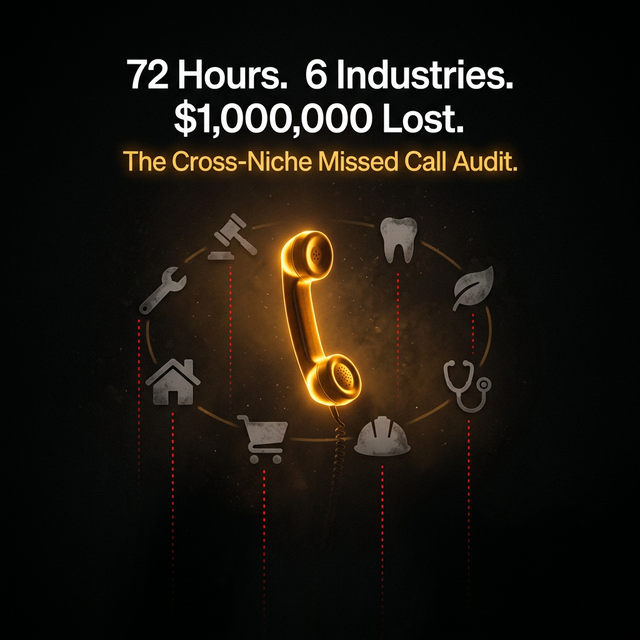
Missed calls do not cost every service business the same way.
That is the first thing owners need to understand.
A missed routine cleaning inquiry is not the same as a missed restoration emergency.
A missed dental pain call is not the same as a missed landscaping quote.
A missed personal injury call is not the same as a missed HVAC maintenance request.
The mechanism is similar.
The buyer tried to reach the business.
The business did not create a useful next step.
The buyer moved on.
But the value, urgency, and downstream cost change by niche.
That is why missed-call math should be calibrated.
Not inflated.
Not ignored.
Calibrated.
The Basic Formula
Start with a simple calculation.
Missed calls x qualified percentage x likely conversion rate x average first job value.
That gives the monthly missed-call leak.
Multiply by 12 for the annual number.
This is not perfect.
It is useful.
The goal is not to pretend every missed call would become revenue.
The goal is to stop pretending missed calls are worth zero.
Zero is almost always the wrong number.
Use conservative assumptions first.
If the conservative version is still meaningful, the business has found a real front-door leak.
What Counts as a Missed Call
Do not count only voicemail.
That is a common mistake.
Missed-call cost can include:
- Calls that rang out.
- Calls that went to voicemail.
- Calls that arrived after hours.
- Calls abandoned during hold.
- Calls shorter than a real conversation.
- Calls transferred to voicemail.
- Calls answered but not routed to a next step.
- Calls that received a callback too late.
The buyer does not care which category your phone system uses.
They care whether the business helped them move forward.
If the answer is no, the call belongs in the audit.
Why Cross-Niche Math Matters
The same missed-call count can mean different things.
Ten missed calls for a high-ticket restoration company may represent far more revenue risk than ten missed routine service calls.
But ten missed calls for a dental practice may carry lifetime patient value that is not visible in the first appointment.
Ten missed calls for a personal injury law firm may include one case that changes the month.
Ten missed calls for plumbing may be a mix of low-ticket drains and high-ticket emergencies.
This is why averages are dangerous.
A good Revenue Leak Diagnostic separates calls by category.
Emergency.
Routine.
High-ticket.
Consultation.
Existing customer.
New prospect.
After-hours.
Business-hours overflow.
Then the math becomes more useful.
Personal Injury Law
The missed-call risk in personal injury is not volume.
It is value and timing.
A potential client may call after a crash, injury, denial, or frightening event.
They may be calling multiple firms.
They may not leave voicemail.
They may choose the first firm that creates confidence.
The first calculation should be conservative.
Missed consult calls x qualified case percentage x retained-case percentage x average fee.
Do not count every call as a case.
Do not use the biggest possible settlement.
Use a realistic average fee for the firm's case mix.
Then look at weekends and evenings separately.
Many firms miss their highest-intent calls outside normal intake hours.
HVAC
HVAC missed-call math changes by season.
A no-cooling call during a heat wave is not the same as a routine tune-up inquiry.
The buyer's urgency changes.
The booking likelihood changes.
The value changes.
Run separate calculations:
Emergency service calls.
Routine maintenance calls.
Replacement inquiries.
Maintenance agreement calls.
After-hours calls.
Peak-season overflow.
The leak is usually largest during surge periods, when the business is already busy and the phone system is least able to keep up.
That is what makes it dangerous.
The best calls arrive when the team is overloaded.
Restoration
Restoration is one of the clearest missed-call categories.
Water events, fire events, storm damage, and mold concerns do not wait for office hours.
The buyer is usually anxious.
The job value can be high.
The first company to create confidence often wins the project.
The calculation should separate:
Emergency water calls.
Storm calls.
Mold inquiries.
Insurance-related calls.
After-hours calls.
Weekend calls.
Even one or two missed qualified restoration calls per month can create a large annual number.
That does not mean every missed call is a $25,000 job.
It means the category deserves careful tracking because the upside and risk are both high.
Electrical
Electrical calls often involve safety language.
Burning smell.
Panel issue.
Breaker will not reset.
Flickering after storm.
Outlet sparking.
These calls carry urgency and fear.
They may also create downstream work:
Panel upgrades.
EV chargers.
Generator installs.
Whole-home inspections.
The missed-call calculation should start with first-job value.
Then the owner can separately consider repeat and upgrade potential.
Do not start with the biggest possible lifetime value.
Start with the conservative job the business likely lost.
That number is usually enough.
Plumbing
Plumbing has one of the clearest first-answer dynamics.
When water is involved, homeowners call until someone answers.
The missed-call audit should separate:
Emergency plumbing.
Drain calls.
Water heater calls.
Sewer line calls.
Routine fixtures.
Commercial calls.
After-hours calls.
A missed drain call may be modest.
A missed sewer call may be significant.
A missed water heater call may create replacement revenue, future service, and a customer relationship.
The average matters, but the mix matters more.
Dental
Dental missed-call cost is often underestimated because the first appointment may not look large.
But a new patient can become years of hygiene, restorative work, cosmetic treatment, family referrals, and reviews.
Still, the first calculation should be conservative.
Missed new patient calls x qualified percentage x booked appointment percentage x first-visit value.
Then calculate lifetime value separately.
Emergency pain calls need special attention.
The patient is motivated now.
If they cannot reach the practice, they call another office.
The practice may lose the immediate visit and the future patient relationship.
The Cross-Niche Lesson
The industries differ.
The front-door pattern is the same.
High-intent calls arrive.
The business is busy, closed, understaffed, or slow.
The caller does not wait.
Revenue moves to someone else.
The owner sees only the work that booked.
They do not see the work that disappeared.
That is why missed-call audits change the conversation.
The owner stops asking whether the team is busy.
They start asking whether the business is capturing the demand it already earned.
Why Owners Undercount the Leak
Owners undercount missed calls because the business still feels productive.
The team is answering many calls.
The calendar has jobs.
Revenue is coming in.
Customers are being served.
Nothing feels broken enough to trigger a crisis.
But missed-call leakage lives underneath visible activity.
The business can be busy and still lose its best incremental demand.
The missed caller does not file a complaint.
They do not show up in a lost-deal report.
They do not tell the owner they booked a competitor.
They simply disappear.
That is why call logs matter.
They show the demand that tried to enter before the CRM ever saw it.
Use the Phone System as Source of Truth
For this audit, the CRM is not enough.
The CRM shows the leads that survived intake.
The phone system shows the attempts that happened before intake worked or failed.
Start there.
Pull raw call logs.
Then compare them against booked jobs, consultations, estimates, and CRM records.
The gap between call attempts and created opportunities is where the front-door leak lives.
That gap is often invisible until the owner compares both systems side by side.
Once it is visible, the marketing conversation gets much more honest because the owner can see whether demand is missing or simply being lost before anyone on the team has a fair chance to win it.
A Simple Cross-Niche Audit
Pull 30 days of call data.
Tag every call:
Answered.
Missed.
Voicemail.
After hours.
Short call.
Hold abandon.
Transferred.
Booked.
Not booked.
Then tag category:
Emergency.
Routine.
High-ticket.
Consultation.
Existing customer.
New prospect.
Wrong fit.
Now calculate by group.
Do not blend everything into one average if the business has multiple call types.
A blended average hides the most expensive leaks.
Segment by Urgency
Urgency changes everything.
The same caller behaves differently when the need is immediate.
A routine buyer may wait for a callback.
An emergency buyer usually will not.
A high-ticket buyer may wait if they trust the brand, but only if the first response gives them confidence.
That is why the audit should label urgency.
Immediate.
Same day.
This week.
Researching.
Existing customer.
Unknown.
Then compare conversion.
If immediate calls are being missed after hours, the business has a serious leak.
If researching calls are missed but recovered later, the leak may be smaller.
The fix should follow the urgency pattern.
Do not treat all missed calls as equal.
The Fix Sequence
Do not begin with a giant automation project.
Start with the biggest missed-call category.
If the Leak Is After-Hours
Add after-hours AI intake, live answering, or on-call triage.
The caller needs a path while intent is active.
If the Leak Is Business-Hours Overflow
Add overflow routing, AI answer, or better queue handling.
The team may be working hard and still missing demand.
If the Leak Is Hold Abandonment
Reduce hold time.
Give the front door more authority.
Move routine questions into the first answer.
If the Leak Is Slow Callback
Use missed-call text-back, immediate voice response, and structured follow-up.
Do not let callbacks depend on memory.
If the Leak Is Poor Routing
Build clearer triage rules.
Emergency calls, routine calls, and high-ticket consults should not enter the same path.
What Not to Do
Do not multiply every missed call by your highest-ticket service.
That makes the number easy to dismiss.
Do not count spam, vendors, and wrong numbers.
Do not ignore calls that did not leave voicemail.
Do not assume morning callbacks recover after-hours urgency.
Do not buy more ads before checking whether existing calls are captured.
Do not treat all missed calls the same.
The useful number is conservative and segmented.
That is the number owners can actually manage.
Example Calculation: Emergency Trade
Suppose an emergency trade business misses 24 calls per month.
After filtering out spam, vendors, duplicates, and wrong-fit calls, 15 look like real opportunities.
Of those, the owner estimates that 40 percent would have booked if answered properly.
Average first job value is $850.
15 x 40% x $850 = $5,100 per month.
Annualized, that is $61,200.
Now separate after-hours from business-hours overflow.
If 70 percent of that leak happens after hours, the first fix is clear.
Do not start with a new CRM.
Start with after-hours intake.
Example Calculation: Consultation Business
Now take a professional service firm.
It misses 18 calls per month.
Only 8 are real prospective clients.
Only 25 percent would have become consultations.
Average first engagement value is $2,500.
8 x 25% x $2,500 = $5,000 per month.
Annualized, that is $60,000.
The call volume is lower.
The value per qualified call is higher.
The fix may be less about dispatch and more about secure intake, consultation booking, and after-hours response.
Same formula.
Different operating system.
The Weekly Management Rhythm
Once the audit is done, make missed calls a weekly review item.
Do not wait for a quarterly marketing meeting.
Every week, review:
Total inbound calls.
Missed calls.
After-hours calls.
Short calls.
Hold abandons.
Missed-call recoveries.
Bookings from recovered calls.
Call categories with the highest leak.
This does not need to be complicated.
The point is to keep the front door visible.
Most missed-call problems persist because nobody owns the metric.
Once the owner sees the pattern weekly, the team can fix the actual bottleneck.
A 30-Day Action Plan
Week 1: Pull the Logs
Export call records, form submissions, chats, and booking records.
Tag missed calls, short calls, after-hours calls, and callbacks.
Week 2: Listen and Categorize
Listen to a sample.
Separate emergency, routine, high-ticket, existing customer, and wrong-fit calls.
Do not rely only on phone-system labels.
Week 3: Calculate the Leak
Use conservative assumptions by category.
Calculate the monthly and annual missed-call number.
Identify the largest category.
Week 4: Patch One Category
Fix the biggest leak first.
After-hours coverage.
Overflow routing.
Missed-call text-back.
Booking authority.
Emergency triage.
Do not try to fix everything at once.
How do I calculate missed-call cost?
Use missed calls x qualified percentage x likely conversion rate x average first job value. Segment by call type if your business handles emergencies, routine calls, and high-ticket consults.
Should I include calls that did not leave voicemail?
Yes. Those calls are often central to the leak. Many serious buyers hang up and call the next provider instead of leaving a message.
Is the missed-call cost different by industry?
Yes. Average job value, urgency, lifetime value, and buyer behavior vary by niche. Restoration, legal, dental, HVAC, plumbing, and electrical calls should not be calculated with the same assumptions.
Should I use lifetime value?
Start with first-job value. Lifetime value matters, but it can make the first calculation feel inflated. Use lifetime value as a second layer after the conservative number is accepted.
What is the fastest fix?
Fix the largest leak first. For many businesses, that is after-hours calls or busy-hour overflow. For others, it is slow callback or weak routing.
The Bottom Line
Missed calls are not one problem.
They are a category of problems.
Each niche has its own urgency, value, and buyer behavior.
But the owner question is the same:
How much demand are we already earning and failing to capture?
That question should be answered with phone logs, not guesses.
Once the number is visible, the fix becomes easier to prioritize.
Answer after hours.
Recover missed calls.
Route urgent calls differently.
Book the next step while the buyer is still active.
Measure the result.
That is how a service business turns missed-call anxiety into an operating system.
*To calculate your own number, pull 30 days of call logs and run a Revenue Leak Diagnostic by call type. The blended average is less useful than knowing exactly where the most valuable callers disappear.*
The loss estimate is basic business math, not a magic claim.
Revenue-leak examples on this site are built from visible operating inputs: inquiry volume, missed-call or slow-response rate, booking rate, average job or client value, repeat value, and follow-up recovery. The fastest way to make the number real is to run the diagnostic for your closest business type, then compare it against your own call log, CRM, booking calendar, form timestamps, and review activity.
Turn the article into one week of real numbers.
Use your own call log, form timestamps, calendar, and CRM before accepting any industry estimate.
Use your own operating numbers to see where response, booking, reviews, and follow-up may be costing the business.
See how the capability in this article fits into a complete customer journey.
Legal, Financial & AdvisorySee the same decision through the language, buyer behavior, and operating reality of this industry.
Client Results & ProofInspect the starting condition, installation, measurement window, and outcome behind real client work.

Why Prospects Hang Up on Robotic AI: Programming Brand Empathy into Your Voice System
Prospects hang up on robotic AI when it interrupts, over-talks, or fails to route sensitive calls. Learn how service businesses can program brand empathy into voice AI.

Software Fatigue: Why Your Team Hates Your New Tools (and How to Fix It)
Service teams resist new software when tools add steps, duplicate work, and hide ownership. Learn how to reduce software fatigue and implement tools around real workflows.

Why Service Businesses Lose Inbound Leads Before the Phone Rings
It is not a traffic problem. Many service businesses lose revenue because the front door breaks before the buyer reaches a real conversation.