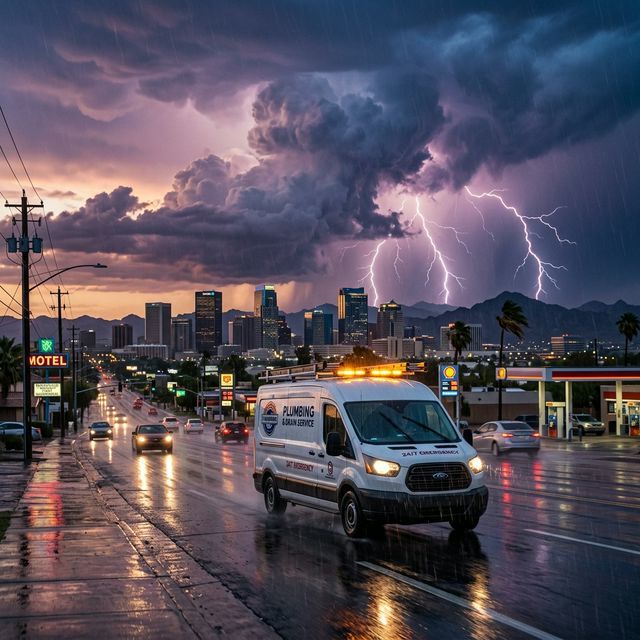
A Phoenix plumbing company can lose emergency revenue in minutes during monsoon season. When water is moving through a home, the caller books the first competent company that answers, qualifies the problem, and gives a clear arrival path.
Treat any number without a nearby source or stated method as a planning assumption, then replace it with your own records.
Water intrusion. Foundation shifts that crack supply lines. Sump pump failures in homes that haven't needed one in three years. Water heater pressure spikes. Pipe joints stressed by rapid temperature swings between 115-degree days and 70-degree monsoon evenings. These are the Phoenix plumber's summer inventory, and every emergency call during a monsoon event is worth two or three times a normal service call because the homeowner needs help now.
The problem is that these calls cluster. When the monsoon rolls through Chandler at 6 PM on a Thursday, 40 plumbers get calls in the next 90 minutes. Whoever answers - whoever has an intake system that doesn't just ring through to voicemail - captures the job.
The Monsoon Call Spike Is Unlike Any Other Demand Pattern
Most plumbing demand is distributed somewhat evenly across the week. Faucets drip on Tuesdays. Water heaters fail on Saturdays. Drain blockages happen when they happen.
Monsoon demand doesn't work that way. It hits in a specific geographic pattern (the storm tracking from southeast to northwest across the Valley), during specific hours (afternoon and evening when storms develop), and with a specific urgency level (water intrusion is not a wait-until-morning problem).
The result is that every Phoenix plumber who's been in business for more than a few years has experienced the same scenario: a major monsoon event, 8 calls coming in within two hours, their dispatcher can only handle three simultaneously, and five jobs go to whoever is answering next on the homeowner's call list.
Why Standard Plumbing Intake Fails During Storm Events
The typical Phoenix plumbing company's intake process is built for normal volume: one or two calls per hour, a dispatcher who can give each call attention, a callback protocol for missed calls that works fine when the next callback is within 30 minutes.
During a monsoon event, that process breaks in two specific places:
The Concurrent Call Failure
A single dispatcher can meaningfully handle one call at a time. During a spike, calls that hit while the dispatcher is on another call go to hold or voicemail. In a normal day, a held call waits. During a monsoon event, a homeowner with water coming through the ceiling is calling the next number before they've left the voicemail on the first.
An AI intake layer doesn't get tired, doesn't go to hold, and can handle any number of simultaneous contacts. During a storm spike, the difference between answering 3 calls and answering 8 calls can represent $5,000 to $8,000 in emergency service revenue in a single evening.
The After-Hours Storm Gap
Phoenix monsoons are not 9-to-5 events. They're most active between 3 PM and 10 PM, which means the back half of every storm window overlaps with evening hours when dispatcher staffing typically drops. A storm that rolls through Mesa at 7:30 PM and causes basement flooding calls that hit at 8 PM go to voicemail at most Phoenix plumbing shops. By 8:15, the homeowner has booked with the company whose after-hours system responded.
What Phoenix Homeowners Do During a Monsoon Emergency
Understanding Phoenix homeowner behavior during storm emergencies is essential for understanding the intake opportunity. Phoenix has a large population of newer residents - people who relocated from California, Illinois, New York, and other states in the last five years. These are consumers accustomed to Uber, Instacart, and Amazon Prime. They do not wait.
When water is coming into the house at 8 PM, the Phoenix 2026 homeowner opens Google, searches 'emergency plumber Phoenix' or 'water damage plumber Chandler,' and calls the first number they see. If voicemail, they call the second. If voicemail, they call the third. They may be making all three calls simultaneously from different devices.
The first company to respond with a human voice or an immediate AI acknowledgment - 'We've received your emergency, confirming a tech is on the way' - captures the job.
The Revenue Math for a Phoenix Monsoon Season
A Phoenix plumbing company doing $1.6M annually in service revenue fields roughly 140 to 160 inbound contacts in a normal summer month. During July and August at peak monsoon activity, that number can spike 40 to 60 percent - 200 to 256 contacts per month.
At a conservative 30 percent after-hours or concurrent-call leak rate during storm months - contacts that reach voicemail and don't call back - that's 60 to 77 lost contacts per monsoon month. Emergency service calls during storm events average $650 to $900 (vs. $350 to $450 for routine service). If half of those lost contacts were storm-related emergencies:
30 to 38 lost emergency calls at $750 average = $22,500 to $28,500 in monsoon-month revenue evaporating from intake failure alone. Over two peak monsoon months: $45,000 to $57,000.
The Specific Monsoon Call Types Worth Prioritizing
Not all monsoon plumbing calls are equal. AI intake for Phoenix plumbing companies can triage by type to route and prioritize appropriately:
Active water intrusion calls: dispatch-now priority
Water actively entering the home from foundation cracks, window wells, or damaged exterior connections. These are immediately dispatched. AI identifies them with a single question: 'Is water actively coming into the home right now?'
Water heater pressure and expansion tank failures: same-day
Monsoon temperature swings stress water heaters, particularly older units without functioning expansion tanks. These calls are scheduled for same-day service - not emergency, but not tomorrow either. AI captures unit age and symptoms to pre-inform the dispatched tech.
Post-storm drain and sewer calls: next-day queue
Flash flooding pushes debris into sewer cleanouts and storm drains. These calls are real but not urgent. AI routes them to the morning queue with address and symptom captured.
The West Valley Versus East Valley Intake Dynamics
Phoenix's geography matters for intake strategy. The monsoon tracking pattern means the West Valley (Glendale, Avondale, Goodyear, Buckeye) and East Valley (Mesa, Gilbert, Chandler, Queen Creek) often get hit at different times, sometimes hours apart. A plumbing company serving both sides of the Valley with smart intake routing can maximize technician efficiency by assigning calls based on geographic proximity during the storm event.
A plumbing company dispatching exclusively from its central shop without address-aware routing is burning drive time during the highest-value service window of the year.
Competing with the National Brands During Monsoon Season
During Phoenix monsoon events, the national emergency plumbing operators and franchise brands have a structural advantage: they maintain high staffing ratios, have dedicated storm protocols, and advertise aggressively during storm weather. They also have 24/7 call centers that don't spike in the same way a local dispatcher operation does.
An independent Phoenix plumber can compete on this dimension with the right intake infrastructure. An AI system that handles concurrent contacts, routes by address, and provides immediate storm-event acknowledgment gives a local operator the same intake capacity as a national brand's call center - without the overhead.
The Preparation Window
Phoenix plumbing companies have a clear preparation window: April through June before the monsoon season opens. Installing an AI intake layer before monsoon season means the system is proven, tested, and operating efficiently when the first July storms hit.
Companies that wait until August to think about this problem are installing during the chaos instead of benefiting from the preparation. The monsoon season is predictable in its arrival. The intake gap it reveals doesn't have to be.
The Quiet Protocol works with Phoenix-area plumbing companies to install AI intake systems that handle monsoon-season demand spikes without adding dispatcher headcount. If your storm-season numbers should be higher than they are, the intake layer is where to look first.
What to check before you choose a fix
Before buying another answering service, chatbot, phone tree, or AI receptionist, look at the actual path a leak, drain, water heater, fixture, or emergency plumbing caller takes when they reach your business. The first question is not whether the tool sounds impressive. The first question is whether the buyer gets a clear next step while they still care. In plumbing company operations, that usually means a fast answer, a useful question, a booked appointment or estimate path, and a follow-up record that does not rely on memory.
A strong system should make the business feel easier to choose. It should reduce the waiting, repeating, guessing, and manual chasing that make a buyer keep searching. If the current setup answers only during business hours, takes a message without qualifying intent, or leaves the follow-up to whoever remembers first, the problem is not only staffing. It is front-door design.
The Week-One Diagnostic
Run this review over the last seven days before making a decision. Pull the call log, website form submissions, chat history, booking calendar, CRM notes, missed-call list, and Google Business Profile activity. Do not start with opinions. Start with timestamps and outcomes. A small sample is enough to show whether the leak is response speed, qualification, booking friction, review weakness, or follow-up failure.
- Count every missed call and every call that lasted under 20 seconds. Those are often buyers who never became visible in the CRM.
- Count every form or chat that waited more than 10 minutes for a real next step. This is where high-intent demand starts cooling off.
- Mark every inquiry that needed a human callback before booking. That tells you whether the website is explaining the next step clearly enough.
- Review the last five reviews buyers can see publicly. Recency matters because buyers compare proof before they commit.
This is the source method for the article: use your own call log, CRM, booking calendar, form inbox, and Google Business Profile review activity. Public research can explain the pattern, but your own records show where money is escaping in this business.
Where the revenue usually leaks
The leak usually appears in one of four places. First, the buyer calls when the team is busy or closed. Second, the buyer reaches the business but is not qualified clearly enough to book. Third, the buyer receives a polite response but no firm next step. Fourth, the buyer finishes the job or visit but no review, referral, or reactivation path happens after the work is done. Each leak looks small by itself. Together, they decide whether marketing produces booked revenue or only more noise.
For a plumbing company, the most valuable fix is the one that protects same-day dispatch, emergency triage, booked jobs, and review follow-through. That is why phoenix plumbers are losing emergency calls during the summer monsoon window should be judged by business outcomes, not by novelty. A phone feature that sounds clever but does not improve booked appointments is not enough. A website widget that collects contact details but does not trigger follow-up is not enough. A review tool that asks once and disappears is not enough.
What a stronger system should do
A stronger front door answers quickly, asks the right questions, captures the reason for contact, separates urgent from routine demand, books when rules are clear, sends confirmations, updates the follow-up path, and asks for reviews after the work is done. The system should make the owner less dependent on heroic callbacks and make the buyer feel that the business is organized from the first touch.
The Quiet Protocol treats this as an operating system, not a single widget. Calls, web forms, missed-call text-back, appointment booking, CRM handoff, review requests, and reactivation all need to point in the same direction. When those pieces are connected, a plumbing company can capture more demand without turning the team into a bigger manual call center.
How to judge whether it is working
Do not judge the system by how futuristic it feels on day one. Judge it by what changes in the business. Useful measurements include missed-call recovery rate, average response time, booked appointment rate, no-show recovery, review request volume, review recency, reactivated past-customer conversations, and the number of leads that have a clear next action in the CRM.
The best early sign is calm. Fewer loose callbacks. Fewer mystery leads. Fewer buyers waiting for a reply. More conversations with a clear status. That is what good automation should feel like to the owner and to the customer.
The loss estimate is basic business math, not a magic claim.
Revenue-leak examples on this site are built from visible operating inputs: inquiry volume, missed-call or slow-response rate, booking rate, average job or client value, repeat value, and follow-up recovery. The fastest way to make the number real is to run the diagnostic for your closest business type, then compare it against your own call log, CRM, booking calendar, form timestamps, and review activity.
The practical questions behind this decision.
Is this just a 24/7 answering service?
No. A traditional answering service usually takes a message. A properly designed AI receptionist and front-door system captures intent, qualifies the buyer, routes the request, books when possible, triggers follow-up, and supports reviews after the work is done. Message-taking is coverage. Revenue capture is a fuller operating path.
What should a plumbing company fix first?
Fix the first place buyers disappear. For some businesses that is after-hours calls. For others it is slow website follow-up, weak booking logic, old leads, or stale reviews. The right first move comes from the seven-day diagnostic, not from guessing.
Will AI make the business feel less human?
Bad automation feels colder than a person. Good automation feels like the business is paying attention. It answers quickly, uses plain language, collects the right information, and hands the buyer to a human when judgment or empathy is needed. The goal is not to remove people. The goal is to stop making buyers wait for basic next steps.
How fast should we expect improvement?
The first lift should come from visibility and speed: fewer missed opportunities and cleaner routing. Deeper gains come after the system has enough real conversations to tune scripts, booking rules, follow-up timing, and review requests. Treat the first month as deployment and calibration, not a magic switch.
Locate the point where interested buyers stop hearing from the business.
Review one customer journey from first inquiry through booking, estimate, reminder, and recovery.

Vikram Roy is the founder of The Quiet Protocol, a Toronto-based systems firm serving service businesses across the Greater Toronto Area, Canada, and the United States. He works directly with professional firms, home service companies, dental practices, clinics, and local businesses to connect websites, customer intake, booking, reviews, follow-up, and practical AI into a clearer digital front door. All content is written from Toronto, Ontario. See the editorial method →
Use the diagnostic to locate the handoff where good inquiries, estimates, appointments, or past customers stop moving.
See how the capability in this article fits into a complete customer journey.
PlumbingSee the same decision through the language, buyer behavior, and operating reality of this industry.
Client Results & ProofInspect the starting condition, installation, measurement window, and outcome behind real client work.
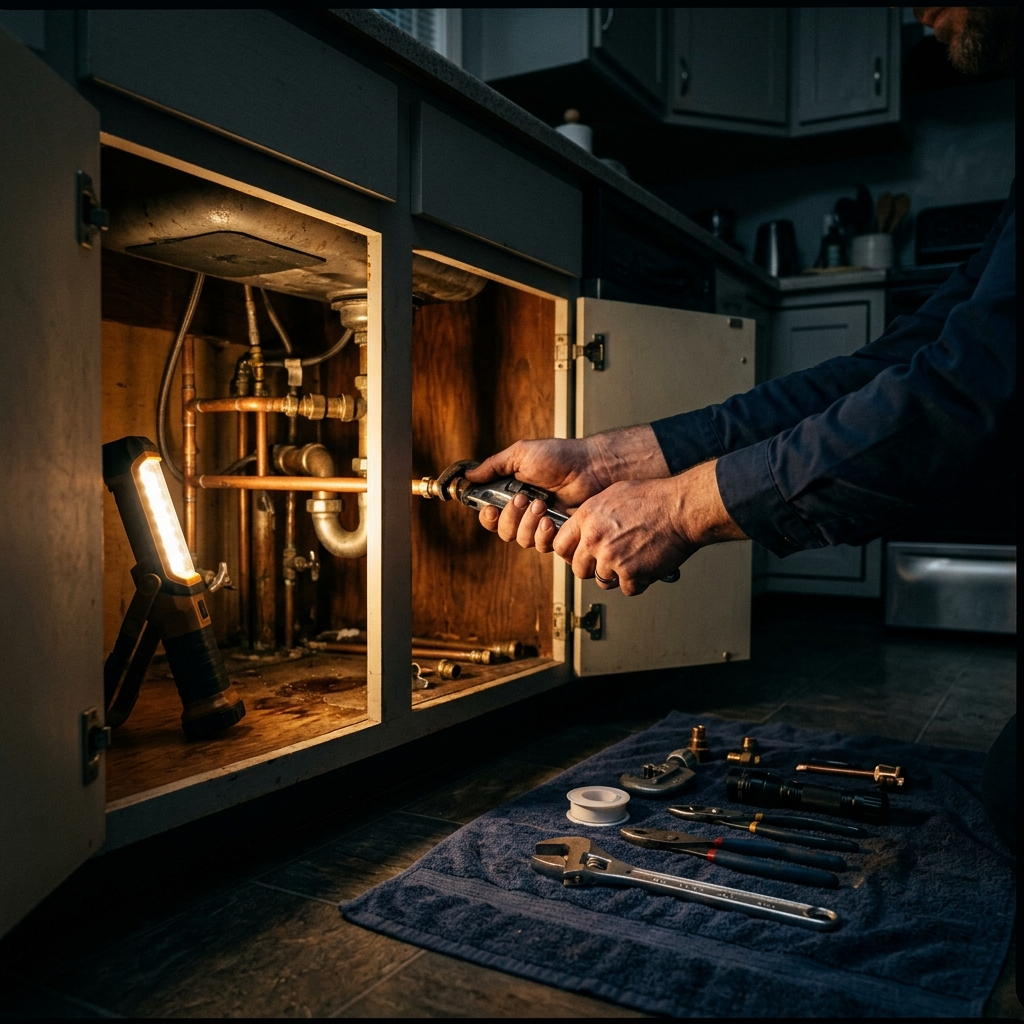
Emergency Plumbing Calls After Hours: How the Best Plumbers Turn Saturday Night Crises Into Loyal Clients
After-hours emergency plumbing calls are the highest-value, highest-margin leads a plumber receives. Most go to voicemail. Here is how the plumbers capturing these calls have built their intake systems.

How to Audit Weekend Call Handling in a Plumbing Company
A first-party operating guide for testing weekend phone intake, emergency routing, on-call ownership, booking, follow-up, and the evidence a plumbing company should review.
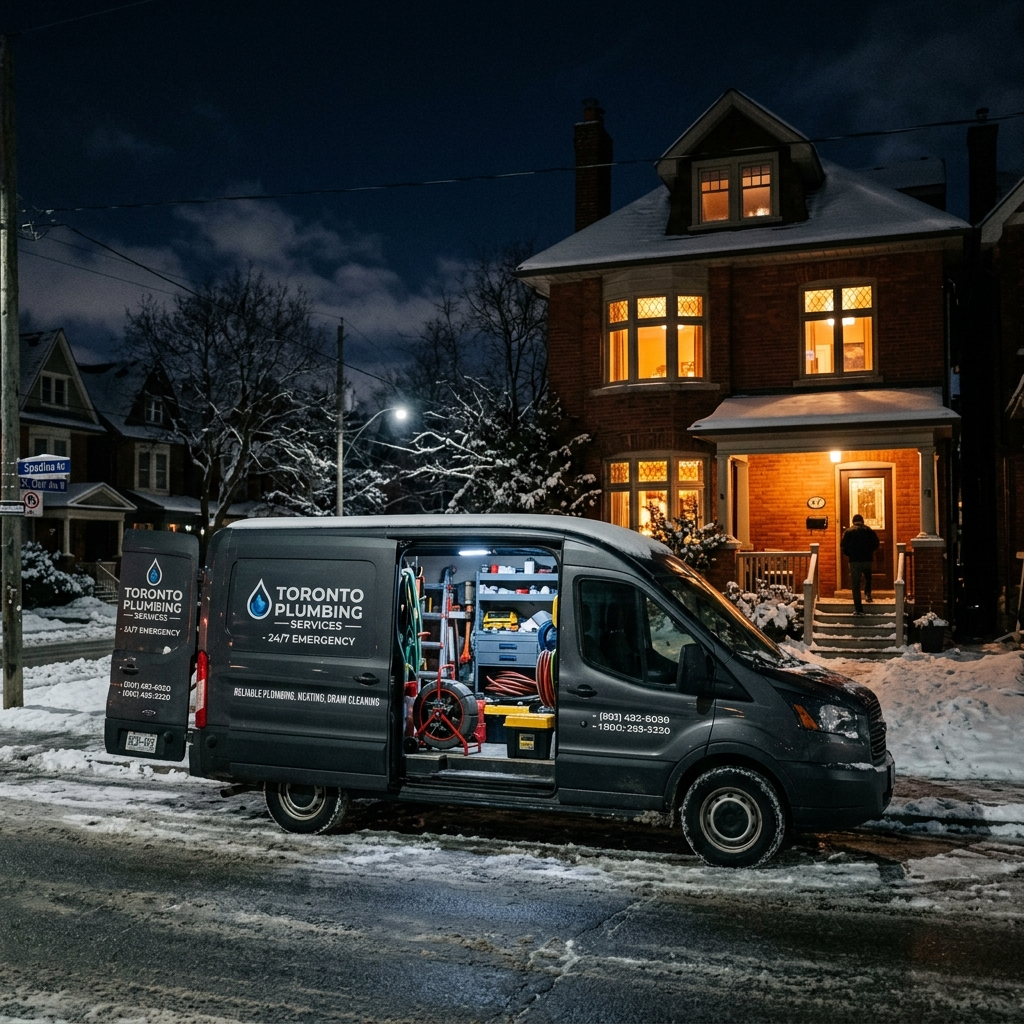
AI for Plumbers in Toronto and the GTA: More Emergency Calls Captured, More Jobs Protected (2026)
Plumbing is one of the most demand-driven trades businesses in the GTA. When someone's basement is flooding at 9 PM or a pipe bursts on a February weekend, they call the first plumber that answers. Not the best one. The one that picks up. This guide covers how Toronto and GTA plumbing companies are using AI to answer every call, capture every emergency, follow up on every estimate, and build the review profile that earns repeat and referral business.